The Federal Reserve's hawkish stance continued to exert downward pressure, causing gold and silver to weaken significantly.
2026-06-19 00:09:05
On Thursday (June 18), during the early US trading session, international spot gold prices fell sharply, while spot silver saw a significantly larger decline. The market continued to digest the Federal Reserve's hawkish interest rate decision, and market expectations for a near-term rate hike increased. This, coupled with easing tensions between the US and Iran leading to lower oil prices, put significant pressure on precious metals. New York gold futures traded around $4244.8 per ounce, down 136.6 points, or 3.12%, for the day; New York silver was quoted at $66.175, a single-day drop of 6.49%.

The Federal Reserve kept the target range for the federal funds rate unchanged at 3.50%–3.75% on Wednesday, but the policy signals released after the meeting were generally hawkish. The June dot plot showed that nine of the 18 policymakers expect further rate hikes this year. Fed Chairman Kevin Warsh did not submit his personal interest rate projections this time, simplified the policy statement at his first policy meeting in office, and announced a comprehensive review of the Fed's five major policy frameworks: communication mechanisms, balance sheet, economic data system, employment and productivity, and inflation.
As a result, the current trend of the precious metals market is mainly driven by the yield of US Treasury bonds and the US dollar, while the demand for safe-haven hedging has taken a backseat.
Following the Fed's decision, market movements revolved entirely around interest rate expectations: US Treasury yields rose across the board, with the 2-year Treasury yield reaching its highest level since February and the 10-year Treasury yield climbing to the middle of the 4.4% range; investors bet that the Fed's room for rate cuts had narrowed and the risk of rate hikes had increased, leading to a simultaneous strengthening of the US dollar.
U.S. stock index futures closed higher across the board in early trading on Thursday. Falling oil prices and easing tensions between the U.S. and Iran partially offset the negative impact of the Fed's hawkish policies, but bullish sentiment in precious metals remained extremely cautious: gold failed to hold onto Wednesday's rebound above $4,300, and silver continued to decline after breaking below the $68 mark, with the market refocusing on the 200-day moving average support level.
The US and Iran have reached a preliminary agreement, agreeing to end the conflict, reopen shipping lanes, and resume Iranian crude oil exports. However, the market remains concerned about the implementation risks, including those related to shipping, insurance, and policy continuity.
The agreement currently has two major market impacts: firstly, it suppresses inflation expectations, and secondly, it boosts sentiment towards risk assets. Brent crude oil weakened in tandem, with New York WTI crude oil futures currently trading at $73.83 per barrel, a sharp drop of 2.87% on the day. US fuel oil and unleaded gasoline also declined, with only natural gas bucking the trend and rising by 2.29%. US stock indices rose, and purely safe-haven buying of gold subsided significantly.
For silver, low inflation expectations should have been a positive factor, but the combined effects of weakening crude oil and a stronger US dollar have significantly dampened the pricing logic of silver as both an inflation hedge and an industrial asset, resulting in a price drop for silver that far exceeded that of gold.
U.S. stocks rebounded across the board after opening, recovering from the losses following Wednesday's Federal Reserve decision: the S&P 500 rose 0.96%, the Nasdaq gained 1.32%, and the Dow Jones Industrial Average climbed 0.34%. The technology sector led the rebound, while lower fuel prices benefited airline and tourism-related stocks.
Global commodity market updates: WTI crude oil prices on the New York Mercantile Exchange fell, currently trading at approximately $73.83 per barrel; Brent crude oil also declined. The US dollar index strengthened; the benchmark 10-year US Treasury yield rose. No precise intraday price levels are currently available.
Technical Analysis
spot gold
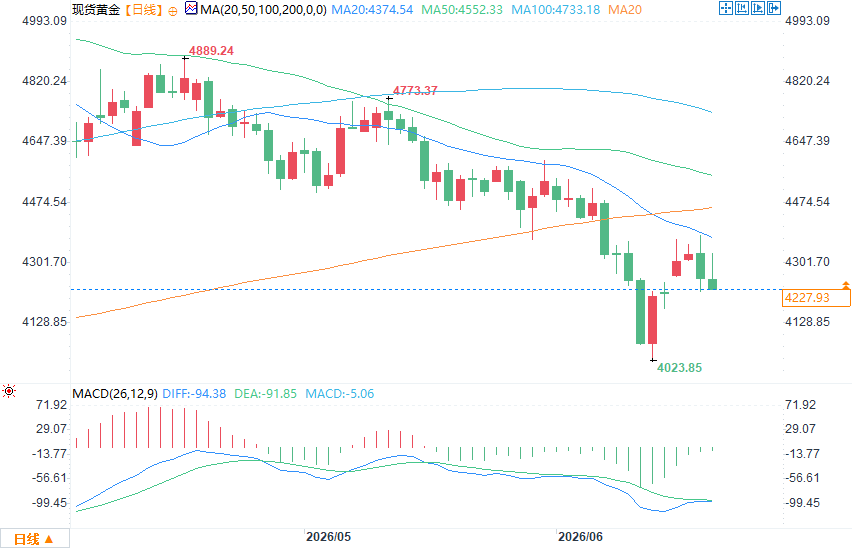
The primary target for the bulls in the short term is for gold prices to return to the resistance zone of $4,280–$4,320. If it holds above this zone, the next target will be $4,364, with the next target being the high of the downward channel at $4,575.
The primary short-term downside target for the bears is a break below the $4,240 support level (currently the gold price is very close to this level), with further downside targets at $4,200 and deeper support at $4,180.
The first short-term resistance level is $4280, and the second resistance level is $4320; the first short-term support level is $4240, and the second support level is $4200.
spot silver
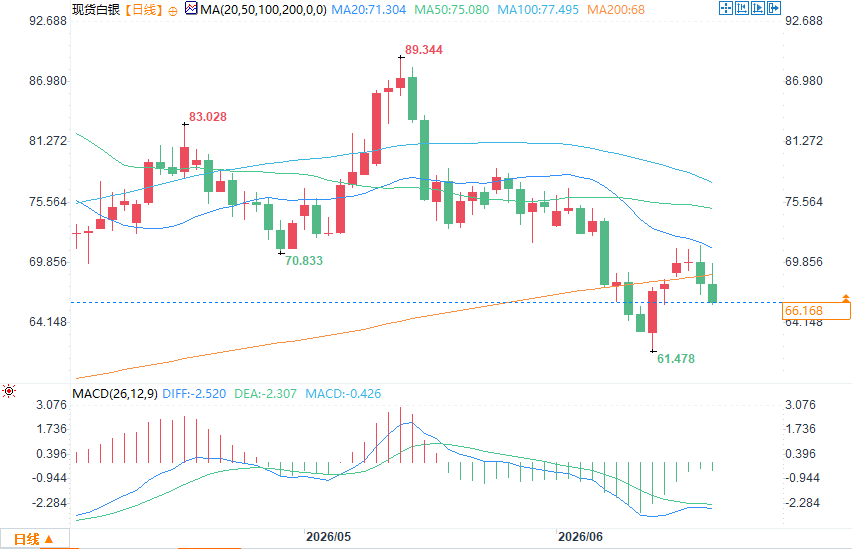
The primary short-term upside target for the bulls is for silver prices to return to the $69.08–$70 resistance zone, with a break above that level targeting $72, and the next target at $72.47.
The primary short-term downside target for the bears is a break below the $67 support level. The current price has already fallen below $67, with further downside targets at $66 and deeper support at $65.
The first short-term resistance level is $69.08, and the second resistance level is $70; the first short-term support level is $67, and the second support level is $66.
The Federal Reserve kept the target range for the federal funds rate unchanged at 3.50%–3.75% on Wednesday, but the policy signals released after the meeting were generally hawkish. The June dot plot showed that nine of the 18 policymakers expect further rate hikes this year. Fed Chairman Kevin Warsh did not submit his personal interest rate projections this time, simplified the policy statement at his first policy meeting in office, and announced a comprehensive review of the Fed's five major policy frameworks: communication mechanisms, balance sheet, economic data system, employment and productivity, and inflation.
As a result, the current trend of the precious metals market is mainly driven by the yield of US Treasury bonds and the US dollar, while the demand for safe-haven hedging has taken a backseat.
Following the Fed's decision, market movements revolved entirely around interest rate expectations: US Treasury yields rose across the board, with the 2-year Treasury yield reaching its highest level since February and the 10-year Treasury yield climbing to the middle of the 4.4% range; investors bet that the Fed's room for rate cuts had narrowed and the risk of rate hikes had increased, leading to a simultaneous strengthening of the US dollar.
U.S. stock index futures closed higher across the board in early trading on Thursday. Falling oil prices and easing tensions between the U.S. and Iran partially offset the negative impact of the Fed's hawkish policies, but bullish sentiment in precious metals remained extremely cautious: gold failed to hold onto Wednesday's rebound above $4,300, and silver continued to decline after breaking below the $68 mark, with the market refocusing on the 200-day moving average support level.
The US and Iran have reached a preliminary agreement, agreeing to end the conflict, reopen shipping lanes, and resume Iranian crude oil exports. However, the market remains concerned about the implementation risks, including those related to shipping, insurance, and policy continuity.
The agreement currently has two major market impacts: firstly, it suppresses inflation expectations, and secondly, it boosts sentiment towards risk assets. Brent crude oil weakened in tandem, with New York WTI crude oil futures currently trading at $73.83 per barrel, a sharp drop of 2.87% on the day. US fuel oil and unleaded gasoline also declined, with only natural gas bucking the trend and rising by 2.29%. US stock indices rose, and purely safe-haven buying of gold subsided significantly.
For silver, low inflation expectations should have been a positive factor, but the combined effects of weakening crude oil and a stronger US dollar have significantly dampened the pricing logic of silver as both an inflation hedge and an industrial asset, resulting in a price drop for silver that far exceeded that of gold.
U.S. stocks rebounded across the board after opening, recovering from the losses following Wednesday's Federal Reserve decision: the S&P 500 rose 0.96%, the Nasdaq gained 1.32%, and the Dow Jones Industrial Average climbed 0.34%. The technology sector led the rebound, while lower fuel prices benefited airline and tourism-related stocks.
Global commodity market updates: WTI crude oil prices on the New York Mercantile Exchange fell, currently trading at approximately $73.83 per barrel; Brent crude oil also declined. The US dollar index strengthened; the benchmark 10-year US Treasury yield rose. No precise intraday price levels are currently available.
Technical Analysis
spot gold
The primary target for the bulls in the short term is for gold prices to return to the resistance zone of $4,280–$4,320. If it holds above this zone, the next target will be $4,364, with the next target being the high of the downward channel at $4,575.
The primary short-term downside target for the bears is a break below the $4,240 support level (currently the gold price is very close to this level), with further downside targets at $4,200 and deeper support at $4,180.
The first short-term resistance level is $4280, and the second resistance level is $4320; the first short-term support level is $4240, and the second support level is $4200.
spot silver
The primary short-term upside target for the bulls is for silver prices to return to the $69.08–$70 resistance zone, with a break above that level targeting $72, and the next target at $72.47.
The primary short-term downside target for the bears is a break below the $67 support level. The current price has already fallen below $67, with further downside targets at $66 and deeper support at $65.
The first short-term resistance level is $69.08, and the second resistance level is $70; the first short-term support level is $67, and the second support level is $66.
- Risk Warning and Disclaimer
- The market involves risk, and trading may not be suitable for all investors. This article is for reference only and does not constitute personal investment advice, nor does it take into account certain users’ specific investment objectives, financial situation, or other needs. Any investment decisions made based on this information are at your own risk.