The Federal Reserve released a hawkish signal, causing the dollar to hit a new high for the year and putting downward pressure on gold prices.
2026-06-19 02:34:50
On Thursday (June 18), spot gold fell 0.70% during the US trading session. The market was still digesting the Federal Reserve's hawkish policy shift, which significantly boosted the dollar, pushing it to a new high for the year. A strong dollar exerted downward pressure on gold. Gold prices had previously reached a high of $4330 and were trading at $4223 during the session.
The Fed's hawkish expectations repriced the dollar, causing gold prices to weaken.
Despite a shift in the Federal Reserve's policy stance, optimism that the Middle East conflict is likely to end and a surge in technology stocks have boosted overall market risk appetite.
The Federal Reserve kept its benchmark interest rate unchanged at 3.50%-3.75% on Wednesday and updated its dot plot of economic projections: 9 out of 19 policymakers expect the Fed to raise interest rates before the end of the year.
Federal Reserve Chairman Warsh did not participate in filling out the dot plot projections, but he said he respected the dot plot figures for interest rate projections submitted by his colleagues. Warsh stated that in the current economic environment, forward guidance is no longer an appropriate policy tool; however, he also noted that the overall job market is performing well, and the Fed's core policy objective remains price stability.
Data from the CME FedWatch Tool shows that the market is currently pricing in an 85% probability of a Fed rate hike in December, far higher than the 61% probability before the policy statement was released.
The Federal Reserve's hawkish stance pressured gold prices and boosted the dollar. The dollar index (DXY) continued its upward trend on Thursday, reaching 100.81, its highest level since May 2025.
The median forecast from Federal Reserve officials indicates that U.S. inflation will fall to 3.6% in 2026 and will not reach the Fed's 2% inflation target until 2028; economic growth forecasts have been slightly lowered, with full-year GDP growth expected to be 2.2%, while the unemployment rate is expected to remain at current levels.
On the data front, the number of Americans filing for unemployment benefits for the first time fell to 226,000 from 230,000, slightly higher than the market expectation of 225,000, but still reflects the strong resilience of the job market.
Due to the Juneteenth public holiday, there are no major economic data releases in the United States this week; next week, a number of key indicators will be released: the preliminary Purchasing Managers' Index (PMI), employment data, the final value of GDP for the first quarter of 2026, and the core personal consumption expenditures (PCE) price index, the inflation indicator most valued by the Federal Reserve.
Spot Gold Technical Analysis: Hawkish Fed Statements Drag Gold Prices Below $4,300
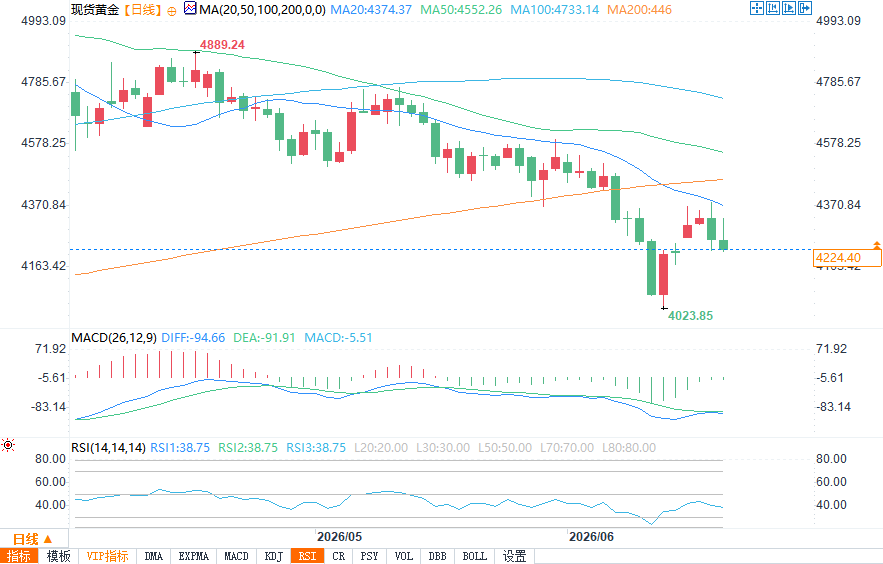
(Spot gold daily chart source: FX678)
Following the Fed's decision, gold prices turned bearish, breaking below the June 16 support level of $4,306 and hitting a two-day low of $4,219 before rebounding slightly. Although it briefly rose to $4,330, bullish momentum quickly weakened, and at the time of writing, gold prices remained below $4,300.
The Relative Strength Index (RSI) has entered bearish territory, indicating that bears are currently dominating the market. If spot gold falls below $4,200, it may test the June 11 low of $4,023, approaching the psychological level of $4,000.
On the upside, gold needs to hold above $4,300 for bulls to have room to push prices higher; to continue its upward trend, it needs to break through the two key psychological levels of $4,350 and $4,400.
The Fed's hawkish expectations repriced the dollar, causing gold prices to weaken.
Despite a shift in the Federal Reserve's policy stance, optimism that the Middle East conflict is likely to end and a surge in technology stocks have boosted overall market risk appetite.
The Federal Reserve kept its benchmark interest rate unchanged at 3.50%-3.75% on Wednesday and updated its dot plot of economic projections: 9 out of 19 policymakers expect the Fed to raise interest rates before the end of the year.
Federal Reserve Chairman Warsh did not participate in filling out the dot plot projections, but he said he respected the dot plot figures for interest rate projections submitted by his colleagues. Warsh stated that in the current economic environment, forward guidance is no longer an appropriate policy tool; however, he also noted that the overall job market is performing well, and the Fed's core policy objective remains price stability.
Data from the CME FedWatch Tool shows that the market is currently pricing in an 85% probability of a Fed rate hike in December, far higher than the 61% probability before the policy statement was released.
The Federal Reserve's hawkish stance pressured gold prices and boosted the dollar. The dollar index (DXY) continued its upward trend on Thursday, reaching 100.81, its highest level since May 2025.
The median forecast from Federal Reserve officials indicates that U.S. inflation will fall to 3.6% in 2026 and will not reach the Fed's 2% inflation target until 2028; economic growth forecasts have been slightly lowered, with full-year GDP growth expected to be 2.2%, while the unemployment rate is expected to remain at current levels.
On the data front, the number of Americans filing for unemployment benefits for the first time fell to 226,000 from 230,000, slightly higher than the market expectation of 225,000, but still reflects the strong resilience of the job market.
Due to the Juneteenth public holiday, there are no major economic data releases in the United States this week; next week, a number of key indicators will be released: the preliminary Purchasing Managers' Index (PMI), employment data, the final value of GDP for the first quarter of 2026, and the core personal consumption expenditures (PCE) price index, the inflation indicator most valued by the Federal Reserve.
Spot Gold Technical Analysis: Hawkish Fed Statements Drag Gold Prices Below $4,300
(Spot gold daily chart source: FX678)
Following the Fed's decision, gold prices turned bearish, breaking below the June 16 support level of $4,306 and hitting a two-day low of $4,219 before rebounding slightly. Although it briefly rose to $4,330, bullish momentum quickly weakened, and at the time of writing, gold prices remained below $4,300.
The Relative Strength Index (RSI) has entered bearish territory, indicating that bears are currently dominating the market. If spot gold falls below $4,200, it may test the June 11 low of $4,023, approaching the psychological level of $4,000.
On the upside, gold needs to hold above $4,300 for bulls to have room to push prices higher; to continue its upward trend, it needs to break through the two key psychological levels of $4,350 and $4,400.
- Risk Warning and Disclaimer
- The market involves risk, and trading may not be suitable for all investors. This article is for reference only and does not constitute personal investment advice, nor does it take into account certain users’ specific investment objectives, financial situation, or other needs. Any investment decisions made based on this information are at your own risk.