Peace talks may stabilize prices, but they can't save gold! Geopolitical concerns and equity market volatility are both hurting gold prices.
2026-06-19 15:55:41
On Friday (June 19), during the Asian and European sessions, spot gold experienced a continuous decline followed by a slight rebound after hitting a low. Previous articles have highlighted the phenomenon of gold stagnation despite frequent positive news and discussed the reasons behind it; readers can refer back to those articles. On the news front, the US-Iran trip to Switzerland to sign a memorandum of understanding was postponed, and the continued rise in global stock markets led to a need for a correction in the market's overheated risk appetite, all of which were bearish for gold prices. Additionally, recently, gold prices have shown a pattern of slightly rising when stocks rise and falling sharply when stocks fall.
On June 18 local time (early morning of June 19 Beijing time), US Vice President JD Vance stated at a White House press conference that the 60-day negotiation window for the US-Iran memorandum of understanding signed by US President Trump and Iranian President Pezechzian has officially begun.
Vance elaborated on the core content of the agreement and the US position: the Strait of Hormuz blockade has been officially lifted, "12.5 million barrels of oil passed through the strait last night," and Iran has made specific nuclear commitments, including accepting international supervision, diluting and destroying its existing stockpile of highly enriched uranium, and refraining from developing missiles that pose a wide-ranging threat to the world.
He emphasized that, unlike the Joint Comprehensive Plan of Action (JCPOA) during the Obama era, "the United States will not give Iran a single penny under this agreement." It will only allow Iran to use the $6 billion in oil revenue stored in Qatar in stages, and only for purchasing American humanitarian aid and non-sanctioned goods. The unfreezing of funds will be directly linked to the progress of navigation in the Taiwan Strait and the outcome of the negotiations.
In line with Trump's remarks and Khamenei's response, although the trip to Switzerland was delayed, the overall atmosphere for the peace talks remained relatively stable.
Regarding the implementation of the agreement and subsequent arrangements, Vance pointed out that the U.S. has lifted the naval blockade on Iranian ports, and the U.S. Central Command has also confirmed that all blockade operations against Iranian coastal traffic have been stopped, and ships will remain in the area to ensure the implementation of the agreement.
The agreement aims to establish a long-term security mechanism for the Strait of Hormuz jointly by Oman, Iran, and the Gulf alliance. Its core objective is to ensure that this international waterway no longer becomes a choke point that hinders the global economy, and it opposes any form of toll collection.
On the political front, Vance stated that he would brief Congress as soon as possible and "believes that the sanctions can be temporarily lifted without congressional approval." This refuted speculation that the US-Iran peace agreement would not be approved by Congress, while also responding to Trump's joke about "blaming others for the failure of negotiations," saying that "the president is just making a habitual joke," and countering progressives' doubts about his diplomatic experience.
He also made it clear that the United States has destroyed Iran's nuclear infrastructure worth hundreds of billions of dollars through military strikes, "firmly seizing control of its economic lifeline," and will push for the establishment of an effective verification and enforcement monitoring mechanism to ensure that Iran completely changes its way of doing things.
Both the US and Iranian leaders expressed their support for the agreement: the White House declared that "the resumption of oil supply, the continued decline in gasoline prices , and the booming market are a victory for the United States and the world," and reiterated that "Iran must never possess nuclear weapons."
Iran's Supreme Leader Khamenei directly stated, "I approved this memorandum," providing the highest level of political endorsement for the negotiations.
President Trump also optimistically predicted that "Lebanon, Hezbollah, and Israel will reach a ceasefire agreement," while Iran's Supreme National Security Council revealed that the volume of ship traffic in the Strait of Hormuz will gradually increase. The dynamics of this key global oil shipping route have attracted widespread attention from the energy and trade industries.
However, just as all parties were pushing for the agreement to be implemented, US Vice President Vance's scheduled trip to Switzerland that evening to participate in technical negotiations was suddenly canceled.
The White House's official explanation was that "logistical arrangements for the negotiations have not yet been finalized," but combined with previous reports from Pan Arab Satellite Television's Mayadin, the core reason for the cancellation of this trip is most likely Israel's military strikes in southern Lebanon.
Israeli Prime Minister Benjamin Netanyahu has made it clear that the Israeli military will continue to be stationed in the "safe zone" in southern Lebanon "as long as security needs require, " a tough stance that is closely related to Israel's upcoming snap election.
It is reported that the Israeli parliament has decided to hold early elections, with the voting date expected to be between September 8 and October 20, to be finalized by the parliament's internal affairs committee.
Faced with electoral pressure, the Netanyahu government attempted to consolidate support among domestic hawkish voters by intensifying military operations in Lebanon. This move not only led to Iran postponing the dispatch of a negotiating delegation but also cast a shadow over the 60-day window for negotiations between the US and Iran.
As discussed in previous articles, the core of Israeli elections lies in the gains achieved through war. For example, war can create disputed land, granting temporary control over it, and ultimately, by blurring the lines of war duration, achieve long-term occupation and gain practical benefits such as control over water resources.
Recent fluctuations in gold prices have largely been driven by changes in geopolitical situations, but the underlying reason for the overall weakening trend in gold prices is a shift in the logic influencing real interest rates.
The real interest rate is roughly equal to the nominal interest rate minus inflation expectations. During the US-Iran conflict, the nominal interest rate was driven up by the global sell-off of US Treasury bonds for dollars and expectations of massive capital expenditures by AI, making it relatively rigid. In contrast, the inflation expectations brought about by the war peaked at the outset and then quickly declined.
The overall real interest rate continued to rise during the US-Iran conflict, suppressing the holding cost of gold. At the same time, the higher yields of US Treasury bonds and US stocks diverted funds from gold investment, ultimately causing gold to decline. This resulted in a phenomenon where stocks rose and gold rose slightly, while stocks fell and gold fell sharply. This is the core reason. As for the impact of central banks on gold prices, it is more of a medium- to long-term issue. Readers can refer to previous articles discussing this topic.
From a technical perspective, gold prices continue to move within a downward channel, and a typical rebound in the market is a selling signal within the downward trend.
The 0.618 Fibonacci retracement level of this upward move, around 4025, remains a key support level, while resistance lies near the 5-day moving average and the middle line of the descending channel.
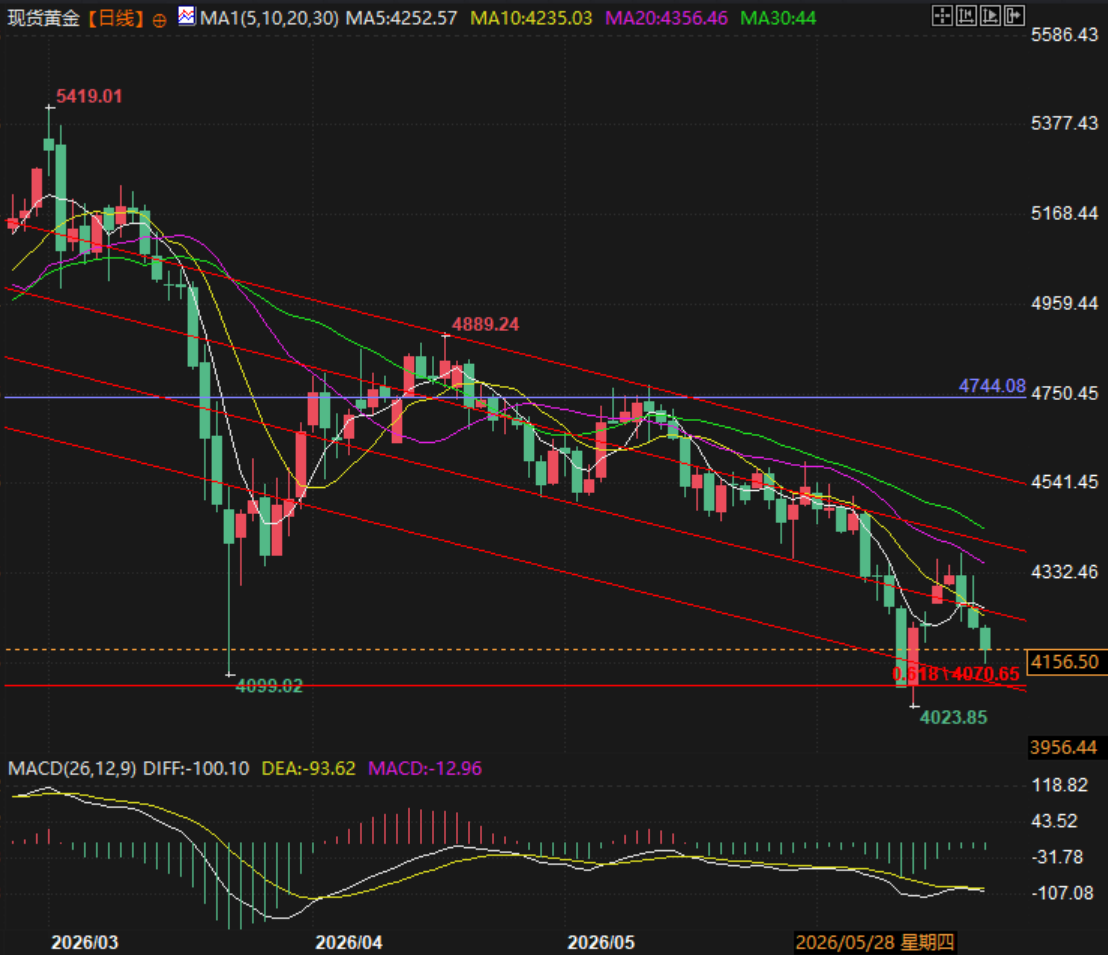
(Spot gold daily chart, source: FX678)
At 15:51 Beijing time, spot gold was trading at $4,155 per ounce.
On June 18 local time (early morning of June 19 Beijing time), US Vice President JD Vance stated at a White House press conference that the 60-day negotiation window for the US-Iran memorandum of understanding signed by US President Trump and Iranian President Pezechzian has officially begun.
Vance elaborated on the core content of the agreement and the US position: the Strait of Hormuz blockade has been officially lifted, "12.5 million barrels of oil passed through the strait last night," and Iran has made specific nuclear commitments, including accepting international supervision, diluting and destroying its existing stockpile of highly enriched uranium, and refraining from developing missiles that pose a wide-ranging threat to the world.
He emphasized that, unlike the Joint Comprehensive Plan of Action (JCPOA) during the Obama era, "the United States will not give Iran a single penny under this agreement." It will only allow Iran to use the $6 billion in oil revenue stored in Qatar in stages, and only for purchasing American humanitarian aid and non-sanctioned goods. The unfreezing of funds will be directly linked to the progress of navigation in the Taiwan Strait and the outcome of the negotiations.
In line with Trump's remarks and Khamenei's response, although the trip to Switzerland was delayed, the overall atmosphere for the peace talks remained relatively stable.
Agreement Implementation and Follow-up Arrangements: Lockdown Lifting + Long-Term Mechanism, Congressional Notification on the Agenda
Regarding the implementation of the agreement and subsequent arrangements, Vance pointed out that the U.S. has lifted the naval blockade on Iranian ports, and the U.S. Central Command has also confirmed that all blockade operations against Iranian coastal traffic have been stopped, and ships will remain in the area to ensure the implementation of the agreement.
The agreement aims to establish a long-term security mechanism for the Strait of Hormuz jointly by Oman, Iran, and the Gulf alliance. Its core objective is to ensure that this international waterway no longer becomes a choke point that hinders the global economy, and it opposes any form of toll collection.
On the political front, Vance stated that he would brief Congress as soon as possible and "believes that the sanctions can be temporarily lifted without congressional approval." This refuted speculation that the US-Iran peace agreement would not be approved by Congress, while also responding to Trump's joke about "blaming others for the failure of negotiations," saying that "the president is just making a habitual joke," and countering progressives' doubts about his diplomatic experience.
He also made it clear that the United States has destroyed Iran's nuclear infrastructure worth hundreds of billions of dollars through military strikes, "firmly seizing control of its economic lifeline," and will push for the establishment of an effective verification and enforcement monitoring mechanism to ensure that Iran completely changes its way of doing things.
Senior US and Iranian officials stated that they have mutually endorsed the agreement, focusing on a ceasefire and the reopening of shipping lanes.
Both the US and Iranian leaders expressed their support for the agreement: the White House declared that "the resumption of oil supply, the continued decline in gasoline prices , and the booming market are a victory for the United States and the world," and reiterated that "Iran must never possess nuclear weapons."
Iran's Supreme Leader Khamenei directly stated, "I approved this memorandum," providing the highest level of political endorsement for the negotiations.
President Trump also optimistically predicted that "Lebanon, Hezbollah, and Israel will reach a ceasefire agreement," while Iran's Supreme National Security Council revealed that the volume of ship traffic in the Strait of Hormuz will gradually increase. The dynamics of this key global oil shipping route have attracted widespread attention from the energy and trade industries.
Sudden Change in Situation: Vance's Swiss Negotiation Trip Cancelled, Israeli Military Action Becomes the Core Trigger
However, just as all parties were pushing for the agreement to be implemented, US Vice President Vance's scheduled trip to Switzerland that evening to participate in technical negotiations was suddenly canceled.
The White House's official explanation was that "logistical arrangements for the negotiations have not yet been finalized," but combined with previous reports from Pan Arab Satellite Television's Mayadin, the core reason for the cancellation of this trip is most likely Israel's military strikes in southern Lebanon.
Israeli Prime Minister Benjamin Netanyahu has made it clear that the Israeli military will continue to be stationed in the "safe zone" in southern Lebanon "as long as security needs require, " a tough stance that is closely related to Israel's upcoming snap election.
Deep Geopolitical Logic: With Israel's snap election approaching, Netanyahu's electoral maneuvering
It is reported that the Israeli parliament has decided to hold early elections, with the voting date expected to be between September 8 and October 20, to be finalized by the parliament's internal affairs committee.
Faced with electoral pressure, the Netanyahu government attempted to consolidate support among domestic hawkish voters by intensifying military operations in Lebanon. This move not only led to Iran postponing the dispatch of a negotiating delegation but also cast a shadow over the 60-day window for negotiations between the US and Iran.
As discussed in previous articles, the core of Israeli elections lies in the gains achieved through war. For example, war can create disputed land, granting temporary control over it, and ultimately, by blurring the lines of war duration, achieve long-term occupation and gain practical benefits such as control over water resources.
Geopolitical inflection points are key, but real interest rates are the underlying factor.
Recent fluctuations in gold prices have largely been driven by changes in geopolitical situations, but the underlying reason for the overall weakening trend in gold prices is a shift in the logic influencing real interest rates.
The real interest rate is roughly equal to the nominal interest rate minus inflation expectations. During the US-Iran conflict, the nominal interest rate was driven up by the global sell-off of US Treasury bonds for dollars and expectations of massive capital expenditures by AI, making it relatively rigid. In contrast, the inflation expectations brought about by the war peaked at the outset and then quickly declined.
The overall real interest rate continued to rise during the US-Iran conflict, suppressing the holding cost of gold. At the same time, the higher yields of US Treasury bonds and US stocks diverted funds from gold investment, ultimately causing gold to decline. This resulted in a phenomenon where stocks rose and gold rose slightly, while stocks fell and gold fell sharply. This is the core reason. As for the impact of central banks on gold prices, it is more of a medium- to long-term issue. Readers can refer to previous articles discussing this topic.
From a technical perspective, gold prices continue to move within a downward channel, and a typical rebound in the market is a selling signal within the downward trend.
The 0.618 Fibonacci retracement level of this upward move, around 4025, remains a key support level, while resistance lies near the 5-day moving average and the middle line of the descending channel.
(Spot gold daily chart, source: FX678)
At 15:51 Beijing time, spot gold was trading at $4,155 per ounce.
- Risk Warning and Disclaimer
- The market involves risk, and trading may not be suitable for all investors. This article is for reference only and does not constitute personal investment advice, nor does it take into account certain users’ specific investment objectives, financial situation, or other needs. Any investment decisions made based on this information are at your own risk.