The US dollar index surged to a 13-month high, but the real driver was not safe-haven demand.
2026-06-19 20:57:11
On Friday, June 19th, the US dollar index retreated to around 100.75 after touching 101.12, with its short-term trend shifting to a repricing driven by interest rate expectations. The market's latest focus is not solely on safe-haven demand, but rather on the Federal Reserve's revised upward policy path. The latest policy meeting maintained the target range for the federal funds rate at 3.50% to 3.75%, but official forecasts show that 9 out of 19 policymakers expect at least one rate hike this year, pushing the dollar index to its highest level since May 2025.
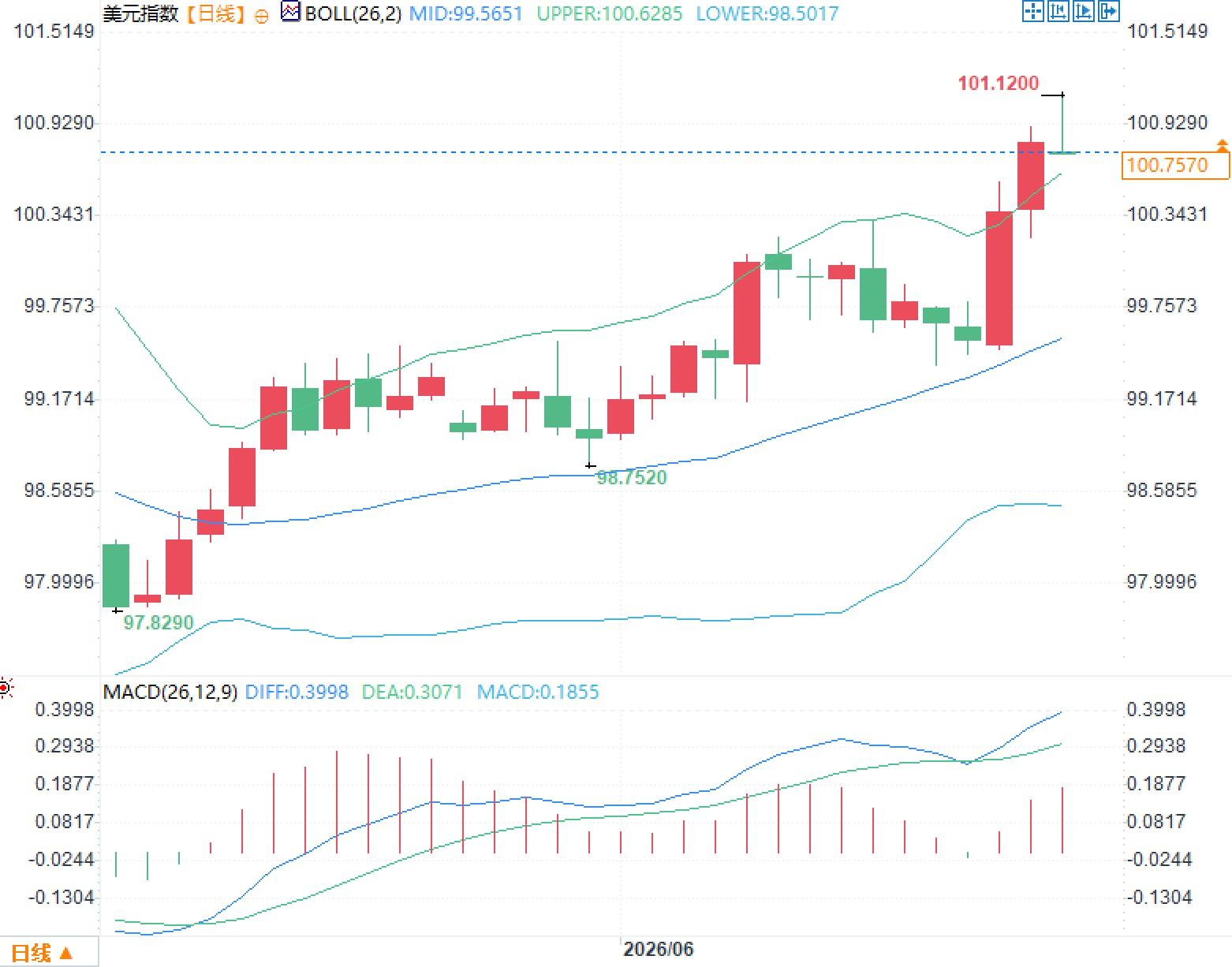
The key to the recent two-day surge in the US dollar index lies not in a sudden surge of safe-haven buying, but in the continuous revision of short-term interest rate expectations. Over the past month, market pricing in the Fed's future policy has shifted rapidly from a continuation of rate cuts to a view that a rate hike is not out of the question. The most direct reflection of this in trading is the US dollar index breaking through the upper Bollinger Band near 100.60 and further testing 101.12. The daily chart shows the Bollinger middle band at 99.5651, the upper band at 100.6285, and the lower band at 98.5017. The current price of 100.75 is already above the upper band, indicating that the price is no longer simply rising moderately along the middle band, but has entered a phase of increased volatility.
More importantly, this round of strengthening is not simply explained by energy conflicts, risk asset pullbacks, or liquidity contraction. Previous rebounds in the dollar index often coincided with sudden risk events, and their sustainability depended on whether safe-haven demand could continue. The underlying variable for the current dollar strength, however, is that the market is beginning to reassess the Federal Reserve's anti-inflationary constraints. Newly appointed Fed Chairman Warsh recently emphasized price stability after his first policy meeting and downplayed the previously overly detailed forward guidance, leading the market to revise upwards on the probability of interest rate hikes.
For traders, the key to whether the dollar index can maintain above 100.60 is not a single day's gain, but whether short-term yields continue to confirm the tightening premium. The two-year US Treasury yield is most sensitive to policy rate expectations; when the market shifts from "continued easing" to "possible further rate hikes," the carry trade attractiveness of the dollar relative to low-interest currencies will be amplified again.
This also explains why the dollar index breaking through 101 is not an isolated event. This round of dollar strengthening has been accompanied by rising short-term yields, while long-term yields have remained relatively stable, indicating that the market is betting on higher and longer policy rates, rather than simply betting on a renewed acceleration of long-term growth. This combination typically has two implications: first, the dollar index is significantly more sensitive to short-term data, with any deviation from inflation, employment, and wage data potentially amplifying volatility; second, the more aggressive the pricing at the front end of the yield curve, the faster the dollar may retrace once inflation falls or employment weakens.
From a technical perspective, the Bollinger Middle Band around 99.56 has become a key level for determining the strength of this market move. If the price continues to trade above 100.60, it indicates that trend-following funds are still accepting the high valuation; if it falls back below the Upper Band, it means that buying pressure after the breakout is starting to come. What dollar bulls really need right now is for further data to support the idea that "interest rate hikes are not a tail risk, but a tradable scenario."
The current rise in the US dollar is based on the logic that "sticky inflation forces the Federal Reserve to maintain a more hawkish stance," but this logic is not without flaws. If oil and gasoline prices fall, consumer price pressures may ease, forcing the market to revise its pricing of the probability of a Fed rate hike. Some institutions believe that the year-on-year growth rate of consumer prices may have peaked around May, and subsequent cooling of energy prices will reduce the necessity for further tightening. If this judgment is verified by subsequent data, the upward logic of the US dollar index will shift from "re-tightening of policy" to "a temporary interest rate advantage."
This is the most easily underestimated risk in the current market: the closer the US dollar index gets to above 101, the more aggressive the implied policy expectations, and the lower the margin for error in data. If subsequent inflation data only shows a moderate decline, the US dollar may experience high-level fluctuations; if inflation declines faster than market pricing, interest rate futures and short-term bond yields will correct first, and the US dollar index may retest the 99.56 level.
Therefore, the essence of this round of dollar strengthening is not unconditional strength, but rather a valuation increase driven by policy expectations. It's necessary to distinguish between two types of market movements: safe-haven rallies tend to be quick to arrive and quick to recede; interest rate differential rallies are more sustainable, but rely more heavily on data confirmation. Currently, the dollar index is at the intersection of these two factors, supported by both liquidity preferences stemming from regional conflicts and interest rate differentials resulting from the Federal Reserve's pricing revaluation.
The core reason for the US dollar index's breakout is not risk aversion, but rather the repricing of interest rate expectations.
The key to the recent two-day surge in the US dollar index lies not in a sudden surge of safe-haven buying, but in the continuous revision of short-term interest rate expectations. Over the past month, market pricing in the Fed's future policy has shifted rapidly from a continuation of rate cuts to a view that a rate hike is not out of the question. The most direct reflection of this in trading is the US dollar index breaking through the upper Bollinger Band near 100.60 and further testing 101.12. The daily chart shows the Bollinger middle band at 99.5651, the upper band at 100.6285, and the lower band at 98.5017. The current price of 100.75 is already above the upper band, indicating that the price is no longer simply rising moderately along the middle band, but has entered a phase of increased volatility.
More importantly, this round of strengthening is not simply explained by energy conflicts, risk asset pullbacks, or liquidity contraction. Previous rebounds in the dollar index often coincided with sudden risk events, and their sustainability depended on whether safe-haven demand could continue. The underlying variable for the current dollar strength, however, is that the market is beginning to reassess the Federal Reserve's anti-inflationary constraints. Newly appointed Fed Chairman Warsh recently emphasized price stability after his first policy meeting and downplayed the previously overly detailed forward guidance, leading the market to revise upwards on the probability of interest rate hikes.
Short-term yields are the pricing anchor for the current dollar rally.
For traders, the key to whether the dollar index can maintain above 100.60 is not a single day's gain, but whether short-term yields continue to confirm the tightening premium. The two-year US Treasury yield is most sensitive to policy rate expectations; when the market shifts from "continued easing" to "possible further rate hikes," the carry trade attractiveness of the dollar relative to low-interest currencies will be amplified again.
This also explains why the dollar index breaking through 101 is not an isolated event. This round of dollar strengthening has been accompanied by rising short-term yields, while long-term yields have remained relatively stable, indicating that the market is betting on higher and longer policy rates, rather than simply betting on a renewed acceleration of long-term growth. This combination typically has two implications: first, the dollar index is significantly more sensitive to short-term data, with any deviation from inflation, employment, and wage data potentially amplifying volatility; second, the more aggressive the pricing at the front end of the yield curve, the faster the dollar may retrace once inflation falls or employment weakens.
From a technical perspective, the Bollinger Middle Band around 99.56 has become a key level for determining the strength of this market move. If the price continues to trade above 100.60, it indicates that trend-following funds are still accepting the high valuation; if it falls back below the Upper Band, it means that buying pressure after the breakout is starting to come. What dollar bulls really need right now is for further data to support the idea that "interest rate hikes are not a tail risk, but a tradable scenario."
The inflation narrative is reflexive, and the strength of the dollar also has inherent vulnerabilities.
The current rise in the US dollar is based on the logic that "sticky inflation forces the Federal Reserve to maintain a more hawkish stance," but this logic is not without flaws. If oil and gasoline prices fall, consumer price pressures may ease, forcing the market to revise its pricing of the probability of a Fed rate hike. Some institutions believe that the year-on-year growth rate of consumer prices may have peaked around May, and subsequent cooling of energy prices will reduce the necessity for further tightening. If this judgment is verified by subsequent data, the upward logic of the US dollar index will shift from "re-tightening of policy" to "a temporary interest rate advantage."
This is the most easily underestimated risk in the current market: the closer the US dollar index gets to above 101, the more aggressive the implied policy expectations, and the lower the margin for error in data. If subsequent inflation data only shows a moderate decline, the US dollar may experience high-level fluctuations; if inflation declines faster than market pricing, interest rate futures and short-term bond yields will correct first, and the US dollar index may retest the 99.56 level.
Therefore, the essence of this round of dollar strengthening is not unconditional strength, but rather a valuation increase driven by policy expectations. It's necessary to distinguish between two types of market movements: safe-haven rallies tend to be quick to arrive and quick to recede; interest rate differential rallies are more sustainable, but rely more heavily on data confirmation. Currently, the dollar index is at the intersection of these two factors, supported by both liquidity preferences stemming from regional conflicts and interest rate differentials resulting from the Federal Reserve's pricing revaluation.
- Risk Warning and Disclaimer
- The market involves risk, and trading may not be suitable for all investors. This article is for reference only and does not constitute personal investment advice, nor does it take into account certain users’ specific investment objectives, financial situation, or other needs. Any investment decisions made based on this information are at your own risk.