Hawkish signals from the Federal Reserve boosted the dollar, while gold remained range-bound, awaiting stabilization.
2026-06-22 10:10:38
International gold prices initially declined during Asian trading hours on Monday before rebounding. Spot gold (XAU/USD) fell to around $4150 before quickly recovering to around $4200. Following the signing of an agreement between the US and Iran, which eased safe-haven demand, the market had anticipated further gold price corrections. However, renewed uncertainty in the Middle East over the weekend limited the decline in gold prices.

US President Trump stated over the weekend that if Lebanese armed groups continue to launch attacks against Israel, the US may take stronger measures, including a new military strike against Iran. These remarks have raised renewed concerns in markets about the prospects for peace talks between the US and Iran.
Meanwhile, Iranian negotiators temporarily suspended key consultations in Switzerland in response to a hardline stance from the United States. However, communication channels between the two sides have not been completely closed, and negotiations are continuing. The market believes that despite the increased short-term diplomatic friction, the risk of a complete withdrawal from negotiations is currently limited. A resurgence in safe-haven demand initially provided support for gold, but market focus quickly returned to the outlook for US monetary policy. With newly appointed Federal Reserve Chairman Kevin Warsh consistently sending hawkish signals, investor expectations for interest rate cuts this year have further cooled, pushing the US dollar index to remain strong.
Market expectations for a Federal Reserve rate cut this year have declined significantly, and the US dollar index remains high, putting continued downward pressure on gold. Analysts point out that gold, as an asset that does not generate interest income, is highly sensitive to changes in the interest rate environment. When the market expects high interest rates to persist for a longer period, the attractiveness of gold as an asset allocation often diminishes.
Meanwhile, a stronger dollar is eroding gold's safe-haven appeal. Tim Waterler, chief market analyst at KCM Trade, stated that the gold rally triggered by the previous interim agreement between the US and Iran was short-lived, and the dollar has once again become the market's focus, with the Federal Reserve's hawkish stance dominating current market trading logic.
In terms of institutional views, Goldman Sachs has recently adjusted its gold price forecast. The firm now expects international gold prices to rise to around $4,900 per ounce by December, significantly lower than its previous target of $5,400. Goldman Sachs believes that the resilience of the US economy and the possibility that interest rates will remain high for longer than previously anticipated are among the key reasons for its downward revision of its gold price target.
From an overall market perspective, gold is currently influenced by both safe-haven demand and interest rate expectations. Geopolitical risks provide downside support for gold prices, while a stronger dollar and a high-interest-rate environment limit upside potential, leading to a period of high-level consolidation. Going forward, the market will focus on the progress of negotiations between the US and Iran, speeches by Federal Reserve officials, and subsequent inflation and employment data. If the dollar continues to strengthen, gold may face further consolidation pressure in the short term; conversely, if the escalation of the Middle East situation leads to a significant increase in safe-haven demand, it could attract renewed inflows into the precious metals market.
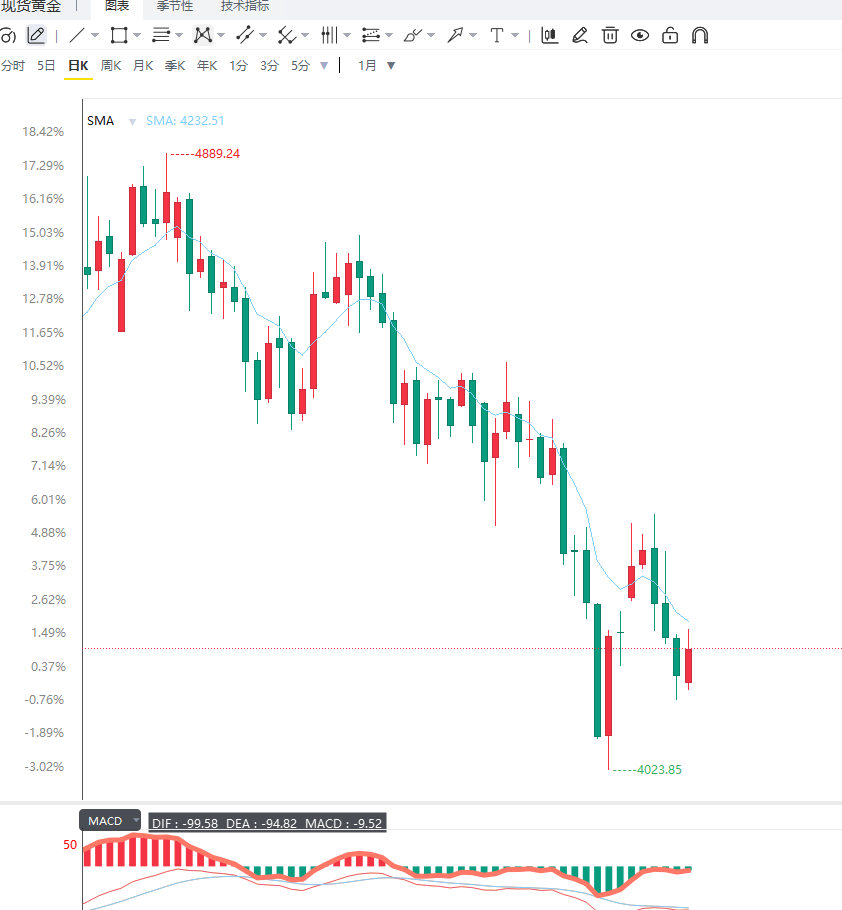
From a daily chart perspective, spot gold has been consolidating after its previous correction from above $4,500, and remains in a period of consolidation. While recent geopolitical risks have led to a temporary rebound, prices have failed to break through resistance levels, indicating continued selling pressure. Currently, gold is trading around $4,150, with short-term moving averages beginning to flatten, suggesting a back-and-forth struggle between bulls and bears. Key resistance levels to watch are $4,250 and $4,300. Failure to break through these levels could lead to a further pullback to the $4,100 or even $4,050 support zone. Overall, the medium-term correction is not yet over, and the overall weak and volatile pattern remains unchanged.
From the 4-hour chart, gold's rebound momentum has weakened, and the price center of gravity shows signs of a slow downward shift. Recent attempts to break through the $4200 level have failed, indicating insufficient market willingness to chase higher prices. In the short term, a strong dollar and persistently high US Treasury yields continue to suppress gold's performance. If it breaks below the support level around $4120, it may further test the $4100 mark; conversely, only by regaining a foothold above $4200 can gold prices potentially reopen upside potential. Currently, the 4-hour chart remains in a high-level consolidation phase, with a short-term bias towards a pullback.
Editor's Summary : The gold market is currently in a phase of interplay between safe-haven demand and monetary policy expectations. Uncertainty surrounding the Middle East situation provides some support for gold prices, but the Federal Reserve's hawkish stance and a stronger dollar are diminishing gold's appeal. From a market pricing perspective, investors' expectations for interest rate cuts this year continue to be revised, putting some pressure on the precious metals market. In the short term, if negotiations between the US and Iran continue, the safe-haven premium may further decline; however, if geopolitical tensions escalate again, it could provide new upward momentum for gold. Overall, gold may maintain a high-level consolidation pattern in the short term, and the market should remain wary of the risk of a correction before breaking through key resistance levels.
US President Trump stated over the weekend that if Lebanese armed groups continue to launch attacks against Israel, the US may take stronger measures, including a new military strike against Iran. These remarks have raised renewed concerns in markets about the prospects for peace talks between the US and Iran.
Meanwhile, Iranian negotiators temporarily suspended key consultations in Switzerland in response to a hardline stance from the United States. However, communication channels between the two sides have not been completely closed, and negotiations are continuing. The market believes that despite the increased short-term diplomatic friction, the risk of a complete withdrawal from negotiations is currently limited. A resurgence in safe-haven demand initially provided support for gold, but market focus quickly returned to the outlook for US monetary policy. With newly appointed Federal Reserve Chairman Kevin Warsh consistently sending hawkish signals, investor expectations for interest rate cuts this year have further cooled, pushing the US dollar index to remain strong.
Market expectations for a Federal Reserve rate cut this year have declined significantly, and the US dollar index remains high, putting continued downward pressure on gold. Analysts point out that gold, as an asset that does not generate interest income, is highly sensitive to changes in the interest rate environment. When the market expects high interest rates to persist for a longer period, the attractiveness of gold as an asset allocation often diminishes.
Meanwhile, a stronger dollar is eroding gold's safe-haven appeal. Tim Waterler, chief market analyst at KCM Trade, stated that the gold rally triggered by the previous interim agreement between the US and Iran was short-lived, and the dollar has once again become the market's focus, with the Federal Reserve's hawkish stance dominating current market trading logic.
In terms of institutional views, Goldman Sachs has recently adjusted its gold price forecast. The firm now expects international gold prices to rise to around $4,900 per ounce by December, significantly lower than its previous target of $5,400. Goldman Sachs believes that the resilience of the US economy and the possibility that interest rates will remain high for longer than previously anticipated are among the key reasons for its downward revision of its gold price target.
From an overall market perspective, gold is currently influenced by both safe-haven demand and interest rate expectations. Geopolitical risks provide downside support for gold prices, while a stronger dollar and a high-interest-rate environment limit upside potential, leading to a period of high-level consolidation. Going forward, the market will focus on the progress of negotiations between the US and Iran, speeches by Federal Reserve officials, and subsequent inflation and employment data. If the dollar continues to strengthen, gold may face further consolidation pressure in the short term; conversely, if the escalation of the Middle East situation leads to a significant increase in safe-haven demand, it could attract renewed inflows into the precious metals market.
From a daily chart perspective, spot gold has been consolidating after its previous correction from above $4,500, and remains in a period of consolidation. While recent geopolitical risks have led to a temporary rebound, prices have failed to break through resistance levels, indicating continued selling pressure. Currently, gold is trading around $4,150, with short-term moving averages beginning to flatten, suggesting a back-and-forth struggle between bulls and bears. Key resistance levels to watch are $4,250 and $4,300. Failure to break through these levels could lead to a further pullback to the $4,100 or even $4,050 support zone. Overall, the medium-term correction is not yet over, and the overall weak and volatile pattern remains unchanged.
From the 4-hour chart, gold's rebound momentum has weakened, and the price center of gravity shows signs of a slow downward shift. Recent attempts to break through the $4200 level have failed, indicating insufficient market willingness to chase higher prices. In the short term, a strong dollar and persistently high US Treasury yields continue to suppress gold's performance. If it breaks below the support level around $4120, it may further test the $4100 mark; conversely, only by regaining a foothold above $4200 can gold prices potentially reopen upside potential. Currently, the 4-hour chart remains in a high-level consolidation phase, with a short-term bias towards a pullback.
Editor's Summary : The gold market is currently in a phase of interplay between safe-haven demand and monetary policy expectations. Uncertainty surrounding the Middle East situation provides some support for gold prices, but the Federal Reserve's hawkish stance and a stronger dollar are diminishing gold's appeal. From a market pricing perspective, investors' expectations for interest rate cuts this year continue to be revised, putting some pressure on the precious metals market. In the short term, if negotiations between the US and Iran continue, the safe-haven premium may further decline; however, if geopolitical tensions escalate again, it could provide new upward momentum for gold. Overall, gold may maintain a high-level consolidation pattern in the short term, and the market should remain wary of the risk of a correction before breaking through key resistance levels.
- Risk Warning and Disclaimer
- The market involves risk, and trading may not be suitable for all investors. This article is for reference only and does not constitute personal investment advice, nor does it take into account certain users’ specific investment objectives, financial situation, or other needs. Any investment decisions made based on this information are at your own risk.