Divergence over the dot plot, controversy over private dinners, and conflicting statements from officials—what will be the cost of a "quieter Fed"?
2026-06-22 13:58:09
On Monday (June 22) during the Asian session, the US dollar index fluctuated higher, currently up about 0.1% to trade around 100.85.
When the market most needed guidance, Warsh chose to remain silent. The FOMC statement was condensed to 130 words, and the dot plot signaled a split but pointed to a hawkish stance—nine officials supported raising interest rates.
Last week, Kevin Warsh did his best to keep a low profile, delivering on his promise of a "quieter Fed." The FOMC statement was cut in half, reduced to just 130 words; Warsh did not participate in the Summary of Economic Projections (SEP) that included the dot plot; and at the press conference, he declined to elaborate on monetary policy or inflation issues outside the statement.
Warsh believes that market prices are the most important signal from the Federal Reserve, but when the market merely "reflects what we've said," the Fed loses the value of that signal. In his view, less Fed communication would allow the Fed to hear clearer market signals.
Warsh is reversing the flow of information—overturning the traditional model of the Federal Reserve influencing current interest rates by conveying policy intentions to the market through "forward guidance." While opinions may differ on the best way to exchange information with financial markets, this exchange is only one aspect of the Fed's communication function. Public accountability and transparency are equally important. Even if the public focuses on the former, the market cannot force Warsh to speak, nor can Warsh make the market ignore the Fed's existence. So, who will fill this void?
The brief FOMC statement concluded with a strong commitment: "The Committee will achieve price stability." The natural next question was: What are the Fed's plans for achieving price stability? Warsh decided against discussing the path, so a dot plot filled the gap—a dot plot that Warsh himself did not participate in creating. This dot plot, anonymously created by 18 other Fed officials, became the first candidate for "shadow chairman."
The dot plot reveals a deep division among Federal Reserve officials regarding the best path for monetary policy this year: nine officials believe that raising interest rates may be appropriate, eight prefer to keep rates unchanged, and only one supports a rate cut.
However, the committee unanimously voted to keep interest rates unchanged—unanimous on the current decision, but deeply divided on the future path. The dot plot, lacking Warsh's guidance, signaled a significant shift: compared to March, more Fed officials believed significantly higher interest rates were appropriate, reflecting a deteriorating inflation outlook in recent months. Their previous projections were drawn at the beginning of the Middle East conflict, a period since which has seen dramatic changes.
Financial markets reacted to the hawkish dot plot, pushing market interest rates higher. Even so, the dot plot has proven ineffective as a "shadow chairman."
First and foremost, it is obvious that the median in the June dot plot is not the FOMC median—but rather the FOMC median minus the Chairman's value. This is a "significant omission" not present in the March dot plot. Even a complete dot plot is merely a crude substitute indicator—it is the result of independent preparation by officials before the meeting, not a consensus reached by the committee, and it is only updated every two meetings, rendering it completely useless for the July meeting.
Since Warsh is unwilling to speak, the market will turn to Federal Reserve officials who are willing to speak and seem to reflect the consensus of the committee.
Warsh could not force other Fed officials to stop speaking. Out of respect for the new chairman, less explicit discussion of policy is expected, but most officials will still explain their reasons for voting and their views on the future path, which goes far beyond what Warsh is willing to reveal.
Federal Reserve Governor Chris Waller—a former shortlisted candidate for Fed chair—will speak at a conference on the dollar on Monday. New York Fed President John Williams and Chicago Fed President Austan Goolsbee will speak later this week. Interpreting the Fed will become a process of listening to each official's remarks and piecing together the pieces over time—noisier and less precise than the style of recent Fed chairs we're used to.
The key point is that Federal Reserve officials can only speak for themselves and cannot reveal the content of the committee's discussions. Only the Federal Reserve Chairman has the authority to speak on behalf of the FOMC, and Warsh chose not to. No other official will speak for the Chairman. The Chairman is the missing piece of the puzzle; he sets the meeting agenda, so his silence is the most difficult gap to fill when interpreting the committee's consensus.
Other Federal Reserve officials considered "shadow chairs" might fill some of the gaps, but as Powell stated in a previous press conference, "The Federal Reserve Board has only one chair." That chair is Warsh, who is currently remaining silent. A replacement might be found, but that replacement can never perfectly replace the only person authorized to speak on behalf of the committee.
The worst outcome is that the "shadow chairman" becomes the "shadow" itself. Private communications within the Federal Reserve are nothing new, and the line between compliance and violation has always been difficult to define. But when the Fed's public statements decrease significantly, this scarcity makes any private contact with officials more valuable, and the gray area more dangerous. If Warsh truly wants to reduce the Fed's public communication, he must more aggressively control private communication channels.
Last weekend, media reports indicated that Federal Reserve Vice Chair for Supervision Michelle Bowman attended an invitation-only private dinner hosted by Bank of America for its clients, just hours after the Warsh press conference. Bowman stated that the report "unfairly portrayed" the event and claimed she adhered to the Fed's ethical guidelines. She may indeed have. But with the Fed's public pronouncements decreasing, a private remark or even an expression from an official becomes far more valuable. Therefore, the Fed's ethical guidelines regarding private communication need to be tightened to match Warsh's vision of a "quieter Fed."
If the Federal Reserve under Warsh's leadership reduces public communication, the stakes in the game of private interests will rise significantly. Less public transparency means more backroom deals.
So, who or what will become the "shadow chairman"? The honest answer is: no one and nothing can truly replace him. Dot plots, other officials, and even private settings can fill some information gaps, but each is a noisier and less reliable substitute—none can do what only the Federal Reserve Chairman can do: speak on behalf of the committee and take responsibility for decisions.
This gap comes at a cost. More ambiguous signals increase the probability of the Federal Reserve unexpectedly impacting the market, thereby pushing up borrowing costs. At the same time, it loosens public accountability towards the Fed—an institution to which it owes a duty of accountability and transparency. One of Warsh's five newly established task forces is a communications task force. Forward guidance is too narrow a perspective; it should also ask: How much public knowledge does the public actually have about the Fed's policy thinking? And how will the Fed ensure that access to this information doesn't become a privilege reserved for a select few?
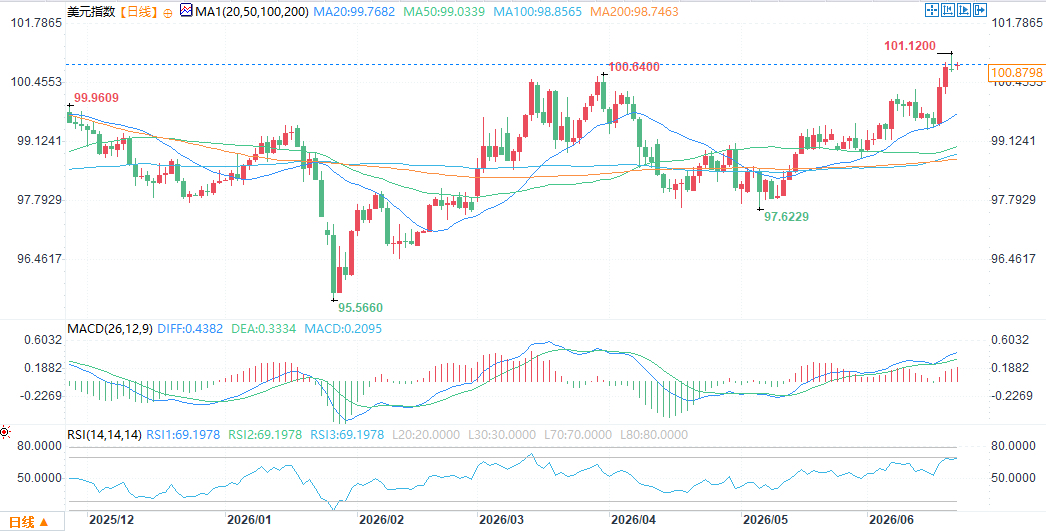
(US Dollar Index Daily Chart, Source: FX678)
At 13:57 Beijing time on June 22, the US dollar index was at 100.90.
When the market most needed guidance, Warsh chose to remain silent. The FOMC statement was condensed to 130 words, and the dot plot signaled a split but pointed to a hawkish stance—nine officials supported raising interest rates.
Last week, Kevin Warsh did his best to keep a low profile, delivering on his promise of a "quieter Fed." The FOMC statement was cut in half, reduced to just 130 words; Warsh did not participate in the Summary of Economic Projections (SEP) that included the dot plot; and at the press conference, he declined to elaborate on monetary policy or inflation issues outside the statement.
Warsh believes that market prices are the most important signal from the Federal Reserve, but when the market merely "reflects what we've said," the Fed loses the value of that signal. In his view, less Fed communication would allow the Fed to hear clearer market signals.
Warsh is reversing the flow of information—overturning the traditional model of the Federal Reserve influencing current interest rates by conveying policy intentions to the market through "forward guidance." While opinions may differ on the best way to exchange information with financial markets, this exchange is only one aspect of the Fed's communication function. Public accountability and transparency are equally important. Even if the public focuses on the former, the market cannot force Warsh to speak, nor can Warsh make the market ignore the Fed's existence. So, who will fill this void?
The first candidate to fill the blank: a bitmap
The brief FOMC statement concluded with a strong commitment: "The Committee will achieve price stability." The natural next question was: What are the Fed's plans for achieving price stability? Warsh decided against discussing the path, so a dot plot filled the gap—a dot plot that Warsh himself did not participate in creating. This dot plot, anonymously created by 18 other Fed officials, became the first candidate for "shadow chairman."
The dot plot reveals a deep division among Federal Reserve officials regarding the best path for monetary policy this year: nine officials believe that raising interest rates may be appropriate, eight prefer to keep rates unchanged, and only one supports a rate cut.
However, the committee unanimously voted to keep interest rates unchanged—unanimous on the current decision, but deeply divided on the future path. The dot plot, lacking Warsh's guidance, signaled a significant shift: compared to March, more Fed officials believed significantly higher interest rates were appropriate, reflecting a deteriorating inflation outlook in recent months. Their previous projections were drawn at the beginning of the Middle East conflict, a period since which has seen dramatic changes.
Financial markets reacted to the hawkish dot plot, pushing market interest rates higher. Even so, the dot plot has proven ineffective as a "shadow chairman."
First and foremost, it is obvious that the median in the June dot plot is not the FOMC median—but rather the FOMC median minus the Chairman's value. This is a "significant omission" not present in the March dot plot. Even a complete dot plot is merely a crude substitute indicator—it is the result of independent preparation by officials before the meeting, not a consensus reached by the committee, and it is only updated every two meetings, rendering it completely useless for the July meeting.
The second candidate to fill the vacancy: other Federal Reserve officials
Since Warsh is unwilling to speak, the market will turn to Federal Reserve officials who are willing to speak and seem to reflect the consensus of the committee.
Warsh could not force other Fed officials to stop speaking. Out of respect for the new chairman, less explicit discussion of policy is expected, but most officials will still explain their reasons for voting and their views on the future path, which goes far beyond what Warsh is willing to reveal.
Federal Reserve Governor Chris Waller—a former shortlisted candidate for Fed chair—will speak at a conference on the dollar on Monday. New York Fed President John Williams and Chicago Fed President Austan Goolsbee will speak later this week. Interpreting the Fed will become a process of listening to each official's remarks and piecing together the pieces over time—noisier and less precise than the style of recent Fed chairs we're used to.
The key point is that Federal Reserve officials can only speak for themselves and cannot reveal the content of the committee's discussions. Only the Federal Reserve Chairman has the authority to speak on behalf of the FOMC, and Warsh chose not to. No other official will speak for the Chairman. The Chairman is the missing piece of the puzzle; he sets the meeting agenda, so his silence is the most difficult gap to fill when interpreting the committee's consensus.
Other Federal Reserve officials considered "shadow chairs" might fill some of the gaps, but as Powell stated in a previous press conference, "The Federal Reserve Board has only one chair." That chair is Warsh, who is currently remaining silent. A replacement might be found, but that replacement can never perfectly replace the only person authorized to speak on behalf of the committee.
The most dangerous void: the "shadow" in private.
The worst outcome is that the "shadow chairman" becomes the "shadow" itself. Private communications within the Federal Reserve are nothing new, and the line between compliance and violation has always been difficult to define. But when the Fed's public statements decrease significantly, this scarcity makes any private contact with officials more valuable, and the gray area more dangerous. If Warsh truly wants to reduce the Fed's public communication, he must more aggressively control private communication channels.
Last weekend, media reports indicated that Federal Reserve Vice Chair for Supervision Michelle Bowman attended an invitation-only private dinner hosted by Bank of America for its clients, just hours after the Warsh press conference. Bowman stated that the report "unfairly portrayed" the event and claimed she adhered to the Fed's ethical guidelines. She may indeed have. But with the Fed's public pronouncements decreasing, a private remark or even an expression from an official becomes far more valuable. Therefore, the Fed's ethical guidelines regarding private communication need to be tightened to match Warsh's vision of a "quieter Fed."
If the Federal Reserve under Warsh's leadership reduces public communication, the stakes in the game of private interests will rise significantly. Less public transparency means more backroom deals.
Summarize
So, who or what will become the "shadow chairman"? The honest answer is: no one and nothing can truly replace him. Dot plots, other officials, and even private settings can fill some information gaps, but each is a noisier and less reliable substitute—none can do what only the Federal Reserve Chairman can do: speak on behalf of the committee and take responsibility for decisions.
This gap comes at a cost. More ambiguous signals increase the probability of the Federal Reserve unexpectedly impacting the market, thereby pushing up borrowing costs. At the same time, it loosens public accountability towards the Fed—an institution to which it owes a duty of accountability and transparency. One of Warsh's five newly established task forces is a communications task force. Forward guidance is too narrow a perspective; it should also ask: How much public knowledge does the public actually have about the Fed's policy thinking? And how will the Fed ensure that access to this information doesn't become a privilege reserved for a select few?
(US Dollar Index Daily Chart, Source: FX678)
At 13:57 Beijing time on June 22, the US dollar index was at 100.90.
- Risk Warning and Disclaimer
- The market involves risk, and trading may not be suitable for all investors. This article is for reference only and does not constitute personal investment advice, nor does it take into account certain users’ specific investment objectives, financial situation, or other needs. Any investment decisions made based on this information are at your own risk.