The Australian dollar is caught between geopolitical risks and hawkish policies. How should traders position themselves?
2026-06-22 14:57:30
On Monday (June 22) during the Asian session, the Australian dollar remained volatile against the US dollar, currently trading around 0.7000, mainly pressured by rising risk aversion in the market.
Investors continue to assess the latest developments in the US-Iran peace agreement – despite some positive progress in the negotiations, Trump’s military threats have cast doubt on the prospects of the agreement, putting downward pressure on the risk-sensitive Australian dollar.
Meanwhile, the hawkish signals released by the Reserve Bank of Australia last week provided some support for the Australian dollar.

The US-Iran talks were held last Sunday (June 21) in Burgenstock, Switzerland, with delegations from Iran, the United States, Qatar and Pakistan participating.
On Monday, mediators Qatar and Pakistan issued a joint statement confirming that the talks were being conducted in a "positive and constructive" atmosphere. According to Iran's Tasnim News Agency, citing a spokesperson for the Iranian Foreign Ministry, the parties have "successfully arranged a formal transit mechanism to ensure the safe passage of commercial vessels through the Strait of Hormuz, a vital waterway."
However, market optimism was quickly dampened by Trump's remarks over the weekend. Trump explicitly threatened a US military strike against Iran if Hezbollah continued its attacks on Israel. This statement cast a shadow of uncertainty over the prospects of a US-Iran peace agreement, dampened market risk appetite, and prompted investors to turn to safe-haven assets, putting pressure on the risk-sensitive Australian dollar. The "peace talks on one hand, threats on the other" dynamic in the Middle East makes it difficult for the Australian dollar to receive a sustained boost.
In contrast to the pressure from geopolitical risks on the Australian dollar, the hawkish signals released by the Reserve Bank of Australia last week are providing a floor for the Australian dollar.
At its June monetary policy meeting, the Reserve Bank of Australia decided to keep the official cash rate (OCR) unchanged at 4.35%. This follows three consecutive rate hikes of 25 basis points earlier this year; this decision to hold rates steady is a pause rather than an end.
More importantly, the council members made it clear that further interest rate hikes may still be necessary to achieve policy objectives. This hawkish stance contrasts sharply with the policy paths of other major central banks—thus maintaining market confidence in the Australian dollar's interest rate advantage and limiting its downside potential to some extent.
In the short term, the Australian dollar's performance is highly dependent on changes in global risk appetite. As a typical commodity and risk currency, the Australian dollar is extremely sensitive to geopolitical situations and market risk aversion—it is often sought after when risk appetite rises and easily sold off when risk aversion intensifies.
Currently, positive and negative factors are intertwined, creating a stark contrast. Supporting the Australian dollar include: the Reserve Bank of Australia's hawkish stance—keeping interest rates unchanged last week but clearly hinting at potential further rate hikes; the potential for optimism stemming from the finalization of the US-Iran negotiation framework; and the relatively high levels of commodity prices, providing fundamental support for commodity currencies.
However, the forces suppressing the Australian dollar cannot be ignored. Trump's military threats have cast a shadow over the prospects of a US-Iran peace agreement, and geopolitical uncertainty continues to escalate; global risk aversion is high, with funds flowing into safe-haven assets such as the US dollar; and the US dollar is simultaneously supported by expectations of a Fed rate hike and safe-haven demand, further putting downward pressure on the Australian dollar.
Until the situation between the US and Iran becomes clearer, the Australian dollar will likely remain in a weak, volatile pattern around the 0.7000 level. The tug-of-war between bulls and bears at this level will continue, and any upward correction is likely to face renewed pressure from geopolitical risks rather than the start of a trend reversal.
Morgan Stanley maintains its bullish stance on the Australian dollar against the US dollar, viewing it as one of the top-performing high-yield/commodity currencies in a weak dollar environment. The firm expects the US dollar to continue its moderate weakening in the first half of 2026 (the DXY could fall to around 94), providing significant support for the Australian dollar against the US dollar. Earlier forecasts indicated that AUD/USD could rise to 0.70 (an increase of approximately 8% from that level).
Analysts emphasize that Australia's domestic fundamentals are solid: the RBA's relatively hawkish policy, the recovery in Chinese demand driving commodity exports (such as iron ore), and the resilience of the Australian economy support the Australian dollar as a "clean expression of the US dollar bear market."
Despite the risks of a shift in Federal Reserve policy or a slowdown in the Chinese economy in the medium term, Morgan Stanley believes the Australian dollar still has room to appreciate against the US dollar in the first half of 2026, potentially testing the 0.72-0.75 range, with subsequent adjustments depending on global risk sentiment and policy divergence.
Short-term risks include geopolitical tensions driving demand for the safe-haven US dollar or a correction in commodity prices, but the medium- to long-term logic remains solid: policy divergence, a recovery in risk appetite, and attractive valuations. Institutions recommend increasing allocations to the Australian dollar during pullbacks, viewing it as a top choice for foreign exchange allocation in 2026. The overall outlook is optimistic; the Australian dollar is considered one of the top performers in the US dollar bear market and is expected to show a structural appreciation trend throughout the year.
UBS points out that the RBA's hawkish stance (maintaining a high cash rate) and the Federal Reserve's potential for easing have created a policy divergence, supporting the appreciation of the Australian dollar. Meanwhile, China's stable economy and commodity exports provide fundamental support.
Despite short-term pressure from intermittent rebounds in the US dollar, UBS believes the Australian dollar will gradually strengthen against the US dollar, benefiting from global risk appetite and investor reallocation.
Risks include escalating geopolitical tensions, unexpected tightening by the Federal Reserve, or weaker-than-expected Chinese demand, but in the long term, the Australian dollar's role as a diversified asset is strengthened. UBS recommends that investors review their US dollar exposure and increase their AUD allocation as a hedge.
Overall, institutions are cautiously optimistic, expecting the Australian dollar to test the 0.72-0.75 range against the US dollar in 2026, depending on the evolution of macroeconomic data and the central bank's policy path.
According to the daily chart, the Australian dollar against the US dollar previously rose to a high of 0.7277 before falling back. Currently, the price is trading around 0.7000, testing the key support level of 0.6978. The moving average system is showing bearish signals, with the short-term MA20 (0.7081) and MA50 (0.7138) lines simultaneously suppressing the price. The price has stabilized below these short-term moving averages, with only the medium- and long-term MA100 and MA200 still trending upwards. Therefore, the medium- and long-term upward trend has not been completely broken, and a short-term pullback is clearly evident.
Both indicators are weakening. The MACD indicator's DIFF line has slightly crossed below the DEA line, and the histogram remains below the zero axis, indicating that bearish momentum continues to be released. The RSI value is 37.51, which is below the 50 midline and has not yet entered the oversold zone, suggesting that there is still room for the downward momentum to continue.
The key support level at 0.6978 is the previous consolidation zone. A decisive break below this level would target the previous low of 0.6832. The first resistance level is the 20-day moving average (MA20) at 0.7081, followed by the 0.7176 range. Short-term moving average resistance combined with bearish indicators suggests a weak and volatile market. Holding above 0.6978 could lead to a slight rebound, but a rebound to the vicinity of the short-term moving average is likely to encounter resistance. Therefore, a short-selling strategy is recommended, with close monitoring of the 0.6978 support level.
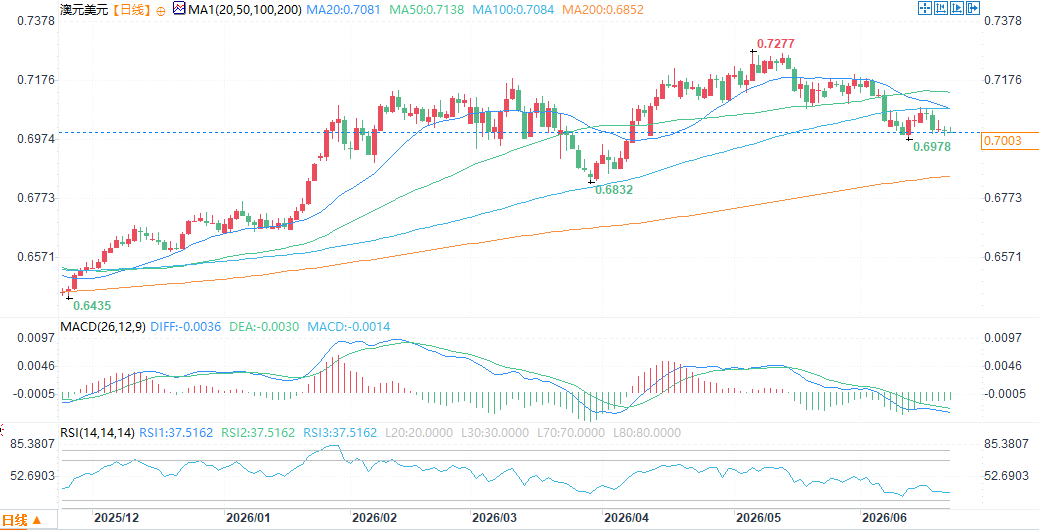
(AUD/USD daily chart, source: FX678)
At 14:57 Beijing time on June 22, the Australian dollar was trading at 0.7004/05 against the US dollar.
Investors continue to assess the latest developments in the US-Iran peace agreement – despite some positive progress in the negotiations, Trump’s military threats have cast doubt on the prospects of the agreement, putting downward pressure on the risk-sensitive Australian dollar.
Meanwhile, the hawkish signals released by the Reserve Bank of Australia last week provided some support for the Australian dollar.
Geopolitical Risks: The US-Iran Peace Agreement: A Mixture of Good and Bad News
The US-Iran talks were held last Sunday (June 21) in Burgenstock, Switzerland, with delegations from Iran, the United States, Qatar and Pakistan participating.
On Monday, mediators Qatar and Pakistan issued a joint statement confirming that the talks were being conducted in a "positive and constructive" atmosphere. According to Iran's Tasnim News Agency, citing a spokesperson for the Iranian Foreign Ministry, the parties have "successfully arranged a formal transit mechanism to ensure the safe passage of commercial vessels through the Strait of Hormuz, a vital waterway."
However, market optimism was quickly dampened by Trump's remarks over the weekend. Trump explicitly threatened a US military strike against Iran if Hezbollah continued its attacks on Israel. This statement cast a shadow of uncertainty over the prospects of a US-Iran peace agreement, dampened market risk appetite, and prompted investors to turn to safe-haven assets, putting pressure on the risk-sensitive Australian dollar. The "peace talks on one hand, threats on the other" dynamic in the Middle East makes it difficult for the Australian dollar to receive a sustained boost.
Monetary Policy: The Reserve Bank of Australia (RBA) held rates steady, providing a floor for the Australian dollar.
In contrast to the pressure from geopolitical risks on the Australian dollar, the hawkish signals released by the Reserve Bank of Australia last week are providing a floor for the Australian dollar.
At its June monetary policy meeting, the Reserve Bank of Australia decided to keep the official cash rate (OCR) unchanged at 4.35%. This follows three consecutive rate hikes of 25 basis points earlier this year; this decision to hold rates steady is a pause rather than an end.
More importantly, the council members made it clear that further interest rate hikes may still be necessary to achieve policy objectives. This hawkish stance contrasts sharply with the policy paths of other major central banks—thus maintaining market confidence in the Australian dollar's interest rate advantage and limiting its downside potential to some extent.
Market Sentiment: Risk Appetite Dominates Short-Term Volatility
In the short term, the Australian dollar's performance is highly dependent on changes in global risk appetite. As a typical commodity and risk currency, the Australian dollar is extremely sensitive to geopolitical situations and market risk aversion—it is often sought after when risk appetite rises and easily sold off when risk aversion intensifies.
Currently, positive and negative factors are intertwined, creating a stark contrast. Supporting the Australian dollar include: the Reserve Bank of Australia's hawkish stance—keeping interest rates unchanged last week but clearly hinting at potential further rate hikes; the potential for optimism stemming from the finalization of the US-Iran negotiation framework; and the relatively high levels of commodity prices, providing fundamental support for commodity currencies.
However, the forces suppressing the Australian dollar cannot be ignored. Trump's military threats have cast a shadow over the prospects of a US-Iran peace agreement, and geopolitical uncertainty continues to escalate; global risk aversion is high, with funds flowing into safe-haven assets such as the US dollar; and the US dollar is simultaneously supported by expectations of a Fed rate hike and safe-haven demand, further putting downward pressure on the Australian dollar.
Until the situation between the US and Iran becomes clearer, the Australian dollar will likely remain in a weak, volatile pattern around the 0.7000 level. The tug-of-war between bulls and bears at this level will continue, and any upward correction is likely to face renewed pressure from geopolitical risks rather than the start of a trend reversal.
Institutional Views
Morgan Stanley maintains its bullish stance on the Australian dollar against the US dollar, viewing it as one of the top-performing high-yield/commodity currencies in a weak dollar environment. The firm expects the US dollar to continue its moderate weakening in the first half of 2026 (the DXY could fall to around 94), providing significant support for the Australian dollar against the US dollar. Earlier forecasts indicated that AUD/USD could rise to 0.70 (an increase of approximately 8% from that level).
Analysts emphasize that Australia's domestic fundamentals are solid: the RBA's relatively hawkish policy, the recovery in Chinese demand driving commodity exports (such as iron ore), and the resilience of the Australian economy support the Australian dollar as a "clean expression of the US dollar bear market."
Despite the risks of a shift in Federal Reserve policy or a slowdown in the Chinese economy in the medium term, Morgan Stanley believes the Australian dollar still has room to appreciate against the US dollar in the first half of 2026, potentially testing the 0.72-0.75 range, with subsequent adjustments depending on global risk sentiment and policy divergence.
Short-term risks include geopolitical tensions driving demand for the safe-haven US dollar or a correction in commodity prices, but the medium- to long-term logic remains solid: policy divergence, a recovery in risk appetite, and attractive valuations. Institutions recommend increasing allocations to the Australian dollar during pullbacks, viewing it as a top choice for foreign exchange allocation in 2026. The overall outlook is optimistic; the Australian dollar is considered one of the top performers in the US dollar bear market and is expected to show a structural appreciation trend throughout the year.
UBS points out that the RBA's hawkish stance (maintaining a high cash rate) and the Federal Reserve's potential for easing have created a policy divergence, supporting the appreciation of the Australian dollar. Meanwhile, China's stable economy and commodity exports provide fundamental support.
Despite short-term pressure from intermittent rebounds in the US dollar, UBS believes the Australian dollar will gradually strengthen against the US dollar, benefiting from global risk appetite and investor reallocation.
Risks include escalating geopolitical tensions, unexpected tightening by the Federal Reserve, or weaker-than-expected Chinese demand, but in the long term, the Australian dollar's role as a diversified asset is strengthened. UBS recommends that investors review their US dollar exposure and increase their AUD allocation as a hedge.
Overall, institutions are cautiously optimistic, expecting the Australian dollar to test the 0.72-0.75 range against the US dollar in 2026, depending on the evolution of macroeconomic data and the central bank's policy path.
Technical Analysis
According to the daily chart, the Australian dollar against the US dollar previously rose to a high of 0.7277 before falling back. Currently, the price is trading around 0.7000, testing the key support level of 0.6978. The moving average system is showing bearish signals, with the short-term MA20 (0.7081) and MA50 (0.7138) lines simultaneously suppressing the price. The price has stabilized below these short-term moving averages, with only the medium- and long-term MA100 and MA200 still trending upwards. Therefore, the medium- and long-term upward trend has not been completely broken, and a short-term pullback is clearly evident.
Both indicators are weakening. The MACD indicator's DIFF line has slightly crossed below the DEA line, and the histogram remains below the zero axis, indicating that bearish momentum continues to be released. The RSI value is 37.51, which is below the 50 midline and has not yet entered the oversold zone, suggesting that there is still room for the downward momentum to continue.
The key support level at 0.6978 is the previous consolidation zone. A decisive break below this level would target the previous low of 0.6832. The first resistance level is the 20-day moving average (MA20) at 0.7081, followed by the 0.7176 range. Short-term moving average resistance combined with bearish indicators suggests a weak and volatile market. Holding above 0.6978 could lead to a slight rebound, but a rebound to the vicinity of the short-term moving average is likely to encounter resistance. Therefore, a short-selling strategy is recommended, with close monitoring of the 0.6978 support level.
(AUD/USD daily chart, source: FX678)
At 14:57 Beijing time on June 22, the Australian dollar was trading at 0.7004/05 against the US dollar.
- Risk Warning and Disclaimer
- The market involves risk, and trading may not be suitable for all investors. This article is for reference only and does not constitute personal investment advice, nor does it take into account certain users’ specific investment objectives, financial situation, or other needs. Any investment decisions made based on this information are at your own risk.