US-Iran-Switzerland peace talks conclude! Warmth returns to the Straits, gold prices rebound and rise above $4200.
2026-06-22 15:13:12
On Monday (June 22), during the Asian and European sessions, spot gold rebounded after a slight dip. The risk of a delay in the weekend's US-Iran-Switzerland talks was eliminated, and the two sides completed their first round of high-level talks in Switzerland on Monday. Influenced by optimistic sentiment surrounding the talks, spot gold traded around 4202, up 1.11%, although it had fallen as much as -0.5% during the session.
The first round of high-level talks between the United States and Iran concluded successfully at the Biergenstock resort on the shores of Lake Lucerne in Switzerland, with the two sides completing consultations against a backdrop of friction at the outset.
With the joint mediation of Qatar and Pakistan, the US and Iran have established a multi-level negotiation mechanism, outlining a clear path for finalizing a comprehensive and permanent ceasefire agreement within the next 60 days.
The US delegation to the negotiations was led by Vice President Vance, Special Envoy Vitkov, and President Trump's son-in-law Kushner, while the Iranian delegation was led by Parliament Speaker Ghalibaf and Foreign Minister Araqchi. The first day of negotiations stalled due to US President Trump's strong threatening remarks, and the Iranian delegation walked out in protest, which once made the market worry that the negotiation process would completely break down.
Previously, Trump not only publicly warned the Iranian president against insisting on the right to enrich uranium and threatened to take strong military action, but also pressured Iran on social media to immediately restrain the proxy armed forces in Lebanon. These conflicting statements made the already fragile bilateral dialogue more uncertain. The announcement of the completion of the peace talks the next day was an unexpected development.

Despite the frequent controversies, the mediating parties, Qatar and Pakistan, issued a joint statement confirming that the talks made substantial progress in a positive and constructive tone, and consensus was successfully reached on several implementation mechanisms.
Both sides agreed to establish a high-level political committee, with the chief negotiators of each country reporting on the progress of the consultations regularly. The committee will coordinate the advancement of all issues and monitor the implementation of the final version of the agreement within 60 days.
A de-escalation task force will be established concurrently, with the participation of the US, Iran, Lebanon, and mediators. The core objective is to completely curb the armed conflict between Israel and Hezbollah in Lebanon and implement a regional ceasefire agreement.
Regarding the safety of navigation in the Strait of Hormuz, a vital global energy artery, the US and Iran reached a key consensus to establish a dedicated communication hotline and a vessel passage guarantee mechanism to avoid misjudgments of the waterway and emergencies, thereby reducing the risk of strait blockade from an institutional perspective.
A spokesperson for the Iranian Foreign Ministry confirmed that the mediators will compile the core consensus reached during the 18-hour talks into a formal document, and that the two sides have laid the groundwork for negotiations on a final agreement. The round of consultations in Switzerland has yielded significant results in fulfilling each other's commitments.
In addition, the negotiation agenda covers thorny issues such as Iran's nuclear program, uranium enrichment rights, the unfreezing of overseas frozen assets, the lifting of the ban on oil and petrochemical exports, and Iran's reconstruction and development plan. Iran has clearly listed the handling of the Lebanese war as a priority in the negotiations, while Israel and Hezbollah did not participate in the signing of the interim agreement between the US and Iran, and the implementation of the subsequent ceasefire remains uncertain.
With continued signals of easing tensions on both sides, the Persian Gulf crude oil export and shipping market has seen a significant recovery.
Data from tanker tracking agency TankerTrackers shows that since the signing of the interim peace agreement on June 15, 2026, Iran's crude oil exports have reached 36 million barrels, and its floating crude oil inventory at sea has remained at a similar level.
Following the lifting of the blockade on Iranian ports by the United States, the crude oil terminal on Hargh Island has resumed loading operations after a six-week hiatus. Currently, three very large crude carriers (VLCCs) are docked at the terminal awaiting loading. Previously, Iran had already transported 20 million barrels of crude oil out of the port of Chabahar via transshipment tankers, and a large number of empty tankers continue to enter the Persian Gulf to replenish shipping capacity.
Shipping data shows that the supertanker Desh Vibhor, which had previously planned to bypass the southern route recommended by the US military, has changed its course and is now taking a route closer to the northern coast of Iran to return to the Strait of Hormuz, reflecting a rebound in market confidence in the stability of navigation in the strait.
However, Iran has maintained its bottom line of control, reiterating that all ships must obtain Iranian permission to pass through, and the complete freedom of navigation has not yet been fully realized.
As arranged by both sides, the US and Iran will continue technical details negotiations in Switzerland for the remainder of this week, refining the terms one by one on issues such as nuclear issues, asset unfreezing, shipping regulation, and the details of the ceasefire in Lebanon.
The obstruction of navigation in the Strait of Hormuz and the restriction of Iranian crude oil exports will push up international oil prices, exacerbate global inflationary pressures, force the Federal Reserve to maintain a hawkish monetary policy, and continue to suppress the valuation of non-interest-bearing gold due to high real interest rates.
With substantial progress in US-Iran negotiations and the smooth flow of oil transportation, the geopolitical risk premium for crude oil has declined, and upward pressure on inflation has eased. The market will pre-trade in expectations of marginal easing by the Federal Reserve, and the decline in real interest rates will actually open up room for gold prices to rise.
In the short term, Trump's continued confrontational rhetoric and the protracted negotiation process will cause gold prices to fluctuate widely, with safe-haven demand providing temporary support for gold prices.
In the medium to long term, if the US and Iran successfully reach a complete agreement within the 60-day window, shipping in the Strait of Hormuz will become normalized, and Iranian crude oil supply will continue to increase. The decline in the central level of oil prices will alleviate the global inflation burden. Coupled with the structural support of continued gold purchases by global central banks, gold will usher in a sustained valuation recovery.
Traders need to continue to track three key signals: the progress of Swiss technical negotiations, tanker traffic data in the Strait of Hormuz, and the pace of Iranian crude oil exports. These signals will help them judge the speed at which the Middle East geopolitical risk premium dissipates and accurately grasp the key turning points in the shift between bullish and bearish trends in gold.
Technical Analysis: Despite the unexpected outcome of the US-Iran-Switzerland negotiations, gold prices remained restrained and are still in a downtrend. This trend has significantly limited any rebound in prices. Currently, the resistance level is near the lower trendline of the descending channel and the 5-day moving average, while support is around 4140.
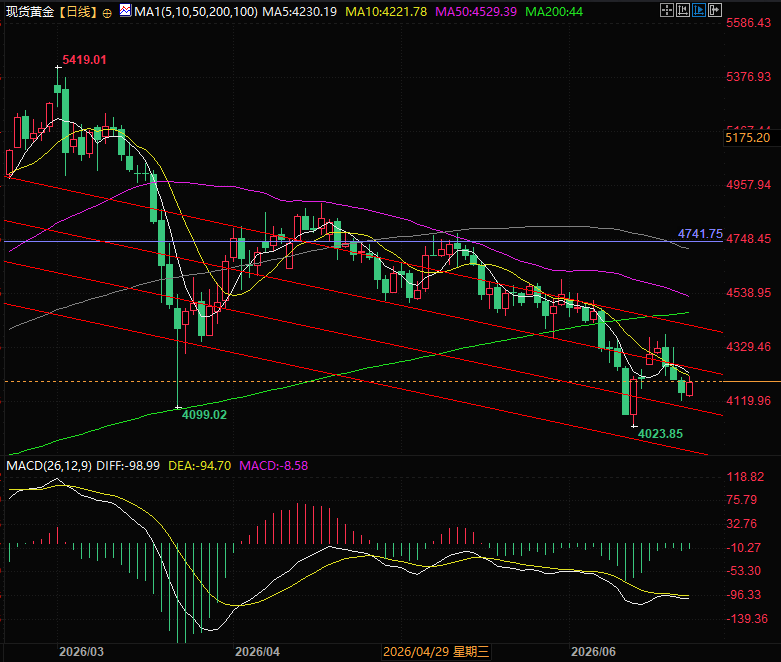
(Spot gold daily chart, source: FX678)
At 15:07 Beijing time, spot gold was trading at $4,200 per ounce.
The first round of high-level talks between the United States and Iran concluded successfully at the Biergenstock resort on the shores of Lake Lucerne in Switzerland, with the two sides completing consultations against a backdrop of friction at the outset.
With the joint mediation of Qatar and Pakistan, the US and Iran have established a multi-level negotiation mechanism, outlining a clear path for finalizing a comprehensive and permanent ceasefire agreement within the next 60 days.
The US delegation to the negotiations was led by Vice President Vance, Special Envoy Vitkov, and President Trump's son-in-law Kushner, while the Iranian delegation was led by Parliament Speaker Ghalibaf and Foreign Minister Araqchi. The first day of negotiations stalled due to US President Trump's strong threatening remarks, and the Iranian delegation walked out in protest, which once made the market worry that the negotiation process would completely break down.
Previously, Trump not only publicly warned the Iranian president against insisting on the right to enrich uranium and threatened to take strong military action, but also pressured Iran on social media to immediately restrain the proxy armed forces in Lebanon. These conflicting statements made the already fragile bilateral dialogue more uncertain. The announcement of the completion of the peace talks the next day was an unexpected development.
The talks exceeded expectations, with multiple mechanisms showing positive results and key consensus reached on core issues.
Despite the frequent controversies, the mediating parties, Qatar and Pakistan, issued a joint statement confirming that the talks made substantial progress in a positive and constructive tone, and consensus was successfully reached on several implementation mechanisms.
Both sides agreed to establish a high-level political committee, with the chief negotiators of each country reporting on the progress of the consultations regularly. The committee will coordinate the advancement of all issues and monitor the implementation of the final version of the agreement within 60 days.
A de-escalation task force will be established concurrently, with the participation of the US, Iran, Lebanon, and mediators. The core objective is to completely curb the armed conflict between Israel and Hezbollah in Lebanon and implement a regional ceasefire agreement.
Regarding the safety of navigation in the Strait of Hormuz, a vital global energy artery, the US and Iran reached a key consensus to establish a dedicated communication hotline and a vessel passage guarantee mechanism to avoid misjudgments of the waterway and emergencies, thereby reducing the risk of strait blockade from an institutional perspective.
A spokesperson for the Iranian Foreign Ministry confirmed that the mediators will compile the core consensus reached during the 18-hour talks into a formal document, and that the two sides have laid the groundwork for negotiations on a final agreement. The round of consultations in Switzerland has yielded significant results in fulfilling each other's commitments.
In addition, the negotiation agenda covers thorny issues such as Iran's nuclear program, uranium enrichment rights, the unfreezing of overseas frozen assets, the lifting of the ban on oil and petrochemical exports, and Iran's reconstruction and development plan. Iran has clearly listed the handling of the Lebanese war as a priority in the negotiations, while Israel and Hezbollah did not participate in the signing of the interim agreement between the US and Iran, and the implementation of the subsequent ceasefire remains uncertain.
The oil shipping market is showing strong signs of recovery, and navigation in the Strait of Hormuz is gradually picking up.
With continued signals of easing tensions on both sides, the Persian Gulf crude oil export and shipping market has seen a significant recovery.
Data from tanker tracking agency TankerTrackers shows that since the signing of the interim peace agreement on June 15, 2026, Iran's crude oil exports have reached 36 million barrels, and its floating crude oil inventory at sea has remained at a similar level.
Following the lifting of the blockade on Iranian ports by the United States, the crude oil terminal on Hargh Island has resumed loading operations after a six-week hiatus. Currently, three very large crude carriers (VLCCs) are docked at the terminal awaiting loading. Previously, Iran had already transported 20 million barrels of crude oil out of the port of Chabahar via transshipment tankers, and a large number of empty tankers continue to enter the Persian Gulf to replenish shipping capacity.
Shipping data shows that the supertanker Desh Vibhor, which had previously planned to bypass the southern route recommended by the US military, has changed its course and is now taking a route closer to the northern coast of Iran to return to the Strait of Hormuz, reflecting a rebound in market confidence in the stability of navigation in the strait.
However, Iran has maintained its bottom line of control, reiterating that all ships must obtain Iranian permission to pass through, and the complete freedom of navigation has not yet been fully realized.
As arranged by both sides, the US and Iran will continue technical details negotiations in Switzerland for the remainder of this week, refining the terms one by one on issues such as nuclear issues, asset unfreezing, shipping regulation, and the details of the ceasefire in Lebanon.
Geopolitical shifts are reshaping pricing logic, and gold prices are tied to the progress of negotiations.
The obstruction of navigation in the Strait of Hormuz and the restriction of Iranian crude oil exports will push up international oil prices, exacerbate global inflationary pressures, force the Federal Reserve to maintain a hawkish monetary policy, and continue to suppress the valuation of non-interest-bearing gold due to high real interest rates.
With substantial progress in US-Iran negotiations and the smooth flow of oil transportation, the geopolitical risk premium for crude oil has declined, and upward pressure on inflation has eased. The market will pre-trade in expectations of marginal easing by the Federal Reserve, and the decline in real interest rates will actually open up room for gold prices to rise.
In the short term, Trump's continued confrontational rhetoric and the protracted negotiation process will cause gold prices to fluctuate widely, with safe-haven demand providing temporary support for gold prices.
In the medium to long term, if the US and Iran successfully reach a complete agreement within the 60-day window, shipping in the Strait of Hormuz will become normalized, and Iranian crude oil supply will continue to increase. The decline in the central level of oil prices will alleviate the global inflation burden. Coupled with the structural support of continued gold purchases by global central banks, gold will usher in a sustained valuation recovery.
Traders need to continue to track three key signals: the progress of Swiss technical negotiations, tanker traffic data in the Strait of Hormuz, and the pace of Iranian crude oil exports. These signals will help them judge the speed at which the Middle East geopolitical risk premium dissipates and accurately grasp the key turning points in the shift between bullish and bearish trends in gold.
Technical Analysis: Despite the unexpected outcome of the US-Iran-Switzerland negotiations, gold prices remained restrained and are still in a downtrend. This trend has significantly limited any rebound in prices. Currently, the resistance level is near the lower trendline of the descending channel and the 5-day moving average, while support is around 4140.
(Spot gold daily chart, source: FX678)
At 15:07 Beijing time, spot gold was trading at $4,200 per ounce.
- Risk Warning and Disclaimer
- The market involves risk, and trading may not be suitable for all investors. This article is for reference only and does not constitute personal investment advice, nor does it take into account certain users’ specific investment objectives, financial situation, or other needs. Any investment decisions made based on this information are at your own risk.