Falling oil prices eased inflation concerns, supporting a rebound in gold prices; a strong dollar limited gold's upside potential.
2026-06-22 16:34:06
International gold prices rebounded slightly on Monday, with spot gold (XAU/USD) holding steady around $4,200, temporarily shaking off last week's continuous decline. Gold prices had previously fallen to a more than one-week low, but received some technical buying support as market risk sentiment improved.

The main reason supporting the rebound in gold prices came from the decline in international oil prices. Qatar and Pakistan, acting as mediators, announced that the United States and Iran had agreed to launch a 60-day formal roadmap, aiming to reach a final peace agreement within the next two months. Following the announcement, market concerns about a prolonged blockade of the Strait of Hormuz and disruptions to global energy supplies eased somewhat.
The pullback in oil prices cooled investor expectations of future inflationary pressures and eased market concerns about further significant tightening of policies by major central banks, providing some support for gold. The decline in international oil prices eased inflation expectations, becoming a key factor driving the short-term rebound in gold. However, the pressure on the gold market has not been completely eliminated. Last week, the Federal Reserve kept interest rates unchanged, but its overall policy statement was clearly hawkish. The latest interest rate forecasts show that many policymakers expect further rate hikes this year, and market expectations for the future interest rate path have been significantly revised upwards.
The market currently still expects a near 90% probability of a Federal Reserve rate hike before the end of the year. Meanwhile, in his post-meeting remarks, Federal Reserve Chairman Kevin Warsh emphasized the importance of controlling inflation and stated that even if economic growth slows, there will be no rush to initiate a rate-cutting cycle. Market expectations for the Fed to maintain its high-interest-rate policy continue to rise, exerting medium- to long-term downward pressure on gold.
Furthermore, significant uncertainty remains regarding the situation in the Middle East. Iran has accused the United States and Israel of violating the ceasefire agreement and announced the re-closure of the Strait of Hormuz. Meanwhile, US President Trump warned that the US might take new military action if the situation in Lebanon escalates further. While geopolitical risks favor safe-haven demand for gold, they also drive funds towards dollar-denominated assets. As the world's primary safe-haven currency, the US dollar index remains strong, supported by both safe-haven buying and expectations of high interest rates, thus diminishing the appeal of gold.
Meanwhile, renewed tensions between Russia and Ukraine have further increased market demand for the US dollar. The US dollar index remains high, becoming a significant factor limiting gold's rebound. Overall, gold is currently benefiting from both the decline in oil prices and the strength of the US dollar. The market has entered a short-term consolidation phase, but the dominant direction still depends on expectations regarding Federal Reserve policy and changes in the geopolitical situation.
Investors will continue to monitor the progress of US-Iran negotiations, speeches by Federal Reserve officials, and the movement of the US dollar index. If the dollar remains strong, the upside potential for gold may be limited; conversely, if safe-haven demand intensifies further, it could provide new support for gold prices.
From a daily chart perspective, gold remains in a phase of correction. Previous attempts to break through the 200-day moving average failed, and prices retreated again near key resistance levels, indicating continued significant selling pressure. Currently, the 200-day moving average is around $4335, an area that has transformed from previous support into significant resistance. Until the price re-establishes itself above this level, any rebounds should be viewed as technical corrections within the correction process. Momentum indicators suggest that while bearish momentum has weakened, there are no signs of a trend reversal. Support levels to watch are $4180 and $4120; a break below these levels could lead to a retest of the $4050 lows.
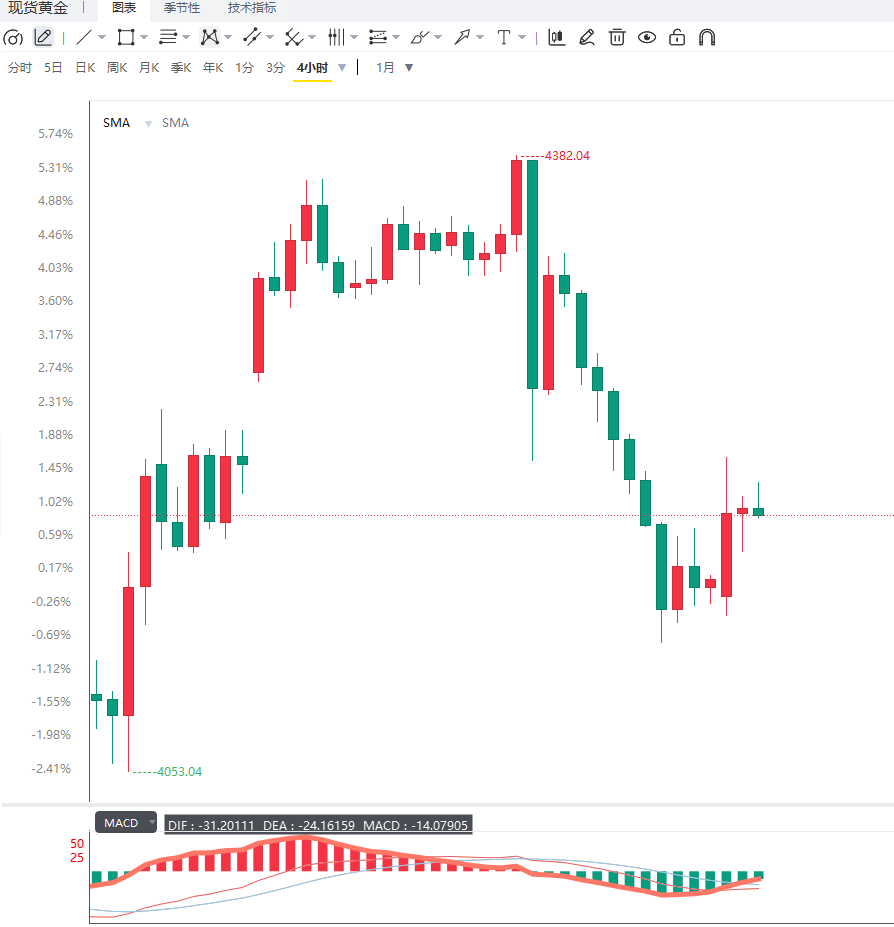
From a 4-hour chart perspective, gold has entered a low-level rebound phase after a continuous decline, but the rebound strength is relatively limited. Although the price has returned above $4200, it has not yet broken through the key resistance area, and market willingness to chase higher prices remains insufficient. Short-term momentum indicators have improved somewhat, but the overall trend remains bearish. If it fails to effectively break through the $4250-$4335 area, there is still a risk of another pullback after the rebound ends. Overall, the current situation is more likely a technical correction within a downtrend, and caution is still needed regarding potential resistance at higher levels after a short-term rebound.
Editor's Summary : The recent rebound in gold prices has been primarily driven by falling oil prices and cooling inflation expectations, but the core trading logic remains focused on the Federal Reserve's policy outlook. With the Fed maintaining a hawkish stance and the dollar remaining strong, gold faces significant upward pressure. Meanwhile, the ongoing Middle East situation and the Russia-Ukraine conflict are causing safe-haven funds to flow more towards the dollar than gold. Technically, gold prices have not yet broken out of their consolidation pattern; before breaking through key resistance levels, the rebound is more of a corrective move. Short-term market volatility may intensify, but the overall trend remains one of high-level consolidation with a slight downward bias.
The main reason supporting the rebound in gold prices came from the decline in international oil prices. Qatar and Pakistan, acting as mediators, announced that the United States and Iran had agreed to launch a 60-day formal roadmap, aiming to reach a final peace agreement within the next two months. Following the announcement, market concerns about a prolonged blockade of the Strait of Hormuz and disruptions to global energy supplies eased somewhat.
The pullback in oil prices cooled investor expectations of future inflationary pressures and eased market concerns about further significant tightening of policies by major central banks, providing some support for gold. The decline in international oil prices eased inflation expectations, becoming a key factor driving the short-term rebound in gold. However, the pressure on the gold market has not been completely eliminated. Last week, the Federal Reserve kept interest rates unchanged, but its overall policy statement was clearly hawkish. The latest interest rate forecasts show that many policymakers expect further rate hikes this year, and market expectations for the future interest rate path have been significantly revised upwards.
The market currently still expects a near 90% probability of a Federal Reserve rate hike before the end of the year. Meanwhile, in his post-meeting remarks, Federal Reserve Chairman Kevin Warsh emphasized the importance of controlling inflation and stated that even if economic growth slows, there will be no rush to initiate a rate-cutting cycle. Market expectations for the Fed to maintain its high-interest-rate policy continue to rise, exerting medium- to long-term downward pressure on gold.
Furthermore, significant uncertainty remains regarding the situation in the Middle East. Iran has accused the United States and Israel of violating the ceasefire agreement and announced the re-closure of the Strait of Hormuz. Meanwhile, US President Trump warned that the US might take new military action if the situation in Lebanon escalates further. While geopolitical risks favor safe-haven demand for gold, they also drive funds towards dollar-denominated assets. As the world's primary safe-haven currency, the US dollar index remains strong, supported by both safe-haven buying and expectations of high interest rates, thus diminishing the appeal of gold.
Meanwhile, renewed tensions between Russia and Ukraine have further increased market demand for the US dollar. The US dollar index remains high, becoming a significant factor limiting gold's rebound. Overall, gold is currently benefiting from both the decline in oil prices and the strength of the US dollar. The market has entered a short-term consolidation phase, but the dominant direction still depends on expectations regarding Federal Reserve policy and changes in the geopolitical situation.
Investors will continue to monitor the progress of US-Iran negotiations, speeches by Federal Reserve officials, and the movement of the US dollar index. If the dollar remains strong, the upside potential for gold may be limited; conversely, if safe-haven demand intensifies further, it could provide new support for gold prices.
From a daily chart perspective, gold remains in a phase of correction. Previous attempts to break through the 200-day moving average failed, and prices retreated again near key resistance levels, indicating continued significant selling pressure. Currently, the 200-day moving average is around $4335, an area that has transformed from previous support into significant resistance. Until the price re-establishes itself above this level, any rebounds should be viewed as technical corrections within the correction process. Momentum indicators suggest that while bearish momentum has weakened, there are no signs of a trend reversal. Support levels to watch are $4180 and $4120; a break below these levels could lead to a retest of the $4050 lows.
From a 4-hour chart perspective, gold has entered a low-level rebound phase after a continuous decline, but the rebound strength is relatively limited. Although the price has returned above $4200, it has not yet broken through the key resistance area, and market willingness to chase higher prices remains insufficient. Short-term momentum indicators have improved somewhat, but the overall trend remains bearish. If it fails to effectively break through the $4250-$4335 area, there is still a risk of another pullback after the rebound ends. Overall, the current situation is more likely a technical correction within a downtrend, and caution is still needed regarding potential resistance at higher levels after a short-term rebound.
Editor's Summary : The recent rebound in gold prices has been primarily driven by falling oil prices and cooling inflation expectations, but the core trading logic remains focused on the Federal Reserve's policy outlook. With the Fed maintaining a hawkish stance and the dollar remaining strong, gold faces significant upward pressure. Meanwhile, the ongoing Middle East situation and the Russia-Ukraine conflict are causing safe-haven funds to flow more towards the dollar than gold. Technically, gold prices have not yet broken out of their consolidation pattern; before breaking through key resistance levels, the rebound is more of a corrective move. Short-term market volatility may intensify, but the overall trend remains one of high-level consolidation with a slight downward bias.
- Risk Warning and Disclaimer
- The market involves risk, and trading may not be suitable for all investors. This article is for reference only and does not constitute personal investment advice, nor does it take into account certain users’ specific investment objectives, financial situation, or other needs. Any investment decisions made based on this information are at your own risk.