Gold rose for the first time in four days! It's hovering below $4200; is it a good time to buy?
2026-06-22 16:39:42
On Monday (June 22) during the European session, spot gold partially gave back its strong gains for the day, trading below $4,200, but still maintained its first increase in four trading days.
Previously, the mediators Qatar and Pakistan announced the launch of a 60-day roadmap for a final peace agreement between the US and Iran, putting downward pressure on oil prices and easing market concerns about rising inflation and interest rates, providing some support for gold. However, gold prices are still not far from the more than one-week low hit last Friday.
Despite gold recording its first gain in four days, market expectations of further interest rate hikes by the Federal Reserve continue to weigh on upward momentum. Federal funds futures markets show traders pricing in a near 90% probability of another Fed rate hike before the end of the year. This expectation was further reinforced after the Fed released hawkish forecasts last week—policymakers made it clear that if inflation remains high, policy rates will need to be raised this year.
In his post-meeting press conference, newly appointed Federal Reserve Chairman Warsh emphasized the "price stability" goal, suggesting that the Fed would not rush to cut interest rates even if economic growth slowed. This hawkish stance provided sustained support for the dollar, becoming a key factor limiting gold's gains.
Meanwhile, weekend geopolitical developments provided another boost to the US dollar. Iran accused the US and Israel of violating the ceasefire agreement and announced the re-closure of the Strait of Hormuz due to continued Israeli airstrikes on Lebanon. US President Trump subsequently threatened new military action against Iran if Hezbollah continued its attacks on Israel. This series of events highlighted the fragility of diplomatic processes, perpetuating geopolitical risk premiums and driving safe-haven flows to the US dollar, putting downward pressure on gold.
Furthermore, the Russia-Ukraine situation has further boosted the safe-haven demand for the US dollar, helping the dollar index halt its pullback from its highest point since May 2025 last Friday, limiting the upside potential for gold.
The current global geopolitical landscape presents a situation of "dual conflict," which has a complex impact on the safe-haven logic of gold:
In the Middle East, the launch of the 60-day peace roadmap between the US and Iran should have eased market anxiety, but Trump's military threats and Iran's announcement of closing the Strait of Hormuz have cast a shadow over the prospects for a ceasefire. Market concerns about the escalating situation in Lebanon and the safety of navigation through the strait continue to support demand for safe-haven assets, but funds are flowing more towards the US dollar than gold—as the dollar enjoys the dual support of expectations of interest rate hikes and safe-haven demand.
The Russia-Ukraine conflict adds another layer of uncertainty to global geopolitical risks. The coexistence of these two major geopolitical hotspots makes it difficult for global risk appetite to recover sustainably, and the logic of risk aversion will continue to play a role in the foreseeable future.
Goldman Sachs maintains its year-end 2026 gold price target of $5,400/oz, having previously raised it to that level at the beginning of the year and not lowering it even after a significant pullback (over 10%) in gold prices in March, demonstrating strong confidence in a structural bull market.
Analysts believe that central bank purchases remain a key support, with monthly purchases expected to average around 60-70 tons in 2026 (significantly higher than pre-pandemic levels), contributing significantly to price increases. While ETF and private sector demand has declined in the short term due to high interest rates and the US dollar, the risks are skewed to the upside, especially if geopolitical conflicts or economic slowdowns escalate. The current gold price range of $4150-$4200 is considered a healthy consolidation, not the start of a bear market.
Goldman Sachs points out that gold prices have retreated from their early 2026 highs, but fundamentals such as tight supply and multilateral demand support further gains. Short-term risks include a more hawkish Federal Reserve policy pushing up real yields, but in the medium to long term, gold's role as a safe-haven and diversifying asset will strengthen. Institutions generally maintain a bullish bias, recommending buying on dips, with target prices implying a potential upside of approximately 25-30% from current levels.
UBS has lowered some of its 2026 targets: the mid-year target has been reduced to around $5,200 per ounce, and the year-end target has been lowered from $5,900 to around $5,500, mainly due to a stronger dollar, high real yields, and weak demand from short-term investors.
Nevertheless, UBS Group still views gold as an attractive diversification asset, expecting demand to recover in the second half of the year, supported by central bank purchases and demand from Asian entities. While earlier, more aggressive forecasts (mid-year $6,200, upside scenario $7,200) have been revised, the long-term bullish logic remains unchanged: geopolitical risks, the possibility of stagflation, and global reserve diversification will continue to benefit gold prices.
Spot gold is currently trading around $4150-$4200. UBS believes this is a market correction period of "rediscovering opportunity costs," but it will not change the bullish trend. Downside risks include a prolonged period of high interest rates by the Federal Reserve, while upside catalysts include geopolitical escalation or weakening economic data. The institution advises investors to view gold as a long-term hedging tool and maintain a moderate allocation. The overall outlook is cautiously optimistic, emphasizing the opportunity to capitalize on structural opportunities amidst volatility.
According to the daily chart, spot gold has been declining from its recent high of $5596.33, and is currently trading around $4200. The previous low of $4023.85 has formed short-term support. The short-term 20-day and 50-day moving averages are both above the price, forming strong resistance, and the price has been trading below these short-term moving averages for an extended period. Only the 200-day moving average (MA200) is still trending upwards, indicating that the long-term uptrend has not yet fully reversed, but significant short-term downward pressure is present.
The indicators clearly show a bearish signal. The MACD indicator's DIFF line remains below the DEA line, and the green bars remain in the bearish zone, indicating that the downward momentum has not yet fully exhausted. The RSI value is 38.42, below the 50 midline, and has not yet entered the oversold zone, suggesting that there is still room for further decline.
The key support level to watch is the previous low of 4023.85. If this level is breached, the downside potential will be fully unlocked. The first resistance level is the 20-day moving average (MA20) at 4337.44, followed by the 50-day moving average (MA50) at 4529.26. Currently, the moving averages are acting as resistance, and bearish indicators are converging, maintaining an overall weak downward trend. Even if a short-term rebound occurs, it is likely to encounter resistance and fall back near the short-term moving averages. The recommended trading strategy is to focus on short positions, closely monitoring the effectiveness of the 4023.85 key support level.
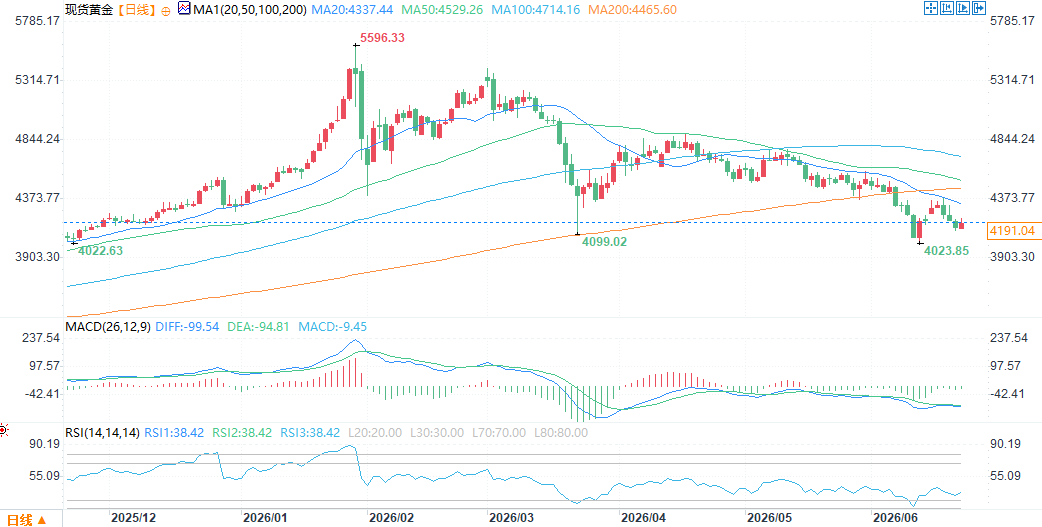
(Spot gold daily chart, source: FX678)
At 16:12 Beijing time on June 22, spot gold was trading at $4190.27 per ounce.
Previously, the mediators Qatar and Pakistan announced the launch of a 60-day roadmap for a final peace agreement between the US and Iran, putting downward pressure on oil prices and easing market concerns about rising inflation and interest rates, providing some support for gold. However, gold prices are still not far from the more than one-week low hit last Friday.
Fundamentals: Interest rate hike expectations and geopolitical risks exert pressure from both sides.
Despite gold recording its first gain in four days, market expectations of further interest rate hikes by the Federal Reserve continue to weigh on upward momentum. Federal funds futures markets show traders pricing in a near 90% probability of another Fed rate hike before the end of the year. This expectation was further reinforced after the Fed released hawkish forecasts last week—policymakers made it clear that if inflation remains high, policy rates will need to be raised this year.
In his post-meeting press conference, newly appointed Federal Reserve Chairman Warsh emphasized the "price stability" goal, suggesting that the Fed would not rush to cut interest rates even if economic growth slowed. This hawkish stance provided sustained support for the dollar, becoming a key factor limiting gold's gains.
Meanwhile, weekend geopolitical developments provided another boost to the US dollar. Iran accused the US and Israel of violating the ceasefire agreement and announced the re-closure of the Strait of Hormuz due to continued Israeli airstrikes on Lebanon. US President Trump subsequently threatened new military action against Iran if Hezbollah continued its attacks on Israel. This series of events highlighted the fragility of diplomatic processes, perpetuating geopolitical risk premiums and driving safe-haven flows to the US dollar, putting downward pressure on gold.
Furthermore, the Russia-Ukraine situation has further boosted the safe-haven demand for the US dollar, helping the dollar index halt its pullback from its highest point since May 2025 last Friday, limiting the upside potential for gold.
Geopolitical risks: Dual conflicts support the hedging logic
The current global geopolitical landscape presents a situation of "dual conflict," which has a complex impact on the safe-haven logic of gold:
In the Middle East, the launch of the 60-day peace roadmap between the US and Iran should have eased market anxiety, but Trump's military threats and Iran's announcement of closing the Strait of Hormuz have cast a shadow over the prospects for a ceasefire. Market concerns about the escalating situation in Lebanon and the safety of navigation through the strait continue to support demand for safe-haven assets, but funds are flowing more towards the US dollar than gold—as the dollar enjoys the dual support of expectations of interest rate hikes and safe-haven demand.
The Russia-Ukraine conflict adds another layer of uncertainty to global geopolitical risks. The coexistence of these two major geopolitical hotspots makes it difficult for global risk appetite to recover sustainably, and the logic of risk aversion will continue to play a role in the foreseeable future.
Institutional Views
Goldman Sachs maintains its year-end 2026 gold price target of $5,400/oz, having previously raised it to that level at the beginning of the year and not lowering it even after a significant pullback (over 10%) in gold prices in March, demonstrating strong confidence in a structural bull market.
Analysts believe that central bank purchases remain a key support, with monthly purchases expected to average around 60-70 tons in 2026 (significantly higher than pre-pandemic levels), contributing significantly to price increases. While ETF and private sector demand has declined in the short term due to high interest rates and the US dollar, the risks are skewed to the upside, especially if geopolitical conflicts or economic slowdowns escalate. The current gold price range of $4150-$4200 is considered a healthy consolidation, not the start of a bear market.
Goldman Sachs points out that gold prices have retreated from their early 2026 highs, but fundamentals such as tight supply and multilateral demand support further gains. Short-term risks include a more hawkish Federal Reserve policy pushing up real yields, but in the medium to long term, gold's role as a safe-haven and diversifying asset will strengthen. Institutions generally maintain a bullish bias, recommending buying on dips, with target prices implying a potential upside of approximately 25-30% from current levels.
UBS has lowered some of its 2026 targets: the mid-year target has been reduced to around $5,200 per ounce, and the year-end target has been lowered from $5,900 to around $5,500, mainly due to a stronger dollar, high real yields, and weak demand from short-term investors.
Nevertheless, UBS Group still views gold as an attractive diversification asset, expecting demand to recover in the second half of the year, supported by central bank purchases and demand from Asian entities. While earlier, more aggressive forecasts (mid-year $6,200, upside scenario $7,200) have been revised, the long-term bullish logic remains unchanged: geopolitical risks, the possibility of stagflation, and global reserve diversification will continue to benefit gold prices.
Spot gold is currently trading around $4150-$4200. UBS believes this is a market correction period of "rediscovering opportunity costs," but it will not change the bullish trend. Downside risks include a prolonged period of high interest rates by the Federal Reserve, while upside catalysts include geopolitical escalation or weakening economic data. The institution advises investors to view gold as a long-term hedging tool and maintain a moderate allocation. The overall outlook is cautiously optimistic, emphasizing the opportunity to capitalize on structural opportunities amidst volatility.
Technical Analysis
According to the daily chart, spot gold has been declining from its recent high of $5596.33, and is currently trading around $4200. The previous low of $4023.85 has formed short-term support. The short-term 20-day and 50-day moving averages are both above the price, forming strong resistance, and the price has been trading below these short-term moving averages for an extended period. Only the 200-day moving average (MA200) is still trending upwards, indicating that the long-term uptrend has not yet fully reversed, but significant short-term downward pressure is present.
The indicators clearly show a bearish signal. The MACD indicator's DIFF line remains below the DEA line, and the green bars remain in the bearish zone, indicating that the downward momentum has not yet fully exhausted. The RSI value is 38.42, below the 50 midline, and has not yet entered the oversold zone, suggesting that there is still room for further decline.
The key support level to watch is the previous low of 4023.85. If this level is breached, the downside potential will be fully unlocked. The first resistance level is the 20-day moving average (MA20) at 4337.44, followed by the 50-day moving average (MA50) at 4529.26. Currently, the moving averages are acting as resistance, and bearish indicators are converging, maintaining an overall weak downward trend. Even if a short-term rebound occurs, it is likely to encounter resistance and fall back near the short-term moving averages. The recommended trading strategy is to focus on short positions, closely monitoring the effectiveness of the 4023.85 key support level.
(Spot gold daily chart, source: FX678)
At 16:12 Beijing time on June 22, spot gold was trading at $4190.27 per ounce.
- Risk Warning and Disclaimer
- The market involves risk, and trading may not be suitable for all investors. This article is for reference only and does not constitute personal investment advice, nor does it take into account certain users’ specific investment objectives, financial situation, or other needs. Any investment decisions made based on this information are at your own risk.