Political uncertainty in the UK weighed on the pound, while the euro remained range-bound against the pound.
2026-06-22 16:31:09
The euro rose against the pound in European trading on Monday, climbing to around 0.8670. Growing concerns about the political situation in the UK weighed on the pound, while the European Central Bank's continued relatively hawkish stance provided support for the euro.

Recent developments in British politics have introduced new uncertainties. Prime Minister Keir Starmer may resign to pave the way for a new leadership. Following his victory in the by-election, Andy Burnham is considered a leading contender for the future Labour Party leadership, and markets are beginning to focus on whether there will be changes in the direction of future British political and fiscal policy.
Investors are particularly focused on the possibility of a future relaxation of fiscal discipline. Market participants believe that if the UK government adopts a more accommodative fiscal spending policy, it could increase public debt pressure and trigger volatility in the UK government bond market, thereby weakening the attractiveness of sterling assets. Political uncertainty in the UK is becoming a significant factor influencing the pound's recent performance.
Meanwhile, the European market remained relatively stable overall. Markets continued to bet that the European Central Bank (ECB) still had room to further tighten monetary policy this year. With inflationary risks from rising energy prices in the Eurozone not yet fully subsided, investors expected the ECB to maintain a cautiously hawkish stance. Market focus was also on ECB President Christine Lagarde's upcoming speech, which investors hoped would provide further clues about the future path of interest rates and the inflation outlook to determine the ECB's subsequent policy direction.
However, the pound is not entirely without support. The latest UK retail sales data significantly exceeded market expectations. The data showed that UK retail sales in May increased by 3.2% year-on-year, far exceeding the previous month's 0.1% and the market expectation of 1.9%; month-on-month growth was 1.2%, also significantly better than the decline in the previous month. Strong UK consumption data indicates that household spending remains resilient, providing some support for the pound.
From an economic perspective, the recovery in retail sales helps alleviate market concerns about a slowdown in the UK economy and may reduce pressure on the Bank of England to shift to an easing policy in the short term. However, against the backdrop of continued escalating political uncertainty, the boost to the pound from strong economic data is relatively limited. The market will also be watching the upcoming Purchasing Managers' Index (PMI) data from Germany, the Eurozone, and the UK. If Eurozone economic activity continues to improve while the UK economy shows signs of slowing, it could further push the euro higher against the pound. Overall, the market is currently seeking a balance between political risk and economic data. In the short term, UK political developments are likely to remain a key factor driving the pound's movement, while the euro benefits from relatively hawkish policy expectations from the European Central Bank.
From a daily chart perspective, the EUR/GBP pair recently broke through the upper edge of its previous trading range and has continued to trade above major moving averages, indicating a gradual shift towards a bullish medium-term trend. The price has stabilized above the key 0.8650 area, suggesting a gradual upward shift in the market's center of gravity. A further break above the psychological level of 0.8700 could open up further upside potential, potentially extending towards the 0.8750 area. On the downside, watch for support at 0.8620 and 0.8580. As long as the price remains above these levels, the medium-term bullish trend is not expected to change significantly.
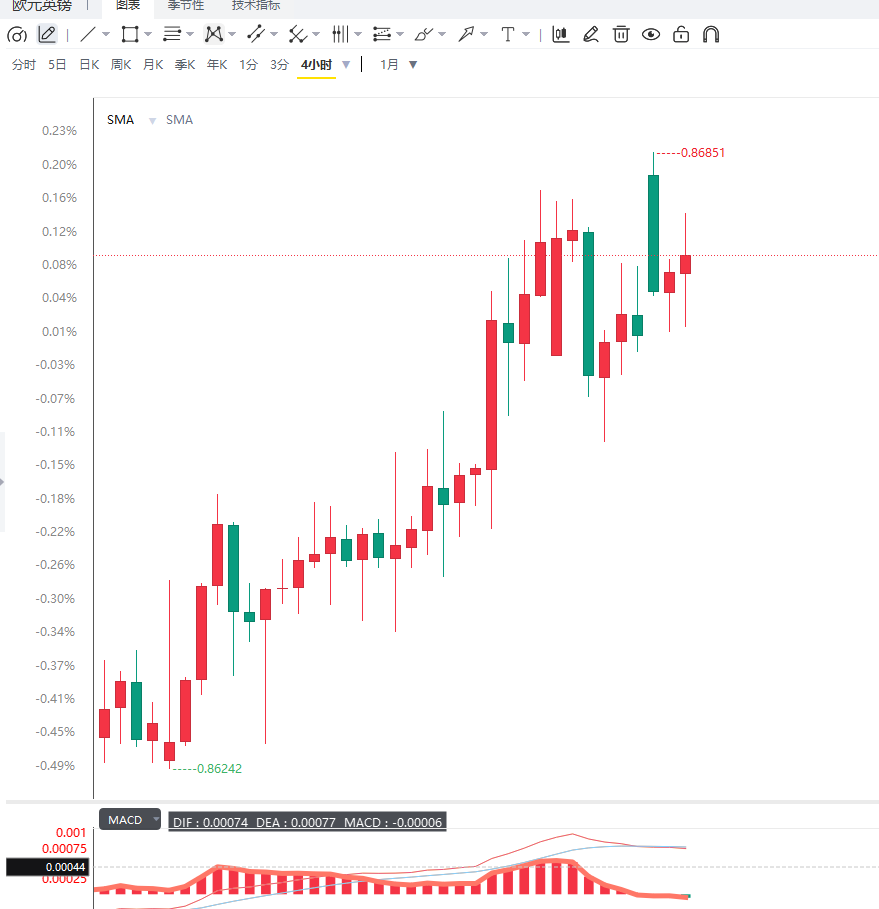
From the 4-hour chart, the exchange rate continues its upward trend with short-term moving averages maintaining a bullish alignment. Although the short-term gains have been rapid, a technical consolidation is possible, but the overall upward momentum remains intact. The area around 0.8650 has now become a key support zone; if it retraces and stabilizes, it may retest the 0.8700 resistance level. Overall, the short-term trend is bullish, and further upward movement is possible after a pullback.
Editor's Summary : The recent rise in the euro against the pound has been primarily driven by political uncertainty in the UK. Market concerns that future changes in fiscal policy could increase the risk of UK assets, thus weakening the pound's appeal. Meanwhile, the European Central Bank's hawkish stance has provided support for the euro. However, better-than-expected UK retail sales data indicates that the economy still possesses some resilience, limiting further weakness in the pound. In the short term, developments in the UK political situation, policy signals from the European Central Bank, and the upcoming PMI data will be key factors influencing the exchange rate. Until political risks significantly ease, the euro/pound exchange rate is expected to maintain a generally strong trend.
Recent developments in British politics have introduced new uncertainties. Prime Minister Keir Starmer may resign to pave the way for a new leadership. Following his victory in the by-election, Andy Burnham is considered a leading contender for the future Labour Party leadership, and markets are beginning to focus on whether there will be changes in the direction of future British political and fiscal policy.
Investors are particularly focused on the possibility of a future relaxation of fiscal discipline. Market participants believe that if the UK government adopts a more accommodative fiscal spending policy, it could increase public debt pressure and trigger volatility in the UK government bond market, thereby weakening the attractiveness of sterling assets. Political uncertainty in the UK is becoming a significant factor influencing the pound's recent performance.
Meanwhile, the European market remained relatively stable overall. Markets continued to bet that the European Central Bank (ECB) still had room to further tighten monetary policy this year. With inflationary risks from rising energy prices in the Eurozone not yet fully subsided, investors expected the ECB to maintain a cautiously hawkish stance. Market focus was also on ECB President Christine Lagarde's upcoming speech, which investors hoped would provide further clues about the future path of interest rates and the inflation outlook to determine the ECB's subsequent policy direction.
However, the pound is not entirely without support. The latest UK retail sales data significantly exceeded market expectations. The data showed that UK retail sales in May increased by 3.2% year-on-year, far exceeding the previous month's 0.1% and the market expectation of 1.9%; month-on-month growth was 1.2%, also significantly better than the decline in the previous month. Strong UK consumption data indicates that household spending remains resilient, providing some support for the pound.
From an economic perspective, the recovery in retail sales helps alleviate market concerns about a slowdown in the UK economy and may reduce pressure on the Bank of England to shift to an easing policy in the short term. However, against the backdrop of continued escalating political uncertainty, the boost to the pound from strong economic data is relatively limited. The market will also be watching the upcoming Purchasing Managers' Index (PMI) data from Germany, the Eurozone, and the UK. If Eurozone economic activity continues to improve while the UK economy shows signs of slowing, it could further push the euro higher against the pound. Overall, the market is currently seeking a balance between political risk and economic data. In the short term, UK political developments are likely to remain a key factor driving the pound's movement, while the euro benefits from relatively hawkish policy expectations from the European Central Bank.
From a daily chart perspective, the EUR/GBP pair recently broke through the upper edge of its previous trading range and has continued to trade above major moving averages, indicating a gradual shift towards a bullish medium-term trend. The price has stabilized above the key 0.8650 area, suggesting a gradual upward shift in the market's center of gravity. A further break above the psychological level of 0.8700 could open up further upside potential, potentially extending towards the 0.8750 area. On the downside, watch for support at 0.8620 and 0.8580. As long as the price remains above these levels, the medium-term bullish trend is not expected to change significantly.
From the 4-hour chart, the exchange rate continues its upward trend with short-term moving averages maintaining a bullish alignment. Although the short-term gains have been rapid, a technical consolidation is possible, but the overall upward momentum remains intact. The area around 0.8650 has now become a key support zone; if it retraces and stabilizes, it may retest the 0.8700 resistance level. Overall, the short-term trend is bullish, and further upward movement is possible after a pullback.
Editor's Summary : The recent rise in the euro against the pound has been primarily driven by political uncertainty in the UK. Market concerns that future changes in fiscal policy could increase the risk of UK assets, thus weakening the pound's appeal. Meanwhile, the European Central Bank's hawkish stance has provided support for the euro. However, better-than-expected UK retail sales data indicates that the economy still possesses some resilience, limiting further weakness in the pound. In the short term, developments in the UK political situation, policy signals from the European Central Bank, and the upcoming PMI data will be key factors influencing the exchange rate. Until political risks significantly ease, the euro/pound exchange rate is expected to maintain a generally strong trend.
- Risk Warning and Disclaimer
- The market involves risk, and trading may not be suitable for all investors. This article is for reference only and does not constitute personal investment advice, nor does it take into account certain users’ specific investment objectives, financial situation, or other needs. Any investment decisions made based on this information are at your own risk.