













Beware! US-Iran negotiations remain volatile; crude oil's "bearish but not falling" performance may be brewing a rebound.
2026-06-22 17:53:36
On Monday (June 22), during the Asian and European sessions, international oil prices saw a slight pullback. The successful conclusion of the US-Iran-Switzerland talks further weakened expectations of tight oil supply. However, due to the still unstable framework of the talks —for example, Iran's declaration last Saturday that it would close the Strait of Hormuz and withdraw from negotiations due to Trump's radical remarks—oil prices did not fall significantly despite the perfect conclusion of the talks. In fact, we should be wary of the strange phenomenon of the negative factors for oil prices being fully priced in and the price not falling despite the negative factors.
The shipping crisis forced an emergency high-level meeting between the US and Iran, with Vice President Vance leading a delegation to launch key negotiations at the Burgenstock resort in Switzerland. The talks lasted from Sunday daytime until late at night.
The negotiations focused on three key issues: reaching a consensus on the management of the Strait of Hormuz, establishing a safeguard mechanism to avoid shipping lane conflicts, and improving the details of the ceasefire agreement with Israel in Lebanon. In addition, in-depth technical consultations were held on Iran's nuclear program.
Oil prices fell only slightly overall. The market’s core concern is whether the outcome of the interim negotiations can transform the 60-day ceasefire in Lebanon into a permanent peace. If the US and Iran release radical and confrontational statements, the binding force of the previously signed ceasefire memorandum of understanding will be greatly reduced, and the overall peace talks process may be hindered again.
The Strait of Hormuz handles about one-fifth of the world's oil and liquefied natural gas shipping, making it a vital choke point for global energy.
Last Saturday, Iran announced the closure of the strait again, citing Israel's sabotage operations in Lebanon and the United States' failure to fulfill its ceasefire commitments. As a result, crude oil shipments through the strait immediately plummeted.
Data from maritime information agency Wenward on Sunday showed that only 12 ships transited the strait that day, a decrease of more than 65% from 35 the previous day;
Of the eight transit vessels, five had their AIS (Aircraft Identification System) turned off to evade monitoring, highlighting the increasingly covert nature of shipping and its close ties to sanctions. However, the U.S. Central Command provided completely contradictory data, stating that 55 merchant ships passed through normally that day.
Supply chain experts explained that the data discrepancy stems from different statistical methods: commercial organizations only count visible ships that have activated their GPS, while the US military's statistics include covert vessels that circle the Omani coastline and have their signals turned off.
At the same time, both countries have a desire to guide public opinion. Iran deliberately emphasizes the disruption of shipping to strengthen its deterrence, while the United States raises shipping data to alleviate market panic.
However, this unilateral and rapid blockade of the strait still casts a shadow over expectations for the subsequent resumption of passage through the strait.
The Philippines is highly dependent on oil and gas imports from the Middle East, and its Department of Energy maintained the highest level of alert throughout the period of instability in the Straits.
Energy Minister Garin stated that the situation in the Middle East has been cyclical over the past three months, with alternating reports of peace, armed conflict, and shipping lane blockades. The department has consistently adhered to the "worst-case scenario" and continued to implement energy supply security measures.
Sufficient inventory buffer capacity: As of June 22, the Philippines' overall fuel inventory can support the country's use for 43.86 days, of which kerosene inventory can be used for more than 128 days, and reserves of various oil products are sufficient to offset the impact of short-term shipping disruptions.
In terms of price regulation, the Philippines has set a floating price range based on the energy emergency decree, and refined oil prices have dropped significantly since last Tuesday.
The Philippines also stated that if the US-Iran peace agreement is formally implemented and the geopolitical crisis is resolved, it will lift the temporary price controls and allow the market supply and demand to determine oil prices.
Today's all-night negotiations between the US, Iran, and Switzerland concluded, and although the market reaped three temporary benefits—the reopening of the Strait of Hormuz, a ceasefire in Lebanon, and negotiations on the Iranian nuclear issue—international oil prices did not weaken significantly. The core reason is that the market had already fully priced in the optimistic expectation of the Strait of Hormuz restoring stable navigation.
As mentioned in previous articles, regarding the Strait of Hormuz, in addition to observing the recent continuous increase in peak traffic volume, we also need to consider whether there are enough repeat customers, i.e., whether insurance prices and other factors can be adjusted accordingly.
As early as the beginning of this week, when the US and Iran signed a ceasefire memorandum of understanding and shipping in the Taiwan Strait briefly rebounded, funds had already factored in the safe-haven premium brought about by the geopolitical conflict. Profit-taking by bullish investors prematurely exhausted the positive potential of the negotiations' conclusion.
The current oil price is based on a neutral benchmark price under the premise that negotiations are progressing smoothly, but potential risks have not been completely eliminated.
If the US and Iran subsequently issue radical and confrontational statements, the implementation of the ceasefire memorandum is hindered, and in-depth technical negotiations stall, funds will quickly reprice the risk of a Strait blockade, and safe-haven buying will surge, pushing oil prices up rapidly.
Technical Analysis: Oil prices are currently trading in a recent low range. The high opening followed by a decline suggests a final drop is imminent. Given that oil prices are approaching pre-war levels, a rebound is possible at any moment.
Support is at the psychological level of 75, while resistance is around 79.40.
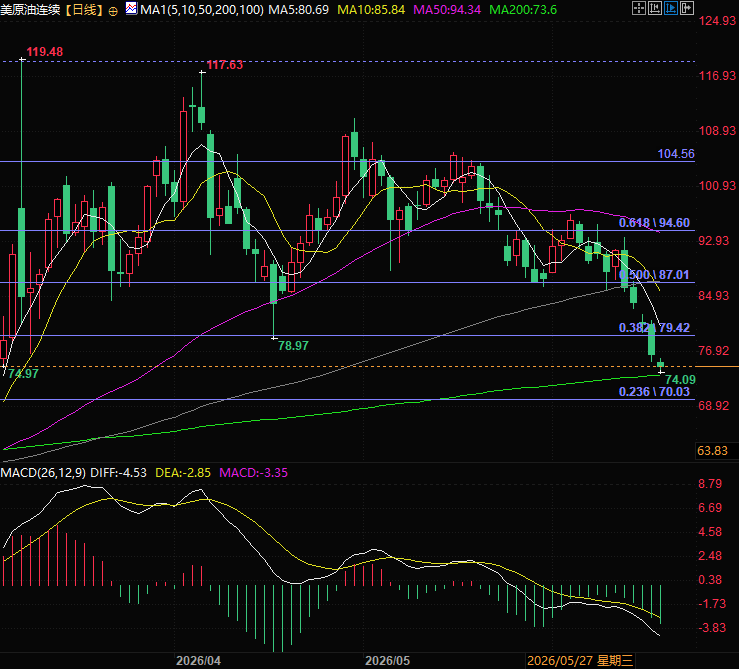
WTI crude oil futures daily chart. Source: EasyForex.
At 17:47 Beijing time, the WTI continuous futures contract is currently trading at $75.21 per barrel.
The shipping crisis forced an emergency high-level meeting between the US and Iran, with Vice President Vance leading a delegation to launch key negotiations at the Burgenstock resort in Switzerland. The talks lasted from Sunday daytime until late at night.
The negotiations focused on three key issues: reaching a consensus on the management of the Strait of Hormuz, establishing a safeguard mechanism to avoid shipping lane conflicts, and improving the details of the ceasefire agreement with Israel in Lebanon. In addition, in-depth technical consultations were held on Iran's nuclear program.
Oil prices fell only slightly overall. The market’s core concern is whether the outcome of the interim negotiations can transform the 60-day ceasefire in Lebanon into a permanent peace. If the US and Iran release radical and confrontational statements, the binding force of the previously signed ceasefire memorandum of understanding will be greatly reduced, and the overall peace talks process may be hindered again.
Traffic data in the Strait of Hormuz is polarized, and the risk of geopolitical blockade is briefly escalating.
The Strait of Hormuz handles about one-fifth of the world's oil and liquefied natural gas shipping, making it a vital choke point for global energy.
Last Saturday, Iran announced the closure of the strait again, citing Israel's sabotage operations in Lebanon and the United States' failure to fulfill its ceasefire commitments. As a result, crude oil shipments through the strait immediately plummeted.
Data from maritime information agency Wenward on Sunday showed that only 12 ships transited the strait that day, a decrease of more than 65% from 35 the previous day;
Of the eight transit vessels, five had their AIS (Aircraft Identification System) turned off to evade monitoring, highlighting the increasingly covert nature of shipping and its close ties to sanctions. However, the U.S. Central Command provided completely contradictory data, stating that 55 merchant ships passed through normally that day.
Supply chain experts explained that the data discrepancy stems from different statistical methods: commercial organizations only count visible ships that have activated their GPS, while the US military's statistics include covert vessels that circle the Omani coastline and have their signals turned off.
At the same time, both countries have a desire to guide public opinion. Iran deliberately emphasizes the disruption of shipping to strengthen its deterrence, while the United States raises shipping data to alleviate market panic.
However, this unilateral and rapid blockade of the strait still casts a shadow over expectations for the subsequent resumption of passage through the strait.
From the perspective of energy import-dependent countries, we must remain highly vigilant.
The Philippines is highly dependent on oil and gas imports from the Middle East, and its Department of Energy maintained the highest level of alert throughout the period of instability in the Straits.
Energy Minister Garin stated that the situation in the Middle East has been cyclical over the past three months, with alternating reports of peace, armed conflict, and shipping lane blockades. The department has consistently adhered to the "worst-case scenario" and continued to implement energy supply security measures.
Sufficient inventory buffer capacity: As of June 22, the Philippines' overall fuel inventory can support the country's use for 43.86 days, of which kerosene inventory can be used for more than 128 days, and reserves of various oil products are sufficient to offset the impact of short-term shipping disruptions.
In terms of price regulation, the Philippines has set a floating price range based on the energy emergency decree, and refined oil prices have dropped significantly since last Tuesday.
The Philippines also stated that if the US-Iran peace agreement is formally implemented and the geopolitical crisis is resolved, it will lift the temporary price controls and allow the market supply and demand to determine oil prices.
Despite negative news, oil prices did not fall, suggesting a potential rebound in trading activity.
Today's all-night negotiations between the US, Iran, and Switzerland concluded, and although the market reaped three temporary benefits—the reopening of the Strait of Hormuz, a ceasefire in Lebanon, and negotiations on the Iranian nuclear issue—international oil prices did not weaken significantly. The core reason is that the market had already fully priced in the optimistic expectation of the Strait of Hormuz restoring stable navigation.
As mentioned in previous articles, regarding the Strait of Hormuz, in addition to observing the recent continuous increase in peak traffic volume, we also need to consider whether there are enough repeat customers, i.e., whether insurance prices and other factors can be adjusted accordingly.
As early as the beginning of this week, when the US and Iran signed a ceasefire memorandum of understanding and shipping in the Taiwan Strait briefly rebounded, funds had already factored in the safe-haven premium brought about by the geopolitical conflict. Profit-taking by bullish investors prematurely exhausted the positive potential of the negotiations' conclusion.
The current oil price is based on a neutral benchmark price under the premise that negotiations are progressing smoothly, but potential risks have not been completely eliminated.
If the US and Iran subsequently issue radical and confrontational statements, the implementation of the ceasefire memorandum is hindered, and in-depth technical negotiations stall, funds will quickly reprice the risk of a Strait blockade, and safe-haven buying will surge, pushing oil prices up rapidly.
Technical Analysis: Oil prices are currently trading in a recent low range. The high opening followed by a decline suggests a final drop is imminent. Given that oil prices are approaching pre-war levels, a rebound is possible at any moment.
Support is at the psychological level of 75, while resistance is around 79.40.
WTI crude oil futures daily chart. Source: EasyForex.
At 17:47 Beijing time, the WTI continuous futures contract is currently trading at $75.21 per barrel.
- Risk Warning and Disclaimer
- The market involves risk, and trading may not be suitable for all investors. This article is for reference only and does not constitute personal investment advice, nor does it take into account certain users’ specific investment objectives, financial situation, or other needs. Any investment decisions made based on this information are at your own risk.

