Possible outcome of US-Iran negotiations 60 days later: "Significant progress, we will continue negotiations."
2026-06-22 18:46:35
There's a classic logic in the capital market: a universally acknowledged classic rule of analysis in the stock market: the opening price sets the tone, and intraday price action determines the trend. In professional trading systems, the bullish and bearish game patterns, capital behavior, and rhythmic paradigms in the first 30 minutes of trading often lock in the overall trading pattern and core trend for the day. The initial game posture has a strong trend continuity and outcome indication, and the opening pattern often foreshadows the entire rhythm and final outcome. This rule is precisely applicable to the current high-level negotiations between the US and Iran. Recently, with the joint mediation of Qatar and Pakistan, the first round of high-level US-Iran talks concluded successfully in Bielgenstöl, Switzerland. This 18-hour-long negotiation was not a simple phase of consultation, but rather a complete finalization of the core script for the future medium- and long-term US-Iran game, the Middle East geopolitical situation, and the global energy market. Iran's game posture on the first day of negotiations has already locked in the core direction of the subsequent long-term situation.
This round of talks yielded several substantial and institutionalized results, establishing a complete framework for future interactions between the US and Iran. All parties formally reached a 60-day roadmap for a final agreement, clarifying the phased negotiation goals and timelines. A high-level monitoring committee and a special technical working group were established to ensure regular supervision and implementation of the negotiation process. A Lebanon conflict control group was specifically established, and a dedicated hotline for communication in the Strait of Hormuz was set up to mitigate the risk of escalation from sudden conflict. In exchange for de-escalation, the US made substantial concessions, temporarily lifting some sanctions on Iranian oil and simultaneously advancing the signing of memorandums related to the unfreezing of Iranian overseas assets. Following the conclusion of the negotiations, Iran quickly issued a five-point official statement, marking a phased and constructive achievement in this round of high-level talks, which was described by the mediators as "encouraging progress."
However, looking beyond the surface of the easing of tensions, this round of negotiations appears to have already reached its conclusion at the outset, and the initial stance has become the norm. Iran's complete strategic maneuvering on the first day of talks—temporarily tightening shipping controls in the Strait of Hormuz, applying pressure to the negotiating table with a hardline stance, creating a stalemate by walking out at key points to protest, softening its stance and returning to negotiations once it had leveraged its bargaining chips, and ultimately securing tangible economic and geopolitical interests—was not a random maneuver in a single negotiation, but rather a carefully crafted and mature strategic model that Iran intends to reuse in the long term. This means that the US-Iran situation will not veer towards either of two extremes: neither a revolutionary, historic comprehensive reconciliation agreement will be reached, completely ending the Middle East power dynamics; nor will negotiations break down, conflict resume, and a return to high-intensity military confrontation. A prolonged ceasefire, continued stalemate, and ongoing negotiations and strategic maneuvering will become the core new normal in the future Middle East situation.
A review of Iran's strategy in this round of negotiations reveals its precise and pragmatic approach, with impeccable control over the pace of both offense and defense. In the early stages, Iran adopted a hardline stance, drawing clear lines and seizing the initiative by tightening passage through the Strait of Hormuz and making a comprehensive ceasefire in Lebanon a prerequisite for negotiations. This forced the US to demonstrate sincerity and make concessions. Ultimately, Iran successfully secured three core practical benefits: a 60-day waiver of sanctions on Iranian oil, a plan to unfreeze its overseas assets, and a legitimate seat in Lebanese security affairs, firmly safeguarding its two core demands for economic recovery and regional influence. Having secured these substantial benefits, Iran proactively softened its stance and returned to the negotiation framework, preventing a complete stalemate. This cycle of "tough pressure – creating a deadlock – concessions and easing tensions – securing tangible benefits" will likely repeat itself in the future. Whenever friction and disagreements arise on the Lebanese border, the implementation of sanctions by the West deviates, or the domestic economy of Iran faces increasing pressure, Iran will repeat the same game scenario. Its core objective remains clear: to extend the ceasefire window to buy breathing room for domestic economic recovery, while consolidating its core voice in the Middle East, without making meaningless compromises or engaging in bottomless confrontation.
The stance of Israel, another key player in the region, has further solidified the stalemate. Israel has consistently insisted on maintaining a security control zone in southern Lebanon and refused a complete withdrawal, maintaining a hardline military posture, but in reality, it has already fallen into a strategic passive position. Currently, the United States holds the dominant position in the Middle East, and Israel is unable to break away from the US strategic rhythm to launch a large-scale, sustained military offensive on its own. There are clear differences in interests and strategic friction between the US and Israel. To stabilize the overall situation and advance the negotiation process, the US continues to pressure Israel to maintain strategic restraint and control the conflict borders. However, it is undeniable that the core foundation of the US-Israel alliance has not wavered; only the strategic priorities of the two sides have diverged. This situation directly declares that the high-intensity bombing and full-scale conflict phase of the Middle East war has completely ended, the probability of a large-scale resurgence of war is essentially zero, and regional conflicts will shift from "full-scale confrontation" to "localized friction and controlled stalemate."
From the US perspective, the 60-day negotiation roadmap promoted by the Trump administration focuses on global macroeconomic stability, rather than a complete reshuffling of the Middle East. The US's current core objective is to stabilize the global energy supply chain, mitigate drastic commodity price fluctuations caused by geopolitical conflict, and reduce the risks of global inflation and supply chain disruptions. Based on this objective, the US has established a clear strategy towards Iran: as long as Iran does not cross its core red lines, does not conduct disruptive nuclear research breakthroughs, and does not directly attack US forces or core US interests, the US will maintain a flexible framework of simultaneous negotiation and pressure, aiming to stabilize the situation through talks, completely abandoning the previous model of maximum pressure and military confrontation. This strategic inclusiveness by the US provides crucial external support for the protracted tug-of-war and continuous negotiations between the US and Iran, making "continuing the ceasefire and normalized negotiations" the optimal choice for all parties.
Based on the aforementioned geopolitical landscape, global oil prices have officially bid farewell to the era of high volatility and high-risk premiums, entering a new range of low volatility and a continuously declining center of gravity. Previously, the market's core concerns about the Middle East situation focused on the sudden closure of the Strait of Hormuz and the resulting abrupt halt in crude oil supply due to a full-scale escalation of regional conflicts. This geopolitical risk premium had long supported high oil prices. However, the current clear 60-day negotiation timetable, the dedicated emergency hotline for the Strait of Hormuz, the normalized conflict management mechanism, the short-term exemption of US sanctions, and the consensus among all parties to proactively avoid escalation of conflict have completely dismantled the core logic behind the surge in oil prices.
The market trading logic has fundamentally shifted: from the previous "panic pricing and concerns about sudden disruptions" to "calm pricing and adaptable, controllable price fluctuations." The risks of sharp price jumps and violent fluctuations triggered by geopolitical black swan events have largely dissipated, and the volatility of the crude oil market will continue to decline. Coupled with the oil sanctions waivers resulting from this round of negotiations, the resumption of Iranian crude oil exports, and improved regional shipping connectivity, the effective global crude oil supply is steadily increasing, further easing the supply-demand balance. Barring extreme unforeseen black swan events, oil prices will maintain a low-volatility trend in the long term, with the overall center of gravity remaining below current levels. Geopolitical risk premiums will gradually recede and be completely eliminated, and the market will return to being dominated by supply and demand fundamentals.
In the long run, this first round of US-Iran negotiations is not the end, but rather a normalized process that can continue indefinitely. The 60-day negotiation window is not a short-term limit, but a dynamic cycle that can be continuously extended and lengthened, most likely gradually extending to 120 days, 180 days, or even longer. With the high-level monitoring committee performing its duties regularly, the technical working group maintaining long-term on-site consultations, the fragile balance of the Lebanese conflict being maintained, and the normalized flow of Iranian crude oil, all parties will continuously erode and slowly test the waters for compromise in a dynamic game.
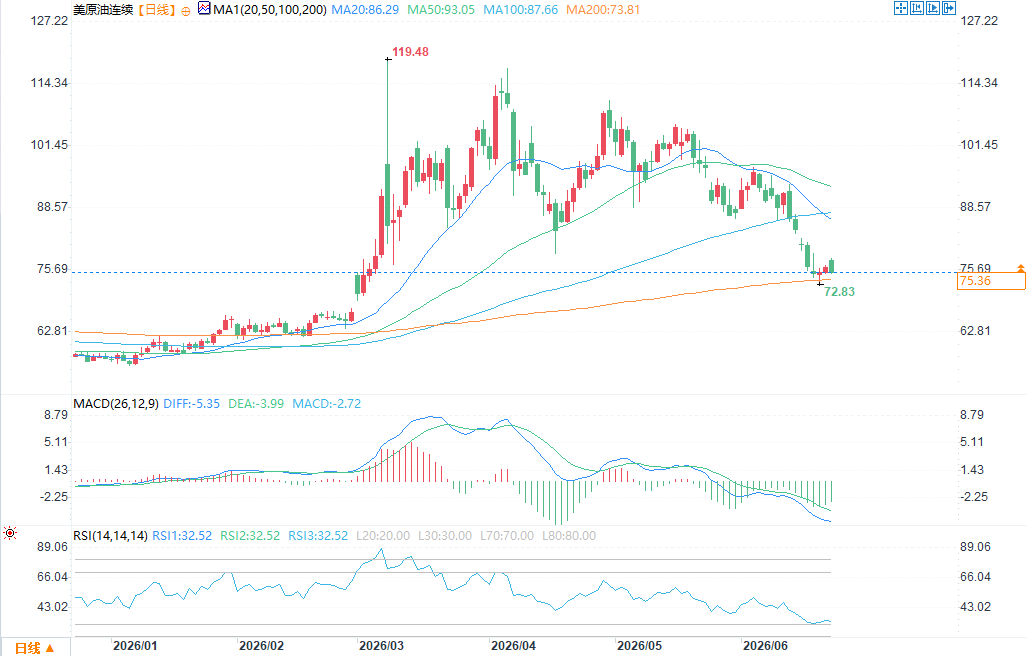
(WTI crude oil daily chart source: FX678)
Overall, the US-Iran rivalry and the Middle East geopolitical situation have undergone a paradigm shift: from a crisis model of "sudden outbreak and violent fluctuations" to a stable model of "steady release and chronic management." No disruptive agreement or reversal of the situation is expected in the short term; the market needs to fully adapt to this new rhythm of prolonged tug-of-war. The medium- to long-term trend of oil prices is already clear: the high-level consolidation pattern has ended, and low volatility and a gradual decline will become the core theme. Subsequent structural trend-based market movements will only gradually emerge after a long period of situational evolution and multiple rounds of negotiation iterations.
This round of talks yielded several substantial and institutionalized results, establishing a complete framework for future interactions between the US and Iran. All parties formally reached a 60-day roadmap for a final agreement, clarifying the phased negotiation goals and timelines. A high-level monitoring committee and a special technical working group were established to ensure regular supervision and implementation of the negotiation process. A Lebanon conflict control group was specifically established, and a dedicated hotline for communication in the Strait of Hormuz was set up to mitigate the risk of escalation from sudden conflict. In exchange for de-escalation, the US made substantial concessions, temporarily lifting some sanctions on Iranian oil and simultaneously advancing the signing of memorandums related to the unfreezing of Iranian overseas assets. Following the conclusion of the negotiations, Iran quickly issued a five-point official statement, marking a phased and constructive achievement in this round of high-level talks, which was described by the mediators as "encouraging progress."
However, looking beyond the surface of the easing of tensions, this round of negotiations appears to have already reached its conclusion at the outset, and the initial stance has become the norm. Iran's complete strategic maneuvering on the first day of talks—temporarily tightening shipping controls in the Strait of Hormuz, applying pressure to the negotiating table with a hardline stance, creating a stalemate by walking out at key points to protest, softening its stance and returning to negotiations once it had leveraged its bargaining chips, and ultimately securing tangible economic and geopolitical interests—was not a random maneuver in a single negotiation, but rather a carefully crafted and mature strategic model that Iran intends to reuse in the long term. This means that the US-Iran situation will not veer towards either of two extremes: neither a revolutionary, historic comprehensive reconciliation agreement will be reached, completely ending the Middle East power dynamics; nor will negotiations break down, conflict resume, and a return to high-intensity military confrontation. A prolonged ceasefire, continued stalemate, and ongoing negotiations and strategic maneuvering will become the core new normal in the future Middle East situation.
A review of Iran's strategy in this round of negotiations reveals its precise and pragmatic approach, with impeccable control over the pace of both offense and defense. In the early stages, Iran adopted a hardline stance, drawing clear lines and seizing the initiative by tightening passage through the Strait of Hormuz and making a comprehensive ceasefire in Lebanon a prerequisite for negotiations. This forced the US to demonstrate sincerity and make concessions. Ultimately, Iran successfully secured three core practical benefits: a 60-day waiver of sanctions on Iranian oil, a plan to unfreeze its overseas assets, and a legitimate seat in Lebanese security affairs, firmly safeguarding its two core demands for economic recovery and regional influence. Having secured these substantial benefits, Iran proactively softened its stance and returned to the negotiation framework, preventing a complete stalemate. This cycle of "tough pressure – creating a deadlock – concessions and easing tensions – securing tangible benefits" will likely repeat itself in the future. Whenever friction and disagreements arise on the Lebanese border, the implementation of sanctions by the West deviates, or the domestic economy of Iran faces increasing pressure, Iran will repeat the same game scenario. Its core objective remains clear: to extend the ceasefire window to buy breathing room for domestic economic recovery, while consolidating its core voice in the Middle East, without making meaningless compromises or engaging in bottomless confrontation.
The stance of Israel, another key player in the region, has further solidified the stalemate. Israel has consistently insisted on maintaining a security control zone in southern Lebanon and refused a complete withdrawal, maintaining a hardline military posture, but in reality, it has already fallen into a strategic passive position. Currently, the United States holds the dominant position in the Middle East, and Israel is unable to break away from the US strategic rhythm to launch a large-scale, sustained military offensive on its own. There are clear differences in interests and strategic friction between the US and Israel. To stabilize the overall situation and advance the negotiation process, the US continues to pressure Israel to maintain strategic restraint and control the conflict borders. However, it is undeniable that the core foundation of the US-Israel alliance has not wavered; only the strategic priorities of the two sides have diverged. This situation directly declares that the high-intensity bombing and full-scale conflict phase of the Middle East war has completely ended, the probability of a large-scale resurgence of war is essentially zero, and regional conflicts will shift from "full-scale confrontation" to "localized friction and controlled stalemate."
From the US perspective, the 60-day negotiation roadmap promoted by the Trump administration focuses on global macroeconomic stability, rather than a complete reshuffling of the Middle East. The US's current core objective is to stabilize the global energy supply chain, mitigate drastic commodity price fluctuations caused by geopolitical conflict, and reduce the risks of global inflation and supply chain disruptions. Based on this objective, the US has established a clear strategy towards Iran: as long as Iran does not cross its core red lines, does not conduct disruptive nuclear research breakthroughs, and does not directly attack US forces or core US interests, the US will maintain a flexible framework of simultaneous negotiation and pressure, aiming to stabilize the situation through talks, completely abandoning the previous model of maximum pressure and military confrontation. This strategic inclusiveness by the US provides crucial external support for the protracted tug-of-war and continuous negotiations between the US and Iran, making "continuing the ceasefire and normalized negotiations" the optimal choice for all parties.
Based on the aforementioned geopolitical landscape, global oil prices have officially bid farewell to the era of high volatility and high-risk premiums, entering a new range of low volatility and a continuously declining center of gravity. Previously, the market's core concerns about the Middle East situation focused on the sudden closure of the Strait of Hormuz and the resulting abrupt halt in crude oil supply due to a full-scale escalation of regional conflicts. This geopolitical risk premium had long supported high oil prices. However, the current clear 60-day negotiation timetable, the dedicated emergency hotline for the Strait of Hormuz, the normalized conflict management mechanism, the short-term exemption of US sanctions, and the consensus among all parties to proactively avoid escalation of conflict have completely dismantled the core logic behind the surge in oil prices.
The market trading logic has fundamentally shifted: from the previous "panic pricing and concerns about sudden disruptions" to "calm pricing and adaptable, controllable price fluctuations." The risks of sharp price jumps and violent fluctuations triggered by geopolitical black swan events have largely dissipated, and the volatility of the crude oil market will continue to decline. Coupled with the oil sanctions waivers resulting from this round of negotiations, the resumption of Iranian crude oil exports, and improved regional shipping connectivity, the effective global crude oil supply is steadily increasing, further easing the supply-demand balance. Barring extreme unforeseen black swan events, oil prices will maintain a low-volatility trend in the long term, with the overall center of gravity remaining below current levels. Geopolitical risk premiums will gradually recede and be completely eliminated, and the market will return to being dominated by supply and demand fundamentals.
In the long run, this first round of US-Iran negotiations is not the end, but rather a normalized process that can continue indefinitely. The 60-day negotiation window is not a short-term limit, but a dynamic cycle that can be continuously extended and lengthened, most likely gradually extending to 120 days, 180 days, or even longer. With the high-level monitoring committee performing its duties regularly, the technical working group maintaining long-term on-site consultations, the fragile balance of the Lebanese conflict being maintained, and the normalized flow of Iranian crude oil, all parties will continuously erode and slowly test the waters for compromise in a dynamic game.
(WTI crude oil daily chart source: FX678)
Overall, the US-Iran rivalry and the Middle East geopolitical situation have undergone a paradigm shift: from a crisis model of "sudden outbreak and violent fluctuations" to a stable model of "steady release and chronic management." No disruptive agreement or reversal of the situation is expected in the short term; the market needs to fully adapt to this new rhythm of prolonged tug-of-war. The medium- to long-term trend of oil prices is already clear: the high-level consolidation pattern has ended, and low volatility and a gradual decline will become the core theme. Subsequent structural trend-based market movements will only gradually emerge after a long period of situational evolution and multiple rounds of negotiation iterations.
- Risk Warning and Disclaimer
- The market involves risk, and trading may not be suitable for all investors. This article is for reference only and does not constitute personal investment advice, nor does it take into account certain users’ specific investment objectives, financial situation, or other needs. Any investment decisions made based on this information are at your own risk.