Crude Oil Trading Alert: Positive progress in US-Iran negotiations eases supply concerns; oil prices continue to fluctuate and adjust.
2026-06-23 09:50:48
On Tuesday during Asian trading hours, WTI crude oil prices fluctuated narrowly around $74 per barrel , largely recovering from the previous day's losses. Although market expectations for a de-escalation of tensions in the Middle East have increased, investors remain cautious about the smooth progress of subsequent negotiations, leaving oil prices temporarily in a directional decision-making phase.

The first round of peace talks between the United States and Iran in Switzerland, brokered by Qatar and Pakistan, has concluded. Both sides reported positive results and reached a preliminary consensus on a framework for future negotiations. According to a joint statement, the two countries agreed to establish a 60-day roadmap for a final agreement , aiming to gradually move the months-long conflict towards a comprehensive resolution. This development significantly eased previous market concerns about a breakdown in diplomatic channels. Previously, due to renewed regional tensions, Iran closed the Strait of Hormuz again over the weekend, raising concerns about the security of global energy transport. Meanwhile, US President Trump warned that he would not rule out new military action if negotiations failed, further exacerbating market tensions.
With negotiations resuming and achieving some progress, investors are beginning to reassess supply risks in the Middle East. The market generally believes that if a broader agreement can be reached within the next two months, the global oil supply shortage could be significantly alleviated. Meanwhile, the US Treasury announced a temporary easing of some restrictions on Iranian oil exports. The market believes this move could allow Iranian oil exports to gradually recover, thereby increasing international market supply. For the oil market, which is already facing expectations of slowing demand growth, this undoubtedly adds additional downward pressure.
From a supply and demand perspective, market focus is gradually shifting from the risk of supply disruptions to the potential scale of future supply recovery. If sanctions are further eased, the market expects Iran's crude oil export capacity to gradually increase in the coming months, which will have a significant impact on the global supply and demand balance. However, significant doubts remain regarding the long-term stability of the ceasefire agreement. Key issues such as navigation arrangements in the Strait of Hormuz, the Iranian nuclear issue, and frozen overseas assets remain significantly divergent. Analysts point out that these issues involve the core interests of all parties, making a comprehensive resolution in the short term difficult.
It is worth noting that the Strait of Hormuz handles approximately 20% of global seaborne crude oil transport , and any news of disruptions to this shipping route could quickly push up international oil prices. Therefore, even with improved market risk appetite, the geopolitical risk premium has not completely disappeared from the market. Furthermore, the global economic growth outlook and changes in the monetary policies of major economies also influence energy demand expectations. With the Federal Reserve maintaining a hawkish stance, concerns persist that a high-interest-rate environment may suppress energy consumption demand, which is one of the key reasons for the recent continued downward pressure on oil prices.
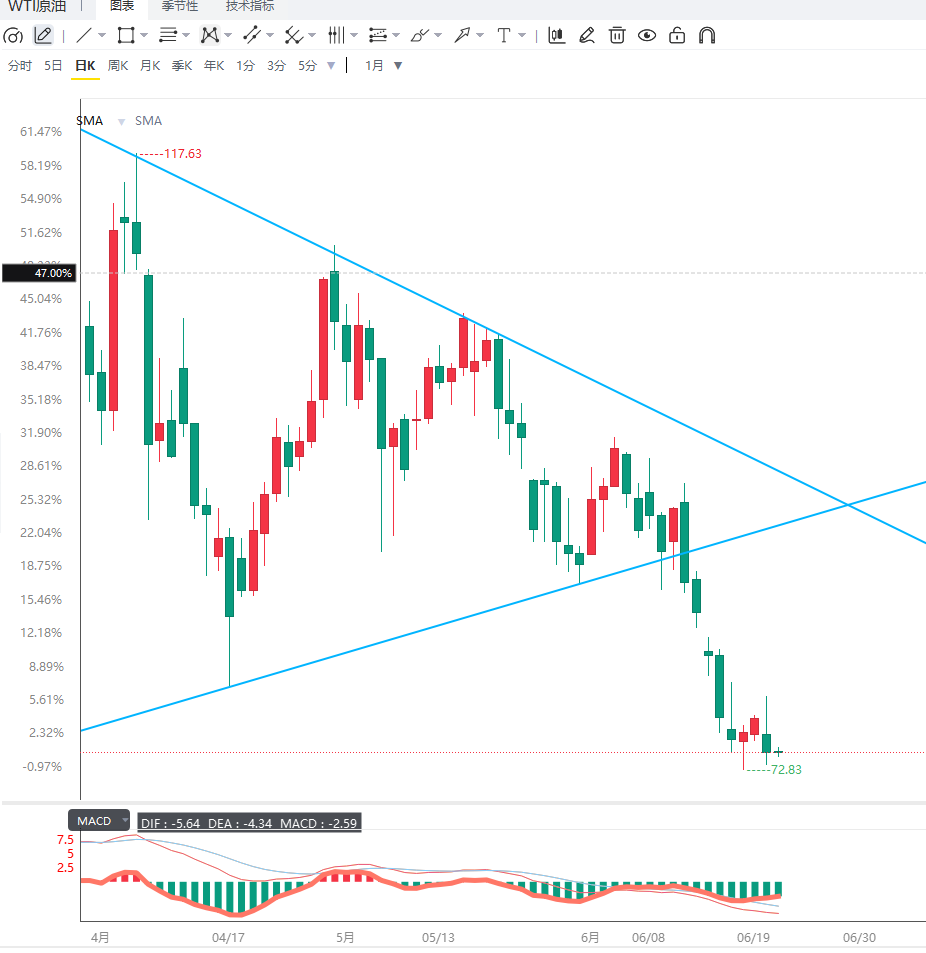
From a technical perspective, WTI crude oil maintains a generally weak and volatile pattern on the daily chart. After falling from its previous highs, prices have been trading within a descending channel, but are currently approaching a key medium- to long-term support level. The 200-day moving average is around $73.00 , a level that has also been a significant dividing line between bullish and bearish sentiment in recent months. In terms of momentum, the MACD indicator remains below the zero line, but the green histogram bars are shortening, indicating a weakening of bearish pressure. Key resistance levels to watch are $75.50 and $77.00 . A sustained move above $77 could open up further upside potential. Support levels to watch are $73.00 and $71.50 ; a break below these levels could lead to a test of the $70 psychological level.
From a 4-hour chart perspective, oil prices have recently been consolidating within the $73-$75 range. The MACD lines are showing signs of convergence at low levels, indicating a significant slowdown in short-term bearish momentum. The price has repeatedly found support near $73, suggesting strong market support around the 200-day moving average. A break above the $75.50 resistance level could form a bottoming pattern, potentially leading to a move towards the $77 area. Conversely, a break below $73.00 support could trigger a new round of selling, accelerating the decline towards $71 or even $70. Based on the current structure, oil prices are at a critical juncture, and the consolidation pattern is likely to continue until the fundamentals become clearer.
Editor's Summary : Positive progress in US-Iran peace talks and the US easing some restrictions on Iranian crude oil exports are easing supply concerns that previously drove up oil prices. However, the security issues in the Strait of Hormuz, Iran's nuclear program, and core differences between the two sides remain unresolved, and geopolitical risks have not completely disappeared. In the short term, the struggle for WTI crude oil around the $73-$75 range will be the focus of market attention. If negotiations continue, expectations of supply recovery may continue to suppress oil prices; however, if the situation reverts, a return of risk premiums could still drive oil prices higher. Investors should pay close attention to the impact of subsequent negotiation progress, US inventory data, and changes in global demand expectations on market sentiment.
The first round of peace talks between the United States and Iran in Switzerland, brokered by Qatar and Pakistan, has concluded. Both sides reported positive results and reached a preliminary consensus on a framework for future negotiations. According to a joint statement, the two countries agreed to establish a 60-day roadmap for a final agreement , aiming to gradually move the months-long conflict towards a comprehensive resolution. This development significantly eased previous market concerns about a breakdown in diplomatic channels. Previously, due to renewed regional tensions, Iran closed the Strait of Hormuz again over the weekend, raising concerns about the security of global energy transport. Meanwhile, US President Trump warned that he would not rule out new military action if negotiations failed, further exacerbating market tensions.
With negotiations resuming and achieving some progress, investors are beginning to reassess supply risks in the Middle East. The market generally believes that if a broader agreement can be reached within the next two months, the global oil supply shortage could be significantly alleviated. Meanwhile, the US Treasury announced a temporary easing of some restrictions on Iranian oil exports. The market believes this move could allow Iranian oil exports to gradually recover, thereby increasing international market supply. For the oil market, which is already facing expectations of slowing demand growth, this undoubtedly adds additional downward pressure.
From a supply and demand perspective, market focus is gradually shifting from the risk of supply disruptions to the potential scale of future supply recovery. If sanctions are further eased, the market expects Iran's crude oil export capacity to gradually increase in the coming months, which will have a significant impact on the global supply and demand balance. However, significant doubts remain regarding the long-term stability of the ceasefire agreement. Key issues such as navigation arrangements in the Strait of Hormuz, the Iranian nuclear issue, and frozen overseas assets remain significantly divergent. Analysts point out that these issues involve the core interests of all parties, making a comprehensive resolution in the short term difficult.
It is worth noting that the Strait of Hormuz handles approximately 20% of global seaborne crude oil transport , and any news of disruptions to this shipping route could quickly push up international oil prices. Therefore, even with improved market risk appetite, the geopolitical risk premium has not completely disappeared from the market. Furthermore, the global economic growth outlook and changes in the monetary policies of major economies also influence energy demand expectations. With the Federal Reserve maintaining a hawkish stance, concerns persist that a high-interest-rate environment may suppress energy consumption demand, which is one of the key reasons for the recent continued downward pressure on oil prices.
From a technical perspective, WTI crude oil maintains a generally weak and volatile pattern on the daily chart. After falling from its previous highs, prices have been trading within a descending channel, but are currently approaching a key medium- to long-term support level. The 200-day moving average is around $73.00 , a level that has also been a significant dividing line between bullish and bearish sentiment in recent months. In terms of momentum, the MACD indicator remains below the zero line, but the green histogram bars are shortening, indicating a weakening of bearish pressure. Key resistance levels to watch are $75.50 and $77.00 . A sustained move above $77 could open up further upside potential. Support levels to watch are $73.00 and $71.50 ; a break below these levels could lead to a test of the $70 psychological level.
From a 4-hour chart perspective, oil prices have recently been consolidating within the $73-$75 range. The MACD lines are showing signs of convergence at low levels, indicating a significant slowdown in short-term bearish momentum. The price has repeatedly found support near $73, suggesting strong market support around the 200-day moving average. A break above the $75.50 resistance level could form a bottoming pattern, potentially leading to a move towards the $77 area. Conversely, a break below $73.00 support could trigger a new round of selling, accelerating the decline towards $71 or even $70. Based on the current structure, oil prices are at a critical juncture, and the consolidation pattern is likely to continue until the fundamentals become clearer.
Editor's Summary : Positive progress in US-Iran peace talks and the US easing some restrictions on Iranian crude oil exports are easing supply concerns that previously drove up oil prices. However, the security issues in the Strait of Hormuz, Iran's nuclear program, and core differences between the two sides remain unresolved, and geopolitical risks have not completely disappeared. In the short term, the struggle for WTI crude oil around the $73-$75 range will be the focus of market attention. If negotiations continue, expectations of supply recovery may continue to suppress oil prices; however, if the situation reverts, a return of risk premiums could still drive oil prices higher. Investors should pay close attention to the impact of subsequent negotiation progress, US inventory data, and changes in global demand expectations on market sentiment.
- Risk Warning and Disclaimer
- The market involves risk, and trading may not be suitable for all investors. This article is for reference only and does not constitute personal investment advice, nor does it take into account certain users’ specific investment objectives, financial situation, or other needs. Any investment decisions made based on this information are at your own risk.