New orders hit a four-year high and employment grew at its fastest pace in eight years, yet why is the yen "unmoved"?
2026-06-23 10:24:29
On Tuesday (June 23) in early Asian trading, the US dollar fluctuated at high levels against the Japanese yen, currently trading around 161.55.
A survey released Tuesday showed that Japan's manufacturing sector maintained strong expansion in June, with new orders growing at their fastest pace in more than four years. However, cost pressures on businesses continue to rise due to the aftermath of the Iran-Iraq war.
The service sector also rebounded after a brief pause in May, pushing the composite PMI up to 52.5.

The preliminary reading of Japan's manufacturing Purchasing Managers' Index (PMI) for June rose slightly to 54.9 from 54.5 in May, further approaching April's 55.1—the strongest expansion level since January 2022. A PMI reading above 50 indicates that economic activity is in expansion territory.
Factory output growth accelerated slightly, while new orders growth hit its highest level in more than four years.
The survey indicates that this growth was partly driven by customers actively building up inventory in anticipation of supply disruptions and potential future price increases due to the Iranian war.
However, the growth rate of new export orders slowed compared to May, when export order growth hit a five-year high.
Although the inflation rates for manufacturing input costs and output prices declined slightly in June compared to May, they remained near their highest levels since the end of 2022, indicating that cost pressures have not fundamentally eased. This situation is mainly due to the ongoing conflict in the Middle East, which continues to push up global energy, fuel, and raw material prices. As a major importer, Japan has seen a significant increase in corporate procurement spending. Coupled with the amplifying effect of import costs caused by the weak yen, this further amplifies the burden on manufacturing companies, potentially squeezing profit margins and transmitting this burden to downstream supply chains.
It is worth noting that manufacturing employment growth in June hit a more than eight-year high, with companies not only accelerating hiring but also demonstrating a strong willingness to expand their workforce. This reflects a gradual improvement in manufacturers' confidence in the future economic outlook, and their willingness to increase manpower to meet the demands of order growth and capacity expansion. The S&P Global survey shows that the recovery in business optimism provided significant support for the Japanese economy in the second quarter.
However, the sustainability of strong job growth depends on whether cost pressures can be effectively controlled and the extent to which geopolitical risks in the Middle East ease. If energy prices remain high, corporate profitability may be limited, thereby impacting subsequent investment and wage growth. While monitoring inflation, the Bank of Japan also needs to be wary of the potential drag on the real economy from cost-push inflation.
After a brief pause in May (PMI at 50.0), the service sector rebounded significantly, with the preliminary June PMI for Japan rising to 51.8, returning to expansion territory. This recovery was mainly driven by improved domestic demand conditions, including a gradual recovery in business and consumer confidence, a rebound in domestic tourism and service sector activity, and the release of pent-up orders in some areas.
Despite a faster decline in foreign demand, the service sector has demonstrated strong resilience. Business feedback indicates that the recovery in domestic business activity has been the main driver of growth in the service sector, while weak international demand is primarily driven by global geopolitical uncertainties and economic slowdowns in some major trading partners.
Meanwhile, the preliminary composite PMI for manufacturing and services rose from 51.1 in May to 52.5 in June, further confirming the acceleration in overall business activity in Japan. This improvement in the composite indicator suggests that the Japanese economy in the second quarter exhibited a positive trend of mutual support between manufacturing expansion and a service sector recovery.
A S&P Global survey shows that businesses are more optimistic about their business outlook for the next 12 months, and a robust job market is also supporting service sector consumption. However, continued weakness in foreign demand remains a potential drag. If easing geopolitical risks in the Middle East leads to a recovery in global trade, the service sector is expected to receive more external support, driving more balanced and sustainable growth in the Japanese economy.
Annabel Fiddes, Associate Director of Economics at S&P Global Market Intelligence, noted: "For the first time since the outbreak of the Middle East wars, Japan's overall business activity growth has rebounded. While this indicates a strong overall performance in the second quarter, it is worth noting that the current growth is partly driven by inventory building activities in the context of the Middle East wars, and these efforts may gradually fade in the coming months."
This means that the current economic expansion may rely to some extent on short-term factors rather than sustained growth in domestic demand.
Overall, Japan's June PMI data presents an economic picture of "short-term strength but emerging concerns": new orders in the manufacturing sector hit a more than four-year high, employment growth was the fastest in more than eight years, and a rebound in the service sector pushed the composite PMI up to 52.5—on the surface, the Japanese economy performed brilliantly in the second quarter.
However, the underlying concerns are equally clear: cost pressures remain high, and the impact of the Middle East wars on energy prices continues to manifest; export order growth has shown signs of slowing; and one of the current key drivers of growth—the inventories built by companies to cope with supply disruptions—may diminish in the coming months. Against the backdrop of the Bank of Japan considering further interest rate hikes, these structural weaknesses could become potential factors constraining a sustained economic recovery.
According to the daily chart, the long-term uptrend of USD/JPY remains intact. After reaching a high of 161.92, the price experienced slight downward pressure and consolidated, but the overall bullish structure remains unbroken. The moving average system is in a bullish alignment, with the price steadily trading above the 20-day, 50-day, 100-day, and 200-day moving averages, all diverging upwards. The 20-day moving average (160.30) forms a key short-term support level, while the long-term upward channel provides ample support.
The indicators are showing divergence. The MACD indicator's DIFF remains above the DEA, but the red bars are narrowing slightly, indicating a slight weakening of bullish momentum. The RSI value is 69.95, nearing the overbought threshold of 80, suggesting that short-term bullish momentum is exhausted and a pullback is likely. The core resistance level is the previous high of 161.92; a successful break above this level would open up new upward potential. The first support level is the 20-day moving average (MA20) at 160.30, with strong medium-term support at the previous low of 155.03. While the long-term moving averages provide support, the bullish logic remains unchanged. However, short-term indicators are approaching overbought levels, suggesting a high probability of consolidation at high levels to digest profit-taking, and a short-term pullback to test the short-term moving averages is possible. The trading strategy is to buy on dips based on the moving averages, paying close attention to the effectiveness of the 160.30 support level.
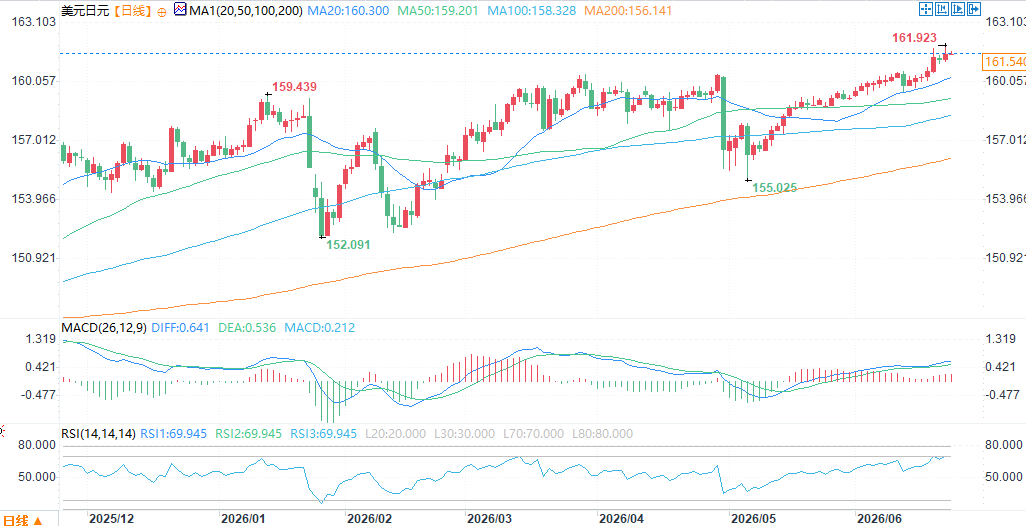
(USD/JPY daily chart, source: FX678)
At 10:22 AM Beijing time on June 23, the USD/JPY exchange rate was 161.54/55.
A survey released Tuesday showed that Japan's manufacturing sector maintained strong expansion in June, with new orders growing at their fastest pace in more than four years. However, cost pressures on businesses continue to rise due to the aftermath of the Iran-Iraq war.
The service sector also rebounded after a brief pause in May, pushing the composite PMI up to 52.5.
Manufacturing PMI rises to 54.9: New orders hit a more than four-year high.
The preliminary reading of Japan's manufacturing Purchasing Managers' Index (PMI) for June rose slightly to 54.9 from 54.5 in May, further approaching April's 55.1—the strongest expansion level since January 2022. A PMI reading above 50 indicates that economic activity is in expansion territory.
Factory output growth accelerated slightly, while new orders growth hit its highest level in more than four years.
The survey indicates that this growth was partly driven by customers actively building up inventory in anticipation of supply disruptions and potential future price increases due to the Iranian war.
However, the growth rate of new export orders slowed compared to May, when export order growth hit a five-year high.
Cost pressures persist: Inflation remains high
Although the inflation rates for manufacturing input costs and output prices declined slightly in June compared to May, they remained near their highest levels since the end of 2022, indicating that cost pressures have not fundamentally eased. This situation is mainly due to the ongoing conflict in the Middle East, which continues to push up global energy, fuel, and raw material prices. As a major importer, Japan has seen a significant increase in corporate procurement spending. Coupled with the amplifying effect of import costs caused by the weak yen, this further amplifies the burden on manufacturing companies, potentially squeezing profit margins and transmitting this burden to downstream supply chains.
It is worth noting that manufacturing employment growth in June hit a more than eight-year high, with companies not only accelerating hiring but also demonstrating a strong willingness to expand their workforce. This reflects a gradual improvement in manufacturers' confidence in the future economic outlook, and their willingness to increase manpower to meet the demands of order growth and capacity expansion. The S&P Global survey shows that the recovery in business optimism provided significant support for the Japanese economy in the second quarter.
However, the sustainability of strong job growth depends on whether cost pressures can be effectively controlled and the extent to which geopolitical risks in the Middle East ease. If energy prices remain high, corporate profitability may be limited, thereby impacting subsequent investment and wage growth. While monitoring inflation, the Bank of Japan also needs to be wary of the potential drag on the real economy from cost-push inflation.
Services sector rebounds: Composite PMI rises to 52.5
After a brief pause in May (PMI at 50.0), the service sector rebounded significantly, with the preliminary June PMI for Japan rising to 51.8, returning to expansion territory. This recovery was mainly driven by improved domestic demand conditions, including a gradual recovery in business and consumer confidence, a rebound in domestic tourism and service sector activity, and the release of pent-up orders in some areas.
Despite a faster decline in foreign demand, the service sector has demonstrated strong resilience. Business feedback indicates that the recovery in domestic business activity has been the main driver of growth in the service sector, while weak international demand is primarily driven by global geopolitical uncertainties and economic slowdowns in some major trading partners.
Meanwhile, the preliminary composite PMI for manufacturing and services rose from 51.1 in May to 52.5 in June, further confirming the acceleration in overall business activity in Japan. This improvement in the composite indicator suggests that the Japanese economy in the second quarter exhibited a positive trend of mutual support between manufacturing expansion and a service sector recovery.
A S&P Global survey shows that businesses are more optimistic about their business outlook for the next 12 months, and a robust job market is also supporting service sector consumption. However, continued weakness in foreign demand remains a potential drag. If easing geopolitical risks in the Middle East leads to a recovery in global trade, the service sector is expected to receive more external support, driving more balanced and sustainable growth in the Japanese economy.
Outlook: The sustainability of inventory building is questionable
Annabel Fiddes, Associate Director of Economics at S&P Global Market Intelligence, noted: "For the first time since the outbreak of the Middle East wars, Japan's overall business activity growth has rebounded. While this indicates a strong overall performance in the second quarter, it is worth noting that the current growth is partly driven by inventory building activities in the context of the Middle East wars, and these efforts may gradually fade in the coming months."
This means that the current economic expansion may rely to some extent on short-term factors rather than sustained growth in domestic demand.
Overall, Japan's June PMI data presents an economic picture of "short-term strength but emerging concerns": new orders in the manufacturing sector hit a more than four-year high, employment growth was the fastest in more than eight years, and a rebound in the service sector pushed the composite PMI up to 52.5—on the surface, the Japanese economy performed brilliantly in the second quarter.
However, the underlying concerns are equally clear: cost pressures remain high, and the impact of the Middle East wars on energy prices continues to manifest; export order growth has shown signs of slowing; and one of the current key drivers of growth—the inventories built by companies to cope with supply disruptions—may diminish in the coming months. Against the backdrop of the Bank of Japan considering further interest rate hikes, these structural weaknesses could become potential factors constraining a sustained economic recovery.
Technical Analysis
According to the daily chart, the long-term uptrend of USD/JPY remains intact. After reaching a high of 161.92, the price experienced slight downward pressure and consolidated, but the overall bullish structure remains unbroken. The moving average system is in a bullish alignment, with the price steadily trading above the 20-day, 50-day, 100-day, and 200-day moving averages, all diverging upwards. The 20-day moving average (160.30) forms a key short-term support level, while the long-term upward channel provides ample support.
The indicators are showing divergence. The MACD indicator's DIFF remains above the DEA, but the red bars are narrowing slightly, indicating a slight weakening of bullish momentum. The RSI value is 69.95, nearing the overbought threshold of 80, suggesting that short-term bullish momentum is exhausted and a pullback is likely. The core resistance level is the previous high of 161.92; a successful break above this level would open up new upward potential. The first support level is the 20-day moving average (MA20) at 160.30, with strong medium-term support at the previous low of 155.03. While the long-term moving averages provide support, the bullish logic remains unchanged. However, short-term indicators are approaching overbought levels, suggesting a high probability of consolidation at high levels to digest profit-taking, and a short-term pullback to test the short-term moving averages is possible. The trading strategy is to buy on dips based on the moving averages, paying close attention to the effectiveness of the 160.30 support level.
(USD/JPY daily chart, source: FX678)
At 10:22 AM Beijing time on June 23, the USD/JPY exchange rate was 161.54/55.
- Risk Warning and Disclaimer
- The market involves risk, and trading may not be suitable for all investors. This article is for reference only and does not constitute personal investment advice, nor does it take into account certain users’ specific investment objectives, financial situation, or other needs. Any investment decisions made based on this information are at your own risk.