The Bank of Japan kept its core inflation gauge above its target, supporting expectations of policy normalization.
2026-06-23 14:38:41
The latest data released by the Bank of Japan on Tuesday showed that Japan's underlying inflation level continued to remain above its policy target. The data showed that the core consumer inflation rate, compiled by the Bank of Japan to exclude one-off factors, recorded 2.7% in May, slightly lower than 2.8% in April, but still above the Bank of Japan's 2.0% inflation target.

Meanwhile, the core-core CPI, excluding special factors, rose 2.1% year-on-year, a slight decrease from the previous value of 2.2% . Although the rate of inflation slowed slightly, it remained above the target level overall, indicating that domestic price pressures in Japan have not yet subsided significantly.
In recent years, the Bank of Japan has been closely monitoring inflation indicators that more accurately reflect underlying price trends. Compared to the traditional Consumer Price Index (CPI), the Bank of Japan's newly adopted core inflation measurement method can eliminate some short-term fluctuations, thus more accurately reflecting changes in consumer prices. Therefore, this data is of high reference value for judging the future direction of monetary policy.
The data suggests that Japan's inflation structure is gradually stabilizing. While the impact of energy price fluctuations and rising food prices has lessened, rising service sector prices and labor costs continue to drive core prices higher. The market generally believes that Japan's core inflation remaining above the target level strengthens the Bank of Japan's confidence in a sustained price recovery. Previously, the Bank of Japan had gradually exited its ultra-loose monetary policy and begun exploring a more normalized policy path. The current inflation data undoubtedly provides some support for this process.
However, the data also shows signs of a marginal slowdown in inflation. Core inflation fell from 2.8% to 2.7%, and the core-to-core inflation rate fell from 2.2% to 2.1%, indicating that inflationary pressures previously driven by energy costs and import prices are gradually weakening. With the global energy market stabilizing, Japanese inflation may decline further in the coming months.
Furthermore, Japan's economic growth momentum remains relatively limited. While improved wage growth has led to a partial recovery in consumer demand, corporate investment and exports still face uncertainty due to the global economic slowdown. Therefore, the Bank of Japan will need to maintain a balance between controlling inflation and supporting economic growth when adjusting its policy.
In the foreign exchange market, persistently higher-than-target inflation theoretically supports the Bank of Japan in further normalizing its policy, thus providing some support for the yen. However, a significant interest rate gap remains between the US and Japan, and the Federal Reserve maintains a hawkish stance, keeping the USD/JPY exchange rate at high levels. Therefore, the positive impact of Japanese inflation data on the yen is relatively limited.
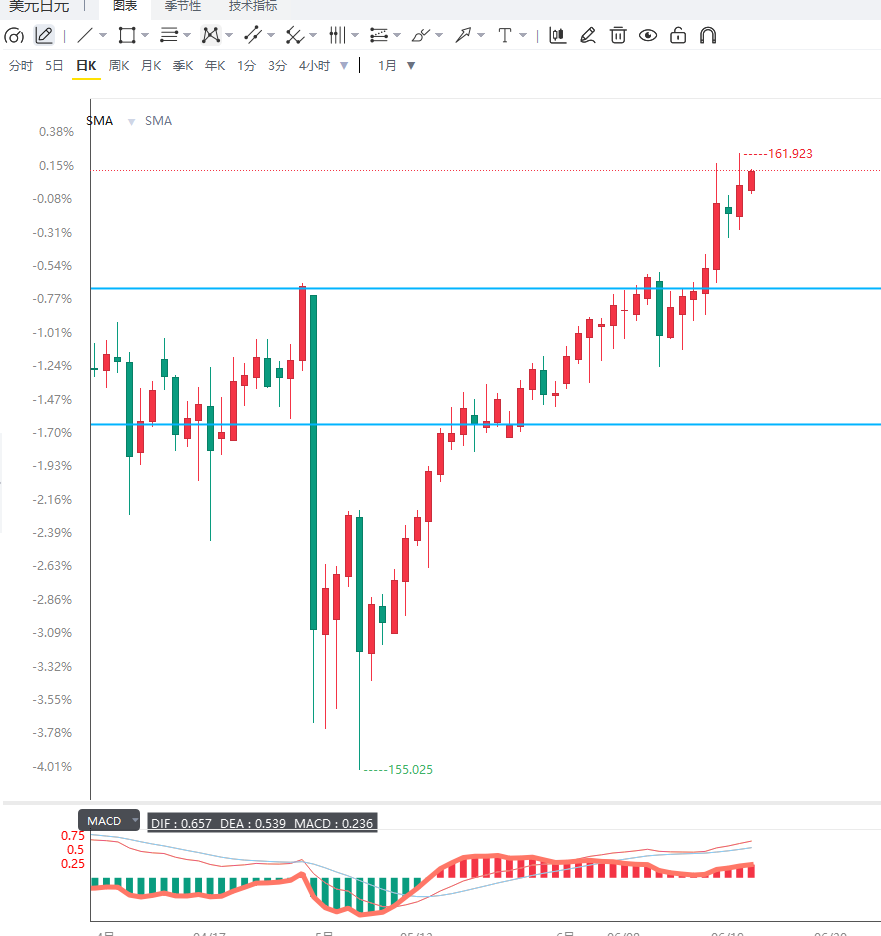
From a technical perspective, the USD/JPY pair maintains its upward trend on the daily chart, with the price trading above major moving averages. The MACD indicator is above the zero line, but the red histogram bars are beginning to converge, indicating a slowdown in upward momentum. Key resistance levels to watch are 162.00 , 163.50 , and 165.00 . Support levels to watch are 160.00 , 158.80 , and 157.00 .
From a 4-hour chart perspective, the USD/JPY pair is maintaining a high-level consolidation trend. With Japanese inflation data continuing to exceed the target, expectations for the Bank of Japan's policy normalization have strengthened, but this is not enough to completely change the market's assessment of the USD/JPY interest rate differential. A break below the 160.00 level could trigger a larger correction; if it continues to hold above 161.00, the bulls may still have a chance to challenge the key resistance level of 162.00.
Editor's Summary : While Japan's core inflation rate declined slightly in May compared to the previous month, it remained above the 2% target for the second consecutive month, indicating a still solid domestic underlying inflation environment. This provides a basis for the Bank of Japan to further normalize its policy in the future. However, signs of slowing inflation and uncertainties facing economic growth suggest that policy adjustments will continue to be gradual. For financial markets, Japanese inflation data will help stabilize yen expectations in the short term, but the strength of the US dollar and the interest rate differential between the US and Japan remain the main factors influencing exchange rate movements. Going forward, the market will focus on statements from Bank of Japan officials and inflation changes in the coming months to determine the specific timing of a policy shift.
Meanwhile, the core-core CPI, excluding special factors, rose 2.1% year-on-year, a slight decrease from the previous value of 2.2% . Although the rate of inflation slowed slightly, it remained above the target level overall, indicating that domestic price pressures in Japan have not yet subsided significantly.
In recent years, the Bank of Japan has been closely monitoring inflation indicators that more accurately reflect underlying price trends. Compared to the traditional Consumer Price Index (CPI), the Bank of Japan's newly adopted core inflation measurement method can eliminate some short-term fluctuations, thus more accurately reflecting changes in consumer prices. Therefore, this data is of high reference value for judging the future direction of monetary policy.
The data suggests that Japan's inflation structure is gradually stabilizing. While the impact of energy price fluctuations and rising food prices has lessened, rising service sector prices and labor costs continue to drive core prices higher. The market generally believes that Japan's core inflation remaining above the target level strengthens the Bank of Japan's confidence in a sustained price recovery. Previously, the Bank of Japan had gradually exited its ultra-loose monetary policy and begun exploring a more normalized policy path. The current inflation data undoubtedly provides some support for this process.
However, the data also shows signs of a marginal slowdown in inflation. Core inflation fell from 2.8% to 2.7%, and the core-to-core inflation rate fell from 2.2% to 2.1%, indicating that inflationary pressures previously driven by energy costs and import prices are gradually weakening. With the global energy market stabilizing, Japanese inflation may decline further in the coming months.
Furthermore, Japan's economic growth momentum remains relatively limited. While improved wage growth has led to a partial recovery in consumer demand, corporate investment and exports still face uncertainty due to the global economic slowdown. Therefore, the Bank of Japan will need to maintain a balance between controlling inflation and supporting economic growth when adjusting its policy.
In the foreign exchange market, persistently higher-than-target inflation theoretically supports the Bank of Japan in further normalizing its policy, thus providing some support for the yen. However, a significant interest rate gap remains between the US and Japan, and the Federal Reserve maintains a hawkish stance, keeping the USD/JPY exchange rate at high levels. Therefore, the positive impact of Japanese inflation data on the yen is relatively limited.
From a technical perspective, the USD/JPY pair maintains its upward trend on the daily chart, with the price trading above major moving averages. The MACD indicator is above the zero line, but the red histogram bars are beginning to converge, indicating a slowdown in upward momentum. Key resistance levels to watch are 162.00 , 163.50 , and 165.00 . Support levels to watch are 160.00 , 158.80 , and 157.00 .
From a 4-hour chart perspective, the USD/JPY pair is maintaining a high-level consolidation trend. With Japanese inflation data continuing to exceed the target, expectations for the Bank of Japan's policy normalization have strengthened, but this is not enough to completely change the market's assessment of the USD/JPY interest rate differential. A break below the 160.00 level could trigger a larger correction; if it continues to hold above 161.00, the bulls may still have a chance to challenge the key resistance level of 162.00.
Editor's Summary : While Japan's core inflation rate declined slightly in May compared to the previous month, it remained above the 2% target for the second consecutive month, indicating a still solid domestic underlying inflation environment. This provides a basis for the Bank of Japan to further normalize its policy in the future. However, signs of slowing inflation and uncertainties facing economic growth suggest that policy adjustments will continue to be gradual. For financial markets, Japanese inflation data will help stabilize yen expectations in the short term, but the strength of the US dollar and the interest rate differential between the US and Japan remain the main factors influencing exchange rate movements. Going forward, the market will focus on statements from Bank of Japan officials and inflation changes in the coming months to determine the specific timing of a policy shift.
- Risk Warning and Disclaimer
- The market involves risk, and trading may not be suitable for all investors. This article is for reference only and does not constitute personal investment advice, nor does it take into account certain users’ specific investment objectives, financial situation, or other needs. Any investment decisions made based on this information are at your own risk.