Hawkish expectations from the Federal Reserve will support the dollar's strength, but caution is advised against a short-term overbought pullback.
2026-06-23 14:49:13
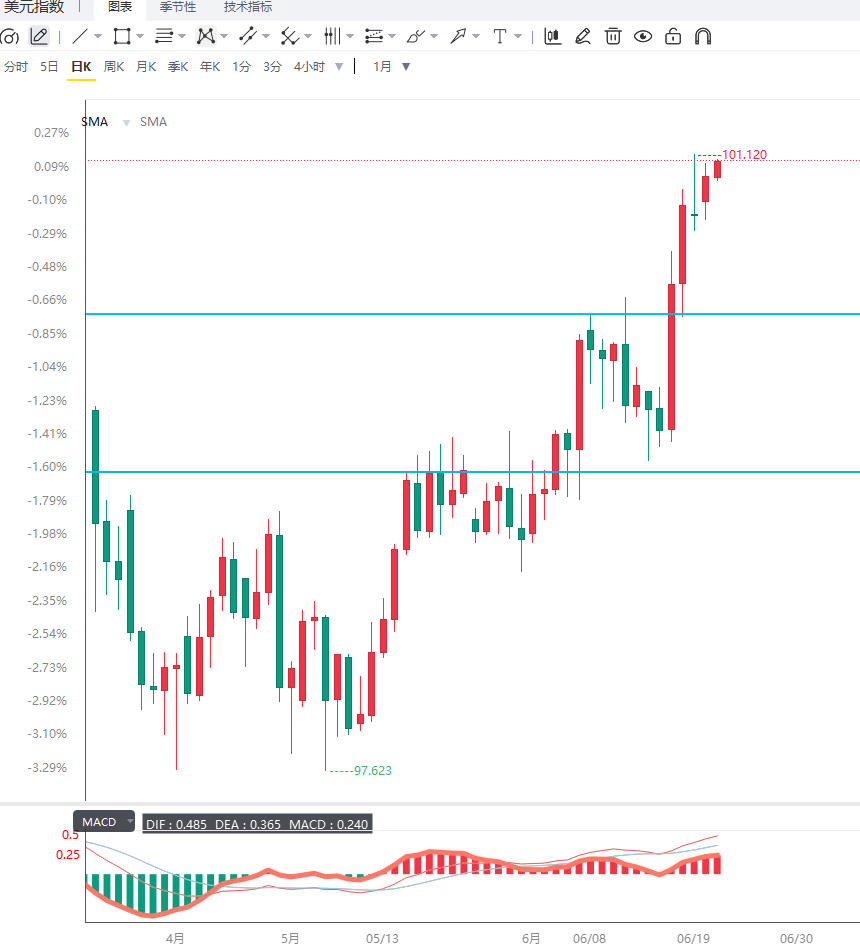
The US dollar index (DXY) remained range-bound during Tuesday's Asian trading session, trading around 101.00 . The dollar index had previously maintained strength for several consecutive trading days, reaching 101.13 on June 19, a new high in nearly 13 months. Current market focus remains on the Federal Reserve's policy outlook and the impact of developments in the Middle East on global risk appetite.
The core factor driving the recent rise in the US dollar stems from the hawkish signals released by the Federal Reserve. Last week, the Fed announced it would maintain the federal funds rate at 3.50%-3.75% , in line with market expectations. However, the latest economic projections and the remarks made by new Chairman Kevin Warsh during his first policy meeting significantly exceeded market expectations. The market believes that the Fed remains highly vigilant about future inflation trends and has not ruled out the possibility of further tightening of monetary policy. Although no rate hike was implemented at this meeting, the policymakers' assessment of the economic growth and inflation outlook was clearly hawkish, prompting investors to readjust their interest rate expectations.
Interest rate futures markets indicate that traders have largely priced in a 25-basis-point rate hike by the Federal Reserve at its September meeting. Meanwhile, some funds are even betting on a possible move as early as next month's meeting. As market expectations for the duration of the high-interest-rate environment continue to lengthen, US Treasury yields remain high, providing solid support for the US dollar.
Meanwhile, the overall resilience of the US economy remains stronger than that of most developed economies. Compared to the growth pressures faced by Europe and the UK, US economic data has remained generally stable, making dollar assets continue to attract global capital. Interest rate differentials and safe-haven demand have jointly driven the dollar index to remain at its highest level in over a year.
However, the dollar's further upward momentum is also constrained by several factors. Recent positive progress in US-Iran peace talks has improved market risk appetite, reducing some of the demand for safe-haven funds flowing into the dollar. US Vice President Vance stated that the negotiations held in Switzerland have made "significant progress," and although some differences remain, the overall atmosphere of the talks has improved significantly. The day before, Vance also revealed that Iran had agreed to reinstate IAEA inspectors to its territory.
Meanwhile, Iranian Foreign Minister Abbas Araqchi confirmed that the dialogue between the two sides had achieved significant results. The market believes that if a broader agreement can be reached in the future, it will help ease tensions in the Middle East and reduce risks to global energy supplies. With market concerns about the security of shipping in the Strait of Hormuz easing, international oil prices have continued to decline recently, and inflation expectations have also shown signs of cooling. This has, to some extent, reduced the attractiveness of the US dollar as a traditional safe-haven currency, thus restraining further upward movement of the dollar index.
From a market sentiment perspective, the US dollar is currently caught in a tug-of-war between two forces. On one hand, expectations of a hawkish Federal Reserve policy are strengthening; on the other hand, easing geopolitical risks are weakening demand for safe-haven assets. In the short term, which factor dominates will determine the direction of the US dollar index in the next stage.
From a technical perspective, the US dollar index maintains a clear upward trend on the daily chart. The price continues to trade above major moving averages and has firmly held above the 100 level, indicating that the medium-term bullish structure remains intact. The MACD indicator is running above the zero line, and although the red momentum bars have somewhat converged, the overall trend remains bullish. Key resistance levels to watch are 101.50 , 102.00 , and 103.00 ; a break above these levels could lead to further new highs. Support levels are located around 100.50 , 100.00 , and 99.30 .
From a 4-hour chart perspective, the US dollar index is showing clear signs of high-level consolidation. The MACD lines are running above the zero line, but short-term momentum has slowed, indicating the market has entered a consolidation phase. If it can effectively hold above 101.00 , it may continue to challenge the 101.50 area; if it breaks below the 100.50 support, it may trigger short-term profit-taking and test the psychological support level of 100. Overall, unless there is a significant change in the Fed's hawkish expectations, the US dollar index is expected to maintain a slightly bullish, oscillating pattern.
Editor's Summary : The US dollar index remains strongly supported by expectations of a hawkish Federal Reserve policy. The high-interest-rate environment and the relative resilience of the US economy continue to attract capital inflows into dollar assets. However, positive progress in US-Iran negotiations is weakening safe-haven demand, limiting the dollar's upside potential. In the short term, the market will focus on US economic data, speeches by Fed officials, and developments in the Middle East. If expectations of interest rate hikes strengthen further, the dollar index is likely to continue challenging new highs; conversely, if risk sentiment continues to improve, it may push the dollar into a consolidation phase at higher levels.
The core factor driving the recent rise in the US dollar stems from the hawkish signals released by the Federal Reserve. Last week, the Fed announced it would maintain the federal funds rate at 3.50%-3.75% , in line with market expectations. However, the latest economic projections and the remarks made by new Chairman Kevin Warsh during his first policy meeting significantly exceeded market expectations. The market believes that the Fed remains highly vigilant about future inflation trends and has not ruled out the possibility of further tightening of monetary policy. Although no rate hike was implemented at this meeting, the policymakers' assessment of the economic growth and inflation outlook was clearly hawkish, prompting investors to readjust their interest rate expectations.
Interest rate futures markets indicate that traders have largely priced in a 25-basis-point rate hike by the Federal Reserve at its September meeting. Meanwhile, some funds are even betting on a possible move as early as next month's meeting. As market expectations for the duration of the high-interest-rate environment continue to lengthen, US Treasury yields remain high, providing solid support for the US dollar.
Meanwhile, the overall resilience of the US economy remains stronger than that of most developed economies. Compared to the growth pressures faced by Europe and the UK, US economic data has remained generally stable, making dollar assets continue to attract global capital. Interest rate differentials and safe-haven demand have jointly driven the dollar index to remain at its highest level in over a year.
However, the dollar's further upward momentum is also constrained by several factors. Recent positive progress in US-Iran peace talks has improved market risk appetite, reducing some of the demand for safe-haven funds flowing into the dollar. US Vice President Vance stated that the negotiations held in Switzerland have made "significant progress," and although some differences remain, the overall atmosphere of the talks has improved significantly. The day before, Vance also revealed that Iran had agreed to reinstate IAEA inspectors to its territory.
Meanwhile, Iranian Foreign Minister Abbas Araqchi confirmed that the dialogue between the two sides had achieved significant results. The market believes that if a broader agreement can be reached in the future, it will help ease tensions in the Middle East and reduce risks to global energy supplies. With market concerns about the security of shipping in the Strait of Hormuz easing, international oil prices have continued to decline recently, and inflation expectations have also shown signs of cooling. This has, to some extent, reduced the attractiveness of the US dollar as a traditional safe-haven currency, thus restraining further upward movement of the dollar index.
From a market sentiment perspective, the US dollar is currently caught in a tug-of-war between two forces. On one hand, expectations of a hawkish Federal Reserve policy are strengthening; on the other hand, easing geopolitical risks are weakening demand for safe-haven assets. In the short term, which factor dominates will determine the direction of the US dollar index in the next stage.
From a technical perspective, the US dollar index maintains a clear upward trend on the daily chart. The price continues to trade above major moving averages and has firmly held above the 100 level, indicating that the medium-term bullish structure remains intact. The MACD indicator is running above the zero line, and although the red momentum bars have somewhat converged, the overall trend remains bullish. Key resistance levels to watch are 101.50 , 102.00 , and 103.00 ; a break above these levels could lead to further new highs. Support levels are located around 100.50 , 100.00 , and 99.30 .
From a 4-hour chart perspective, the US dollar index is showing clear signs of high-level consolidation. The MACD lines are running above the zero line, but short-term momentum has slowed, indicating the market has entered a consolidation phase. If it can effectively hold above 101.00 , it may continue to challenge the 101.50 area; if it breaks below the 100.50 support, it may trigger short-term profit-taking and test the psychological support level of 100. Overall, unless there is a significant change in the Fed's hawkish expectations, the US dollar index is expected to maintain a slightly bullish, oscillating pattern.
Editor's Summary : The US dollar index remains strongly supported by expectations of a hawkish Federal Reserve policy. The high-interest-rate environment and the relative resilience of the US economy continue to attract capital inflows into dollar assets. However, positive progress in US-Iran negotiations is weakening safe-haven demand, limiting the dollar's upside potential. In the short term, the market will focus on US economic data, speeches by Fed officials, and developments in the Middle East. If expectations of interest rate hikes strengthen further, the dollar index is likely to continue challenging new highs; conversely, if risk sentiment continues to improve, it may push the dollar into a consolidation phase at higher levels.
- Risk Warning and Disclaimer
- The market involves risk, and trading may not be suitable for all investors. This article is for reference only and does not constitute personal investment advice, nor does it take into account certain users’ specific investment objectives, financial situation, or other needs. Any investment decisions made based on this information are at your own risk.