The yen is just one step away from a 40-year low, and signs of joint US-Japan intervention are emerging. Can this stop the yen's decline?
2026-06-23 15:18:24
On Tuesday (June 23) during the Asian session, the USD/JPY pair fluctuated at high levels and is currently trading around 161.60.
On Tuesday, Japanese Finance Minister Satsuki Katayama said Tokyo was prepared to take "decisive measures" in the foreign exchange market as the yen's exchange rate against the dollar approached a 40-year low of 162.25.
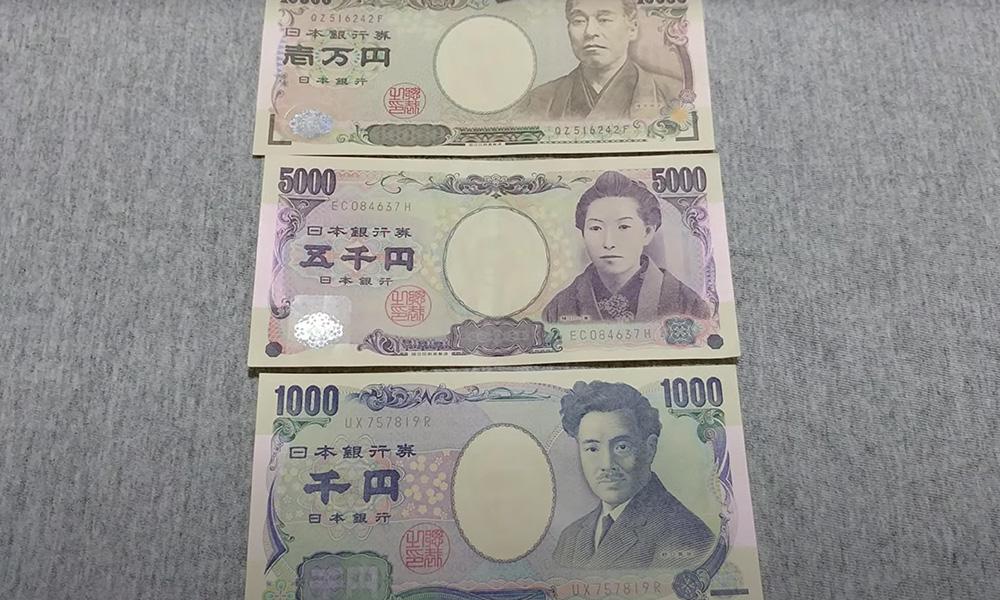
The yen has been weakening for years, and recently it has come under renewed pressure due to safe-haven demand triggered by the Middle East war and the widening interest rate differential between the US and Japan.
On Tuesday afternoon, the dollar traded around 161.60 against the yen – a level not far from the low of 161.93 reached on Monday, and just a step away from the all-time low of 162.25 in December 1986.
Market analysts point out that the current weakness of the yen is not only a result of policy divergence, but also influenced by uncertainty surrounding Japan's domestic economic growth prospects, continued capital outflows, and the enhanced safe-haven appeal of the US dollar amid geopolitical risks in the Middle East. Although Japan's June PMI data showed a rebound in manufacturing and services, high cost pressures and signs of slowing export orders failed to effectively boost confidence in the yen.
In the short term, the USD/JPY pair is expected to continue fluctuating at high levels within the 161-163 range. Investors should pay close attention to any signals of potential currency intervention by the Japanese government and the latest developments in the US-Iran negotiations, as these factors will directly affect the future trend of the yen.
During a phone call on Monday, Japanese Finance Minister Satsuki Katayama and U.S. Treasury official Bessant had in-depth discussions on the current exchange rate issue. The Japanese government subsequently officially confirmed the content of the call. After the call, Katayama publicly stated, "Japan and the United States have reached a firm consensus and will take decisive measures at any time if necessary to maintain exchange rate stability."
This strong statement was widely interpreted by the market as a sign that the Japanese authorities are prepared to intervene in the foreign exchange market again. Previously, last month, the Japanese government had already used over $70 billion of its foreign exchange reserves to intervene on a large scale to support the yen, demonstrating its unwavering determination to defend the yen's exchange rate.
Reports of the recent high-level phone call between Japan and the United States quickly boosted market confidence, helping the USD/JPY pair recover from an intraday low of 161.93 to around 161.60. However, despite the technical rebound, the yen remains in historically weak territory, just a step away from its all-time low of 162.25 set in December 1986.
Analysts point out that while the joint statement from Japan and the US has alleviated market concerns about a disorderly depreciation of the yen in the short term, the fundamental problems remain unresolved. The Bank of Japan's slow pace of interest rate hikes, the persistent interest rate differential between the US and Japan, and the safe-haven demand for the US dollar amid geopolitical risks in the Middle East are all contributing to downward pressure on the yen. Whether the Japanese government will intervene on a large scale again in the near future will remain a key variable influencing the USD/JPY exchange rate.
Analysts at MUFG Financial Group pointed out, "For the yen to achieve a sustained turnaround, the low real interest rate relative to the fundamentals in the United States must change." Last week, the Bank of Japan raised interest rates to a 31-year high, but analysts believe that the central bank needs to "send clearer signals of a hawkish path" to convey more confidence to the market that interest rate hikes are coming.
However, the rate hike may face resistance from the Ishiba government—which fears that high borrowing costs could stifle economic growth. Meanwhile, in the same week that the Bank of Japan raised rates, the Federal Reserve signaled a more hawkish shift, hinting at further rate hikes this year—this contrast means that the US-Japan interest rate differential is unlikely to narrow significantly in the short term, and the yen continues to face macroeconomic pressures.
The fact that the yen is nearing a 40-year low reflects the structural dilemma facing the Japanese economy: under the multiple pressures of a widening interest rate differential between the US and Japan, rising energy import costs due to geopolitical risks in the Middle East, and limited domestic policy space, the yen's weakness has become a systemic phenomenon.
Verbal intervention by Japan's Ministry of Finance and signals of coordination between Japan and the US may curb further yen depreciation in the short term, but as analysts point out, without changing the fundamental situation of low real interest rates, any intervention can only slow the rate of decline, not reverse the trend. The dilemma facing the Bank of Japan—raising interest rates to curb depreciation versus maintaining low interest rates to support growth—will remain the core contradiction troubling the yen for the foreseeable future.
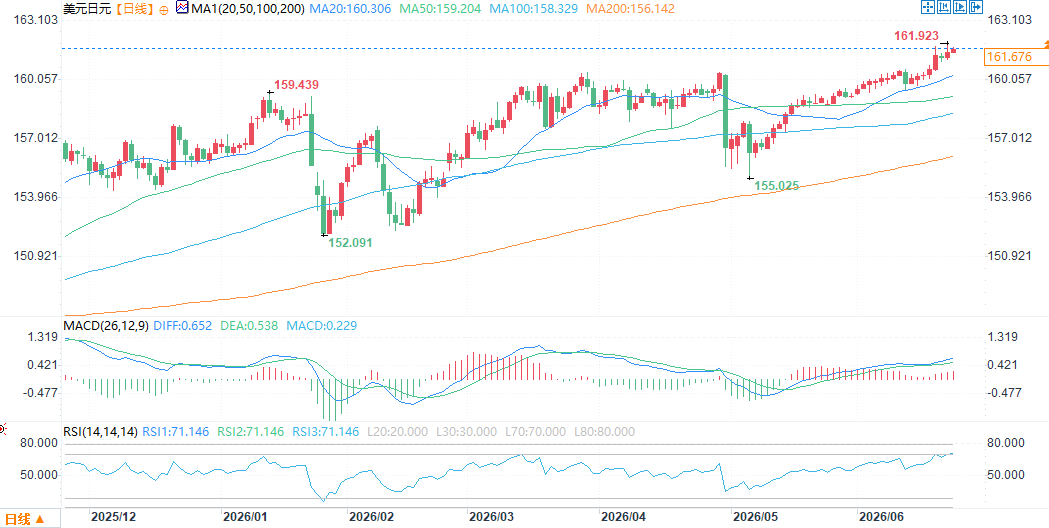
(USD/JPY daily chart, source: FX678)
At 15:18 Beijing time on June 23, the USD/JPY exchange rate was 161.54/55.
On Tuesday, Japanese Finance Minister Satsuki Katayama said Tokyo was prepared to take "decisive measures" in the foreign exchange market as the yen's exchange rate against the dollar approached a 40-year low of 162.25.
The yen is near a 40-year low.
The yen has been weakening for years, and recently it has come under renewed pressure due to safe-haven demand triggered by the Middle East war and the widening interest rate differential between the US and Japan.
On Tuesday afternoon, the dollar traded around 161.60 against the yen – a level not far from the low of 161.93 reached on Monday, and just a step away from the all-time low of 162.25 in December 1986.
Market analysts point out that the current weakness of the yen is not only a result of policy divergence, but also influenced by uncertainty surrounding Japan's domestic economic growth prospects, continued capital outflows, and the enhanced safe-haven appeal of the US dollar amid geopolitical risks in the Middle East. Although Japan's June PMI data showed a rebound in manufacturing and services, high cost pressures and signs of slowing export orders failed to effectively boost confidence in the yen.
In the short term, the USD/JPY pair is expected to continue fluctuating at high levels within the 161-163 range. Investors should pay close attention to any signals of potential currency intervention by the Japanese government and the latest developments in the US-Iran negotiations, as these factors will directly affect the future trend of the yen.
Signals of coordinated US-Japan intervention: Finance Minister says "decisive measures can be taken at any time"
During a phone call on Monday, Japanese Finance Minister Satsuki Katayama and U.S. Treasury official Bessant had in-depth discussions on the current exchange rate issue. The Japanese government subsequently officially confirmed the content of the call. After the call, Katayama publicly stated, "Japan and the United States have reached a firm consensus and will take decisive measures at any time if necessary to maintain exchange rate stability."
This strong statement was widely interpreted by the market as a sign that the Japanese authorities are prepared to intervene in the foreign exchange market again. Previously, last month, the Japanese government had already used over $70 billion of its foreign exchange reserves to intervene on a large scale to support the yen, demonstrating its unwavering determination to defend the yen's exchange rate.
Reports of the recent high-level phone call between Japan and the United States quickly boosted market confidence, helping the USD/JPY pair recover from an intraday low of 161.93 to around 161.60. However, despite the technical rebound, the yen remains in historically weak territory, just a step away from its all-time low of 162.25 set in December 1986.
Analysts point out that while the joint statement from Japan and the US has alleviated market concerns about a disorderly depreciation of the yen in the short term, the fundamental problems remain unresolved. The Bank of Japan's slow pace of interest rate hikes, the persistent interest rate differential between the US and Japan, and the safe-haven demand for the US dollar amid geopolitical risks in the Middle East are all contributing to downward pressure on the yen. Whether the Japanese government will intervene on a large scale again in the near future will remain a key variable influencing the USD/JPY exchange rate.
Policy dilemma: The Bank of Japan has limited room for interest rate hikes.
Analysts at MUFG Financial Group pointed out, "For the yen to achieve a sustained turnaround, the low real interest rate relative to the fundamentals in the United States must change." Last week, the Bank of Japan raised interest rates to a 31-year high, but analysts believe that the central bank needs to "send clearer signals of a hawkish path" to convey more confidence to the market that interest rate hikes are coming.
However, the rate hike may face resistance from the Ishiba government—which fears that high borrowing costs could stifle economic growth. Meanwhile, in the same week that the Bank of Japan raised rates, the Federal Reserve signaled a more hawkish shift, hinting at further rate hikes this year—this contrast means that the US-Japan interest rate differential is unlikely to narrow significantly in the short term, and the yen continues to face macroeconomic pressures.
In summary: Intervention can slow the decline, but it is unlikely to change the overall trend.
The fact that the yen is nearing a 40-year low reflects the structural dilemma facing the Japanese economy: under the multiple pressures of a widening interest rate differential between the US and Japan, rising energy import costs due to geopolitical risks in the Middle East, and limited domestic policy space, the yen's weakness has become a systemic phenomenon.
Verbal intervention by Japan's Ministry of Finance and signals of coordination between Japan and the US may curb further yen depreciation in the short term, but as analysts point out, without changing the fundamental situation of low real interest rates, any intervention can only slow the rate of decline, not reverse the trend. The dilemma facing the Bank of Japan—raising interest rates to curb depreciation versus maintaining low interest rates to support growth—will remain the core contradiction troubling the yen for the foreseeable future.
(USD/JPY daily chart, source: FX678)
At 15:18 Beijing time on June 23, the USD/JPY exchange rate was 161.54/55.
- Risk Warning and Disclaimer
- The market involves risk, and trading may not be suitable for all investors. This article is for reference only and does not constitute personal investment advice, nor does it take into account certain users’ specific investment objectives, financial situation, or other needs. Any investment decisions made based on this information are at your own risk.