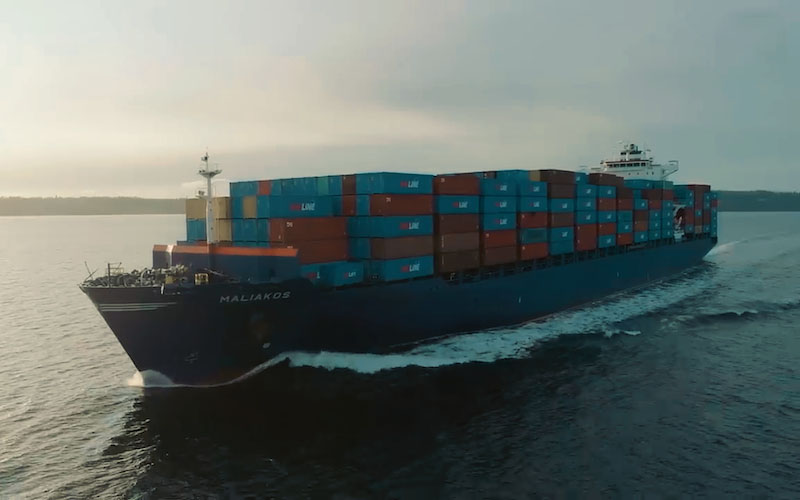
Brent crude oil prices continue to fluctuate around $77: channel repair is far from supply normalization, and the next wave of decline is brewing?
2026-06-23 20:58:11
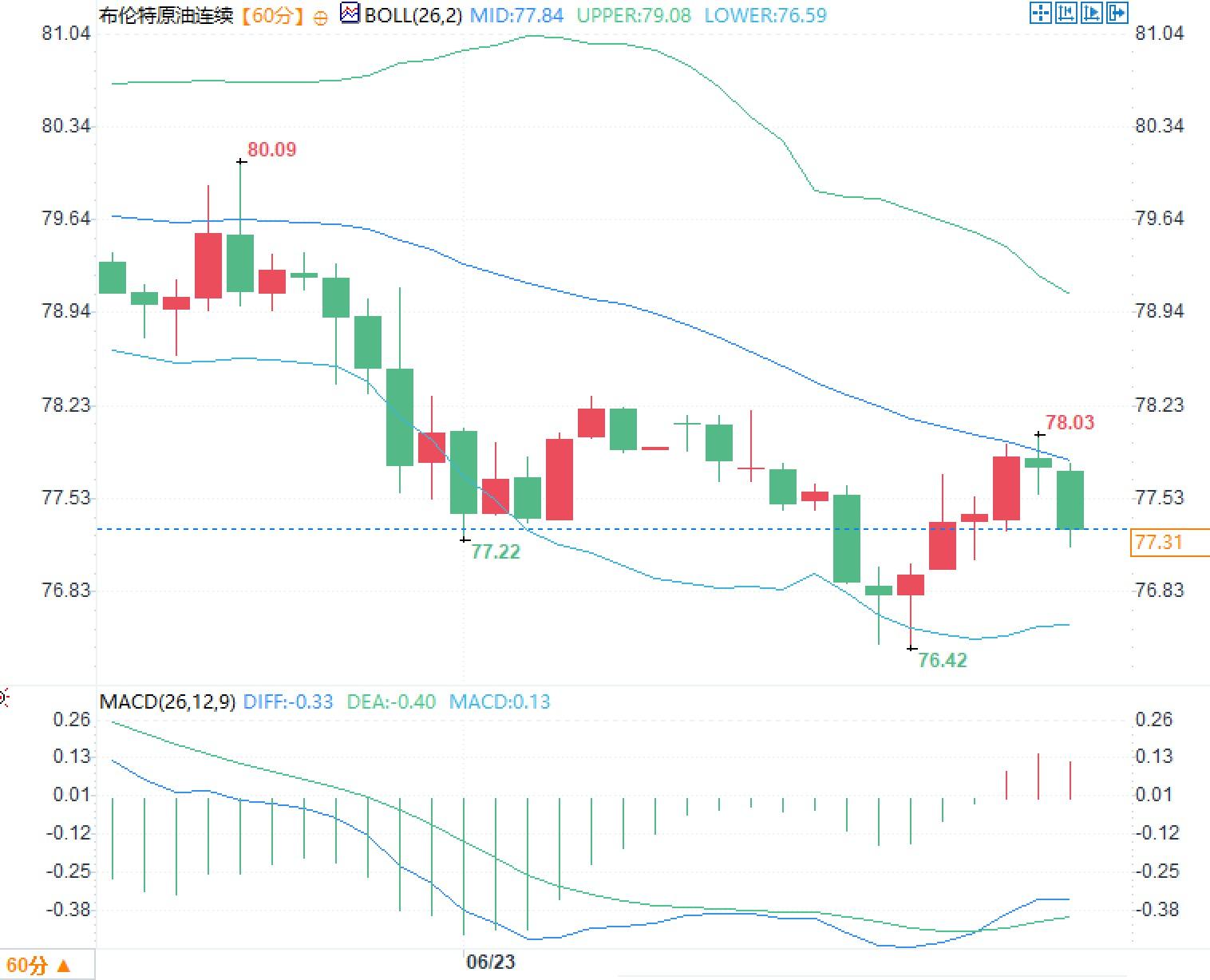
On Tuesday, June 23, the international crude oil market shifted from risk premium trading to channel correction pricing. Brent crude futures are currently fluctuating around $77 per barrel, while West Texas Intermediate crude is hovering around $73 per barrel, having not yet continued its downward trend after the sharp drop of the previous trading day.
While crude oil prices appear to be stabilizing, this actually reflects a market reassessment of three variables: the speed of the resumption of passage through the Strait of Hormuz, the true resilience of Iranian supply returning, and whether the easing of tensions in the Middle East is sufficient to reduce shipping and insurance costs. For traders, the current oil price decline is not a simple correction, but rather a process of risk premiums returning from extreme conditions to verifiable fundamentals.
The immediate trigger for this round of oil price adjustments was the progress in initial peace talks between the US and Iran, coupled with a 60-day waiver for Iranian crude oil sales. Following the announcement, crude oil prices fell by more than 3% in the previous trading day, indicating that the premium previously included in prices due to the Straits blockade, supply disruptions, and the spread of regional conflict was quickly squeezed out.
However, Brent crude is currently holding above $77 per barrel and has not fallen back to its pre-conflict lows. The core reason is that the market cannot yet equate the restoration of the passageway with a complete normalization of supply. The Strait of Hormuz not only affects crude oil transportation but also liquefied natural gas (LNG) trade. Public energy statistics show that in the first half of 2025, approximately 11.4 billion cubic feet of LNG will be transported through the strait daily, accounting for more than 20% of global LNG trade. Crude oil is also highly sensitive, and the market generally considers it one of the world's most critical energy chokepoints.
In other words, the current price pullback is more a reflection of reduced tail risks than a confirmed oversupply. For the futures market, the fading of risk premiums typically outpaces the recovery of physical market flows, which is a key reason why prices have entered a period of consolidation after a sharp drop.
According to market sources, the number of vessels currently allowed to pass through the Strait of Hormuz daily remains limited and requires coordination with local maritime forces. This means the market needs to observe not only whether passage is possible, but also whether passage efficiency can return to normal. In energy trade, the restoration of passageways exhibits a clear non-linear characteristic: the passage of the first vessel can alter sentiment, but sustained, safe, and low-cost passage is what will change the supply-demand balance.
Constraints on the shipping side remain complex. Mine risk assessment, port damage, floating debris, shipping schedule congestion, insurance rate adjustments, and shipowner risk appetite all affect the actual shipment pace. Even with continued signs of political easing, commercial shipping typically requires greater certainty to accelerate its recovery. The previous closure of shipping lanes for over three months resulted in the loss of millions of barrels of oil and gas supply globally, disrupting inventories, refinery procurement plans, and regional trade flows.
Therefore, oil prices are currently not trading on "supply has recovered," but rather on "the increased probability of supply recovery." This distinction is crucial. If cross-strait traffic continues to recover, the risk premium could be further compressed; if traffic recovery is hampered, prices may re-induce transportation bottlenecks.
Institutional forecasts are also being revised downwards. Some banks have lowered their third-quarter Brent crude oil forecasts to $79 per barrel and their fourth-quarter forecasts to $78 per barrel, citing easing risks of supply disruptions in the Gulf. This forecast does not indicate a lack of conditions for a price rebound, but rather reflects a declining market tolerance for high risk premiums. Without new supply disruptions, longer-term prices are more susceptible to constraints from inventory repair and demand elasticity.
From a macro perspective, crude oil currently lacks a strong demand narrative. The price decline has not significantly improved the performance of risk assets, indicating that market focus has shifted from energy shocks to interest rate expectations, corporate profits, and the quality of global growth. While lower energy costs help alleviate inflationary pressures, for crude oil itself, if demand does not strengthen in tandem, supply recovery will translate into upward pressure on prices.
While crude oil prices appear to be stabilizing, this actually reflects a market reassessment of three variables: the speed of the resumption of passage through the Strait of Hormuz, the true resilience of Iranian supply returning, and whether the easing of tensions in the Middle East is sufficient to reduce shipping and insurance costs. For traders, the current oil price decline is not a simple correction, but rather a process of risk premiums returning from extreme conditions to verifiable fundamentals.
The immediate trigger for this round of oil price adjustments was the progress in initial peace talks between the US and Iran, coupled with a 60-day waiver for Iranian crude oil sales. Following the announcement, crude oil prices fell by more than 3% in the previous trading day, indicating that the premium previously included in prices due to the Straits blockade, supply disruptions, and the spread of regional conflict was quickly squeezed out.
However, Brent crude is currently holding above $77 per barrel and has not fallen back to its pre-conflict lows. The core reason is that the market cannot yet equate the restoration of the passageway with a complete normalization of supply. The Strait of Hormuz not only affects crude oil transportation but also liquefied natural gas (LNG) trade. Public energy statistics show that in the first half of 2025, approximately 11.4 billion cubic feet of LNG will be transported through the strait daily, accounting for more than 20% of global LNG trade. Crude oil is also highly sensitive, and the market generally considers it one of the world's most critical energy chokepoints.
In other words, the current price pullback is more a reflection of reduced tail risks than a confirmed oversupply. For the futures market, the fading of risk premiums typically outpaces the recovery of physical market flows, which is a key reason why prices have entered a period of consolidation after a sharp drop.
According to market sources, the number of vessels currently allowed to pass through the Strait of Hormuz daily remains limited and requires coordination with local maritime forces. This means the market needs to observe not only whether passage is possible, but also whether passage efficiency can return to normal. In energy trade, the restoration of passageways exhibits a clear non-linear characteristic: the passage of the first vessel can alter sentiment, but sustained, safe, and low-cost passage is what will change the supply-demand balance.
Constraints on the shipping side remain complex. Mine risk assessment, port damage, floating debris, shipping schedule congestion, insurance rate adjustments, and shipowner risk appetite all affect the actual shipment pace. Even with continued signs of political easing, commercial shipping typically requires greater certainty to accelerate its recovery. The previous closure of shipping lanes for over three months resulted in the loss of millions of barrels of oil and gas supply globally, disrupting inventories, refinery procurement plans, and regional trade flows.
Therefore, oil prices are currently not trading on "supply has recovered," but rather on "the increased probability of supply recovery." This distinction is crucial. If cross-strait traffic continues to recover, the risk premium could be further compressed; if traffic recovery is hampered, prices may re-induce transportation bottlenecks.
Institutional forecasts are also being revised downwards. Some banks have lowered their third-quarter Brent crude oil forecasts to $79 per barrel and their fourth-quarter forecasts to $78 per barrel, citing easing risks of supply disruptions in the Gulf. This forecast does not indicate a lack of conditions for a price rebound, but rather reflects a declining market tolerance for high risk premiums. Without new supply disruptions, longer-term prices are more susceptible to constraints from inventory repair and demand elasticity.
From a macro perspective, crude oil currently lacks a strong demand narrative. The price decline has not significantly improved the performance of risk assets, indicating that market focus has shifted from energy shocks to interest rate expectations, corporate profits, and the quality of global growth. While lower energy costs help alleviate inflationary pressures, for crude oil itself, if demand does not strengthen in tandem, supply recovery will translate into upward pressure on prices.
- Risk Warning and Disclaimer
- The market involves risk, and trading may not be suitable for all investors. This article is for reference only and does not constitute personal investment advice, nor does it take into account certain users’ specific investment objectives, financial situation, or other needs. Any investment decisions made based on this information are at your own risk.