A strong dollar is putting pressure on the pound; can the unexpected "stopping of the bleeding" in British politics reverse the downward trend?
2026-06-24 15:20:46
On Wednesday (June 24) during the European session, the pound continued its decline against the dollar, poised for a second consecutive day of losses, currently trading around 1.3180. The dollar's continued strength, driven by strong US economic data and a complex geopolitical landscape, has put downward pressure on the pound.
However, in the UK, the Labour Party leadership quickly initiated a smooth transition after Prime Minister Starmer's resignation, avoiding a protracted internal party struggle and providing some support for the pound.
The core reason for the weakening of the pound lies in the overall strength of the US dollar, and the rise of the US dollar is driven by two major factors.
On the economic data front, the preliminary US PMI figures for June exceeded expectations across the board, further solidifying the narrative of "American exceptionalism." The S&P Global US Composite Purchasing Managers' Index (PMI) climbed to 52.2, significantly higher than May's 51.5, indicating that business activity remained in healthy expansion. The manufacturing output index jumped from 55.1 in the previous month to 55.7, far exceeding the expected 54.8, demonstrating strong resilience. The services PMI recorded 51.3, slightly higher than May's 50.7 and also exceeding market expectations of 51.0, proving that demand in the services economy remained robust.
These data demonstrate that the US economy maintains a relative advantage among major developed economies, providing solid fundamental support for the US dollar.
Geopolitically, the situation in the Middle East presents complex and contradictory signals. US President Trump claimed that Iran had "fully and completely" agreed to open its facilities for nuclear inspections, but Iranian Foreign Minister Abbas Araqchi quickly responded that substantive nuclear negotiations had not yet begun, clearly downplaying market optimism about a rapid breakthrough between the US and Iran.
Meanwhile, Iran’s chief nuclear negotiator issued a stern warning, stating that the Strait of Hormuz “will never return to its pre-war state” and will always remain under Iran’s tight control, further exacerbating market concerns about energy supplies and regional stability.
However, positive signals also emerged from Washington—the US sponsored a new round of negotiations between Israel and Lebanon, aimed at facilitating a ceasefire agreement with Hezbollah, which is backed by Iran. This complex geopolitical situation has continued to support the US dollar as the world's primary safe-haven asset.
The pound sterling has found some support during this round of decline, mainly due to the rapid easing of domestic political uncertainty in the UK.
Following Prime Minister Keir Starmer's unexpected resignation last week, markets were initially concerned about a potential protracted leadership battle within the Labour Party. However, the situation has unfolded more smoothly than expected – Andy Burnham has quickly emerged as the frontrunner to take over the Labour leadership, securing key support from former Health Secretary Wes Streatine.
This development significantly reduced the risk of a fierce, divisive struggle within the Labour Party, reassuring markets that Britain will experience a swift and orderly political transition.
Investors reacted positively, with the easing of political anxieties providing emotional support for the pound. However, the positive political news proved insufficient in the face of a strong dollar, and the overall trend of the pound remains dominated by external factors.
Goldman Sachs Research expects the UK economy to present a mixed picture in 2026, with trend growth accompanied by rising unemployment, but significantly lower inflation. The BoE may cut interest rates three more times to 3%. A weaker dollar will provide external support, but domestic fiscal headwinds and limited independent momentum will limit a significant appreciation of the pound.
HSBC's foreign exchange strategy is cautious on the pound, believing that geopolitical stalemate (Middle East situation) will cause most currency pairs to trade within a range, with the pound facing certain downside pressure. Interest rate differentials are beginning to take effect, but UK political uncertainty and fiscal challenges are limiting performance. The pound is relatively stable in the short term, but faces greater challenges in the medium to long term.
According to the daily chart, the GBP/USD pair is currently in a downward channel, with the bearish trend dominating the market. The moving average system has formed a downward pressure pattern, with the price breaking significantly below multiple moving averages, including the 20-day moving average (MA20) (1.3355), 50-day moving average (MA50) (1.3442), and 100-day moving average (MA100) (1.3433). The medium- and long-term moving averages are also turning downwards, indicating significant resistance to any rebound.
The MACD indicator's DIFF (-0.0062) continues to run below the DEA (-0.0043), with the green momentum bars continuing to expand, indicating sustained bearish momentum and no signs of a golden cross to halt the decline. The RSI indicator has fallen back to 33.41, approaching the oversold zone of 30, suggesting a slight technical correction in the short term, but the overall downward structure remains unchanged.
In terms of price movement, after forming a double top at the previous high of 1.3657, the price weakened and recently quickly fell to a low of 1.3162, breaking through the support near 1.33, the bottom of the previous trading range. The previous low of 1.3159 forms a key short-term support level; a break below this level would open up further downside potential. The first resistance level is around 1.33, followed by the 20-day moving average at 1.3355, and then the medium-term moving average platform at 1.3433.
The overall market trend is bearish in the medium term. The short-term oversold conditions have only triggered a slight rebound. When the price rebounds to the moving average resistance area, the strategy should still be to sell on rallies. Only when the price effectively stabilizes above the 20-day moving average and the MACD forms a golden cross at a low level with the green bars narrowing can the continuous decline be alleviated in stages.
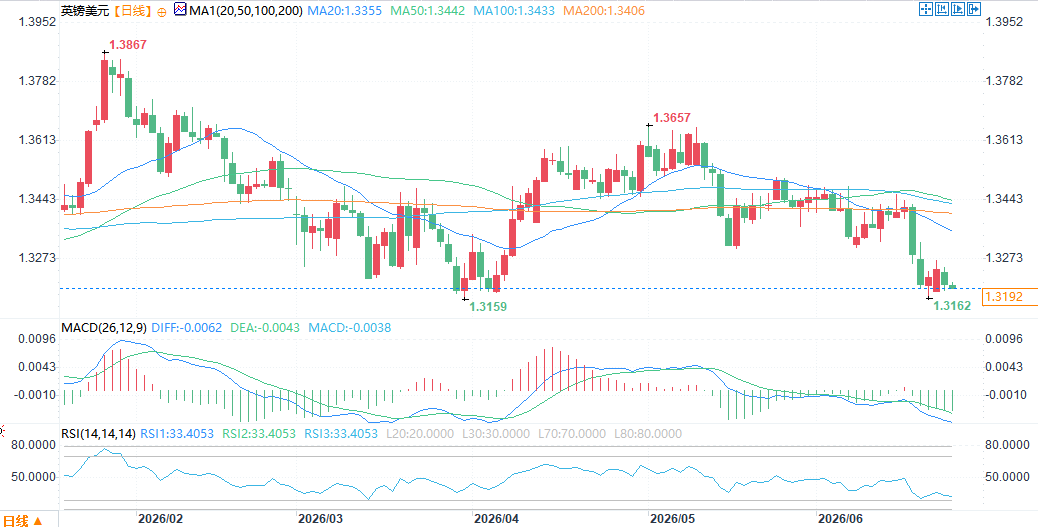
(GBP/USD daily chart, source: FX678)
At 15:17 Beijing time on June 24, the British pound was trading at 1.3181/82 against the US dollar.
However, in the UK, the Labour Party leadership quickly initiated a smooth transition after Prime Minister Starmer's resignation, avoiding a protracted internal party struggle and providing some support for the pound.
A strong dollar is fueled by two engines: better-than-expected economic data coupled with geopolitical risk aversion.
The core reason for the weakening of the pound lies in the overall strength of the US dollar, and the rise of the US dollar is driven by two major factors.
On the economic data front, the preliminary US PMI figures for June exceeded expectations across the board, further solidifying the narrative of "American exceptionalism." The S&P Global US Composite Purchasing Managers' Index (PMI) climbed to 52.2, significantly higher than May's 51.5, indicating that business activity remained in healthy expansion. The manufacturing output index jumped from 55.1 in the previous month to 55.7, far exceeding the expected 54.8, demonstrating strong resilience. The services PMI recorded 51.3, slightly higher than May's 50.7 and also exceeding market expectations of 51.0, proving that demand in the services economy remained robust.
These data demonstrate that the US economy maintains a relative advantage among major developed economies, providing solid fundamental support for the US dollar.
Geopolitically, the situation in the Middle East presents complex and contradictory signals. US President Trump claimed that Iran had "fully and completely" agreed to open its facilities for nuclear inspections, but Iranian Foreign Minister Abbas Araqchi quickly responded that substantive nuclear negotiations had not yet begun, clearly downplaying market optimism about a rapid breakthrough between the US and Iran.
Meanwhile, Iran’s chief nuclear negotiator issued a stern warning, stating that the Strait of Hormuz “will never return to its pre-war state” and will always remain under Iran’s tight control, further exacerbating market concerns about energy supplies and regional stability.
However, positive signals also emerged from Washington—the US sponsored a new round of negotiations between Israel and Lebanon, aimed at facilitating a ceasefire agreement with Hezbollah, which is backed by Iran. This complex geopolitical situation has continued to support the US dollar as the world's primary safe-haven asset.
UK Political Transition: Labour Party Quickly Reorganizes After Starmer's Resignation, Market Sentiment Stabilizes
The pound sterling has found some support during this round of decline, mainly due to the rapid easing of domestic political uncertainty in the UK.
Following Prime Minister Keir Starmer's unexpected resignation last week, markets were initially concerned about a potential protracted leadership battle within the Labour Party. However, the situation has unfolded more smoothly than expected – Andy Burnham has quickly emerged as the frontrunner to take over the Labour leadership, securing key support from former Health Secretary Wes Streatine.
This development significantly reduced the risk of a fierce, divisive struggle within the Labour Party, reassuring markets that Britain will experience a swift and orderly political transition.
Investors reacted positively, with the easing of political anxieties providing emotional support for the pound. However, the positive political news proved insufficient in the face of a strong dollar, and the overall trend of the pound remains dominated by external factors.
Institutional Views
Goldman Sachs Research expects the UK economy to present a mixed picture in 2026, with trend growth accompanied by rising unemployment, but significantly lower inflation. The BoE may cut interest rates three more times to 3%. A weaker dollar will provide external support, but domestic fiscal headwinds and limited independent momentum will limit a significant appreciation of the pound.
HSBC's foreign exchange strategy is cautious on the pound, believing that geopolitical stalemate (Middle East situation) will cause most currency pairs to trade within a range, with the pound facing certain downside pressure. Interest rate differentials are beginning to take effect, but UK political uncertainty and fiscal challenges are limiting performance. The pound is relatively stable in the short term, but faces greater challenges in the medium to long term.
Technical Analysis
According to the daily chart, the GBP/USD pair is currently in a downward channel, with the bearish trend dominating the market. The moving average system has formed a downward pressure pattern, with the price breaking significantly below multiple moving averages, including the 20-day moving average (MA20) (1.3355), 50-day moving average (MA50) (1.3442), and 100-day moving average (MA100) (1.3433). The medium- and long-term moving averages are also turning downwards, indicating significant resistance to any rebound.
The MACD indicator's DIFF (-0.0062) continues to run below the DEA (-0.0043), with the green momentum bars continuing to expand, indicating sustained bearish momentum and no signs of a golden cross to halt the decline. The RSI indicator has fallen back to 33.41, approaching the oversold zone of 30, suggesting a slight technical correction in the short term, but the overall downward structure remains unchanged.
In terms of price movement, after forming a double top at the previous high of 1.3657, the price weakened and recently quickly fell to a low of 1.3162, breaking through the support near 1.33, the bottom of the previous trading range. The previous low of 1.3159 forms a key short-term support level; a break below this level would open up further downside potential. The first resistance level is around 1.33, followed by the 20-day moving average at 1.3355, and then the medium-term moving average platform at 1.3433.
The overall market trend is bearish in the medium term. The short-term oversold conditions have only triggered a slight rebound. When the price rebounds to the moving average resistance area, the strategy should still be to sell on rallies. Only when the price effectively stabilizes above the 20-day moving average and the MACD forms a golden cross at a low level with the green bars narrowing can the continuous decline be alleviated in stages.
(GBP/USD daily chart, source: FX678)
At 15:17 Beijing time on June 24, the British pound was trading at 1.3181/82 against the US dollar.
- Risk Warning and Disclaimer
- The market involves risk, and trading may not be suitable for all investors. This article is for reference only and does not constitute personal investment advice, nor does it take into account certain users’ specific investment objectives, financial situation, or other needs. Any investment decisions made based on this information are at your own risk.