Market sentiment triggered a gold price decline, while central banks quietly bought on the dip; opportunities never need to be announced.
2026-06-24 16:06:25
On Wednesday (June 24), during the Asian and European sessions, spot gold experienced a slight rebound after hitting a low, but maintained its downward trend. It is currently trading around 4085, down 0.59%, having briefly dipped to 4050 during the session.
Gold prices have been under pressure recently, influenced by tightening risk appetite in global equity markets. The easing of US-Iran geopolitical tensions has not provided sufficient support for gold prices, but geopolitical benefits still exist, suggesting that gold prices may be undervalued in the short term.
The geopolitical landscape in the Middle East has recently undergone a phased shift. The navigation status of the Strait of Hormuz has been adjusted, and multiple diplomatic statements have been implemented, resulting in a significant cooling of the intensity of geopolitical conflicts in the Middle East, which is generally beneficial to gold prices.

In an effort to stabilize the sentiments of Gulf allies and resolve regional geopolitical differences, U.S. Secretary of State Marco Rubio embarked on a diplomatic tour of the UAE, Kuwait, and Bahrain. The primary objective of this trip was to alleviate the geopolitical anxieties of the Gulf states regarding the interim memorandum of understanding between the U.S. and Iran.
Earlier, U.S. Vice President Vance led a delegation to Switzerland for two days of intensive diplomatic consultations between the U.S. and Iran, finalizing a phase-one ceasefire agreement. The core contents of the agreement include ending hostile military operations throughout the Middle East, resuming navigation in the Strait of Hormuz, the U.S. easing sanctions against Iran in stages, and setting a deadline of 60 days for special negotiations on Iran's nuclear program.
It is worth noting that the UAE, Kuwait, and Bahrain previously suffered cross-border retaliation from Iranian drones and missiles due to the joint US-Israeli airstrikes against Iran. Compared to the Trump administration, the three Gulf states currently hold a more hardline stance on containing Iran, and generally question whether the US-Iran agreement favors Iran and harms the national security interests of the Gulf states.
Rubio publicly addressed and clarified the key concerns of the Gulf states.
First, Iran's planned $300 billion national investment fund could not be approved, as the US set strict requirements:
Iran must abandon its revolutionary expansionist path of exporting extremism and transform into a compliant, market-oriented sovereign state before financial support will be granted;
Secondly, the three major concerns of the Gulf states—Iran's ballistic missile development, support for foreign proxy armed groups, and delayed management of the nuclear issue—have been included in the scope of the bilateral memorandum of understanding signed last week. The memorandum requires Iran to cut off funding and arms supplies to proxy armed groups such as Hamas, Hezbollah, and the Houthis, and to terminate all regional armed conflicts. These issues will be discussed in detail in subsequent tiered negotiations.
However, it is worth noting that these contents were not written into the memorandum. These contents are just the consistent position of the US side. At the same time, these contents are likely to be discussed in the 60-day ceasefire agreement and are also the obvious points of disagreement in the 60-day peace talks between the US and Iran.
The dispute over navigation fees in the Strait of Hormuz is the core point of contention in the current diplomatic game between the US and Iran.
The US has consistently adhered to the bottom line of international law, recognizing the waterway as an international public waterway, and stating that coastal states have no right to collect passage fees. Rubio made it clear that the US has zero tolerance for Iran's waterway fee scheme, and that Gulf states all believe the strait should be free to navigate.
Recently, Iran has officially changed its stance. Ali Bahrani, Iran’s Permanent Representative to the United Nations Office at Geneva, officially stated on the 23rd that the Strait of Hormuz is now fully open to merchant ships and that passage fees will be waived for the next 60 days.
The US and Iran have established a dedicated communication mechanism to handle any unforeseen issues related to navigation in real time. After the 60-day period expires, the detailed rules for passage through the Taiwan Strait will be finalized in the next round of US-Iran negotiations.
Prior to this, the United Arab Emirates, in conjunction with the International Maritime Organization, had already opened a temporary shipping channel in the strait to ensure the orderly passage of compliant merchant ships, in line with the diplomatic pace of easing tensions between the United States and Iran.
The recovery in shipping directly triggered a surge in freight rates in the tanker charter market.
Supported by a recovery in demand for crude oil exports, regional tanker freight rates have surged, and tanker operators' profits hit a new historical high this week.
Data shows that the cost of chartering standby tankers outside the Strait of Hormuz has surged from $106,500 per week a week ago to $190,500 per day, nearly doubling in price, and freight rates for chartering vessels across the entire Gulf region have risen sharply in tandem.
The continued decline in geopolitical risk premiums has also directly pressured international crude oil prices downward. According to Rabobank energy strategists, the steady recovery of cross-strait traffic, coupled with the continued release of strategic oil reserves by various countries, makes it difficult to reverse the downward pressure on oil prices in the short term.
Currently, gold prices are mainly suppressed by the US dollar index, supported by easing geopolitical tensions, and pressured by shrinking risk appetite in equity markets. The current trend is weak, but as gold prices continue to fall, central banks around the world are more willing to buy in batches.
Geopolitical shifts are generally favorable for gold prices, but recent volatility in equity markets has suppressed them. Gold is relatively cheap here, so after the short-term equity market turmoil subsides, gold prices may break their downtrend. This opportunity may be today. As the saying goes, opportunities arise from declines, and risks arise from rises. We will continue to monitor the turning point for gold.
From a technical perspective, gold prices continue to move within a downward channel, currently finding support at the lower channel line and the important 0.618 Fibonacci retracement level. Going forward, watch for opportunities to break through the middle channel line and the downtrend line.
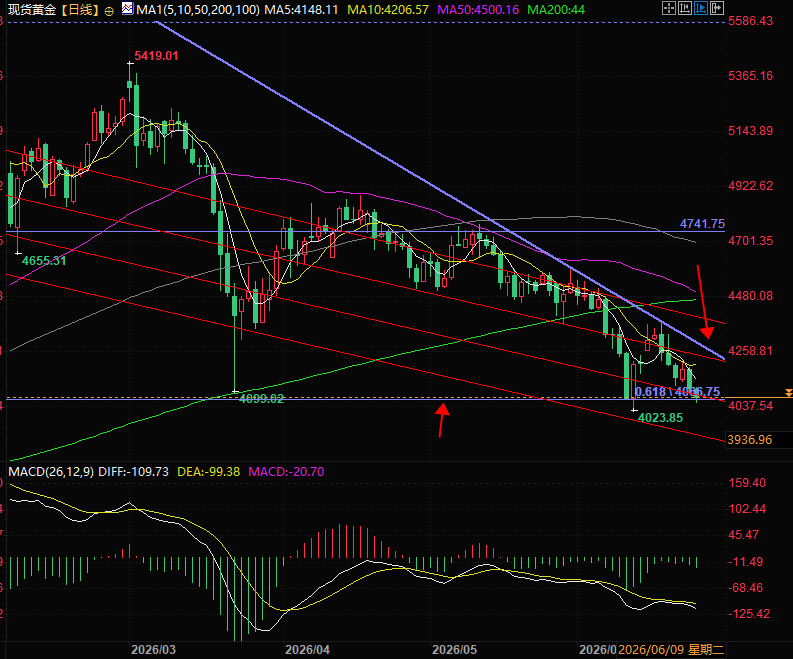
(Spot gold daily chart, source: FX678)
At 16:03 Beijing time, spot gold is currently trading at $4,076 per ounce.
Gold prices have been under pressure recently, influenced by tightening risk appetite in global equity markets. The easing of US-Iran geopolitical tensions has not provided sufficient support for gold prices, but geopolitical benefits still exist, suggesting that gold prices may be undervalued in the short term.
The geopolitical landscape in the Middle East has recently undergone a phased shift. The navigation status of the Strait of Hormuz has been adjusted, and multiple diplomatic statements have been implemented, resulting in a significant cooling of the intensity of geopolitical conflicts in the Middle East, which is generally beneficial to gold prices.
US visits Gulf allies to reassure them and ease regional doubts about the agreement.
In an effort to stabilize the sentiments of Gulf allies and resolve regional geopolitical differences, U.S. Secretary of State Marco Rubio embarked on a diplomatic tour of the UAE, Kuwait, and Bahrain. The primary objective of this trip was to alleviate the geopolitical anxieties of the Gulf states regarding the interim memorandum of understanding between the U.S. and Iran.
Earlier, U.S. Vice President Vance led a delegation to Switzerland for two days of intensive diplomatic consultations between the U.S. and Iran, finalizing a phase-one ceasefire agreement. The core contents of the agreement include ending hostile military operations throughout the Middle East, resuming navigation in the Strait of Hormuz, the U.S. easing sanctions against Iran in stages, and setting a deadline of 60 days for special negotiations on Iran's nuclear program.
It is worth noting that the UAE, Kuwait, and Bahrain previously suffered cross-border retaliation from Iranian drones and missiles due to the joint US-Israeli airstrikes against Iran. Compared to the Trump administration, the three Gulf states currently hold a more hardline stance on containing Iran, and generally question whether the US-Iran agreement favors Iran and harms the national security interests of the Gulf states.
The US explained the details of the agreement and set hard thresholds for cooperation with Iran.
Rubio publicly addressed and clarified the key concerns of the Gulf states.
First, Iran's planned $300 billion national investment fund could not be approved, as the US set strict requirements:
Iran must abandon its revolutionary expansionist path of exporting extremism and transform into a compliant, market-oriented sovereign state before financial support will be granted;
Secondly, the three major concerns of the Gulf states—Iran's ballistic missile development, support for foreign proxy armed groups, and delayed management of the nuclear issue—have been included in the scope of the bilateral memorandum of understanding signed last week. The memorandum requires Iran to cut off funding and arms supplies to proxy armed groups such as Hamas, Hezbollah, and the Houthis, and to terminate all regional armed conflicts. These issues will be discussed in detail in subsequent tiered negotiations.
However, it is worth noting that these contents were not written into the memorandum. These contents are just the consistent position of the US side. At the same time, these contents are likely to be discussed in the 60-day ceasefire agreement and are also the obvious points of disagreement in the 60-day peace talks between the US and Iran.
The dispute over toll fees in the Taiwan Strait has been resolved, with Iran announcing 60 days of free navigation.
The dispute over navigation fees in the Strait of Hormuz is the core point of contention in the current diplomatic game between the US and Iran.
The US has consistently adhered to the bottom line of international law, recognizing the waterway as an international public waterway, and stating that coastal states have no right to collect passage fees. Rubio made it clear that the US has zero tolerance for Iran's waterway fee scheme, and that Gulf states all believe the strait should be free to navigate.
Recently, Iran has officially changed its stance. Ali Bahrani, Iran’s Permanent Representative to the United Nations Office at Geneva, officially stated on the 23rd that the Strait of Hormuz is now fully open to merchant ships and that passage fees will be waived for the next 60 days.
The US and Iran have established a dedicated communication mechanism to handle any unforeseen issues related to navigation in real time. After the 60-day period expires, the detailed rules for passage through the Taiwan Strait will be finalized in the next round of US-Iran negotiations.
Prior to this, the United Arab Emirates, in conjunction with the International Maritime Organization, had already opened a temporary shipping channel in the strait to ensure the orderly passage of compliant merchant ships, in line with the diplomatic pace of easing tensions between the United States and Iran.
The shipping recovery has led to a surge in freight rates, while geopolitical tensions have put downward pressure on international oil prices.
The recovery in shipping directly triggered a surge in freight rates in the tanker charter market.
Supported by a recovery in demand for crude oil exports, regional tanker freight rates have surged, and tanker operators' profits hit a new historical high this week.
Data shows that the cost of chartering standby tankers outside the Strait of Hormuz has surged from $106,500 per week a week ago to $190,500 per day, nearly doubling in price, and freight rates for chartering vessels across the entire Gulf region have risen sharply in tandem.
The continued decline in geopolitical risk premiums has also directly pressured international crude oil prices downward. According to Rabobank energy strategists, the steady recovery of cross-strait traffic, coupled with the continued release of strategic oil reserves by various countries, makes it difficult to reverse the downward pressure on oil prices in the short term.
Summary and Technical Analysis:
Currently, gold prices are mainly suppressed by the US dollar index, supported by easing geopolitical tensions, and pressured by shrinking risk appetite in equity markets. The current trend is weak, but as gold prices continue to fall, central banks around the world are more willing to buy in batches.
Geopolitical shifts are generally favorable for gold prices, but recent volatility in equity markets has suppressed them. Gold is relatively cheap here, so after the short-term equity market turmoil subsides, gold prices may break their downtrend. This opportunity may be today. As the saying goes, opportunities arise from declines, and risks arise from rises. We will continue to monitor the turning point for gold.
From a technical perspective, gold prices continue to move within a downward channel, currently finding support at the lower channel line and the important 0.618 Fibonacci retracement level. Going forward, watch for opportunities to break through the middle channel line and the downtrend line.
(Spot gold daily chart, source: FX678)
At 16:03 Beijing time, spot gold is currently trading at $4,076 per ounce.
- Risk Warning and Disclaimer
- The market involves risk, and trading may not be suitable for all investors. This article is for reference only and does not constitute personal investment advice, nor does it take into account certain users’ specific investment objectives, financial situation, or other needs. Any investment decisions made based on this information are at your own risk.