Why did the decline in tech stocks drag down gold? A cross-asset deleveraging storm is brewing.
2026-06-24 15:52:48
On Wednesday, June 24th, the main theme in the precious metals market shifted from safe-haven premiums to interest rate revaluation. Spot gold fell for the second consecutive day, briefly approaching $4050/oz before returning to around $4080/oz, fluctuating near the previous trading day's low. Meanwhile, the dollar index rose to near a one-year high, US Treasury yields remained high, and cross-asset deleveraging triggered by the tech stock correction caused gold's safe-haven appeal to give way to its liquidity attribute in the short term. This pullback is not simply a "receding of safe-haven demand," but rather the result of a simultaneous repricing of real interest rates, the dollar, equity volatility, and geopolitical premiums.
The most noteworthy change in this round of gold price adjustments is that the market is once again pricing gold within the framework of real interest rates. In recent months, gold prices have been driven more by central bank gold purchases, geopolitical conflicts, and the demand for dollar credit diversification, leading to a temporary decrease in the price's sensitivity to real interest rates. However, the situation has changed: as the Federal Reserve releases stronger anti-inflationary signals and the market begins to revise upwards on the probability of future interest rate hikes, the opportunity cost of gold as a non-interest-bearing asset has risen again.
A recent statement from a Singaporean bank indicates that gold prices are "increasingly re-linked to real yields." This statement highlights a key aspect of the current trading structure: gold has not lost its safe-haven function; rather, with rising interest rate expectations, safe-haven buying is insufficient to offset rising holding costs and margin liquidity pressures. In other words, while gold remains a macro hedge asset, its hedging value is discounted again during periods of a stronger dollar and rising real interest rates.

The market appears to be seeing a decline in both tech stocks and gold, seemingly contrary to traditional safe-haven logic. However, in large-scale cross-asset pullbacks, gold is often treated as a source of liquidity first. Tech stocks, semiconductors, and AI-related assets have seen significant gains in the preceding period, and their valuation trading is highly sensitive to interest rate changes. Once volatility increases, some portfolios will sell the most liquid assets to replenish margin or cover losses in other positions. As a result, gold is prone to exhibiting a phase of "safe-haven assets being sold off."
This doesn't mean safe-haven demand has disappeared; rather, the market is first dealing with balance sheet pressures before discussing the macro narrative. On Tuesday, the Nasdaq and S&P 500 indices fell significantly, with the semiconductor sector experiencing an even larger decline, indicating a rapid contraction in risk appetite. If the equity correction is merely a localized cooling of overvalued sectors, gold's pressure will primarily stem from liquidity shocks; only if the correction spreads to credit spreads and the financing market will gold likely regain stronger defensive buying interest.
The Federal Reserve maintained its interest rate range at 3.50% to 3.75% at its June meeting, but the market was more focused on policy language and changes in expectations. New Chairman Warsh, in his first policy meeting, signaled a more cautious approach and a greater emphasis on inflation risks, significantly increasing market pricing in another rate hike this year. For gold, the question is not just whether there will be a rate hike, but whether expectations of rate cuts have been systematically squeezed out.
The US April PCE rose 3.8% year-on-year, while core PCE rose 3.3% year-on-year, still some distance from the 2% target. The upcoming PCE data release on June 25th will be a key test for short-term gold pricing. If inflation continues to show stickiness, the dollar and real yields are likely to remain supportive, limiting the upside potential for gold. If the data falls short of expectations, the pressure on gold may ease, but whether it can reopen upward momentum depends on whether the Federal Reserve is willing to rekindle its easing policies.
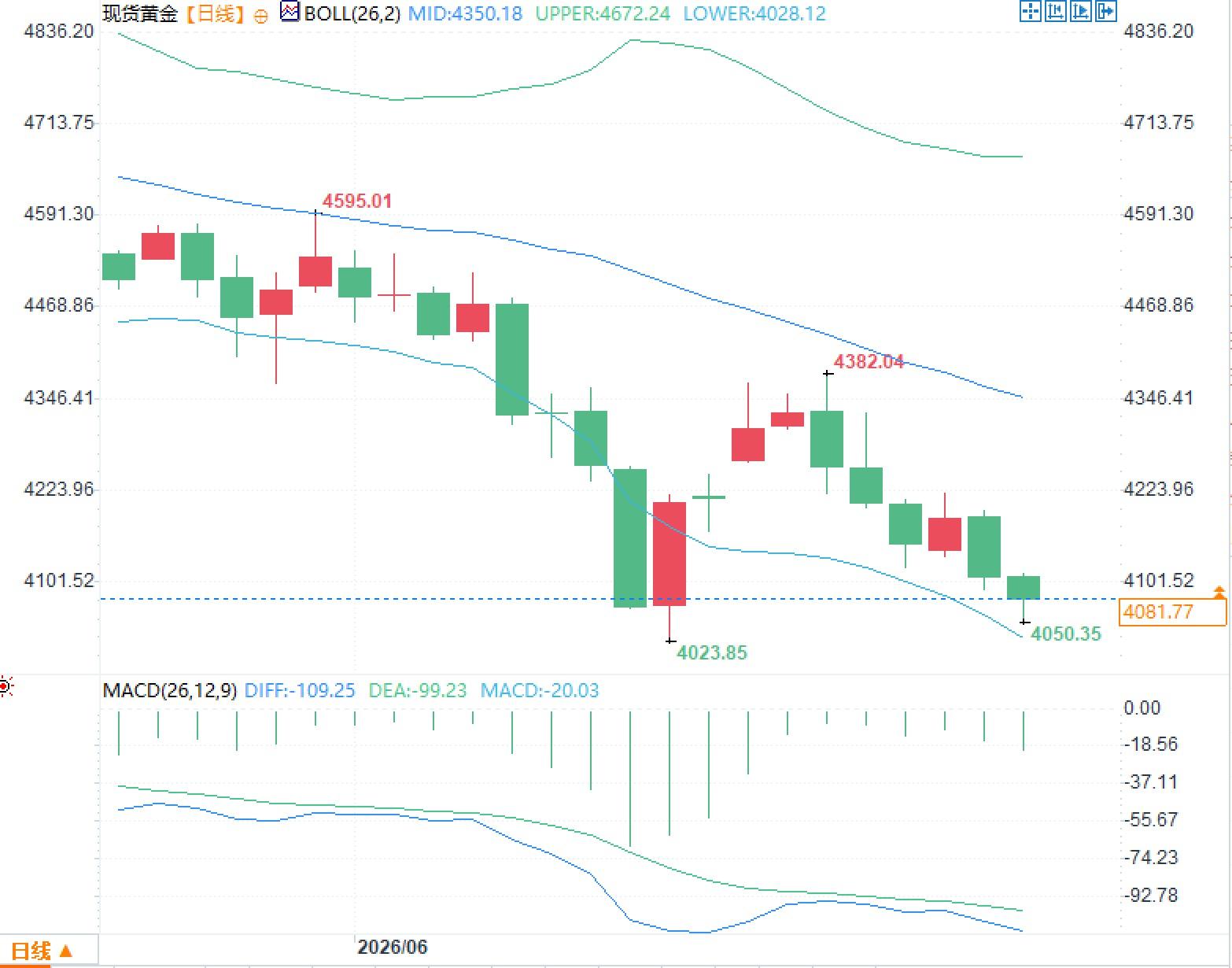
The conflict in the Middle East has seen a temporary easing, reducing concerns about shipping in the Strait of Hormuz and easing pressure on oil prices. A major Australian financial institution has lowered its gold price forecasts for the third and fourth quarters to $4,450/oz and $4,300/oz, respectively. In its report, it stated that the regional conflict appears to be nearing its end, coupled with a more hawkish stance from the Federal Reserve, which has diminished gold's safe-haven appeal.
It's important to note that a downward revision of forecasts does not equate to a long-term bearish outlook on gold. Rather, it indicates that traders are shifting from a "crisis premium model" to an "interest rate cost model." This shift will have two consequences: First, gold prices will become more sensitive to inflation data, real yields, and the US dollar's intraday movements; second, central bank gold purchases and long-term allocation demand will still provide bottom support, but are unlikely to drive an upward trend on their own. Gold has returned from a trending asset to a macro-volatile asset, which is the most significant change in the current market.
The most noteworthy change in this round of gold price adjustments is that the market is once again pricing gold within the framework of real interest rates. In recent months, gold prices have been driven more by central bank gold purchases, geopolitical conflicts, and the demand for dollar credit diversification, leading to a temporary decrease in the price's sensitivity to real interest rates. However, the situation has changed: as the Federal Reserve releases stronger anti-inflationary signals and the market begins to revise upwards on the probability of future interest rate hikes, the opportunity cost of gold as a non-interest-bearing asset has risen again.
A recent statement from a Singaporean bank indicates that gold prices are "increasingly re-linked to real yields." This statement highlights a key aspect of the current trading structure: gold has not lost its safe-haven function; rather, with rising interest rate expectations, safe-haven buying is insufficient to offset rising holding costs and margin liquidity pressures. In other words, while gold remains a macro hedge asset, its hedging value is discounted again during periods of a stronger dollar and rising real interest rates.
The market appears to be seeing a decline in both tech stocks and gold, seemingly contrary to traditional safe-haven logic. However, in large-scale cross-asset pullbacks, gold is often treated as a source of liquidity first. Tech stocks, semiconductors, and AI-related assets have seen significant gains in the preceding period, and their valuation trading is highly sensitive to interest rate changes. Once volatility increases, some portfolios will sell the most liquid assets to replenish margin or cover losses in other positions. As a result, gold is prone to exhibiting a phase of "safe-haven assets being sold off."
This doesn't mean safe-haven demand has disappeared; rather, the market is first dealing with balance sheet pressures before discussing the macro narrative. On Tuesday, the Nasdaq and S&P 500 indices fell significantly, with the semiconductor sector experiencing an even larger decline, indicating a rapid contraction in risk appetite. If the equity correction is merely a localized cooling of overvalued sectors, gold's pressure will primarily stem from liquidity shocks; only if the correction spreads to credit spreads and the financing market will gold likely regain stronger defensive buying interest.
The Federal Reserve maintained its interest rate range at 3.50% to 3.75% at its June meeting, but the market was more focused on policy language and changes in expectations. New Chairman Warsh, in his first policy meeting, signaled a more cautious approach and a greater emphasis on inflation risks, significantly increasing market pricing in another rate hike this year. For gold, the question is not just whether there will be a rate hike, but whether expectations of rate cuts have been systematically squeezed out.
The US April PCE rose 3.8% year-on-year, while core PCE rose 3.3% year-on-year, still some distance from the 2% target. The upcoming PCE data release on June 25th will be a key test for short-term gold pricing. If inflation continues to show stickiness, the dollar and real yields are likely to remain supportive, limiting the upside potential for gold. If the data falls short of expectations, the pressure on gold may ease, but whether it can reopen upward momentum depends on whether the Federal Reserve is willing to rekindle its easing policies.
The conflict in the Middle East has seen a temporary easing, reducing concerns about shipping in the Strait of Hormuz and easing pressure on oil prices. A major Australian financial institution has lowered its gold price forecasts for the third and fourth quarters to $4,450/oz and $4,300/oz, respectively. In its report, it stated that the regional conflict appears to be nearing its end, coupled with a more hawkish stance from the Federal Reserve, which has diminished gold's safe-haven appeal.
It's important to note that a downward revision of forecasts does not equate to a long-term bearish outlook on gold. Rather, it indicates that traders are shifting from a "crisis premium model" to an "interest rate cost model." This shift will have two consequences: First, gold prices will become more sensitive to inflation data, real yields, and the US dollar's intraday movements; second, central bank gold purchases and long-term allocation demand will still provide bottom support, but are unlikely to drive an upward trend on their own. Gold has returned from a trending asset to a macro-volatile asset, which is the most significant change in the current market.
- Risk Warning and Disclaimer
- The market involves risk, and trading may not be suitable for all investors. This article is for reference only and does not constitute personal investment advice, nor does it take into account certain users’ specific investment objectives, financial situation, or other needs. Any investment decisions made based on this information are at your own risk.