India's package of foreign investment measures has failed to mask the rupee's decline, with clear technical correction signals emerging.
2026-06-24 16:32:01
On Wednesday (June 24) during the European session, the US dollar traded in a narrow range against the Indian rupee. The pair has been trading within a narrow range of 94.00 to 95.00 since mid-June, and is currently trading around 94.70.
A package of measures jointly launched by the Indian government and the Reserve Bank of India (RBI) to attract foreign investment has provided effective support for the rupee exchange rate. According to institutional estimates, these policy measures are expected to attract approximately $300 billion to $500 billion in capital inflows.
The Indian government and the RBI recently announced a series of coordinated policy measures aimed at attracting foreign investment through multiple channels and stabilizing the rupee exchange rate. Specific measures include:
Expanding the Full Access Route (FAR): Incorporating long-term government bond issuance into the FAR framework to provide international investors with more sovereign bond options.
Tax incentives: Exemptions from capital gains tax and withholding tax for foreign investors reduce investment costs and enhance the investment attractiveness of Indian assets.
Subsidized foreign exchange swap facilities: Foreign exchange swap arrangements that provide preferential interest rates for external commercial borrowing, reducing the foreign exchange financing costs for enterprises.
FCNR(B) Deposit Support: Provides comprehensive hedging support for FCNR(B) deposits, significantly enhancing the attractiveness of such deposits to foreign non-resident investors.
Of particular note is the RBI's further clarification that foreign exchange hedging related to FCNR(B) deposits will not be subject to the $100 million net open position limit. This clarification alleviates banks' operational concerns. Simultaneously, allowing banks to use these deposits for lending further enhances the instrument's attractiveness and amplifies its potential impact on capital inflows.
From a macroeconomic perspective, India's preliminary Purchasing Managers' Index (PMI) for June points to a slowdown rather than a sharp decline. The manufacturing sector continues to face the dual pressures of weak domestic and international demand and supply chain disruptions, while the service sector has shown relative resilience, mainly due to support from international demand.
Looking ahead, further easing of supply bottlenecks in the Middle East could support a recovery in economic activity in the coming months; however, this outlook will largely depend on the sustainability of the current fragile ceasefire agreement. Overall, the resilience of the Indian economy provides a fundamental floor for the rupee exchange rate.
The stable trading of the USD/RUB exchange rate within the 94.00 to 95.00 range reflects the effectiveness of policy intervention and the balance between external pressures. The timing and strength of the package of policy measures demonstrate the authorities' determination to stabilize the exchange rate. If the expected inflow of approximately $300 to $500 billion in funds gradually materializes, the rupee is expected to find more sustained support within the current range.
However, the external risks facing the rupee should not be ignored. The strength of the US dollar globally—driven by expectations of Federal Reserve interest rate hikes and geopolitical safe-haven demand—continues to put pressure on emerging market currencies, including the rupee. Furthermore, the evolution of the situation in the Middle East, volatility in oil prices, and changes in global risk appetite will all be key variables influencing the rupee's medium-term trajectory.
According to the daily chart, the USD/INR pair previously surged to a high of 96.96 before entering a period of high-level consolidation and decline, indicating a slowdown in the medium- to long-term bullish trend. The moving average system remains bullish, with the price holding above the 100-day and 200-day moving averages. Short-term resistance is formed by the 20-day (95.05) and 50-day (94.96) moving averages, while the 100-day and 200-day moving averages below provide stepped support.
The MACD indicator's DIFF (-0.1571) crossed below the DEA (-0.0677), with the bearish green bars continuing to expand, indicating a significant weakening of upward momentum and confirming a short-term pullback signal. The RSI indicator fell back to 46.35, below the neutral range, showing no signs of oversold conditions, and still has room for further downside.
In terms of price movement, a complete upward wave has formed since the year's low of 89.99, reaching a high of 96.96 before encountering resistance and falling back. The previous low of 94.16 is a key short-term support level; a break below this level would likely lead to a test of the 100-day moving average (MA100) around 93.55. Resistance is concentrated at the short-term moving average of 95.05 and the historical high of 96.96.
The overall long-term trend remains bullish, but the short-term pullback trend is clear. The main strategy is to sell on rallies when prices are under pressure. Only when the price regains its footing above the 20-day moving average and the MACD crosses above the green bars can the upward momentum resume. If the support level of 94.16 is breached, the correction will be more severe.
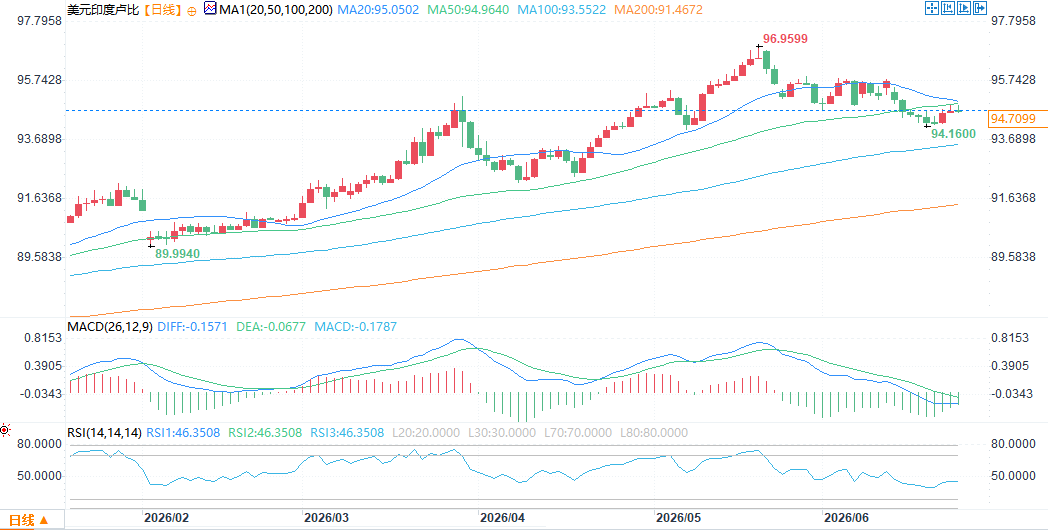
(USD/INR daily chart, source: FX678)
At 15:52 Beijing time on June 24, the US dollar was trading at 94.65/66 against the Indian rupee.
A package of measures jointly launched by the Indian government and the Reserve Bank of India (RBI) to attract foreign investment has provided effective support for the rupee exchange rate. According to institutional estimates, these policy measures are expected to attract approximately $300 billion to $500 billion in capital inflows.
Detailed Explanation of the Policy Package: Attracting Foreign Investment Through Multiple Measures
The Indian government and the RBI recently announced a series of coordinated policy measures aimed at attracting foreign investment through multiple channels and stabilizing the rupee exchange rate. Specific measures include:
Expanding the Full Access Route (FAR): Incorporating long-term government bond issuance into the FAR framework to provide international investors with more sovereign bond options.
Tax incentives: Exemptions from capital gains tax and withholding tax for foreign investors reduce investment costs and enhance the investment attractiveness of Indian assets.
Subsidized foreign exchange swap facilities: Foreign exchange swap arrangements that provide preferential interest rates for external commercial borrowing, reducing the foreign exchange financing costs for enterprises.
FCNR(B) Deposit Support: Provides comprehensive hedging support for FCNR(B) deposits, significantly enhancing the attractiveness of such deposits to foreign non-resident investors.
Of particular note is the RBI's further clarification that foreign exchange hedging related to FCNR(B) deposits will not be subject to the $100 million net open position limit. This clarification alleviates banks' operational concerns. Simultaneously, allowing banks to use these deposits for lending further enhances the instrument's attractiveness and amplifies its potential impact on capital inflows.
Economic growth slows but does not decline sharply: PMI data sends a mild signal
From a macroeconomic perspective, India's preliminary Purchasing Managers' Index (PMI) for June points to a slowdown rather than a sharp decline. The manufacturing sector continues to face the dual pressures of weak domestic and international demand and supply chain disruptions, while the service sector has shown relative resilience, mainly due to support from international demand.
Looking ahead, further easing of supply bottlenecks in the Middle East could support a recovery in economic activity in the coming months; however, this outlook will largely depend on the sustainability of the current fragile ceasefire agreement. Overall, the resilience of the Indian economy provides a fundamental floor for the rupee exchange rate.
Rupee Outlook: Policy Support and External Risks Coexist
The stable trading of the USD/RUB exchange rate within the 94.00 to 95.00 range reflects the effectiveness of policy intervention and the balance between external pressures. The timing and strength of the package of policy measures demonstrate the authorities' determination to stabilize the exchange rate. If the expected inflow of approximately $300 to $500 billion in funds gradually materializes, the rupee is expected to find more sustained support within the current range.
However, the external risks facing the rupee should not be ignored. The strength of the US dollar globally—driven by expectations of Federal Reserve interest rate hikes and geopolitical safe-haven demand—continues to put pressure on emerging market currencies, including the rupee. Furthermore, the evolution of the situation in the Middle East, volatility in oil prices, and changes in global risk appetite will all be key variables influencing the rupee's medium-term trajectory.
Technical Analysis
According to the daily chart, the USD/INR pair previously surged to a high of 96.96 before entering a period of high-level consolidation and decline, indicating a slowdown in the medium- to long-term bullish trend. The moving average system remains bullish, with the price holding above the 100-day and 200-day moving averages. Short-term resistance is formed by the 20-day (95.05) and 50-day (94.96) moving averages, while the 100-day and 200-day moving averages below provide stepped support.
The MACD indicator's DIFF (-0.1571) crossed below the DEA (-0.0677), with the bearish green bars continuing to expand, indicating a significant weakening of upward momentum and confirming a short-term pullback signal. The RSI indicator fell back to 46.35, below the neutral range, showing no signs of oversold conditions, and still has room for further downside.
In terms of price movement, a complete upward wave has formed since the year's low of 89.99, reaching a high of 96.96 before encountering resistance and falling back. The previous low of 94.16 is a key short-term support level; a break below this level would likely lead to a test of the 100-day moving average (MA100) around 93.55. Resistance is concentrated at the short-term moving average of 95.05 and the historical high of 96.96.
The overall long-term trend remains bullish, but the short-term pullback trend is clear. The main strategy is to sell on rallies when prices are under pressure. Only when the price regains its footing above the 20-day moving average and the MACD crosses above the green bars can the upward momentum resume. If the support level of 94.16 is breached, the correction will be more severe.
(USD/INR daily chart, source: FX678)
At 15:52 Beijing time on June 24, the US dollar was trading at 94.65/66 against the Indian rupee.
- Risk Warning and Disclaimer
- The market involves risk, and trading may not be suitable for all investors. This article is for reference only and does not constitute personal investment advice, nor does it take into account certain users’ specific investment objectives, financial situation, or other needs. Any investment decisions made based on this information are at your own risk.