Gold hovers below $4,100: Oil prices fall, but interest rate hike expectations rise; PCE data becomes key.
2026-06-24 16:29:40
On Wednesday (June 24) during the European session, spot gold rebounded slightly from a near two-week low, but remained below the $4,100 mark overall, with the negative downward pressure unchanged.
Although the recent decline in oil prices has eased some inflation concerns, market expectations for a Federal Reserve rate hike this year continue to rise, pushing the US dollar index to a new high since May 2025, which continues to put pressure on gold, a non-interest-bearing asset.
Meanwhile, contradictory statements from the US and Iran on the nuclear issue, coupled with geopolitical risk premiums maintaining demand for the US dollar as a safe haven, mean that the downside risk for gold prices in the short term has not yet been eliminated.
Crude oil prices have fallen significantly over the past month, hitting a new low since early March on Wednesday. The reopening of the Strait of Hormuz was a direct catalyst – according to Iran's Fars News Agency, citing military sources, a limited number of ships have been allowed to pass through the strategic waterway daily, coordinated by the Iranian Revolutionary Guard Navy.
At the same time, the U.S. Treasury Department issued a 60-day temporary sanctions waiver under the framework of a broader peace agreement, allowing the production, delivery, and sale of Iranian crude oil, petroleum, and petrochemical products.
In theory, falling oil prices would help alleviate upstream inflationary pressures, thereby reducing the need for the Federal Reserve to raise interest rates further, which should be beneficial for gold.
However, market trading logic did not unfold along this path. Instead, investors significantly increased their bets on a Fed rate hike in 2026, expecting at least a 25 basis point increase. This seemingly contradictory trend stems from the hawkish signals recently released by Fed officials—in last week's interest rate decision, nine out of 19 committee members believed that further increases in policy rates were needed to combat inflation. The remarks of newly appointed Fed Chairman Kevin Warsh at the post-meeting press conference were particularly noteworthy, as he emphasized the price stability goal, suggesting that even if economic growth slows, the Fed will not rush to cut rates.
This shift in stance directly reversed market expectations regarding the policy path.
The continued antagonism between the US and Iran on the nuclear issue has provided additional safe-haven support for the US dollar. US Vice President Vance stated on Monday that the Swiss peace talks had prompted Iran to agree to invite International Atomic Energy Agency (IAEA) inspectors to its nuclear facilities. Trump went further, claiming that Iran had "fully and completely" agreed to accept the highest level of nuclear inspections for the long term.
However, Iranian state media, citing the Foreign Ministry, reported that Tehran had not made any new commitments regarding nuclear inspections. These contradictory statements suggest that the reliability of the agreement's implementation remains questionable.
This information asymmetry directly drives up the geopolitical risk premium, prompting investors to increase their holdings of traditional safe-haven assets such as the US dollar, thereby indirectly suppressing gold—although gold itself also has safe-haven attributes, its disadvantage as a non-interest-bearing asset is amplified in a strong dollar environment.
JPMorgan Chase predicts that gold will continue to reach record highs in 2026, with an average price of $6,000 per ounce in Q4 and potentially reaching $6,300 by the end of 2027. Despite a recent decline in investor interest, strong support is provided by central bank gold purchases, de-dollarization, geopolitical safe-haven demand, and long-term currency depreciation trends.
JPMorgan Chase believes that even with a hawkish Federal Reserve policy, the structural bottom for gold prices is solid (around the 200-day moving average of $4,340). The risks lie in an unexpectedly strong dollar or overshooting economic growth, but the overall bullish logic remains unchanged. Investors should add to their positions on pullbacks, viewing gold as a core asset in their long-term asset allocation.
The agency emphasized that gold is currently in a range-bound trading pattern, but its upside potential far outweighs its downside risks, making it the preferred safe-haven and value-preserving tool in the medium to long term.
Goldman Sachs is bullish on gold in 2026, with a year-end target of around $4,900-$5,400 per ounce (with a slight upward revision in June). The main drivers are continued central bank gold purchases (expected to remain high) and reserve diversification, although slowing ETF inflows and the Federal Reserve's delayed rate cuts pose short-term pressures.
Goldman Sachs expects increased volatility in gold prices, making a return to the strength of 2025 unlikely, but structural demand will support a moderate rise. A stronger dollar and rising opportunity costs are the main drags, while escalating geopolitical risks or weak US data could pose significant upside risks. Investors can focus on potential catalysts in the second half of the year and adopt a range-bound investment strategy. Overall, the outlook is neutral to slightly optimistic; gold remains suitable as part of a diversified portfolio, especially in a global environment of uncertainty.
According to the daily chart, spot gold maintains its medium-term downtrend, with bears in control. The moving average system is exerting downward pressure across the board, with the price consistently trading below the short-term and medium-term moving averages of MA20, MA50, and MA100. Only the long-term moving average of MA200 (4470.22) is above, forming strong resistance. All moving averages are turning downwards, indicating significant resistance to any rebound.
The MACD indicator's DIFF (-108.49) remains steadily below the DEA (-99.08), with the green bearish bars persisting and the downward momentum showing no significant weakening. There is no low-level golden cross signal indicating a potential bottom. The RSI value is 33.95, slightly approaching the oversold zone of 30, suggesting only a weak technical correction in the short term, which is insufficient to reverse the overall downward trend.
In terms of price movement, after reaching a historical high of 5596.33, the price has been fluctuating downwards, recently testing a low of 4023.85, breaking through the previous support level of 4100. The psychological support level of 4000 has become crucial below. The first resistance level above is the 20-day moving average (MA20) at 4299.34, followed by the previous consolidation level around 4400.
The overall market sentiment is bearish in the medium term. The short-term oversold conditions have only brought a slight rebound. When the price rebounds to the short-term moving average resistance zone, it is advisable to sell on rallies. If the price breaks below the low of 4023, the downside potential will be further expanded. Only when the price stabilizes above the 20-day moving average and the MACD forms a golden cross at a low level will a phase of stabilization and recovery occur.
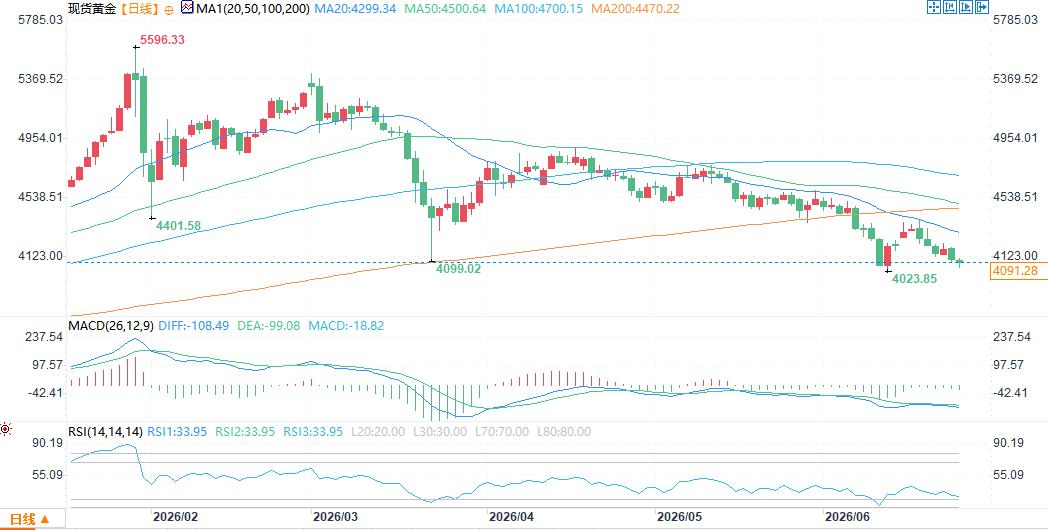
(Spot gold daily chart, source: FX678)
At 15:46 Beijing time on June 24, spot gold was trading at $4082.40 per ounce.
Although the recent decline in oil prices has eased some inflation concerns, market expectations for a Federal Reserve rate hike this year continue to rise, pushing the US dollar index to a new high since May 2025, which continues to put pressure on gold, a non-interest-bearing asset.
Meanwhile, contradictory statements from the US and Iran on the nuclear issue, coupled with geopolitical risk premiums maintaining demand for the US dollar as a safe haven, mean that the downside risk for gold prices in the short term has not yet been eliminated.
The decline in crude oil prices eased inflationary pressures, but expectations of interest rate hikes rose against the trend.
Crude oil prices have fallen significantly over the past month, hitting a new low since early March on Wednesday. The reopening of the Strait of Hormuz was a direct catalyst – according to Iran's Fars News Agency, citing military sources, a limited number of ships have been allowed to pass through the strategic waterway daily, coordinated by the Iranian Revolutionary Guard Navy.
At the same time, the U.S. Treasury Department issued a 60-day temporary sanctions waiver under the framework of a broader peace agreement, allowing the production, delivery, and sale of Iranian crude oil, petroleum, and petrochemical products.
In theory, falling oil prices would help alleviate upstream inflationary pressures, thereby reducing the need for the Federal Reserve to raise interest rates further, which should be beneficial for gold.
However, market trading logic did not unfold along this path. Instead, investors significantly increased their bets on a Fed rate hike in 2026, expecting at least a 25 basis point increase. This seemingly contradictory trend stems from the hawkish signals recently released by Fed officials—in last week's interest rate decision, nine out of 19 committee members believed that further increases in policy rates were needed to combat inflation. The remarks of newly appointed Fed Chairman Kevin Warsh at the post-meeting press conference were particularly noteworthy, as he emphasized the price stability goal, suggesting that even if economic growth slows, the Fed will not rush to cut rates.
This shift in stance directly reversed market expectations regarding the policy path.
Conflicting signals from US-Iran nuclear talks keep the dollar strong due to geopolitical risk premiums.
The continued antagonism between the US and Iran on the nuclear issue has provided additional safe-haven support for the US dollar. US Vice President Vance stated on Monday that the Swiss peace talks had prompted Iran to agree to invite International Atomic Energy Agency (IAEA) inspectors to its nuclear facilities. Trump went further, claiming that Iran had "fully and completely" agreed to accept the highest level of nuclear inspections for the long term.
However, Iranian state media, citing the Foreign Ministry, reported that Tehran had not made any new commitments regarding nuclear inspections. These contradictory statements suggest that the reliability of the agreement's implementation remains questionable.
This information asymmetry directly drives up the geopolitical risk premium, prompting investors to increase their holdings of traditional safe-haven assets such as the US dollar, thereby indirectly suppressing gold—although gold itself also has safe-haven attributes, its disadvantage as a non-interest-bearing asset is amplified in a strong dollar environment.
Institutional Views
JPMorgan Chase predicts that gold will continue to reach record highs in 2026, with an average price of $6,000 per ounce in Q4 and potentially reaching $6,300 by the end of 2027. Despite a recent decline in investor interest, strong support is provided by central bank gold purchases, de-dollarization, geopolitical safe-haven demand, and long-term currency depreciation trends.
JPMorgan Chase believes that even with a hawkish Federal Reserve policy, the structural bottom for gold prices is solid (around the 200-day moving average of $4,340). The risks lie in an unexpectedly strong dollar or overshooting economic growth, but the overall bullish logic remains unchanged. Investors should add to their positions on pullbacks, viewing gold as a core asset in their long-term asset allocation.
The agency emphasized that gold is currently in a range-bound trading pattern, but its upside potential far outweighs its downside risks, making it the preferred safe-haven and value-preserving tool in the medium to long term.
Goldman Sachs is bullish on gold in 2026, with a year-end target of around $4,900-$5,400 per ounce (with a slight upward revision in June). The main drivers are continued central bank gold purchases (expected to remain high) and reserve diversification, although slowing ETF inflows and the Federal Reserve's delayed rate cuts pose short-term pressures.
Goldman Sachs expects increased volatility in gold prices, making a return to the strength of 2025 unlikely, but structural demand will support a moderate rise. A stronger dollar and rising opportunity costs are the main drags, while escalating geopolitical risks or weak US data could pose significant upside risks. Investors can focus on potential catalysts in the second half of the year and adopt a range-bound investment strategy. Overall, the outlook is neutral to slightly optimistic; gold remains suitable as part of a diversified portfolio, especially in a global environment of uncertainty.
Technical Analysis
According to the daily chart, spot gold maintains its medium-term downtrend, with bears in control. The moving average system is exerting downward pressure across the board, with the price consistently trading below the short-term and medium-term moving averages of MA20, MA50, and MA100. Only the long-term moving average of MA200 (4470.22) is above, forming strong resistance. All moving averages are turning downwards, indicating significant resistance to any rebound.
The MACD indicator's DIFF (-108.49) remains steadily below the DEA (-99.08), with the green bearish bars persisting and the downward momentum showing no significant weakening. There is no low-level golden cross signal indicating a potential bottom. The RSI value is 33.95, slightly approaching the oversold zone of 30, suggesting only a weak technical correction in the short term, which is insufficient to reverse the overall downward trend.
In terms of price movement, after reaching a historical high of 5596.33, the price has been fluctuating downwards, recently testing a low of 4023.85, breaking through the previous support level of 4100. The psychological support level of 4000 has become crucial below. The first resistance level above is the 20-day moving average (MA20) at 4299.34, followed by the previous consolidation level around 4400.
The overall market sentiment is bearish in the medium term. The short-term oversold conditions have only brought a slight rebound. When the price rebounds to the short-term moving average resistance zone, it is advisable to sell on rallies. If the price breaks below the low of 4023, the downside potential will be further expanded. Only when the price stabilizes above the 20-day moving average and the MACD forms a golden cross at a low level will a phase of stabilization and recovery occur.
(Spot gold daily chart, source: FX678)
At 15:46 Beijing time on June 24, spot gold was trading at $4082.40 per ounce.
- Risk Warning and Disclaimer
- The market involves risk, and trading may not be suitable for all investors. This article is for reference only and does not constitute personal investment advice, nor does it take into account certain users’ specific investment objectives, financial situation, or other needs. Any investment decisions made based on this information are at your own risk.