White House May Intervene to Support Market: The Trading Logic for Gold Amidst US Stock Market Pullback
2026-06-24 17:39:03
The market has long believed in the "Fed put option," which means that when US stocks and even major asset classes experience a deep pullback and market panic spreads, the Federal Reserve will often implement monetary easing measures such as interest rate cuts, liquidity injections, and easing of financial conditions to stabilize market liquidity and prevent a stampede and a deep crisis. This implicit market support rule has never been officially announced, but it has been verified by multiple major declines, including the 1987 US stock market crash, the global financial crisis, and the COVID-19 pandemic, and has become a recognized bottom line for investors' assets.
In recent years, the market landscape has undergone a key change. The White House government, represented by Trump, has formed a "White House market support system" that is independent of monetary policy, also known as "Trump put options." Today, traders' assessment of the priority of White House policies and statements is comparable to that of the Federal Reserve's monetary policy.

Key Differences: Monetary Guarantee vs. Political Guarantee – The Underlying Logics are Different; the two major market support logics are fundamentally different.
The Federal Reserve's intervention relies on monetary policy; when assets fall, financial conditions tighten and risk appetite is dampened, the central bank will step in to offset the impact.
The White House relies on political policies to provide a safety net. When political actions such as tariff sanctions and geopolitical conflicts cause stock market crashes, fluctuations in US Treasury bonds, and a collapse in business confidence, the US government will usually take the initiative to compromise and make concessions, suspending hardline policies, advancing diplomatic negotiations, and releasing conciliatory signals to stabilize the financial market.
Whether it was the new tariff policy triggering a sell-off in US stocks or the geopolitical conflict in the Middle East disrupting global risk assets, the US government has replicated its operational pattern of softening its stance and making statements to stabilize the market during sharp declines.
At its root, the US political establishment is highly tied to the performance of the capital market. In his public statements and social media posts, Trump has consistently regarded stock market gains as an economic achievement and a bargaining chip for governance. The market has also reached a consensus: the White House cannot afford a continued deep decline in the capital market. If the market falls to a critical point of panic, political measures to stabilize the situation will inevitably be implemented.
However, compared to the Federal Reserve, which has clear responsibilities and is anchored to inflation and employment, the White House's market intervention is highly subjective. It will weigh the election, national security, and foreign policy strategy, and will not intervene in every small correction. Policy compromise will only come when the market deteriorates rapidly and panic gets out of control.
Especially given the current unfavorable situation in the midterm elections, government intervention is more likely to occur.
Historically, the initial stages of significant pullbacks in the US capital market, particularly the extreme panic and oversold levels, often present highly valuable opportunities for speculative trading and represent excellent entry points on the left side of the trading spectrum.
The early pronouncements from the Federal Reserve and the White House to stabilize the market, along with policy interventions, were extremely effective. Each official statement quickly restored market sentiment and drove a rapid rebound in the index.
However, as the frequency of official market intervention and public statements to stabilize the market increases, the market gradually digests the expectation of a safety net, and the boosting effect of policy pronouncements on the market will continue to weaken marginally, with the rebound strength gradually narrowing.
Given the current market environment, political pressure from the US midterm elections continues to rise, and the ruling team's demands to stabilize the capital market and protect the returns on people's assets have increased significantly. If the US stock market falls rapidly and market panic intensifies, the probability of the White House cooperating with the Federal Reserve to introduce stabilization measures and release positive signals has increased significantly, further lowering the trigger threshold for this round of double bottoming.
This also sets a core trading mindset for traders today: when the capital market is in a state of extreme panic and the market is extremely pessimistic, it is often not the time to exit. Instead, it is necessary to restrain emotional panic, rationally identify oversold opportunities, and practice the trading strategy of finding opportunities in crises.
In practical terms, during periods of significant and irrational pullback in US stocks, risk appetite is suppressed, and traditional assets such as gold are also affected and subject to selling. At this time, it is easy to create a "golden opportunity" (a temporary undervalued area where asset prices deviate downward from their intrinsic value) due to emotional selling.
For example, the US PCE and core PCE price indices will be released on Thursday. If the data shows a trend of remaining high, it is unlikely to change. At this time, US stocks and gold will experience another wave of negative impact from inflation. Combined with the aforementioned White House put options, there may be a good buying opportunity when the negative impact is exhausted.
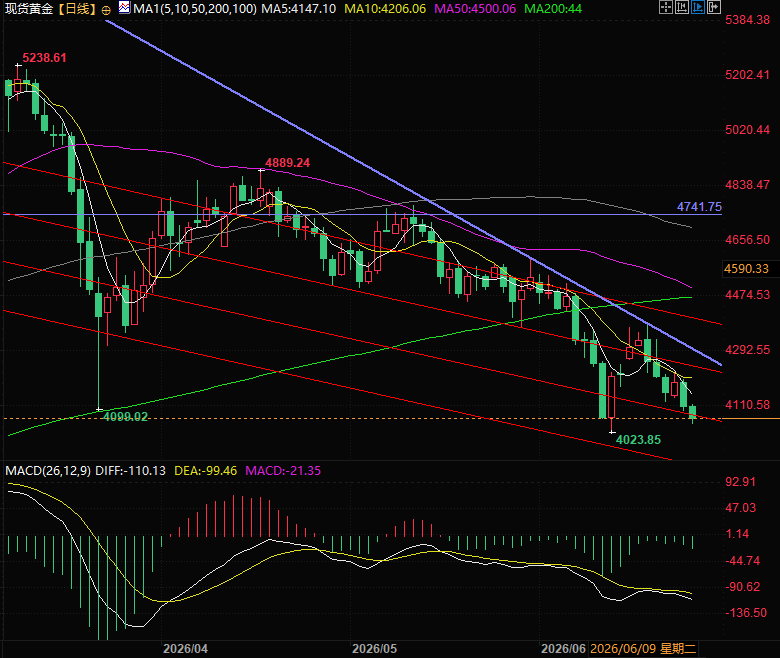
(Spot gold daily chart, source: FX678)
At 17:36 Beijing time, spot gold was trading at $4,067 per ounce.
In recent years, the market landscape has undergone a key change. The White House government, represented by Trump, has formed a "White House market support system" that is independent of monetary policy, also known as "Trump put options." Today, traders' assessment of the priority of White House policies and statements is comparable to that of the Federal Reserve's monetary policy.
Key Differences: Monetary Guarantee vs. Political Guarantee – The Underlying Logics are Different; the two major market support logics are fundamentally different.
The Federal Reserve's intervention relies on monetary policy; when assets fall, financial conditions tighten and risk appetite is dampened, the central bank will step in to offset the impact.
The White House relies on political policies to provide a safety net. When political actions such as tariff sanctions and geopolitical conflicts cause stock market crashes, fluctuations in US Treasury bonds, and a collapse in business confidence, the US government will usually take the initiative to compromise and make concessions, suspending hardline policies, advancing diplomatic negotiations, and releasing conciliatory signals to stabilize the financial market.
Whether it was the new tariff policy triggering a sell-off in US stocks or the geopolitical conflict in the Middle East disrupting global risk assets, the US government has replicated its operational pattern of softening its stance and making statements to stabilize the market during sharp declines.
The White House's "safety net" characteristic: highly subjective and discretionary.
At its root, the US political establishment is highly tied to the performance of the capital market. In his public statements and social media posts, Trump has consistently regarded stock market gains as an economic achievement and a bargaining chip for governance. The market has also reached a consensus: the White House cannot afford a continued deep decline in the capital market. If the market falls to a critical point of panic, political measures to stabilize the situation will inevitably be implemented.
However, compared to the Federal Reserve, which has clear responsibilities and is anchored to inflation and employment, the White House's market intervention is highly subjective. It will weigh the election, national security, and foreign policy strategy, and will not intervene in every small correction. Policy compromise will only come when the market deteriorates rapidly and panic gets out of control.
Especially given the current unfavorable situation in the midterm elections, government intervention is more likely to occur.
Trading pattern: The market support effect gradually diminishes at the margin.
Historically, the initial stages of significant pullbacks in the US capital market, particularly the extreme panic and oversold levels, often present highly valuable opportunities for speculative trading and represent excellent entry points on the left side of the trading spectrum.
The early pronouncements from the Federal Reserve and the White House to stabilize the market, along with policy interventions, were extremely effective. Each official statement quickly restored market sentiment and drove a rapid rebound in the index.
However, as the frequency of official market intervention and public statements to stabilize the market increases, the market gradually digests the expectation of a safety net, and the boosting effect of policy pronouncements on the market will continue to weaken marginally, with the rebound strength gradually narrowing.
Current fundamentals: The midterm elections significantly increase the probability of intervention.
Given the current market environment, political pressure from the US midterm elections continues to rise, and the ruling team's demands to stabilize the capital market and protect the returns on people's assets have increased significantly. If the US stock market falls rapidly and market panic intensifies, the probability of the White House cooperating with the Federal Reserve to introduce stabilization measures and release positive signals has increased significantly, further lowering the trigger threshold for this round of double bottoming.
Practical Insights: Control Panic, Employ a Two-Pronged Approach to Find Opportunities Amidst Crisis
This also sets a core trading mindset for traders today: when the capital market is in a state of extreme panic and the market is extremely pessimistic, it is often not the time to exit. Instead, it is necessary to restrain emotional panic, rationally identify oversold opportunities, and practice the trading strategy of finding opportunities in crises.
In practical terms, during periods of significant and irrational pullback in US stocks, risk appetite is suppressed, and traditional assets such as gold are also affected and subject to selling. At this time, it is easy to create a "golden opportunity" (a temporary undervalued area where asset prices deviate downward from their intrinsic value) due to emotional selling.
For example, the US PCE and core PCE price indices will be released on Thursday. If the data shows a trend of remaining high, it is unlikely to change. At this time, US stocks and gold will experience another wave of negative impact from inflation. Combined with the aforementioned White House put options, there may be a good buying opportunity when the negative impact is exhausted.
(Spot gold daily chart, source: FX678)
At 17:36 Beijing time, spot gold was trading at $4,067 per ounce.
- Risk Warning and Disclaimer
- The market involves risk, and trading may not be suitable for all investors. This article is for reference only and does not constitute personal investment advice, nor does it take into account certain users’ specific investment objectives, financial situation, or other needs. Any investment decisions made based on this information are at your own risk.