Metals market under pressure: Transaction pricing has already factored in the peak of policy tightening; demand is not the core driver of the decline.
2026-06-24 18:55:10
On Wednesday (June 24), during the European trading session, industrial and precious metals weakened across the board, as financial markets continued to digest expectations of rising financing costs and further tightening of US monetary policy. This round of sell-offs intensified, with technology stocks experiencing a significant correction: yesterday, the South Korean KOSPI index, which is heavily weighted towards technology stocks, plummeted by 10%, and the Nasdaq index fell below 30,000 points, with large-scale reductions in risk assets occurring across various asset classes.
This round of decline clearly reflects that metals are currently viewed more as financial trading instruments, with their commodity attributes taking a backseat. While the long-term supply and demand fundamentals for many metal categories remain positive, rising market volatility, higher bond yields, and a stronger US dollar have led investors to prioritize capital preservation and hedging. In short, the current market is more focused on borrowing costs than on the physical supply and demand dynamics of metals.
Precious metals are deeply burdened by high financing costs.
Gold's brief rebound proved short-lived, with prices falling again and approaching the key $4,000 level. Last week's FOMC meeting signaled a hawkish stance on interest rates, causing the market to revise its expectations for US interest rates, which became the core resistance level suppressing gold prices.
Rising US Treasury yields and a continued strengthening of the US dollar, coupled with market expectations that policy interest rates will remain high for an extended period, have continuously weakened the market's willingness to allocate to non-interest-bearing assets. While several leading investment banks remain bullish on gold prices at the end of the year, they have lowered their gold price forecasts in recent weeks, reflecting the market's assessment that the upside potential for gold is limited in a prolonged high-interest-rate environment.
From a technical perspective, the $4,000–$4,100 range is a key support level for gold. A break below this range could trigger a new round of panic selling, continuing the downward trend that has driven gold prices sharply lower from their historical highs this year.
Silver underperformed gold, with the gold-silver ratio climbing to a near three-month high of around 66, highlighting the dual pressures brought about by silver's dual nature as both a precious and industrial metal. While gold still received some support from safe-haven buying, silver was additionally pressured by concerns about global economic growth and a generally weak sentiment towards industrial metals.
Macroeconomic headwinds are becoming apparent for copper prices, but fundamentals remain favorable.
Copper prices failed to escape the current market-wide risk aversion, with high-grade copper futures falling sharply and once again approaching the key support level of $6.15 per pound. However, the physical spot market has not shown any substantial signs of weakness: visible inventories on major global futures exchanges continue to decline; and the long-term demand growth logic driven by electrification transformation, power grid construction, and electricity demand from data centers and artificial intelligence remains unshaken.

The decline in copper prices was driven by negative macroeconomic factors that suppress all pro-cyclical assets. Market concerns about tightening financial conditions and weakening economic growth momentum led investors to reduce their holdings of various economically sensitive assets, and the sharp drop in technology stocks further exacerbated the downward pressure on copper prices. Over the past two years, copper prices have been deeply intertwined with sectors such as electrification, artificial intelligence infrastructure, and explosive electricity demand. The downward sentiment in technology growth stocks is now continuing to spread to the industrial metals sector.
This pullback also confirms a pattern: even if commodity fundamentals are supported, prices will still experience significant adjustments once financial conditions tighten and investors collectively reduce their positions to avoid risks.
Why is the tightening of policies likely to have peaked?
The market is currently focused on the various risks brought about by high financing costs, but more and more signals indicate that the peak of this round of monetary tightening may be approaching, with the most critical variable being a sharp drop in energy prices.
Following the implementation of the interim US-Iran agreement and the gradual resumption of shipping through the Strait of Hormuz, international crude oil prices have fallen significantly, and refined oil prices have declined accordingly. Just weeks ago, rising energy prices were a core risk driving up inflation; now, this negative factor has largely subsided.
The decline in energy costs will quickly spread throughout the entire industry chain: lower logistics and transportation costs, reduced pressure on raw material prices in manufacturing, and a subsequent cooling of inflation expectations. The market's previous widespread expectation that the Federal Reserve would maintain an extremely tight monetary policy for an extended period may be revised.
Currently, speculative long positions in the US dollar are at a high level, meaning that most of the expectations for a hawkish interest rate hike have already been fully reflected in current trading positions. If subsequent inflation data continues to weaken along with declining energy prices, the dollar's upward trend will be unsustainable, at which point precious metals and industrial metals will benefit.
Lower real interest rates and a weaker dollar will directly boost gold; improved market risk sentiment and a cooling of expectations for policy tightening will provide price support for copper and silver.
The medium- to long-term positive logic has not failed.
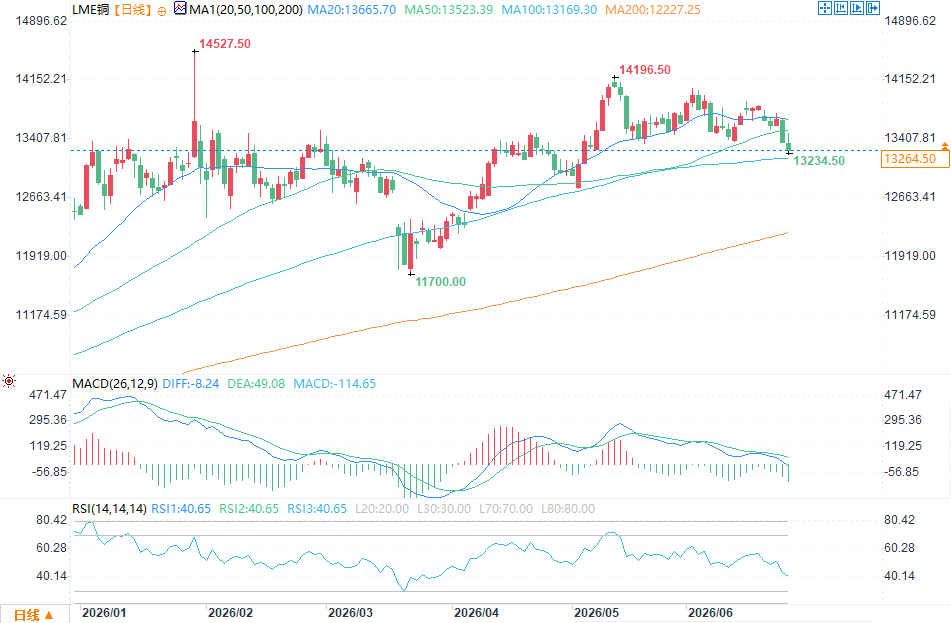
(LME copper daily chart source: EasyForex)
The downward pressure on prices from the short-term pullback is obvious, but we need to distinguish between short-term trading drivers and medium- to long-term supply and demand fundamentals.
For gold, the continued gold purchases by central banks, global fiscal risks, high debt levels, and geopolitical conflicts remain the structural logic supporting the long-term upward trend of gold prices.
The long-term prospects for silver and copper still rely on electrification transformation, renewable energy investment, grid expansion, and the incremental demand brought by data centers and artificial intelligence infrastructure. The aforementioned industry development logic has not disappeared. However, the market's excessive focus on monetary policy, financing costs, and market risk appetite in the short term has suppressed the commodity attributes of the metals. In the short term, the technology sector, which has seen excessive gains previously, is still in a digestion and adjustment phase, and the market's focus will likely remain on macroeconomic policies.
At present, the market is still dominated by the short-term macro environment, but if energy prices continue to decline and inflationary pressures gradually ease, market attention will return to the core supply and demand fundamentals that support the medium- and long-term trend of the metals sector.
This round of decline clearly reflects that metals are currently viewed more as financial trading instruments, with their commodity attributes taking a backseat. While the long-term supply and demand fundamentals for many metal categories remain positive, rising market volatility, higher bond yields, and a stronger US dollar have led investors to prioritize capital preservation and hedging. In short, the current market is more focused on borrowing costs than on the physical supply and demand dynamics of metals.
Precious metals are deeply burdened by high financing costs.
Gold's brief rebound proved short-lived, with prices falling again and approaching the key $4,000 level. Last week's FOMC meeting signaled a hawkish stance on interest rates, causing the market to revise its expectations for US interest rates, which became the core resistance level suppressing gold prices.
Rising US Treasury yields and a continued strengthening of the US dollar, coupled with market expectations that policy interest rates will remain high for an extended period, have continuously weakened the market's willingness to allocate to non-interest-bearing assets. While several leading investment banks remain bullish on gold prices at the end of the year, they have lowered their gold price forecasts in recent weeks, reflecting the market's assessment that the upside potential for gold is limited in a prolonged high-interest-rate environment.
From a technical perspective, the $4,000–$4,100 range is a key support level for gold. A break below this range could trigger a new round of panic selling, continuing the downward trend that has driven gold prices sharply lower from their historical highs this year.
Silver underperformed gold, with the gold-silver ratio climbing to a near three-month high of around 66, highlighting the dual pressures brought about by silver's dual nature as both a precious and industrial metal. While gold still received some support from safe-haven buying, silver was additionally pressured by concerns about global economic growth and a generally weak sentiment towards industrial metals.
Macroeconomic headwinds are becoming apparent for copper prices, but fundamentals remain favorable.
Copper prices failed to escape the current market-wide risk aversion, with high-grade copper futures falling sharply and once again approaching the key support level of $6.15 per pound. However, the physical spot market has not shown any substantial signs of weakness: visible inventories on major global futures exchanges continue to decline; and the long-term demand growth logic driven by electrification transformation, power grid construction, and electricity demand from data centers and artificial intelligence remains unshaken.
The decline in copper prices was driven by negative macroeconomic factors that suppress all pro-cyclical assets. Market concerns about tightening financial conditions and weakening economic growth momentum led investors to reduce their holdings of various economically sensitive assets, and the sharp drop in technology stocks further exacerbated the downward pressure on copper prices. Over the past two years, copper prices have been deeply intertwined with sectors such as electrification, artificial intelligence infrastructure, and explosive electricity demand. The downward sentiment in technology growth stocks is now continuing to spread to the industrial metals sector.
This pullback also confirms a pattern: even if commodity fundamentals are supported, prices will still experience significant adjustments once financial conditions tighten and investors collectively reduce their positions to avoid risks.
Why is the tightening of policies likely to have peaked?
The market is currently focused on the various risks brought about by high financing costs, but more and more signals indicate that the peak of this round of monetary tightening may be approaching, with the most critical variable being a sharp drop in energy prices.
Following the implementation of the interim US-Iran agreement and the gradual resumption of shipping through the Strait of Hormuz, international crude oil prices have fallen significantly, and refined oil prices have declined accordingly. Just weeks ago, rising energy prices were a core risk driving up inflation; now, this negative factor has largely subsided.
The decline in energy costs will quickly spread throughout the entire industry chain: lower logistics and transportation costs, reduced pressure on raw material prices in manufacturing, and a subsequent cooling of inflation expectations. The market's previous widespread expectation that the Federal Reserve would maintain an extremely tight monetary policy for an extended period may be revised.
Currently, speculative long positions in the US dollar are at a high level, meaning that most of the expectations for a hawkish interest rate hike have already been fully reflected in current trading positions. If subsequent inflation data continues to weaken along with declining energy prices, the dollar's upward trend will be unsustainable, at which point precious metals and industrial metals will benefit.
Lower real interest rates and a weaker dollar will directly boost gold; improved market risk sentiment and a cooling of expectations for policy tightening will provide price support for copper and silver.
The medium- to long-term positive logic has not failed.
(LME copper daily chart source: EasyForex)
The downward pressure on prices from the short-term pullback is obvious, but we need to distinguish between short-term trading drivers and medium- to long-term supply and demand fundamentals.
For gold, the continued gold purchases by central banks, global fiscal risks, high debt levels, and geopolitical conflicts remain the structural logic supporting the long-term upward trend of gold prices.
The long-term prospects for silver and copper still rely on electrification transformation, renewable energy investment, grid expansion, and the incremental demand brought by data centers and artificial intelligence infrastructure. The aforementioned industry development logic has not disappeared. However, the market's excessive focus on monetary policy, financing costs, and market risk appetite in the short term has suppressed the commodity attributes of the metals. In the short term, the technology sector, which has seen excessive gains previously, is still in a digestion and adjustment phase, and the market's focus will likely remain on macroeconomic policies.
At present, the market is still dominated by the short-term macro environment, but if energy prices continue to decline and inflationary pressures gradually ease, market attention will return to the core supply and demand fundamentals that support the medium- and long-term trend of the metals sector.
- Risk Warning and Disclaimer
- The market involves risk, and trading may not be suitable for all investors. This article is for reference only and does not constitute personal investment advice, nor does it take into account certain users’ specific investment objectives, financial situation, or other needs. Any investment decisions made based on this information are at your own risk.