The 10-year US Treasury yield fell below its lower bound, but this was a feint; the final blow is about to surface.
2026-06-24 20:01:26
On Wednesday (June 24), global markets were on edge. The 10-year US Treasury yield hovered around the 4.48% mark, while spot gold plunged towards $4,050, hitting a near two-week low. On the surface, this appeared to be a risk-averse reaction to Thursday's key inflation data; however, beneath the surface, the market is digesting a more sobering reality: the consensus within the Federal Reserve regarding interest rate hikes may be far more hawkish than anticipated. Furthermore, the ongoing geopolitical tensions in the Middle East have created dangerous cracks in the traditional safe-haven logic of "buying US Treasuries and selling gold."
From a fundamental perspective, the core PCE data to be released on Thursday could be the final straw for US Treasury bulls. On the policy front, the Fed under Warsh's leadership's inclination to "tolerate higher inflation and maintain tighter interest rates" is reshaping the entire yield curve. Technically, we've observed two interesting extreme signals: the 10-year US Treasury yield has seen a rare break below its oversold level, while the 2-year yield is quietly brewing a weak golden cross. What do these signals suggest, and why has gold's safe-haven appeal suddenly failed?
Logically, the biggest source of pressure on the current US Treasury market is not geopolitics, but rather inflation itself. At last week's FOMC meeting, nine of the 18 policymakers believed that interest rates needed to be raised this year, with six of them supporting two or more rate hikes. This proportion was almost unexpected before the meeting.
If the core PCE annual rate does indeed reach 3.5% on Thursday, the door to a second rate hike this year will essentially be open. Even more chilling is that the Fed itself has significantly raised its core inflation forecast for 2026 to 3.3%, and believes it will be impossible to return to the 2% target until the end of 2028. This means that even with an economic slowdown, high interest rates must be maintained to preserve credibility. As the asset most sensitive to long-term interest rate expectations, every rebound in the 10-year Treasury yield at this moment could be seen as a selling opportunity.
In the past, when geopolitical tensions arose, funds would flow into US Treasury bonds and gold. But this time, the farce of the US-Iran peace agreement is instead causing trouble for US Treasury bonds. Washington and Tehran are locked in a dispute over the scope of nuclear inspections, the pace of sanctions lifting, and the issue of "transit fees" in the Strait of Hormuz.
A well-known foreign media analysis points out that even if the Taiwan Strait is not ultimately blocked, this event has completely shattered the assumption that "global energy arteries are risk-free." Shipping companies and refineries have begun to factor higher insurance premiums and detour costs into oil prices. Crude oil has found solid support in the $68-70 range, and momentum is building towards $86-90. Oil prices are more likely to rise than fall, which is tantamount to adding fuel to the already overheated inflation expectations, making it easier for US Treasury yields to rise than fall.
Looking at the 60-minute chart, today's market action reveals two telltale signs that require close examination.
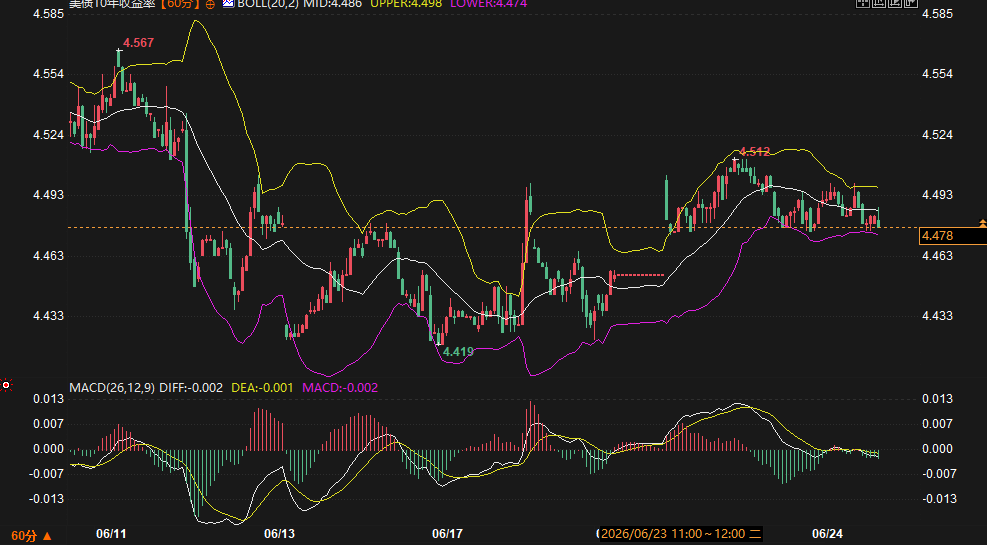
The 10-year US Treasury yield is currently at 4.478%, having decisively broken below the lower Bollinger Band at 4.474%. This break below the band technically indicates oversold conditions. While bearish momentum is dominant (the MACD lines are still below the zero line), the negative bars of the DIFF and DEA lines are shortening. This serves as a warning: the bond market may need a technical correction in the short term, but this could very well be just a "dead cat bounce."
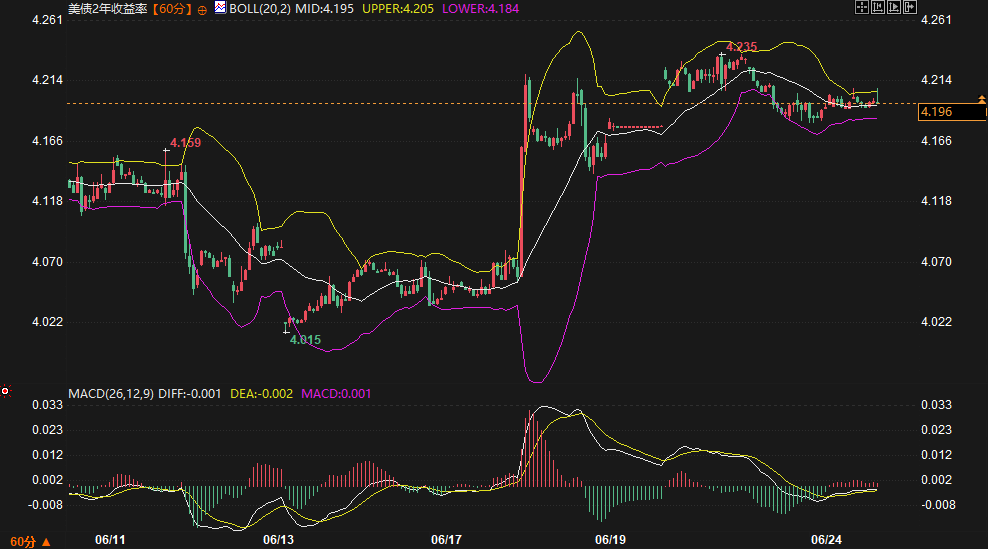
Looking at the 2-year yield, it's hovering around the middle band at 4.196%, and the MACD has just shown a weak positive bar. This indicates that the short-term bears have run out of steam, and the bulls and bears are temporarily evenly matched. Combining these two factors, the spread between the 10-year and 2-year yields remains around 28 basis points. This combination of weakness at the long end and stalemate at the short end often suggests that the market is waiting for Thursday's PCE data to reorient the long end. If the data is exceptionally strong, the 10-year yield will likely quickly escape the oversold zone and rebound towards the upper band.
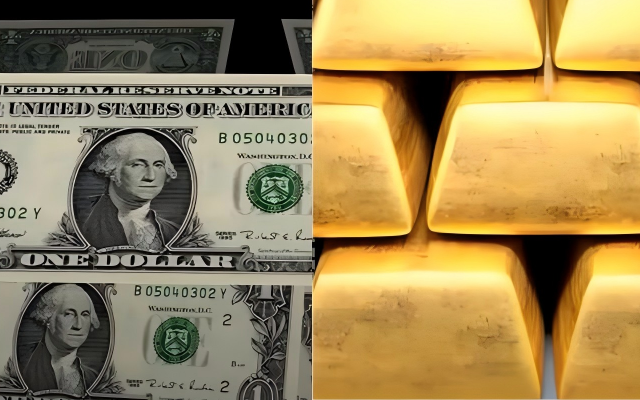
Gold fell to around $4,050 today, down more than 4% since the Fed meeting. Behind this large bearish candlestick lies a brutal repricing of a non-interest-bearing asset. With the market betting on three possible rate hikes this year, the opportunity cost of holding gold is simply too high.
The US dollar index surged to a 13-month high, making gold expensive for overseas buyers. Meanwhile, gold ETF holdings also appeared to lack momentum. According to reports from well-known foreign media citing institutional opinions, although central bank buying has provided support at low prices, investment buying is unlikely to recover as long as the Federal Reserve's concerns about inflation persist. Some institutions have even significantly lowered their quarterly average gold price forecasts by over $400. Geopolitical tensions should have been a plus for gold, but the strong dollar and expectations of interest rate hikes have almost completely overwhelmed any safe-haven impulses.
In the short term, Thursday's PCE data will be crucial. If core inflation falls below 3.5%, pent-up short covering could cause the 10-year yield to quickly reverse course and decline, giving gold a much-needed breather. If geopolitical news leads to a surge in oil prices at this point, market logic will become extremely chaotic. However, if the inflation reading meets or exceeds expectations, then the current "oversold" state of the 10-year US Treasury yield is merely a continuation of the downtrend. Any corrective rebound will be quickly swallowed up by selling pressure, and long-term yields will head towards the resistance zone of 4.55% to 4.60%. In that scenario, gold is likely to lose the psychological barrier of $4,000 and test a more solid bottom. From a longer-term perspective, as long as the Federal Reserve doesn't abandon its hawkish stance, a trend reversal in the downward pressure on US Treasuries and gold is unlikely.
Why did gold prices fall despite the recent tensions between the US and Iran?
The core issue lies with the US dollar and interest rates. While the US and Iran are engaged in a power struggle, the market doesn't believe a full-blown military conflict leading to an oil supply disruption is imminent. Geopolitical tensions are currently primarily reinforcing expectations of an "inflation-interest rate hike" cycle by driving up oil prices. This pushes up the US dollar and also raises real interest rates. Gold doesn't offer interest; as interest rate hike expectations strengthen, its holding costs increase, leading to institutional funds flowing out and into dollar-denominated assets.
The 10-year US Treasury yield has broken below its lower bound. Is now a good time to buy the dip?
The oversold condition shown on the technical charts only indicates a short-term rebound demand, but it's not a signal to blindly buy. The MACD is still in a bearish crossover and has not yet formed a confirmed golden cross. Before Thursday's PCE data release, this pattern seems more like a "bull trap." Logically, before the Damocles' sword of inflation data falls, any rebound based on oversold conditions is likely fragile and faces the possibility of being quickly repriced.
What does it mean when the 2-year yield forms a golden cross?
A weak golden cross on the 60-minute chart reflects the exhaustion of short-term bearish momentum and the bulls beginning to test the waters. However, this does not indicate a trend reversal. The Bollinger Bands are narrowing, indicating that the market is in a tense period awaiting a directional choice. If Thursday's PCE data supports a pause in interest rate hikes, this golden cross may trigger a short-term rebound; if the data is exceptionally strong, the golden cross signal will be instantly negated.
If oil prices really rise to $90, what real impact will it have on US Treasury bonds?
The impact is very direct. Rising oil prices will be passed on to transportation and chemical costs, ultimately pushing up prices in our daily lives. The Fed monitors the core PCE, and although it excludes food and energy, rising energy prices will indirectly increase the costs of core services and goods. Once inflation expectations rise, the market will immediately demand a higher term premium as compensation, which will lead to a concentrated sell-off of long-term US Treasuries and increased upward pressure on yields.
Is it normal for the interest rate spread between short and long terms to remain at 28 basis points?
This is a normal steepening after a correction, but it's not healthy. A normal steepening is usually driven by stable short-term interest rates and a slight rise in long-term rates due to economic optimism. But in the current situation, long-term yields are rising due to inflation concerns and deficit expectations, while short-term yields are pegged high by expectations of interest rate hikes. This widening spread reflects anxiety about policy mistakes rather than optimism about the economic outlook.
From a fundamental perspective, the core PCE data to be released on Thursday could be the final straw for US Treasury bulls. On the policy front, the Fed under Warsh's leadership's inclination to "tolerate higher inflation and maintain tighter interest rates" is reshaping the entire yield curve. Technically, we've observed two interesting extreme signals: the 10-year US Treasury yield has seen a rare break below its oversold level, while the 2-year yield is quietly brewing a weak golden cross. What do these signals suggest, and why has gold's safe-haven appeal suddenly failed?
The sword of Damocles is falling on inflation.
Logically, the biggest source of pressure on the current US Treasury market is not geopolitics, but rather inflation itself. At last week's FOMC meeting, nine of the 18 policymakers believed that interest rates needed to be raised this year, with six of them supporting two or more rate hikes. This proportion was almost unexpected before the meeting.
If the core PCE annual rate does indeed reach 3.5% on Thursday, the door to a second rate hike this year will essentially be open. Even more chilling is that the Fed itself has significantly raised its core inflation forecast for 2026 to 3.3%, and believes it will be impossible to return to the 2% target until the end of 2028. This means that even with an economic slowdown, high interest rates must be maintained to preserve credibility. As the asset most sensitive to long-term interest rate expectations, every rebound in the 10-year Treasury yield at this moment could be seen as a selling opportunity.
Geopolitical risks are rewriting the rules of the game.
In the past, when geopolitical tensions arose, funds would flow into US Treasury bonds and gold. But this time, the farce of the US-Iran peace agreement is instead causing trouble for US Treasury bonds. Washington and Tehran are locked in a dispute over the scope of nuclear inspections, the pace of sanctions lifting, and the issue of "transit fees" in the Strait of Hormuz.
A well-known foreign media analysis points out that even if the Taiwan Strait is not ultimately blocked, this event has completely shattered the assumption that "global energy arteries are risk-free." Shipping companies and refineries have begun to factor higher insurance premiums and detour costs into oil prices. Crude oil has found solid support in the $68-70 range, and momentum is building towards $86-90. Oil prices are more likely to rise than fall, which is tantamount to adding fuel to the already overheated inflation expectations, making it easier for US Treasury yields to rise than fall.
The "Double Signal" of 10-Year and 2-Year Terms
Looking at the 60-minute chart, today's market action reveals two telltale signs that require close examination.
The 10-year US Treasury yield is currently at 4.478%, having decisively broken below the lower Bollinger Band at 4.474%. This break below the band technically indicates oversold conditions. While bearish momentum is dominant (the MACD lines are still below the zero line), the negative bars of the DIFF and DEA lines are shortening. This serves as a warning: the bond market may need a technical correction in the short term, but this could very well be just a "dead cat bounce."
Looking at the 2-year yield, it's hovering around the middle band at 4.196%, and the MACD has just shown a weak positive bar. This indicates that the short-term bears have run out of steam, and the bulls and bears are temporarily evenly matched. Combining these two factors, the spread between the 10-year and 2-year yields remains around 28 basis points. This combination of weakness at the long end and stalemate at the short end often suggests that the market is waiting for Thursday's PCE data to reorient the long end. If the data is exceptionally strong, the 10-year yield will likely quickly escape the oversold zone and rebound towards the upper band.
Why is gold not considered a safe haven?
Gold fell to around $4,050 today, down more than 4% since the Fed meeting. Behind this large bearish candlestick lies a brutal repricing of a non-interest-bearing asset. With the market betting on three possible rate hikes this year, the opportunity cost of holding gold is simply too high.
The US dollar index surged to a 13-month high, making gold expensive for overseas buyers. Meanwhile, gold ETF holdings also appeared to lack momentum. According to reports from well-known foreign media citing institutional opinions, although central bank buying has provided support at low prices, investment buying is unlikely to recover as long as the Federal Reserve's concerns about inflation persist. Some institutions have even significantly lowered their quarterly average gold price forecasts by over $400. Geopolitical tensions should have been a plus for gold, but the strong dollar and expectations of interest rate hikes have almost completely overwhelmed any safe-haven impulses.
Trend Outlook
In the short term, Thursday's PCE data will be crucial. If core inflation falls below 3.5%, pent-up short covering could cause the 10-year yield to quickly reverse course and decline, giving gold a much-needed breather. If geopolitical news leads to a surge in oil prices at this point, market logic will become extremely chaotic. However, if the inflation reading meets or exceeds expectations, then the current "oversold" state of the 10-year US Treasury yield is merely a continuation of the downtrend. Any corrective rebound will be quickly swallowed up by selling pressure, and long-term yields will head towards the resistance zone of 4.55% to 4.60%. In that scenario, gold is likely to lose the psychological barrier of $4,000 and test a more solid bottom. From a longer-term perspective, as long as the Federal Reserve doesn't abandon its hawkish stance, a trend reversal in the downward pressure on US Treasuries and gold is unlikely.
Frequently Asked Questions
Why did gold prices fall despite the recent tensions between the US and Iran?
The core issue lies with the US dollar and interest rates. While the US and Iran are engaged in a power struggle, the market doesn't believe a full-blown military conflict leading to an oil supply disruption is imminent. Geopolitical tensions are currently primarily reinforcing expectations of an "inflation-interest rate hike" cycle by driving up oil prices. This pushes up the US dollar and also raises real interest rates. Gold doesn't offer interest; as interest rate hike expectations strengthen, its holding costs increase, leading to institutional funds flowing out and into dollar-denominated assets.
The 10-year US Treasury yield has broken below its lower bound. Is now a good time to buy the dip?
The oversold condition shown on the technical charts only indicates a short-term rebound demand, but it's not a signal to blindly buy. The MACD is still in a bearish crossover and has not yet formed a confirmed golden cross. Before Thursday's PCE data release, this pattern seems more like a "bull trap." Logically, before the Damocles' sword of inflation data falls, any rebound based on oversold conditions is likely fragile and faces the possibility of being quickly repriced.
What does it mean when the 2-year yield forms a golden cross?
A weak golden cross on the 60-minute chart reflects the exhaustion of short-term bearish momentum and the bulls beginning to test the waters. However, this does not indicate a trend reversal. The Bollinger Bands are narrowing, indicating that the market is in a tense period awaiting a directional choice. If Thursday's PCE data supports a pause in interest rate hikes, this golden cross may trigger a short-term rebound; if the data is exceptionally strong, the golden cross signal will be instantly negated.
If oil prices really rise to $90, what real impact will it have on US Treasury bonds?
The impact is very direct. Rising oil prices will be passed on to transportation and chemical costs, ultimately pushing up prices in our daily lives. The Fed monitors the core PCE, and although it excludes food and energy, rising energy prices will indirectly increase the costs of core services and goods. Once inflation expectations rise, the market will immediately demand a higher term premium as compensation, which will lead to a concentrated sell-off of long-term US Treasuries and increased upward pressure on yields.
Is it normal for the interest rate spread between short and long terms to remain at 28 basis points?
This is a normal steepening after a correction, but it's not healthy. A normal steepening is usually driven by stable short-term interest rates and a slight rise in long-term rates due to economic optimism. But in the current situation, long-term yields are rising due to inflation concerns and deficit expectations, while short-term yields are pegged high by expectations of interest rate hikes. This widening spread reflects anxiety about policy mistakes rather than optimism about the economic outlook.
- Risk Warning and Disclaimer
- The market involves risk, and trading may not be suitable for all investors. This article is for reference only and does not constitute personal investment advice, nor does it take into account certain users’ specific investment objectives, financial situation, or other needs. Any investment decisions made based on this information are at your own risk.