Gold prices briefly fell below $4,000; is the panic an abyss or an opportunity?
2026-06-24 22:01:19
On Wednesday (June 24), during the European and American trading sessions, spot gold suddenly accelerated its decline, breaking below the $4,000 mark and currently trading around $3,968, a drop of 3.44%. This article briefly outlines the possible reasons.
The Federal Reserve’s last policy meeting released a clear hawkish signal, and the market has begun to price in the possibility of a rate hike in September. Coupled with investors’ pessimistic outlook on Thursday’s core PCE inflation data, funds have collectively flowed into dollar assets as a safe haven.
The continued upward trend of the US dollar index is normal due to rising expectations of interest rate hikes. However, the fact that US Treasury yields have not risen in tandem suggests that large funds have increased their allocation to US Treasuries, indicating that institutions are hedging against risks. If the rise in the dollar was solely due to rising expectations of interest rate hikes, then the normal trend for US Treasury yields should be a simultaneous increase, as interest rate hikes would require higher interest rates for US Treasuries to attract buyers.
A stronger US dollar directly increases the cost for holders of non-US currencies to purchase precious metals, putting significant pressure on spot gold.
At the emerging market level, although the Colombian peso has led the way in gains among emerging market currencies this year, the risk of exchange rate volatility remains high amid a strong dollar cycle, and the policy buffer window for central banks to refrain from aggressive tightening continues to shrink.
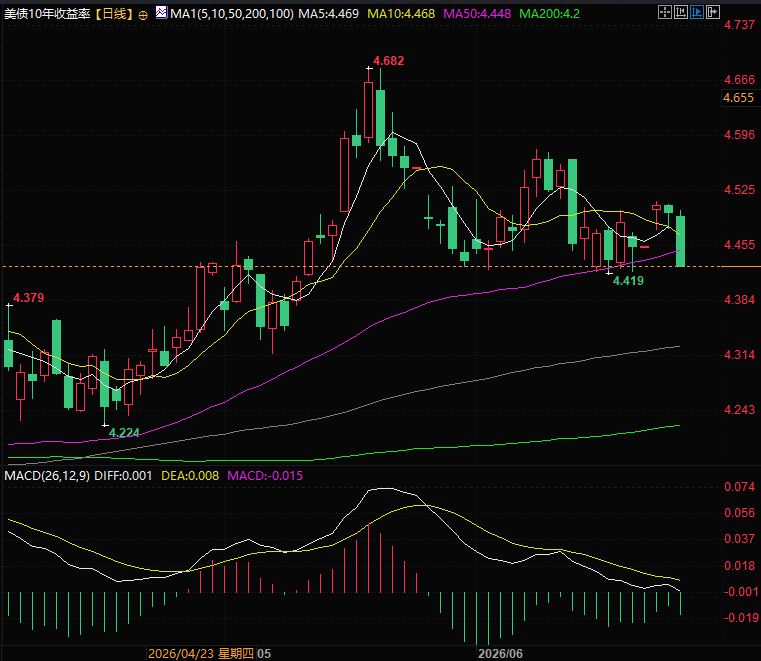
(Daily chart of the US 10-year Treasury yield, source: EasyTrade)
The Nasdaq index has recently begun a rapid correction, with technology stocks experiencing a concentrated wave of profit-taking and exits.
Regional market conditions showed significant divergence in expectations. Japanese and South Korean stock markets experienced a substantial overall recovery after previous sharp declines, and risk sentiment in some parts of the Asia-Pacific region briefly improved. However, the three major US stock indices did not show a synchronized and effective rebound, and the recovery was extremely weak.
This divergence in market sentiment reflects the current short-term pessimism of investors regarding US stocks. High interest rates continue to suppress the valuation of the technology sector, the AI sector's previous gains have fully priced in the positive factors, and the stickiness of inflation may force the Federal Reserve to maintain a tight monetary policy, leading to continued reductions in US stock holdings by institutions.
Even with improved sentiment in overseas markets, the willingness of funds to buy on dips remains weak, and risk assets lack sustained upward momentum.
Meanwhile, Nvidia will hold its shareholder meeting on Thursday, and the market has already priced in the gains ahead of schedule.
The $4,050 gold price level represents the 0.618 Fibonacci retracement level of this upward trend. It is also a key price level where there was a high volume of trading in the previous period, making it a significant technical support level.
If the gold price breaks below this level, a large number of long positions placed at this level will be stopped out, and the resulting selling pressure will accelerate the decline in the gold price.
The simultaneous decline in crude oil prices further confirms that the bullish sentiment in the market has turned into panic. The easing of geopolitical tensions in the Middle East has improved expectations for energy supply, leading to a concentrated sell-off by crude oil bulls.
Commodities weakened across the board, precious metals faced a breakdown, and US stocks continued to adjust, with multiple signals pointing downwards simultaneously, leading to a comprehensive decline in market risk appetite.
There are actually two possibilities. First, the market pricing of tomorrow's PCE deterioration and the fermentation of short-term hawkish expectations from the Fed could lead to a significant strengthening of the US dollar. A stronger dollar would put pressure on gold prices , while the opening of the Strait of Hormuz would put pressure on oil prices.
The sharp drop in the yield on 10-year US Treasury bonds and the slight drop in the yield on 2-year Treasury bonds confirm that short-term inflation persists while long-term inflation is receding. Meanwhile, the drop in gold prices to around 4,000 points triggered a concentrated sell-off by long positions.
Another possibility is that the rise in the US dollar and the fall in US Treasury yields represent a safe-haven inflow into the US dollar and US Treasury bonds, with the market betting on a turning point in the contraction of global risk appetite. Meanwhile, the suppression of bullish sentiment in traditional markets has put the bulls in US stocks, gold, and crude oil under pressure.
If the overall market continues to weaken and the rebound in US stocks falls short of expectations, the current drop in gold prices may be a prelude to a pessimistic shift in the overall market style. However, this probability is relatively small . It is more likely that short-term inflationary pressures have led to an overvaluation of the US dollar, while gold and oil prices are under short-term pressure, triggering stop-loss orders. Eventually, as global asset prices recover, a rebound will occur, which would be a worthwhile buying opportunity. There is no need for excessive panic in the market.
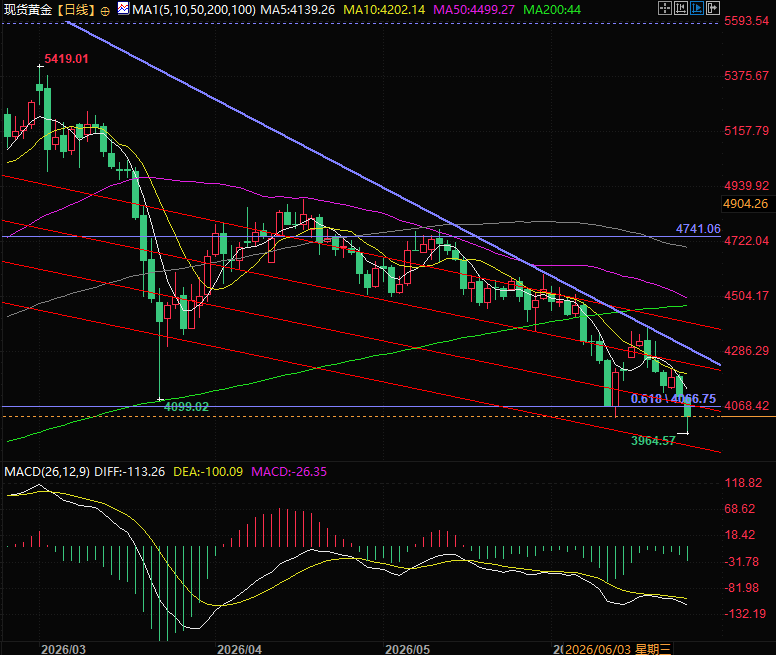
(Spot gold daily chart, source: FX678)
At 21:56 Beijing time, spot gold is currently trading at $4,026 per ounce.
A stronger dollar and lower US Treasury yields, coupled with risk aversion and pessimistic PCE expectations, dominated market activity.
The Federal Reserve’s last policy meeting released a clear hawkish signal, and the market has begun to price in the possibility of a rate hike in September. Coupled with investors’ pessimistic outlook on Thursday’s core PCE inflation data, funds have collectively flowed into dollar assets as a safe haven.
The continued upward trend of the US dollar index is normal due to rising expectations of interest rate hikes. However, the fact that US Treasury yields have not risen in tandem suggests that large funds have increased their allocation to US Treasuries, indicating that institutions are hedging against risks. If the rise in the dollar was solely due to rising expectations of interest rate hikes, then the normal trend for US Treasury yields should be a simultaneous increase, as interest rate hikes would require higher interest rates for US Treasuries to attract buyers.
A stronger US dollar directly increases the cost for holders of non-US currencies to purchase precious metals, putting significant pressure on spot gold.
At the emerging market level, although the Colombian peso has led the way in gains among emerging market currencies this year, the risk of exchange rate volatility remains high amid a strong dollar cycle, and the policy buffer window for central banks to refrain from aggressive tightening continues to shrink.
(Daily chart of the US 10-year Treasury yield, source: EasyTrade)
The divergence between the US stock market correction and the performance of Asian stock markets suggests underlying pessimistic expectations for the stock market.
The Nasdaq index has recently begun a rapid correction, with technology stocks experiencing a concentrated wave of profit-taking and exits.
Regional market conditions showed significant divergence in expectations. Japanese and South Korean stock markets experienced a substantial overall recovery after previous sharp declines, and risk sentiment in some parts of the Asia-Pacific region briefly improved. However, the three major US stock indices did not show a synchronized and effective rebound, and the recovery was extremely weak.
This divergence in market sentiment reflects the current short-term pessimism of investors regarding US stocks. High interest rates continue to suppress the valuation of the technology sector, the AI sector's previous gains have fully priced in the positive factors, and the stickiness of inflation may force the Federal Reserve to maintain a tight monetary policy, leading to continued reductions in US stock holdings by institutions.
Even with improved sentiment in overseas markets, the willingness of funds to buy on dips remains weak, and risk assets lack sustained upward momentum.
Meanwhile, Nvidia will hold its shareholder meeting on Thursday, and the market has already priced in the gains ahead of schedule.
Gold's key support level is in jeopardy, and weakening oil prices further confirm the collapse of market confidence in buying.
The $4,050 gold price level represents the 0.618 Fibonacci retracement level of this upward trend. It is also a key price level where there was a high volume of trading in the previous period, making it a significant technical support level.
If the gold price breaks below this level, a large number of long positions placed at this level will be stopped out, and the resulting selling pressure will accelerate the decline in the gold price.
The simultaneous decline in crude oil prices further confirms that the bullish sentiment in the market has turned into panic. The easing of geopolitical tensions in the Middle East has improved expectations for energy supply, leading to a concentrated sell-off by crude oil bulls.
Commodities weakened across the board, precious metals faced a breakdown, and US stocks continued to adjust, with multiple signals pointing downwards simultaneously, leading to a comprehensive decline in market risk appetite.
Summarize:
There are actually two possibilities. First, the market pricing of tomorrow's PCE deterioration and the fermentation of short-term hawkish expectations from the Fed could lead to a significant strengthening of the US dollar. A stronger dollar would put pressure on gold prices , while the opening of the Strait of Hormuz would put pressure on oil prices.
The sharp drop in the yield on 10-year US Treasury bonds and the slight drop in the yield on 2-year Treasury bonds confirm that short-term inflation persists while long-term inflation is receding. Meanwhile, the drop in gold prices to around 4,000 points triggered a concentrated sell-off by long positions.
Another possibility is that the rise in the US dollar and the fall in US Treasury yields represent a safe-haven inflow into the US dollar and US Treasury bonds, with the market betting on a turning point in the contraction of global risk appetite. Meanwhile, the suppression of bullish sentiment in traditional markets has put the bulls in US stocks, gold, and crude oil under pressure.
If the overall market continues to weaken and the rebound in US stocks falls short of expectations, the current drop in gold prices may be a prelude to a pessimistic shift in the overall market style. However, this probability is relatively small . It is more likely that short-term inflationary pressures have led to an overvaluation of the US dollar, while gold and oil prices are under short-term pressure, triggering stop-loss orders. Eventually, as global asset prices recover, a rebound will occur, which would be a worthwhile buying opportunity. There is no need for excessive panic in the market.
(Spot gold daily chart, source: FX678)
At 21:56 Beijing time, spot gold is currently trading at $4,026 per ounce.
- Risk Warning and Disclaimer
- The market involves risk, and trading may not be suitable for all investors. This article is for reference only and does not constitute personal investment advice, nor does it take into account certain users’ specific investment objectives, financial situation, or other needs. Any investment decisions made based on this information are at your own risk.