The Lebanon-Israel stalemate, coupled with continued US pressure, has increased supply, but geopolitical factors continue to support oil prices.
2026-06-25 16:16:25
On Thursday (June 25), during the Asian and European sessions, international oil prices rebounded slightly after hitting a low, suggesting that the downward trend may be slowing down.
Following the US-Israel military strike against Iran on February 28, one-fifth of the world's oil and gas transportation routes were disrupted, and oil prices have been supported by geopolitical risk premiums for an extended period.
The US and Iran recently signed a memorandum of understanding, agreeing to a 60-day window for consultations on a permanent ceasefire in the Middle East. However, the various conflicts have not been truly resolved, and shipping in the Straits, the Lebanon-Israel conflict, and the US-Iran rivalry continue to influence crude oil pricing.
Trump stated yesterday that he had communicated with oil companies today, and that their current efforts to lower gasoline prices have not yet met expectations, demonstrating his determination to suppress oil prices.
However, Trump also stated that charging passage fees for the Strait of Hormuz is unacceptable, and the US president is putting pressure on the country almost daily. Coupled with the Israeli issue, the US-Iran conflict may see further relapses.
Hezbollah and Israel continue to clash. The latest round of conflict, which broke out in March, has resulted in the deaths of more than 4,000 people in Lebanon, as well as dozens of Israeli soldiers, civilian defense personnel, and civilians.
Iran insists that a complete ceasefire in Lebanon and the withdrawal of Israel from occupied Lebanese territory are hard preconditions for a permanent US-Iran agreement.
Meanwhile, the first day of the first round of talks between Israel and Lebanon in Washington failed to make any progress, with the two sides having major differences on the scope and timing of Israel's troop withdrawal.
The atmosphere of the talks became increasingly tense, with the differences between the two countries remaining significant. The US mediator has essentially restarted negotiations in an attempt to persuade both sides to soften their positions and get the consultations back on track.
On Thursday, the Liberian-flagged oil tanker "Perseverance Warrior" became the first to use a new near-shore route designated by the Oman-International Maritime Organization, far from Iran, and successfully passed through the Strait of Hormuz . The entire voyage closely followed the coast of the UAE and Oman, circumnavigating the Musandam Peninsula. Several merchant ships followed closely behind, and no shipping accidents occurred in the strait in the short term.
This new shipping route bypasses the traditional central shipping lane in the strait, which was previously closed due to mines laid by the Iranian Revolutionary Guard. It has become a temporary option for shipping companies to avoid risks, and has also directly triggered a strong counterattack from Iran.
The Iranian Revolutionary Guard issued a warning through official media, stating that the unauthorized opening of the new shipping lane without Iranian coordination poses a significant security risk. They declared the lane as the only legal passage through the strait, and that any vessel attempting to bypass it will be punished. The successful passage of the Liberian-flagged cruise ship through the strait may have challenged Iran's red line, potentially leading to a more aggressive response, which could boost oil prices.
At the same time, Iran introduced strict navigation rules requiring all transit vessels to complete channel 16 reporting and coordination with Iran in advance. The new rules grant the Iranian Navy the authority to intercept, board, or seize vessels that violate regulations, thus completely controlling the approval authority for transit vessels through the strait.
A senior UAE diplomat publicly refuted Iran's position, opposing the use of geopolitical conflict to forcibly change the rules of navigation in the Gulf and to impose passage fees on passing oil tankers; Trump also made it clear that he did not agree with Iran's demand to collect passage fees in the Strait of Hormuz. The conflicting positions of the parties make the order of navigation in the Strait of Hormuz uncertain.
The U.S. Energy Secretary disclosed that 20 million barrels of crude oil have been shipped out of the Strait of Hormuz in the past 24 hours, and three tankers carrying a total of 5 million barrels of crude oil that had been stranded in the strait have left the strait one after another, with the previously accumulated physical cargo flowing into the market.
Selling sentiment was evident in the market. According to the head of energy futures at Mizuho, the August near-month contract faced massive selling pressure from Middle Eastern crude oil. Global spot crude oil was generally traded at a discount, and the original oil and gas trade flows were being restructured.
Coupled with the US temporarily easing sanctions on Iranian oil, Iran's oil exports are expected to accelerate, further consolidating the oversupply situation in the short term and continuing to drag down crude oil prices.
Although crude oil supply is ample in the short term, geopolitical risks have not been cleared, and there are hard constraints on the downside potential of oil prices.
Industry analysts predict that Iran's new regulations mandating ship registration will directly increase tanker shipping insurance rates and cross-border transportation costs, with the costs ultimately being passed on to the final price of crude oil, thus raising the inherent risk premium of crude oil.
Currently, there are two major disagreements in the market regarding the purpose of Iran's tough measures: whether this move is a countermeasure against the US and Gulf countries opening up alternative shipping routes, or a preemptive move by Iran to secure sovereignty over the Strait of Hormuz. There is no conclusion yet, but regardless of the initial intention, it will continue to provide geopolitical support for crude oil.
In addition, US energy policy is also affecting oil price trends. Trump admitted that the current reduction in US refined oil prices has not met the White House's expectations, and the US may introduce energy control policies to intervene in oil prices. Coupled with the possibility of escalation of conflicts among various parties in the Middle East, the downward trend in crude oil prices could be easily interrupted.
From the perspective of term premium, the near-month premium and far-month discount (backwardation pattern) indicates that the market is still worried about the possibility of reversals in the US-Iran Strait issue, while betting on weak oil prices due to a future global economic recession.
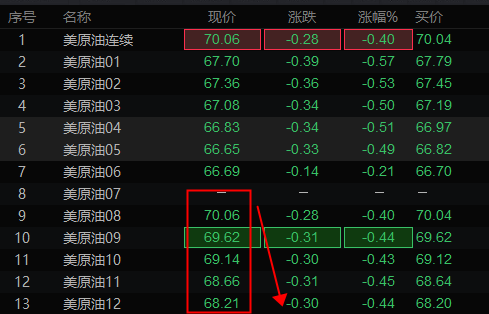
(WTI crude oil term premium, source: FX678)
In summary, the current international crude oil market is in a contradictory situation of improved supply but unresolved geopolitical risks. The Liberian-flagged vessel challenged Iran's bottom line, and the US president continued to exert pressure. In addition, the issue of Israel's withdrawal from Hezbollah remains unresolved. All of these factors have the potential to escalate and ultimately stimulate a rebound in oil prices.
In the short term, the resumption of navigation in the Strait of Hormuz, the concentrated release of pent-up crude oil, and the realization of increased Iranian exports have created a triple bearish force, continuously suppressing oil prices.
However, during the 60-day negotiation period between the US and Iran, the Lebanese war, the Strait of Hormuz shipping disputes, and Iran's shipping control policies could change at any time. If the geopolitical conflict escalates again, the market will quickly re-price the risk of supply disruption, the geopolitical premium will quickly make up for the decline in prices, and the volatility of crude oil prices will remain high. The overall trend of oil prices is completely tied to the progress of the US-Iran negotiations and the stability of navigation in the Strait of Hormuz.
The recent overshooting of oil prices may be due to the market betting on a global economic recession caused by war.
Technically, oil prices have fallen below the 0.236 level of this round of gains, almost erasing all the price increases brought about by the war. Currently, they are holding above the gap created by the war. Classic technical analysis considers gaps to be very strong support levels, especially original gaps. At present, any developments unfavorable to the US-Iran peace talks or economic data could easily lead to a rebound in oil prices. There is also a possibility of further declines triggering a large number of stop-loss orders, but this is already in the sweet spot of oil prices, so there is no need to panic excessively.
Moreover, the negative correlation between oil and gold prices has significantly decreased, and there is a high probability that gold and crude oil will rebound together in the future.
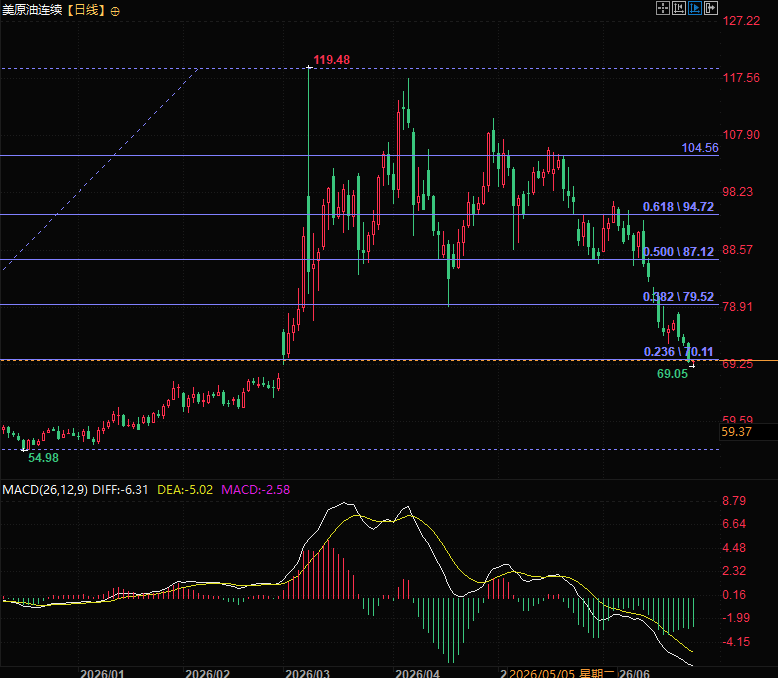
(WTI crude oil futures daily chart, source: EasyForex)
At 16:09 Beijing time, WTI crude oil futures were trading at $69.85 per barrel.
Following the US-Israel military strike against Iran on February 28, one-fifth of the world's oil and gas transportation routes were disrupted, and oil prices have been supported by geopolitical risk premiums for an extended period.
The US and Iran recently signed a memorandum of understanding, agreeing to a 60-day window for consultations on a permanent ceasefire in the Middle East. However, the various conflicts have not been truly resolved, and shipping in the Straits, the Lebanon-Israel conflict, and the US-Iran rivalry continue to influence crude oil pricing.
Trump stated yesterday that he had communicated with oil companies today, and that their current efforts to lower gasoline prices have not yet met expectations, demonstrating his determination to suppress oil prices.
However, Trump also stated that charging passage fees for the Strait of Hormuz is unacceptable, and the US president is putting pressure on the country almost daily. Coupled with the Israeli issue, the US-Iran conflict may see further relapses.
The recent conflict in Lebanon has become the biggest external obstacle to a permanent agreement between the US and Iran.
Hezbollah and Israel continue to clash. The latest round of conflict, which broke out in March, has resulted in the deaths of more than 4,000 people in Lebanon, as well as dozens of Israeli soldiers, civilian defense personnel, and civilians.
Iran insists that a complete ceasefire in Lebanon and the withdrawal of Israel from occupied Lebanese territory are hard preconditions for a permanent US-Iran agreement.
Meanwhile, the first day of the first round of talks between Israel and Lebanon in Washington failed to make any progress, with the two sides having major differences on the scope and timing of Israel's troop withdrawal.
The atmosphere of the talks became increasingly tense, with the differences between the two countries remaining significant. The US mediator has essentially restarted negotiations in an attempt to persuade both sides to soften their positions and get the consultations back on track.
Changes in Strait Navigation: New Waterway Launched and Opened to Traffic; Iran Issues Declaration of Strong Navigation Authority
On Thursday, the Liberian-flagged oil tanker "Perseverance Warrior" became the first to use a new near-shore route designated by the Oman-International Maritime Organization, far from Iran, and successfully passed through the Strait of Hormuz . The entire voyage closely followed the coast of the UAE and Oman, circumnavigating the Musandam Peninsula. Several merchant ships followed closely behind, and no shipping accidents occurred in the strait in the short term.
This new shipping route bypasses the traditional central shipping lane in the strait, which was previously closed due to mines laid by the Iranian Revolutionary Guard. It has become a temporary option for shipping companies to avoid risks, and has also directly triggered a strong counterattack from Iran.
The Iranian Revolutionary Guard issued a warning through official media, stating that the unauthorized opening of the new shipping lane without Iranian coordination poses a significant security risk. They declared the lane as the only legal passage through the strait, and that any vessel attempting to bypass it will be punished. The successful passage of the Liberian-flagged cruise ship through the strait may have challenged Iran's red line, potentially leading to a more aggressive response, which could boost oil prices.
At the same time, Iran introduced strict navigation rules requiring all transit vessels to complete channel 16 reporting and coordination with Iran in advance. The new rules grant the Iranian Navy the authority to intercept, board, or seize vessels that violate regulations, thus completely controlling the approval authority for transit vessels through the strait.
A senior UAE diplomat publicly refuted Iran's position, opposing the use of geopolitical conflict to forcibly change the rules of navigation in the Gulf and to impose passage fees on passing oil tankers; Trump also made it clear that he did not agree with Iran's demand to collect passage fees in the Strait of Hormuz. The conflicting positions of the parties make the order of navigation in the Strait of Hormuz uncertain.
The backlog of crude oil entering the market collectively suppressed oil prices.
The U.S. Energy Secretary disclosed that 20 million barrels of crude oil have been shipped out of the Strait of Hormuz in the past 24 hours, and three tankers carrying a total of 5 million barrels of crude oil that had been stranded in the strait have left the strait one after another, with the previously accumulated physical cargo flowing into the market.
Selling sentiment was evident in the market. According to the head of energy futures at Mizuho, the August near-month contract faced massive selling pressure from Middle Eastern crude oil. Global spot crude oil was generally traded at a discount, and the original oil and gas trade flows were being restructured.
Coupled with the US temporarily easing sanctions on Iranian oil, Iran's oil exports are expected to accelerate, further consolidating the oversupply situation in the short term and continuing to drag down crude oil prices.
Term premiums and physical constraints in navigation procedures may boost oil prices.
Although crude oil supply is ample in the short term, geopolitical risks have not been cleared, and there are hard constraints on the downside potential of oil prices.
Industry analysts predict that Iran's new regulations mandating ship registration will directly increase tanker shipping insurance rates and cross-border transportation costs, with the costs ultimately being passed on to the final price of crude oil, thus raising the inherent risk premium of crude oil.
Currently, there are two major disagreements in the market regarding the purpose of Iran's tough measures: whether this move is a countermeasure against the US and Gulf countries opening up alternative shipping routes, or a preemptive move by Iran to secure sovereignty over the Strait of Hormuz. There is no conclusion yet, but regardless of the initial intention, it will continue to provide geopolitical support for crude oil.
In addition, US energy policy is also affecting oil price trends. Trump admitted that the current reduction in US refined oil prices has not met the White House's expectations, and the US may introduce energy control policies to intervene in oil prices. Coupled with the possibility of escalation of conflicts among various parties in the Middle East, the downward trend in crude oil prices could be easily interrupted.
From the perspective of term premium, the near-month premium and far-month discount (backwardation pattern) indicates that the market is still worried about the possibility of reversals in the US-Iran Strait issue, while betting on weak oil prices due to a future global economic recession.
(WTI crude oil term premium, source: FX678)
Summary and Technical Analysis:
In summary, the current international crude oil market is in a contradictory situation of improved supply but unresolved geopolitical risks. The Liberian-flagged vessel challenged Iran's bottom line, and the US president continued to exert pressure. In addition, the issue of Israel's withdrawal from Hezbollah remains unresolved. All of these factors have the potential to escalate and ultimately stimulate a rebound in oil prices.
In the short term, the resumption of navigation in the Strait of Hormuz, the concentrated release of pent-up crude oil, and the realization of increased Iranian exports have created a triple bearish force, continuously suppressing oil prices.
However, during the 60-day negotiation period between the US and Iran, the Lebanese war, the Strait of Hormuz shipping disputes, and Iran's shipping control policies could change at any time. If the geopolitical conflict escalates again, the market will quickly re-price the risk of supply disruption, the geopolitical premium will quickly make up for the decline in prices, and the volatility of crude oil prices will remain high. The overall trend of oil prices is completely tied to the progress of the US-Iran negotiations and the stability of navigation in the Strait of Hormuz.
The recent overshooting of oil prices may be due to the market betting on a global economic recession caused by war.
Technically, oil prices have fallen below the 0.236 level of this round of gains, almost erasing all the price increases brought about by the war. Currently, they are holding above the gap created by the war. Classic technical analysis considers gaps to be very strong support levels, especially original gaps. At present, any developments unfavorable to the US-Iran peace talks or economic data could easily lead to a rebound in oil prices. There is also a possibility of further declines triggering a large number of stop-loss orders, but this is already in the sweet spot of oil prices, so there is no need to panic excessively.
Moreover, the negative correlation between oil and gold prices has significantly decreased, and there is a high probability that gold and crude oil will rebound together in the future.
(WTI crude oil futures daily chart, source: EasyForex)
At 16:09 Beijing time, WTI crude oil futures were trading at $69.85 per barrel.
- Risk Warning and Disclaimer
- The market involves risk, and trading may not be suitable for all investors. This article is for reference only and does not constitute personal investment advice, nor does it take into account certain users’ specific investment objectives, financial situation, or other needs. Any investment decisions made based on this information are at your own risk.