Stabilizing market risk sentiment is supporting the euro, and institutions expect EUR/USD to potentially return to the 1.1400 area.
2026-06-25 16:40:41
The euro traded in a range above 1.13 against the US dollar ahead of the European session on Thursday. Following a period of correction, market sentiment gradually stabilized, easing some of the downward pressure on the euro. Although the US dollar remains strong overall, some institutions believe that the euro/dollar pair may have reached a short-term equilibrium.

One of the key drivers in the recent foreign exchange market has been changes in global risk appetite. Previously, significant volatility in the technology sector and adjustments in assets related to the artificial intelligence industry chain triggered a global flow of funds into safe-haven assets such as the US dollar, pushing the dollar index higher and putting significant downward pressure on the euro. As the market gradually digests the previous risk events, investor sentiment has shown signs of improvement. Analysts believe that if global stock markets can continue to stabilize, especially if artificial intelligence-related sectors regain investor attention, the recovery in market risk appetite will weaken the demand for the US dollar as a safe haven, thus providing some support for the euro.
Meanwhile, US economic data remains a crucial variable influencing exchange rates. The market is widely focused on the upcoming release of the US May Personal Consumption Expenditures Price Index (PCE) and other consumption data. Some analysts believe that US consumer spending is likely to remain robust, but core PCE growth may be relatively moderate, which will limit further significant upward revisions to market expectations for a Fed rate hike.
Despite a recent shift towards a more hawkish stance from the Federal Reserve, the dollar's appreciation has slowed. The market currently anticipates further rate hikes by the Fed this year, but some of these positive factors have already been priced into the dollar's price. In Europe, the recently released German IFO Business Climate Index exceeded market expectations, alleviating some concerns stemming from weaker-than-expected manufacturing and services Purchasing Managers' Indices (PMIs). As the Eurozone's largest economy, Germany's improved economic performance provides some fundamental support for the euro.
It's worth noting that market expectations for future interest rate cuts or easing by the European Central Bank (ECB) have also shifted. Previously, investors anticipated the ECB might signal further easing against the backdrop of slowing economic growth, but recent relatively hawkish comments from some ECB officials have led the market to reduce its bets on future easing policies. Compared to ECB President Christine Lagarde's previously cautious remarks, some policymakers are more focused on the persistence of inflation risks. This difference in policy stance has also helped provide some support for the euro recently.
From a market structure perspective, the biggest negative factors for the euro against the US dollar currently remain the interest rate differential between the US and Europe and the overall strong cycle of the US dollar. However, as market risk sentiment gradually improves, the bearish momentum for the euro is weakening, and the exchange rate is expected to enter a period of consolidation and bottoming out in the short term. Institutions generally believe that the 1.1300 area has become a crucial watershed for the market. If global risk appetite remains stable, and US inflation data does not significantly exceed expectations, the euro against the US dollar is expected to gradually recover towards the 1.1400 area.
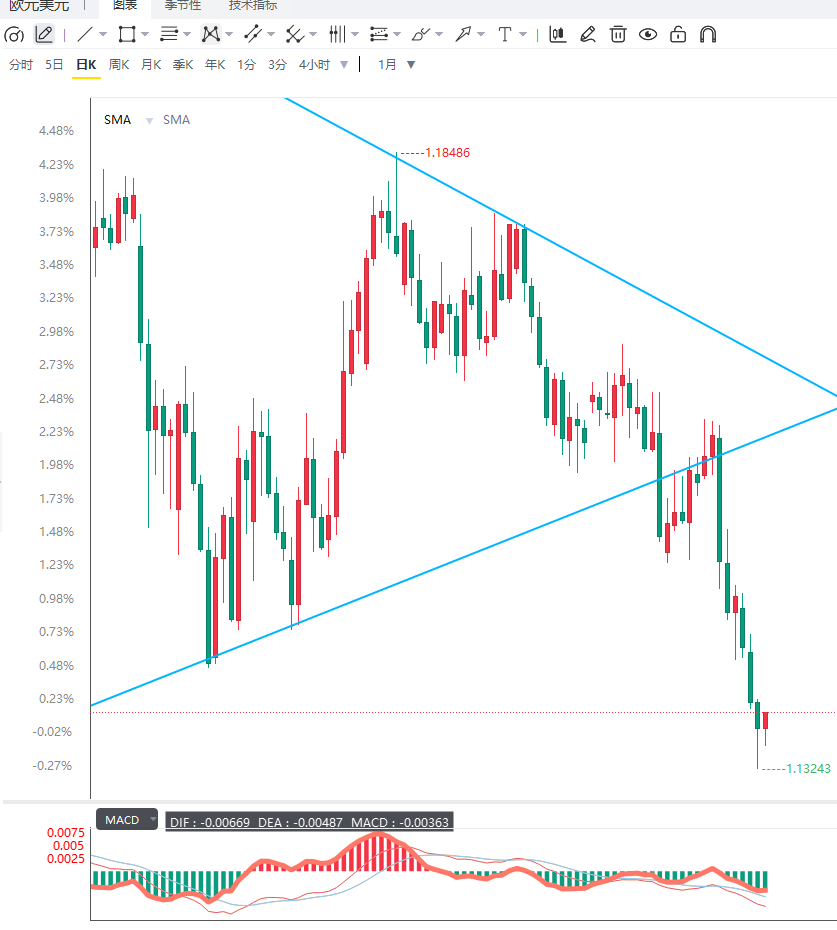
From a daily chart perspective, EUR/USD broke below its consolidation range and quickly declined, currently finding significant support around 1.1300 . The bearish momentum has weakened after the recent pullback, and the market is entering a bottoming-out phase. Key support levels are currently at 1.1300 and the 1.1250 area; a break below these levels could lead to a further test of support around 1.1200. Resistance levels are located at 1.1400 , 1.1450 , and the 1.1500 area. Overall, until a firm hold above 1.1500 is established, the medium-term trend remains in a correction phase, but strong support has emerged around 1.1300.
From a 4-hour chart perspective, EUR/USD is in a rebound and recovery phase after breaking below a converging structure. Currently, the price is gradually moving away from the previous lows, and short-term moving averages are beginning to flatten, indicating that the bearish advantage is weakening. If risk sentiment continues to improve and pushes the exchange rate above 1.1400, it is expected to further test the 1.1450 to 1.1500 area. Considering the current trend, EUR/USD has not yet entered a dense resistance zone, and the market remains focused on directional choice until the trend completely reverses. If a subsequent second pullback can hold the 1.1300 support, a bottom formation is expected, leading to a larger rebound; conversely, a break below 1.1300 could restart the downward trend, heading towards the 1.1200 area.
Editor's Summary : The euro has recently shown signs of stabilizing against the US dollar, mainly benefiting from improved global risk sentiment and marginal recovery in European economic data. Although the dollar remains supported by hawkish expectations from the Federal Reserve, market enthusiasm for further significant dollar gains has cooled. The 1.1300 area has become a crucial support level for both bulls and bears; whether it can hold will directly determine the euro's future trajectory. In the short term, US PCE data, global stock market performance, and subsequent statements from ECB officials will be key factors influencing market direction. If risk appetite continues to recover, EUR/USD is expected to gradually rebound towards the 1.1400 or even 1.1500 area; however, if market risk aversion resurfaces, the euro still faces the risk of further declines.
One of the key drivers in the recent foreign exchange market has been changes in global risk appetite. Previously, significant volatility in the technology sector and adjustments in assets related to the artificial intelligence industry chain triggered a global flow of funds into safe-haven assets such as the US dollar, pushing the dollar index higher and putting significant downward pressure on the euro. As the market gradually digests the previous risk events, investor sentiment has shown signs of improvement. Analysts believe that if global stock markets can continue to stabilize, especially if artificial intelligence-related sectors regain investor attention, the recovery in market risk appetite will weaken the demand for the US dollar as a safe haven, thus providing some support for the euro.
Meanwhile, US economic data remains a crucial variable influencing exchange rates. The market is widely focused on the upcoming release of the US May Personal Consumption Expenditures Price Index (PCE) and other consumption data. Some analysts believe that US consumer spending is likely to remain robust, but core PCE growth may be relatively moderate, which will limit further significant upward revisions to market expectations for a Fed rate hike.
Despite a recent shift towards a more hawkish stance from the Federal Reserve, the dollar's appreciation has slowed. The market currently anticipates further rate hikes by the Fed this year, but some of these positive factors have already been priced into the dollar's price. In Europe, the recently released German IFO Business Climate Index exceeded market expectations, alleviating some concerns stemming from weaker-than-expected manufacturing and services Purchasing Managers' Indices (PMIs). As the Eurozone's largest economy, Germany's improved economic performance provides some fundamental support for the euro.
It's worth noting that market expectations for future interest rate cuts or easing by the European Central Bank (ECB) have also shifted. Previously, investors anticipated the ECB might signal further easing against the backdrop of slowing economic growth, but recent relatively hawkish comments from some ECB officials have led the market to reduce its bets on future easing policies. Compared to ECB President Christine Lagarde's previously cautious remarks, some policymakers are more focused on the persistence of inflation risks. This difference in policy stance has also helped provide some support for the euro recently.
From a market structure perspective, the biggest negative factors for the euro against the US dollar currently remain the interest rate differential between the US and Europe and the overall strong cycle of the US dollar. However, as market risk sentiment gradually improves, the bearish momentum for the euro is weakening, and the exchange rate is expected to enter a period of consolidation and bottoming out in the short term. Institutions generally believe that the 1.1300 area has become a crucial watershed for the market. If global risk appetite remains stable, and US inflation data does not significantly exceed expectations, the euro against the US dollar is expected to gradually recover towards the 1.1400 area.
From a daily chart perspective, EUR/USD broke below its consolidation range and quickly declined, currently finding significant support around 1.1300 . The bearish momentum has weakened after the recent pullback, and the market is entering a bottoming-out phase. Key support levels are currently at 1.1300 and the 1.1250 area; a break below these levels could lead to a further test of support around 1.1200. Resistance levels are located at 1.1400 , 1.1450 , and the 1.1500 area. Overall, until a firm hold above 1.1500 is established, the medium-term trend remains in a correction phase, but strong support has emerged around 1.1300.
From a 4-hour chart perspective, EUR/USD is in a rebound and recovery phase after breaking below a converging structure. Currently, the price is gradually moving away from the previous lows, and short-term moving averages are beginning to flatten, indicating that the bearish advantage is weakening. If risk sentiment continues to improve and pushes the exchange rate above 1.1400, it is expected to further test the 1.1450 to 1.1500 area. Considering the current trend, EUR/USD has not yet entered a dense resistance zone, and the market remains focused on directional choice until the trend completely reverses. If a subsequent second pullback can hold the 1.1300 support, a bottom formation is expected, leading to a larger rebound; conversely, a break below 1.1300 could restart the downward trend, heading towards the 1.1200 area.
Editor's Summary : The euro has recently shown signs of stabilizing against the US dollar, mainly benefiting from improved global risk sentiment and marginal recovery in European economic data. Although the dollar remains supported by hawkish expectations from the Federal Reserve, market enthusiasm for further significant dollar gains has cooled. The 1.1300 area has become a crucial support level for both bulls and bears; whether it can hold will directly determine the euro's future trajectory. In the short term, US PCE data, global stock market performance, and subsequent statements from ECB officials will be key factors influencing market direction. If risk appetite continues to recover, EUR/USD is expected to gradually rebound towards the 1.1400 or even 1.1500 area; however, if market risk aversion resurfaces, the euro still faces the risk of further declines.
- Risk Warning and Disclaimer
- The market involves risk, and trading may not be suitable for all investors. This article is for reference only and does not constitute personal investment advice, nor does it take into account certain users’ specific investment objectives, financial situation, or other needs. Any investment decisions made based on this information are at your own risk.