With PCE exceeding 4%, the resilience of consumption has become a risk to interest rates.
2026-06-25 21:55:02
On Thursday, June 25th, the market refocused its pricing attention on the path of US inflation and interest rates. The personal consumption expenditure price index rose 4.1% year-on-year in May, the fastest pace since April 2023; the core index rose 3.4% year-on-year and 0.3% month-on-month. On the same day, the final reading of Q1 real GDP was revised upward to an annualized rate of 2.1%, but consumer spending contributed only slightly, durable goods orders fell 4.5% month-on-month, and initial jobless claims dropped to 215,000. On the surface, the data combination supports a recovery in risk appetite, with Brent crude oil falling back to $73.30 per barrel and US stock indices rebounding in the short term.
The first driver of inflation in May came from the energy chain. The Middle East conflict raised oil and transportation costs. Although the subsequent easing of supply risks led to a rapid pullback in oil prices, end-user prices did not recover accordingly. The average price of regular gasoline across the US remained at $3.918 per gallon, lower than $4.507 per gallon a month ago, but significantly higher than $3.227 per gallon in the same period last year. For household cash flow, the drop in oil prices only provides a marginal buffer and cannot immediately reverse the cost pressures already passed on to logistics, travel, and service prices.
More worrying is the stickiness of core services. The core PCE, excluding food and energy, remained at 3.4%, meaning inflation has not entirely been contained by external shocks. Services beyond housing, financial services, healthcare, and transportation-related costs still exhibit strong inertia. If the decline in energy prices fails to suppress core service inflation, the market cannot simply view the May data as a one-off shock. For the interest rate market, the real risk is not whether oil prices have peaked, but whether inflation expectations are once again anchored above the target level.
Nominal personal consumption expenditure increased by $156.1 billion in May, a month-on-month increase of 0.7%; however, real consumption expenditure, adjusted for inflation, increased by only 0.3%. This indicates that residents are still consuming, but a large portion of the increase in spending has been eroded by price increases. Personal income increased by $181.6 billion, and disposable personal income increased by $164.9 billion, with real disposable income growing by 0.3%, a rare positive growth since the beginning of the year. However, personal savings amounted to $704.2 billion, and the savings rate remained at 3.0%, which is relatively low, indicating that households have a limited buffer against price shocks.
Consumption patterns are also diverging. Essential consumption and service spending are relatively stable, but large durable goods are more vulnerable to squeezes from high interest rates, oil prices, and credit costs. Retailers have recently noted that consumers are more inclined towards discounts, promotions, and small, essential items, rather than complete shopping baskets and large durable goods. This shift is significant for macro pricing: it's not a typical example of broad-based demand expansion, but rather nominal spending supported by prices, essential needs, and credit turnover. If the savings rate continues to remain low, subsequent consumption elasticity will depend more on employment and wages than on sentiment recovery driven by asset prices.
The final figure for Q1 GDP showed an annualized growth rate of 2.1%, higher than previously estimated. However, this upward revision was mainly driven by adjustments to imports and support from investment, exports, and government spending. Consumption did not strengthen in tandem, meaning the overall figure was better than the quality of demand. It is necessary to distinguish between the signals of "upward revision of aggregate figures" and "improvement in domestic demand." The former can improve risk appetite in the short term, while the latter determines the sustainability of inflation and profits.
Durable goods orders offer another clue. New durable goods orders fell by $15.6 billion to $332.1 billion in May, a 4.5% decrease month-over-month; however, excluding transportation, they actually increased by 1.3%. This suggests that the manufacturing sector is not entirely weakening; while high-volatility items such as aircraft are dragging down the overall volume, demand for core equipment remains supportive. The problem lies in the fact that if the Federal Reserve continues to maintain high real interest rates, the financial threshold for corporate capital expenditures will be raised, and the order structure may further shift from expansionary investment to replacement and efficiency-oriented investment. Currently, the manufacturing sector is not showing signs of recession, but rather a coexistence of increased volatility and heightened financing sensitivity.
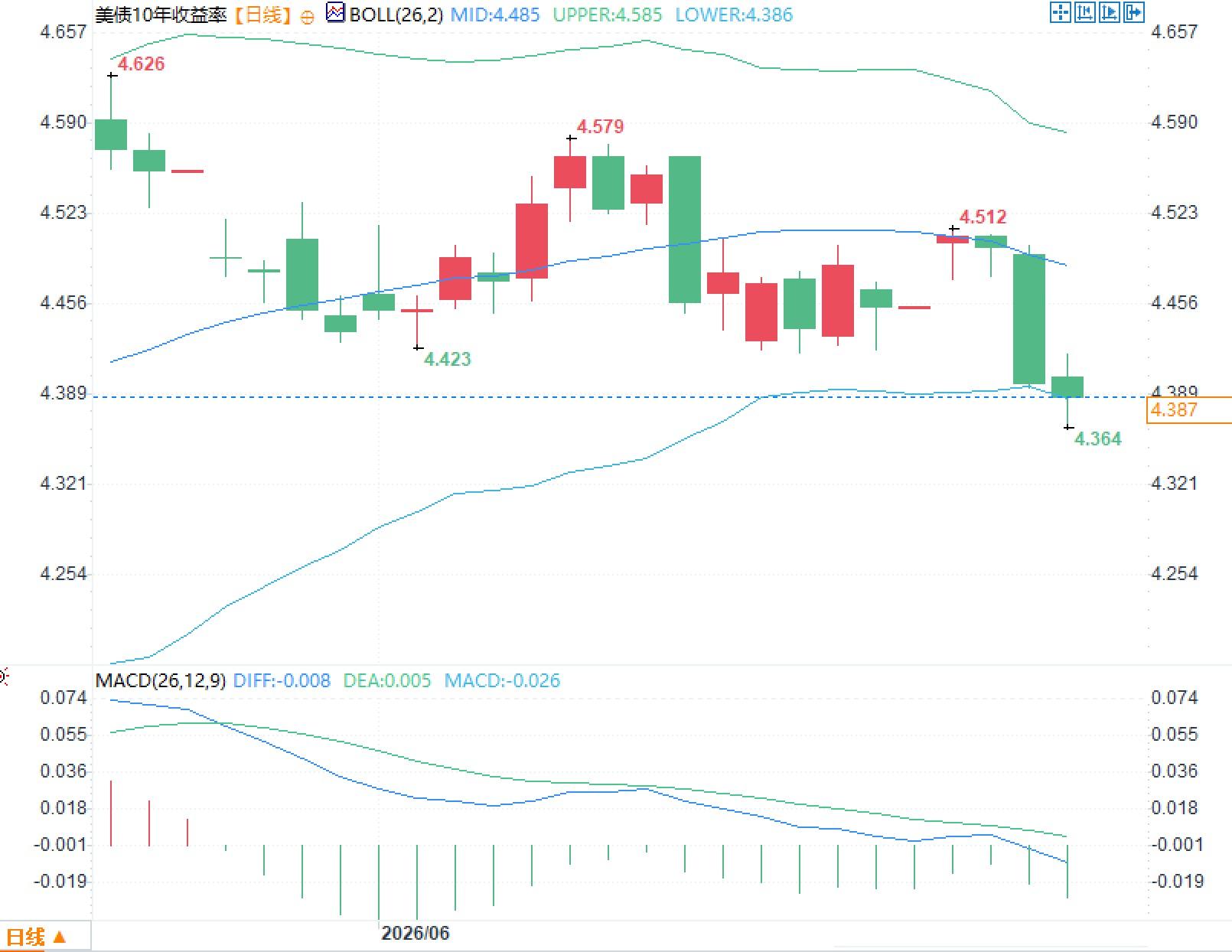
The Federal Reserve maintained its target range for the federal funds rate at 3.50% to 3.75% in June, while emphasizing that inflation remained above the 2% target. Following the release of the May PCE data, the core of policy discussions shifted from whether to ease monetary policy to whether further tightening was needed this year. The 2-year Treasury yield remained near the upper end of the policy rate range, while the 10-year yield fluctuated around 4.4%, indicating that the bond market is pricing in a higher duration premium and a more uncertain policy response function.
Gold is fluctuating around $4010/ounce, having retreated more than 11% over the past month, reflecting the pressure on non-interest-bearing assets from the temporary strengthening of real interest rates and the US dollar index. The rebound in equity indices is more attributable to inflation not exceeding expectations and the recovery of technology-heavy stocks, rather than the disappearance of macroeconomic constraints. If oil prices remain low, the market may briefly trade a decline in inflation; however, as long as core PCE remains above 3%, the upward tail risk of policy interest rates will be difficult to completely eliminate.
The first driver of inflation in May came from the energy chain. The Middle East conflict raised oil and transportation costs. Although the subsequent easing of supply risks led to a rapid pullback in oil prices, end-user prices did not recover accordingly. The average price of regular gasoline across the US remained at $3.918 per gallon, lower than $4.507 per gallon a month ago, but significantly higher than $3.227 per gallon in the same period last year. For household cash flow, the drop in oil prices only provides a marginal buffer and cannot immediately reverse the cost pressures already passed on to logistics, travel, and service prices.
More worrying is the stickiness of core services. The core PCE, excluding food and energy, remained at 3.4%, meaning inflation has not entirely been contained by external shocks. Services beyond housing, financial services, healthcare, and transportation-related costs still exhibit strong inertia. If the decline in energy prices fails to suppress core service inflation, the market cannot simply view the May data as a one-off shock. For the interest rate market, the real risk is not whether oil prices have peaked, but whether inflation expectations are once again anchored above the target level.
Nominal personal consumption expenditure increased by $156.1 billion in May, a month-on-month increase of 0.7%; however, real consumption expenditure, adjusted for inflation, increased by only 0.3%. This indicates that residents are still consuming, but a large portion of the increase in spending has been eroded by price increases. Personal income increased by $181.6 billion, and disposable personal income increased by $164.9 billion, with real disposable income growing by 0.3%, a rare positive growth since the beginning of the year. However, personal savings amounted to $704.2 billion, and the savings rate remained at 3.0%, which is relatively low, indicating that households have a limited buffer against price shocks.
Consumption patterns are also diverging. Essential consumption and service spending are relatively stable, but large durable goods are more vulnerable to squeezes from high interest rates, oil prices, and credit costs. Retailers have recently noted that consumers are more inclined towards discounts, promotions, and small, essential items, rather than complete shopping baskets and large durable goods. This shift is significant for macro pricing: it's not a typical example of broad-based demand expansion, but rather nominal spending supported by prices, essential needs, and credit turnover. If the savings rate continues to remain low, subsequent consumption elasticity will depend more on employment and wages than on sentiment recovery driven by asset prices.
The final figure for Q1 GDP showed an annualized growth rate of 2.1%, higher than previously estimated. However, this upward revision was mainly driven by adjustments to imports and support from investment, exports, and government spending. Consumption did not strengthen in tandem, meaning the overall figure was better than the quality of demand. It is necessary to distinguish between the signals of "upward revision of aggregate figures" and "improvement in domestic demand." The former can improve risk appetite in the short term, while the latter determines the sustainability of inflation and profits.
Durable goods orders offer another clue. New durable goods orders fell by $15.6 billion to $332.1 billion in May, a 4.5% decrease month-over-month; however, excluding transportation, they actually increased by 1.3%. This suggests that the manufacturing sector is not entirely weakening; while high-volatility items such as aircraft are dragging down the overall volume, demand for core equipment remains supportive. The problem lies in the fact that if the Federal Reserve continues to maintain high real interest rates, the financial threshold for corporate capital expenditures will be raised, and the order structure may further shift from expansionary investment to replacement and efficiency-oriented investment. Currently, the manufacturing sector is not showing signs of recession, but rather a coexistence of increased volatility and heightened financing sensitivity.
The Federal Reserve maintained its target range for the federal funds rate at 3.50% to 3.75% in June, while emphasizing that inflation remained above the 2% target. Following the release of the May PCE data, the core of policy discussions shifted from whether to ease monetary policy to whether further tightening was needed this year. The 2-year Treasury yield remained near the upper end of the policy rate range, while the 10-year yield fluctuated around 4.4%, indicating that the bond market is pricing in a higher duration premium and a more uncertain policy response function.
Gold is fluctuating around $4010/ounce, having retreated more than 11% over the past month, reflecting the pressure on non-interest-bearing assets from the temporary strengthening of real interest rates and the US dollar index. The rebound in equity indices is more attributable to inflation not exceeding expectations and the recovery of technology-heavy stocks, rather than the disappearance of macroeconomic constraints. If oil prices remain low, the market may briefly trade a decline in inflation; however, as long as core PCE remains above 3%, the upward tail risk of policy interest rates will be difficult to completely eliminate.
- Risk Warning and Disclaimer
- The market involves risk, and trading may not be suitable for all investors. This article is for reference only and does not constitute personal investment advice, nor does it take into account certain users’ specific investment objectives, financial situation, or other needs. Any investment decisions made based on this information are at your own risk.