June 26th Financial Breakfast: Concerns over excessive Fed rate hikes ease, gold prices rebound above $4000; cargo ship attacked near Oman; supply concerns help oil prices surge over 2%.
2026-06-26 07:32:08
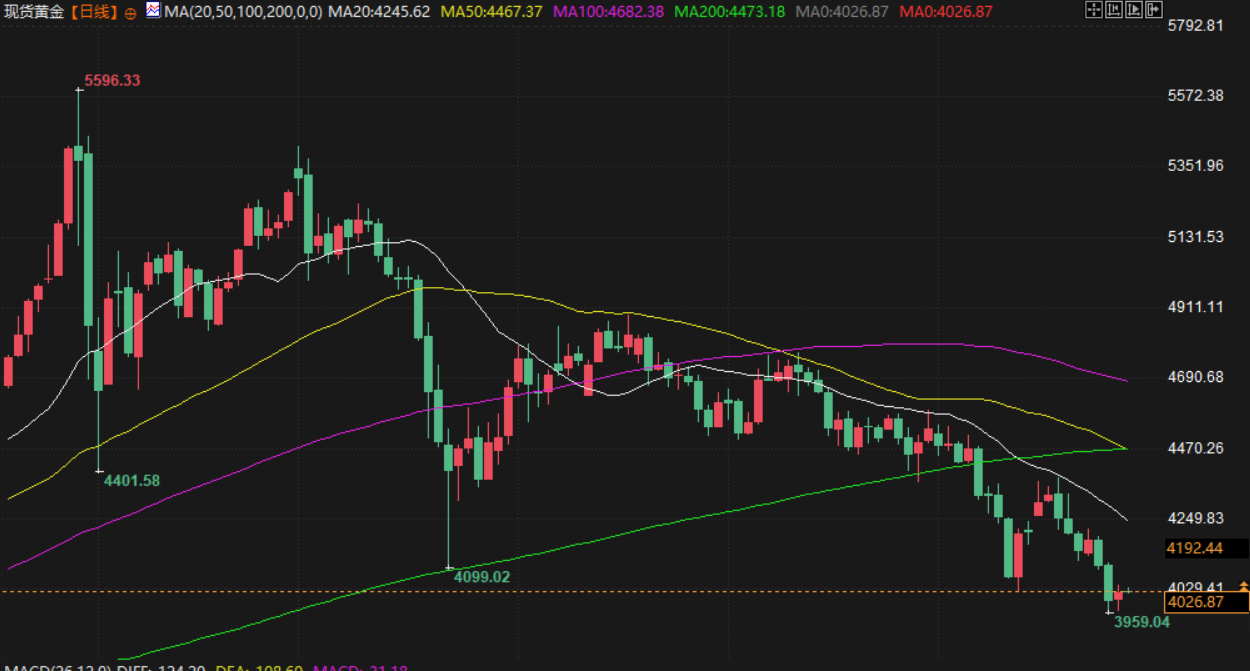
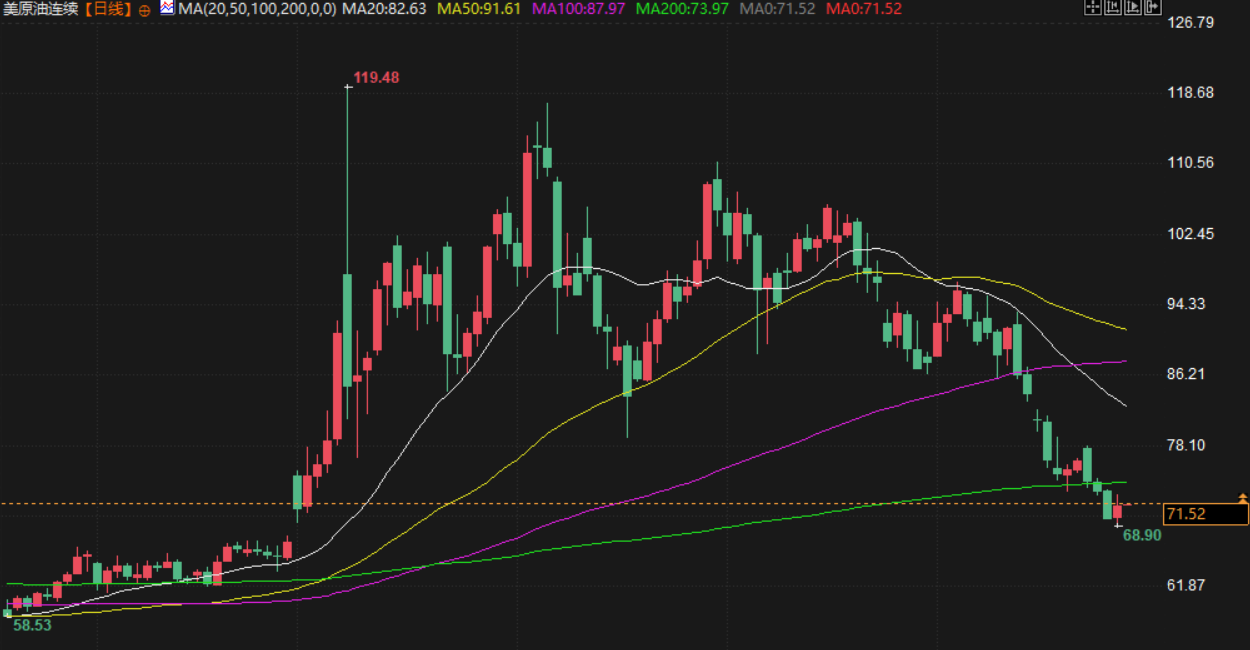
On Friday (June 26, Beijing time) in early Asian trading, spot gold was trading around $4,029.30 per ounce. Gold prices rebounded above $4,000 per ounce on Thursday as the US May PCE figure saw its largest increase since April 2023 and broke through 4.0% for the first time, easing excessive market concerns about an imminent Fed rate hike and pushing the dollar back down. US crude oil was trading around $71.54 per barrel. Oil prices rose sharply by more than 2% on Thursday after a cargo ship was hit by an unidentified projectile near Oman (two US officials later revealed that it was fired by Iran), raising concerns about the prospects for the recovery of Middle Eastern oil supplies.

U.S. stocks closed mixed on Thursday, with the Nasdaq down 0.46% due to declines in large-cap tech stocks, the S&P 500 down slightly by 0.01% and essentially flat, while the Dow Jones Industrial Average rose 0.14%. Tech stocks gave back earlier gains as investor concerns about the massive investments and cost-sharing of AI by mega-corporations overshadowed positive signals from Micron and Qualcomm driven by strong demand for artificial intelligence.
Apple shares plunged 6.1% after raising prices for iPads and MacBooks to cope with soaring memory and storage chip costs. Nvidia, Microsoft, and Alphabet also fell between 0.5% and 3.5%. Meanwhile, Micron shares surged 15.7% after reporting better-than-expected earnings and guidance. Sandisk jumped 22%, and Qualcomm, Western Digital, and Seagate also rose significantly. The Philadelphia Semiconductor Index rose 3.2%, on track for its strongest quarterly performance ever.
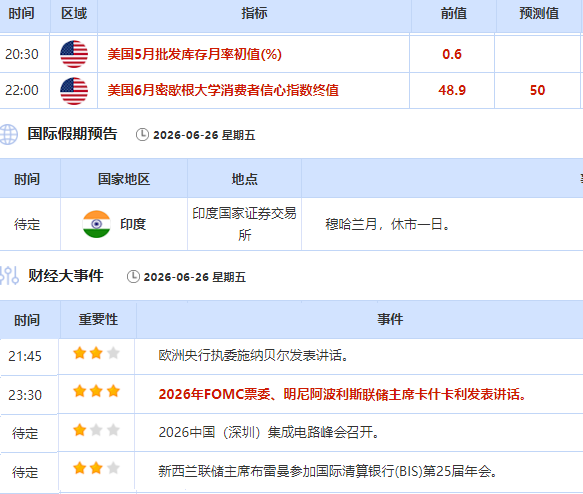
On the economic data front, the U.S. inflation rate broke through 4.0% in May, driven by rising energy prices, for the first time in three years. This could prompt the Federal Reserve to move closer to raising interest rates, with traders expecting at least a 25 basis point increase by the end of the year. Meanwhile, the final reading of first-quarter GDP was revised upward to 2.1%, higher than previously estimated, and the decline in unemployment claims also exceeded expectations.
In terms of sectors, industrial stocks led the gains among the 11 S&P 500 sectors, rising 2.2%, while consumer discretionary and consumer staples sectors saw the largest declines, and technology stocks dipped slightly by 0.1%. Additionally, Bio-Techne surged 11.8% following Merck's $73 per share cash acquisition. Overall, the market is digesting the interplay between rising inflation, interest rate hike expectations, and an optimistic outlook for the semiconductor industry, with the Nasdaq poised to record its largest monthly decline since March 2025.
Gold prices reversed intraday losses on Thursday to close higher, with spot gold returning above $4,000 an ounce to $4,026.41. This was primarily driven by a 4.1% year-on-year surge in the U.S. May Personal Consumption Expenditures (PCE) price index, the largest increase since April 2023 and the first time it had surpassed 4.0%. However, the data was largely in line with market expectations, easing excessive concerns about an impending Federal Reserve rate hike. This pushed the dollar back down and lower, while U.S. Treasury yields declined slightly, making dollar-denominated gold more attractive to overseas buyers. Nevertheless, inflationary pressures remain a key market focus.
The Chicago Mercantile Exchange's FedWatch tool showed that the market's probability of a December rate hike fell from 85% to 80%, but was still significantly higher than the 61% following last week's policy statement. Other precious metals also rose, with spot silver up 0.7% to $57.82 per ounce, and platinum and palladium up 1.8% and 1.9% respectively, to $1606.61 and $1188.19 per ounce.
Oil prices surged more than 2% on Thursday after a cargo ship was hit by an unidentified projectile near Oman (two U.S. officials later revealed that it was fired by Iran), raising concerns about the prospects for the recovery of Middle Eastern oil supplies. Brent crude rose 2.41% to $74.89 a barrel, while WTI crude rose 2.29%.
Following the attacks, the International Maritime Organization of the United Nations suspended its plan to guide ships through the strait, raising renewed doubts in the market about the prospects of a preliminary agreement to end the war with Iran. Rystad Energy pointed out that the Gulf oil storage tanks are currently only 50%-60% full, and if tanker traffic cannot recover in the near future, oil-producing countries will be forced to reduce production, and a full recovery will be delayed until next year.
Goldman Sachs expects that even if sanctions relief is extended, Iranian crude oil production will not rebound significantly. UBS lowered its Brent crude oil price forecast to $85 per barrel (end of September and end of December) and $80 per barrel (end of March and end of June 2027). In addition, US gasoline and diesel futures rose by about 5% and 4% respectively. Analysts also believe that short covering and bargain hunting after overselling have provided technical support for the rise, even though both contracts have been in oversold territory for more than a week.
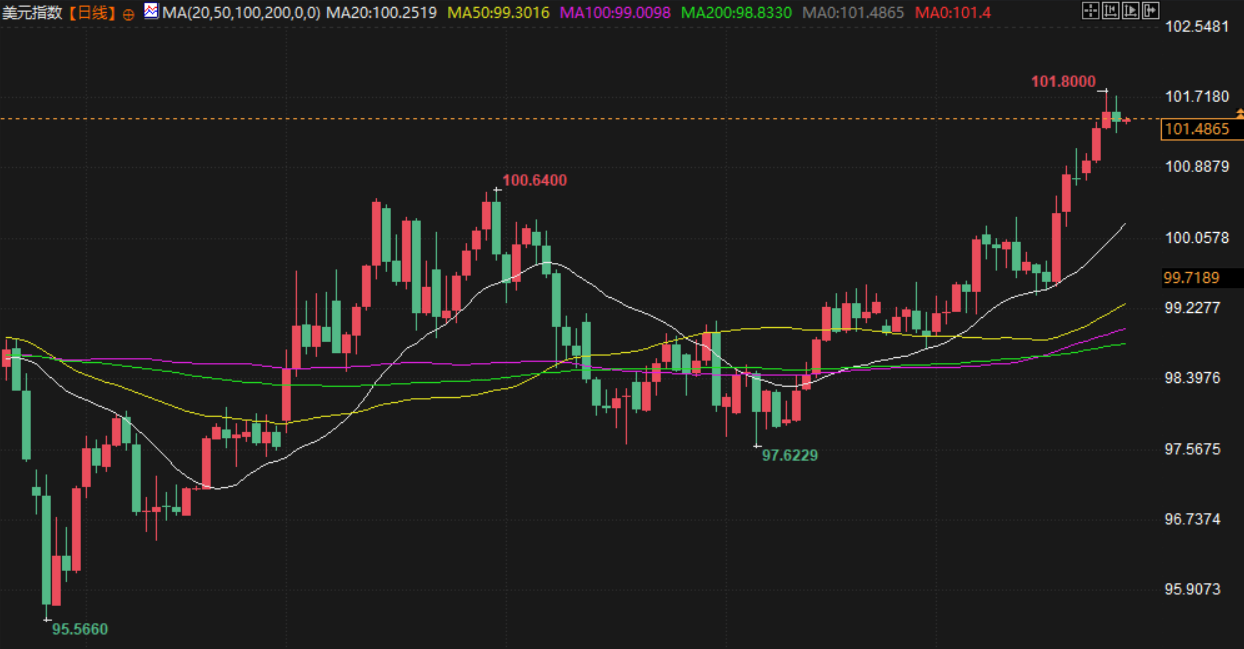
The dollar index fell 0.12% to 101.45 on Thursday, ending a three-day winning streak, as the U.S. May personal consumption expenditures (PCE) price index surged 4.1% year-on-year (in line with expectations) and rose 0.4% month-on-month, slightly below expectations. This, coupled with an upward revision of first-quarter GDP to 2.1% and better-than-expected initial jobless claims of 215,000, eased market concerns about aggressive interest rate hikes by the Federal Reserve.
Data from the Chicago Mercantile Exchange's FedWatch tool shows that the probability of a July rate hike has fallen from 34.2% to about 30%, and the expectation of a September rate hike has also slightly decreased from 65.7% to 62.1%.
The euro rose 0.16% against the dollar to 1.1375, while the pound gained 0.25% to 1.3196, ending a losing streak since Prime Minister Starmer's resignation on Monday. The dollar edged up 0.01% against the yen to 161.79, nearing its lowest level since 1986 at 161.96. Meanwhile, Bank of Japan board member Naoki Tamura, a hawkish figure, advocated for rate hikes every few months and urged preparations for acceleration. However, the Japanese government's draft long-term economic plan urged the implementation of loose monetary policies to boost private demand, maintaining an overall dovish tone. Societe Generale believes the statement should be ignored at this stage, but fiscal risks may increase over time.
Iran's attack on a cargo ship tests Trump's agreement to reopen the Straits of Hormuz.
Two senior U.S. officials revealed that Iran's Islamic Revolutionary Guard Corps attacked a Singapore-flagged cargo ship in the Strait of Hormuz on Thursday, putting the ceasefire agreement signed last week between the U.S. and Iran to restore traffic through this crucial shipping route to the brink of collapse. The UK's Office for Maritime Trade Operations stated that the attack damaged the ship's bridge but caused no casualties. The incident occurred off the coast of Oman, just hours after the Iranian paramilitary naval force warned ships against using the unrecognized strait. The White House has not yet responded to media requests for comment on the attack and its impact on the agreement. Ship tracking platform Marine Traffic indicates that the attacked cargo ship, the "Ever Lovely," had previously loaded cargo at the Iraqi port of Umm Qasr, bound for Singapore. Data from financial data provider London Stock Exchange Group (LSEG) shows that the "Ever Lovely" had been stranded in the Persian Gulf for over 100 days. Early Thursday morning local time, the ship headed towards the strait's entrance, while three other vessels also attempted to transit around the same time.
Iran: Ships that deviate from designated routes will not enjoy security guarantees.
The Persian Gulf Straits Authority (PSA) of Iran issued a notice on social media on the 26th, stating that all vessels transiting the Strait of Hormuz must follow the prescribed routes and procedures. Vessels that deviate from the designated routes without authorization will not be entitled to security guarantees or related insurance coverage. The notice stated that all consequences arising from unauthorized departure from the designated routes will be borne by the ship owner, operator, and captain. Previously, on the 19th, Iran issued a notice stating that vessels submitting navigation applications to the PSA within the timeframe stipulated in the memorandum of understanding would have their navigation arrangements processed swiftly. The requirements included: submitting applications at least 48 hours before arriving in the strait area; submitting applications to the PSA's website or email address; and coordinating routes and navigation times in advance according to the announced schedule. (Xinhua)
With the midterm elections approaching, US media revealed that Musk made a large donation to the Republican Party.
According to an analysis of Federal Election Commission data by The Washington Post, major donors to U.S. politics have invested over $1.3 billion to date this election cycle to influence national politics as the midterm elections approach. These donors tend to support the Republican Party, and this funding could be crucial for the Republicans to retain control of Congress in November. In the first half of 2026, Republican-leaning donors contributed $880 million, compared to $290 million from Democratic-leaning donors and $200 million from bipartisan and special interest groups. Newly minted trillionaire Elon Musk topped the list of individual donors, donating $85.1 million to Republican-affiliated organizations or individuals.
Sources say the Israeli withdrawal from Lebanon is a key "red line" for Iran.
A source close to the negotiating team stated that Israel's withdrawal from Lebanese territory is one of the conditions of the final agreement between Iran and the United States, and is considered a crucial "red line" by the Iranian negotiating team. The source further stated that the final memorandum of understanding will guarantee Lebanon's sovereignty and territorial integrity. The text of the agreement previously reached in Switzerland already emphasized a "conflict resolution mechanism" with Iranian participation and unified implementation. Iran is currently monitoring its specific implementation timeline. The source also stated that the scale of Israeli attacks on Lebanon has significantly decreased in the past six days, indicating that Iran's measures have been effective. However, Iran will not be satisfied unless a permanent ceasefire is achieved and Israel completely withdraws its troops from Lebanon. (CCTV News)
Traffic in the Strait of Hormuz has recovered to nearly 60% of pre-war levels.
S&P Global Energy released a report on the 25th stating that 78 ships passed through the Strait of Hormuz on the 24th, setting a new single-day record since the outbreak of the conflict with Iran. The average daily ship traffic through the Strait of Hormuz this month has recovered to approximately 57% of pre-conflict levels. The report said that as of the 24th, a total of 551 ships had passed through the Strait of Hormuz this month, potentially making it the month with the highest traffic volume since the outbreak of the conflict. The report pointed out that the ships recently departing from the Strait of Hormuz include not only those that have been delayed due to the conflict but also those that recently entered, reflecting initial signs of normalization in shipping activity. However, whether the recovery in traffic volume can be sustained remains to be seen, and relevant agreements still need further consolidation and implementation. (Xinhua)
The probability of a Federal Reserve rate hike in September is 63.4%, and the probability of at least one rate hike this year is 81.7%.
According to CME's "FedWatch": The probability of the Federal Reserve keeping interest rates unchanged in July is 69%, and the probability of a cumulative 25 basis point rate hike is 31%. The probability of the Fed keeping interest rates unchanged by September is 36.6%, the probability of a cumulative 25 basis point rate hike is 48.8%, and the probability of a cumulative 50 basis point rate hike is 14.6%. The probability of the Fed keeping interest rates unchanged by December is 18.3%, the probability of a rate hike of at least 25 basis points is 81.7%, and the probability of a rate hike of at least 50 basis points is 41.6%.
The balance of margin trading and securities lending in A-shares has exceeded 3 trillion yuan for the first time. Experts say increased activity from retail investors and speculative funds may exacerbate market volatility.
The total margin trading and securities lending balance in the A-share market reached 3.000971 trillion yuan on June 23, exceeding the 3 trillion yuan mark for the first time in history, and continued to grow on June 24. Since surpassing 3 trillion yuan on June 23, the balance continued to grow on June 24, reaching 3.015 trillion yuan, of which the margin trading balance was 2.993 trillion yuan, an increase of approximately 450 billion yuan compared to the beginning of the year, and the securities lending balance was 22.47 billion yuan. Industry insiders stated that currently, the margin trading balance accounts for approximately 2.8% of the A-share market capitalization, lower than the peak of 4.72% in 2015. Experts pointed out that the number of individual accounts with margin trading balances exceeding 1.4 million yuan has reached a new high, indicating increased activity from retail investors and speculative capital, but this also brings potential structural risks. Chen Xin, a professor at the Dishui Lake Advanced Institute of Finance at Shanghai University of Finance and Economics, stated, "The rapid growth in the performance of companies in the semiconductor and AI industry chains, along with the significant increase in the number of financing rounds, indicates that some investors are very optimistic about this market and are willing to take on greater risks and leverage. Once the market corrects, this will lead to a faster pullback, and stocks with a high proportion of margin trading will experience greater volatility." (CCTV Finance)
Key Focus Today
stock market
U.S. stocks closed mixed on Thursday, with the Nasdaq down 0.46% due to declines in large-cap tech stocks, the S&P 500 down slightly by 0.01% and essentially flat, while the Dow Jones Industrial Average rose 0.14%. Tech stocks gave back earlier gains as investor concerns about the massive investments and cost-sharing of AI by mega-corporations overshadowed positive signals from Micron and Qualcomm driven by strong demand for artificial intelligence.
Apple shares plunged 6.1% after raising prices for iPads and MacBooks to cope with soaring memory and storage chip costs. Nvidia, Microsoft, and Alphabet also fell between 0.5% and 3.5%. Meanwhile, Micron shares surged 15.7% after reporting better-than-expected earnings and guidance. Sandisk jumped 22%, and Qualcomm, Western Digital, and Seagate also rose significantly. The Philadelphia Semiconductor Index rose 3.2%, on track for its strongest quarterly performance ever.
On the economic data front, the U.S. inflation rate broke through 4.0% in May, driven by rising energy prices, for the first time in three years. This could prompt the Federal Reserve to move closer to raising interest rates, with traders expecting at least a 25 basis point increase by the end of the year. Meanwhile, the final reading of first-quarter GDP was revised upward to 2.1%, higher than previously estimated, and the decline in unemployment claims also exceeded expectations.
In terms of sectors, industrial stocks led the gains among the 11 S&P 500 sectors, rising 2.2%, while consumer discretionary and consumer staples sectors saw the largest declines, and technology stocks dipped slightly by 0.1%. Additionally, Bio-Techne surged 11.8% following Merck's $73 per share cash acquisition. Overall, the market is digesting the interplay between rising inflation, interest rate hike expectations, and an optimistic outlook for the semiconductor industry, with the Nasdaq poised to record its largest monthly decline since March 2025.
Gold Market
Gold prices reversed intraday losses on Thursday to close higher, with spot gold returning above $4,000 an ounce to $4,026.41. This was primarily driven by a 4.1% year-on-year surge in the U.S. May Personal Consumption Expenditures (PCE) price index, the largest increase since April 2023 and the first time it had surpassed 4.0%. However, the data was largely in line with market expectations, easing excessive concerns about an impending Federal Reserve rate hike. This pushed the dollar back down and lower, while U.S. Treasury yields declined slightly, making dollar-denominated gold more attractive to overseas buyers. Nevertheless, inflationary pressures remain a key market focus.
The Chicago Mercantile Exchange's FedWatch tool showed that the market's probability of a December rate hike fell from 85% to 80%, but was still significantly higher than the 61% following last week's policy statement. Other precious metals also rose, with spot silver up 0.7% to $57.82 per ounce, and platinum and palladium up 1.8% and 1.9% respectively, to $1606.61 and $1188.19 per ounce.
oil market
Oil prices surged more than 2% on Thursday after a cargo ship was hit by an unidentified projectile near Oman (two U.S. officials later revealed that it was fired by Iran), raising concerns about the prospects for the recovery of Middle Eastern oil supplies. Brent crude rose 2.41% to $74.89 a barrel, while WTI crude rose 2.29%.
Following the attacks, the International Maritime Organization of the United Nations suspended its plan to guide ships through the strait, raising renewed doubts in the market about the prospects of a preliminary agreement to end the war with Iran. Rystad Energy pointed out that the Gulf oil storage tanks are currently only 50%-60% full, and if tanker traffic cannot recover in the near future, oil-producing countries will be forced to reduce production, and a full recovery will be delayed until next year.
Goldman Sachs expects that even if sanctions relief is extended, Iranian crude oil production will not rebound significantly. UBS lowered its Brent crude oil price forecast to $85 per barrel (end of September and end of December) and $80 per barrel (end of March and end of June 2027). In addition, US gasoline and diesel futures rose by about 5% and 4% respectively. Analysts also believe that short covering and bargain hunting after overselling have provided technical support for the rise, even though both contracts have been in oversold territory for more than a week.
Foreign exchange market
The dollar index fell 0.12% to 101.45 on Thursday, ending a three-day winning streak, as the U.S. May personal consumption expenditures (PCE) price index surged 4.1% year-on-year (in line with expectations) and rose 0.4% month-on-month, slightly below expectations. This, coupled with an upward revision of first-quarter GDP to 2.1% and better-than-expected initial jobless claims of 215,000, eased market concerns about aggressive interest rate hikes by the Federal Reserve.
Data from the Chicago Mercantile Exchange's FedWatch tool shows that the probability of a July rate hike has fallen from 34.2% to about 30%, and the expectation of a September rate hike has also slightly decreased from 65.7% to 62.1%.
The euro rose 0.16% against the dollar to 1.1375, while the pound gained 0.25% to 1.3196, ending a losing streak since Prime Minister Starmer's resignation on Monday. The dollar edged up 0.01% against the yen to 161.79, nearing its lowest level since 1986 at 161.96. Meanwhile, Bank of Japan board member Naoki Tamura, a hawkish figure, advocated for rate hikes every few months and urged preparations for acceleration. However, the Japanese government's draft long-term economic plan urged the implementation of loose monetary policies to boost private demand, maintaining an overall dovish tone. Societe Generale believes the statement should be ignored at this stage, but fiscal risks may increase over time.
International News
Iran's attack on a cargo ship tests Trump's agreement to reopen the Straits of Hormuz.
Two senior U.S. officials revealed that Iran's Islamic Revolutionary Guard Corps attacked a Singapore-flagged cargo ship in the Strait of Hormuz on Thursday, putting the ceasefire agreement signed last week between the U.S. and Iran to restore traffic through this crucial shipping route to the brink of collapse. The UK's Office for Maritime Trade Operations stated that the attack damaged the ship's bridge but caused no casualties. The incident occurred off the coast of Oman, just hours after the Iranian paramilitary naval force warned ships against using the unrecognized strait. The White House has not yet responded to media requests for comment on the attack and its impact on the agreement. Ship tracking platform Marine Traffic indicates that the attacked cargo ship, the "Ever Lovely," had previously loaded cargo at the Iraqi port of Umm Qasr, bound for Singapore. Data from financial data provider London Stock Exchange Group (LSEG) shows that the "Ever Lovely" had been stranded in the Persian Gulf for over 100 days. Early Thursday morning local time, the ship headed towards the strait's entrance, while three other vessels also attempted to transit around the same time.
Iran: Ships that deviate from designated routes will not enjoy security guarantees.
The Persian Gulf Straits Authority (PSA) of Iran issued a notice on social media on the 26th, stating that all vessels transiting the Strait of Hormuz must follow the prescribed routes and procedures. Vessels that deviate from the designated routes without authorization will not be entitled to security guarantees or related insurance coverage. The notice stated that all consequences arising from unauthorized departure from the designated routes will be borne by the ship owner, operator, and captain. Previously, on the 19th, Iran issued a notice stating that vessels submitting navigation applications to the PSA within the timeframe stipulated in the memorandum of understanding would have their navigation arrangements processed swiftly. The requirements included: submitting applications at least 48 hours before arriving in the strait area; submitting applications to the PSA's website or email address; and coordinating routes and navigation times in advance according to the announced schedule. (Xinhua)
With the midterm elections approaching, US media revealed that Musk made a large donation to the Republican Party.
According to an analysis of Federal Election Commission data by The Washington Post, major donors to U.S. politics have invested over $1.3 billion to date this election cycle to influence national politics as the midterm elections approach. These donors tend to support the Republican Party, and this funding could be crucial for the Republicans to retain control of Congress in November. In the first half of 2026, Republican-leaning donors contributed $880 million, compared to $290 million from Democratic-leaning donors and $200 million from bipartisan and special interest groups. Newly minted trillionaire Elon Musk topped the list of individual donors, donating $85.1 million to Republican-affiliated organizations or individuals.
Sources say the Israeli withdrawal from Lebanon is a key "red line" for Iran.
A source close to the negotiating team stated that Israel's withdrawal from Lebanese territory is one of the conditions of the final agreement between Iran and the United States, and is considered a crucial "red line" by the Iranian negotiating team. The source further stated that the final memorandum of understanding will guarantee Lebanon's sovereignty and territorial integrity. The text of the agreement previously reached in Switzerland already emphasized a "conflict resolution mechanism" with Iranian participation and unified implementation. Iran is currently monitoring its specific implementation timeline. The source also stated that the scale of Israeli attacks on Lebanon has significantly decreased in the past six days, indicating that Iran's measures have been effective. However, Iran will not be satisfied unless a permanent ceasefire is achieved and Israel completely withdraws its troops from Lebanon. (CCTV News)
Traffic in the Strait of Hormuz has recovered to nearly 60% of pre-war levels.
S&P Global Energy released a report on the 25th stating that 78 ships passed through the Strait of Hormuz on the 24th, setting a new single-day record since the outbreak of the conflict with Iran. The average daily ship traffic through the Strait of Hormuz this month has recovered to approximately 57% of pre-conflict levels. The report said that as of the 24th, a total of 551 ships had passed through the Strait of Hormuz this month, potentially making it the month with the highest traffic volume since the outbreak of the conflict. The report pointed out that the ships recently departing from the Strait of Hormuz include not only those that have been delayed due to the conflict but also those that recently entered, reflecting initial signs of normalization in shipping activity. However, whether the recovery in traffic volume can be sustained remains to be seen, and relevant agreements still need further consolidation and implementation. (Xinhua)
The probability of a Federal Reserve rate hike in September is 63.4%, and the probability of at least one rate hike this year is 81.7%.
According to CME's "FedWatch": The probability of the Federal Reserve keeping interest rates unchanged in July is 69%, and the probability of a cumulative 25 basis point rate hike is 31%. The probability of the Fed keeping interest rates unchanged by September is 36.6%, the probability of a cumulative 25 basis point rate hike is 48.8%, and the probability of a cumulative 50 basis point rate hike is 14.6%. The probability of the Fed keeping interest rates unchanged by December is 18.3%, the probability of a rate hike of at least 25 basis points is 81.7%, and the probability of a rate hike of at least 50 basis points is 41.6%.
Domestic News
The balance of margin trading and securities lending in A-shares has exceeded 3 trillion yuan for the first time. Experts say increased activity from retail investors and speculative funds may exacerbate market volatility.
The total margin trading and securities lending balance in the A-share market reached 3.000971 trillion yuan on June 23, exceeding the 3 trillion yuan mark for the first time in history, and continued to grow on June 24. Since surpassing 3 trillion yuan on June 23, the balance continued to grow on June 24, reaching 3.015 trillion yuan, of which the margin trading balance was 2.993 trillion yuan, an increase of approximately 450 billion yuan compared to the beginning of the year, and the securities lending balance was 22.47 billion yuan. Industry insiders stated that currently, the margin trading balance accounts for approximately 2.8% of the A-share market capitalization, lower than the peak of 4.72% in 2015. Experts pointed out that the number of individual accounts with margin trading balances exceeding 1.4 million yuan has reached a new high, indicating increased activity from retail investors and speculative capital, but this also brings potential structural risks. Chen Xin, a professor at the Dishui Lake Advanced Institute of Finance at Shanghai University of Finance and Economics, stated, "The rapid growth in the performance of companies in the semiconductor and AI industry chains, along with the significant increase in the number of financing rounds, indicates that some investors are very optimistic about this market and are willing to take on greater risks and leverage. Once the market corrects, this will lead to a faster pullback, and stocks with a high proportion of margin trading will experience greater volatility." (CCTV Finance)
- Risk Warning and Disclaimer
- The market involves risk, and trading may not be suitable for all investors. This article is for reference only and does not constitute personal investment advice, nor does it take into account certain users’ specific investment objectives, financial situation, or other needs. Any investment decisions made based on this information are at your own risk.