Silver continues its downward trend! Is it poised to break the $50 mark?
2026-06-26 10:10:55
On Friday (June 26) in early Asian trading, spot silver fluctuated lower and is currently trading around $57.00 per ounce, a significant pullback from the high at the beginning of the year, and it remains under considerable pressure in the short term.
The silver market has entered a critical phase. The price breaking below the key psychological level of $60/ounce is significant, and market attention is now rapidly shifting to the stronger support zone around $50.
The direct driver of the recent significant pressure on silver prices is the continued strength of the US dollar index. As market expectations for the Federal Reserve to shift back to monetary policy tightening rapidly intensify, global funds are flowing into dollar assets at an accelerated pace, putting significant selling pressure on the precious metals sector as a whole.
Over the past week, investors’ expectations for the Federal Reserve’s policy path have shifted dramatically, rapidly moving from an easing-dominated outlook at the beginning of the year to a hawkish one, which has directly amplified the safe-haven appeal and yield attractiveness of the US dollar.
A recent research report from Deutsche Bank indicates that the Federal Reserve may raise interest rates twice this year, in September and December, to address potential inflation stickiness.
Bank of America is even more aggressive, predicting one rate hike each in September, October, and December, making it one of the most hawkish institutions among mainstream Wall Street investment banks.
Although both institutions expect the Federal Reserve to keep interest rates unchanged throughout 2027, the prospect of multiple rate hikes in 2026 is enough to significantly boost the dollar exchange rate and at the same time severely suppress the prices of precious metals, including silver.
Against this backdrop, rising real yields have further increased the opportunity cost of holding precious metals. The US dollar index has stabilized above 101 and is near its year-to-date high, which has not only worsened the purchasing power of silver for holders of non-US currencies but also prompted some speculative funds to withdraw from the precious metals market.
While industrial demand for silver provides medium- to long-term support, silver prices still face downward pressure in the short term due to the prevailing macroeconomic environment.
While silver, like gold, faces pressure from rising real yields and a stronger dollar, its strong industrial attributes provide significant additional fundamental support. Gold primarily serves as a safe haven and store of value, while approximately 50-60% of silver's demand comes from the industrial sector. This characteristic gives silver greater resilience and growth potential during global economic transformation.
The market generally expects that silver will face a structural supply shortage for the sixth consecutive year in 2026, with slow growth in global mineral supply coupled with bottlenecks in refining capacity further exacerbating the supply-demand imbalance.
Currently, the accelerated construction of AI data centers, the widespread adoption of electric vehicles, and the rapid expansion of renewable energy projects such as solar and wind power are continuously driving industrial demand for silver. Silver's irreplaceable role in photovoltaic cells, electronic components, and high-performance conductive materials makes its medium- to long-term demand prospects extremely optimistic.
The latest forecast from the International Banking Association shows that industrial silver demand is expected to reach a new high in 2026, with the photovoltaic and electronics sectors being the main sources of incremental growth.
These structural drivers give silver a stronger fundamental foundation than gold. Even if silver prices briefly fall below the important psychological level of $50/ounce, this area is likely to attract active participation from industrial buyers and long-term investors, providing strong support.
While short-term speculative selling pressure or macroeconomic headwinds may cause volatility, in the medium to long term, the tight supply-demand balance of silver is expected to drive its performance to outperform gold, achieving a more resilient price recovery.
However, downside risks should not be ignored. Gold prices briefly fell below the key psychological level of $4,000 this week, and further weakness could drag down the entire precious metals sector.
Furthermore, if the Federal Reserve's tightening policy leads to a more severe-than-expected slowdown in global growth, it could weaken the industrial demand premium for silver. In a hard landing scenario, silver's performance may be more in line with that of base metals.
The Fed's high-interest-rate environment, the unwinding of crowded trades, and the collapse of the three major supports (war premium, inflation hedging, and AI hype) remain the dominant forces at present.
Technically, spot silver is in a clear downward channel. The short-term 20-day moving average (MA20), medium-term 50-day moving average (MA50), and 100-day moving average (MA100) are all trending downwards, providing resistance and solidifying the downtrend. Indicators show the MACD maintaining a bearish pattern, with the DIFF line continuing to trade below the DEA line and the green histogram bars continuing to release downward momentum. The RSI indicator has fallen below 30 into oversold territory, suggesting a potential for a slight technical rebound in the short term, but there are currently no signs of a bottom reversal.
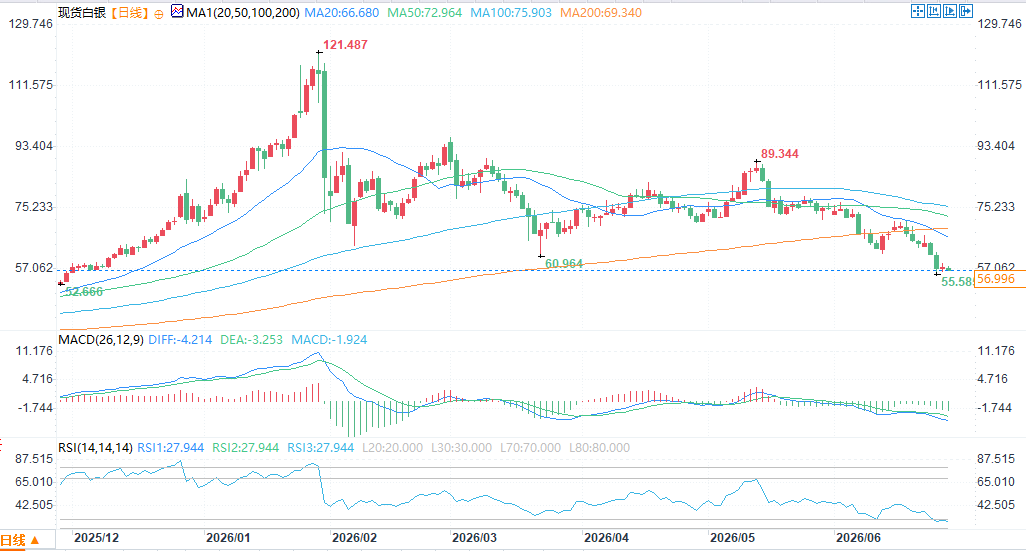
(Spot silver daily chart, source: EasyForex)
At 10:09 AM Beijing time on June 26, spot silver was trading at $56.98 per ounce.
The silver market has entered a critical phase. The price breaking below the key psychological level of $60/ounce is significant, and market attention is now rapidly shifting to the stronger support zone around $50.
The direct drivers of the sell-off: a stronger dollar and expectations of a Fed rate hike.
The direct driver of the recent significant pressure on silver prices is the continued strength of the US dollar index. As market expectations for the Federal Reserve to shift back to monetary policy tightening rapidly intensify, global funds are flowing into dollar assets at an accelerated pace, putting significant selling pressure on the precious metals sector as a whole.
Over the past week, investors’ expectations for the Federal Reserve’s policy path have shifted dramatically, rapidly moving from an easing-dominated outlook at the beginning of the year to a hawkish one, which has directly amplified the safe-haven appeal and yield attractiveness of the US dollar.
A recent research report from Deutsche Bank indicates that the Federal Reserve may raise interest rates twice this year, in September and December, to address potential inflation stickiness.
Bank of America is even more aggressive, predicting one rate hike each in September, October, and December, making it one of the most hawkish institutions among mainstream Wall Street investment banks.
Although both institutions expect the Federal Reserve to keep interest rates unchanged throughout 2027, the prospect of multiple rate hikes in 2026 is enough to significantly boost the dollar exchange rate and at the same time severely suppress the prices of precious metals, including silver.
Against this backdrop, rising real yields have further increased the opportunity cost of holding precious metals. The US dollar index has stabilized above 101 and is near its year-to-date high, which has not only worsened the purchasing power of silver for holders of non-US currencies but also prompted some speculative funds to withdraw from the precious metals market.
While industrial demand for silver provides medium- to long-term support, silver prices still face downward pressure in the short term due to the prevailing macroeconomic environment.
Silver's fundamentals are strong, with industrial demand providing unique support.
While silver, like gold, faces pressure from rising real yields and a stronger dollar, its strong industrial attributes provide significant additional fundamental support. Gold primarily serves as a safe haven and store of value, while approximately 50-60% of silver's demand comes from the industrial sector. This characteristic gives silver greater resilience and growth potential during global economic transformation.
The market generally expects that silver will face a structural supply shortage for the sixth consecutive year in 2026, with slow growth in global mineral supply coupled with bottlenecks in refining capacity further exacerbating the supply-demand imbalance.
Currently, the accelerated construction of AI data centers, the widespread adoption of electric vehicles, and the rapid expansion of renewable energy projects such as solar and wind power are continuously driving industrial demand for silver. Silver's irreplaceable role in photovoltaic cells, electronic components, and high-performance conductive materials makes its medium- to long-term demand prospects extremely optimistic.
The latest forecast from the International Banking Association shows that industrial silver demand is expected to reach a new high in 2026, with the photovoltaic and electronics sectors being the main sources of incremental growth.
These structural drivers give silver a stronger fundamental foundation than gold. Even if silver prices briefly fall below the important psychological level of $50/ounce, this area is likely to attract active participation from industrial buyers and long-term investors, providing strong support.
While short-term speculative selling pressure or macroeconomic headwinds may cause volatility, in the medium to long term, the tight supply-demand balance of silver is expected to drive its performance to outperform gold, achieving a more resilient price recovery.
Downside risks: Macroeconomic headwinds and concerns about industrial demand
However, downside risks should not be ignored. Gold prices briefly fell below the key psychological level of $4,000 this week, and further weakness could drag down the entire precious metals sector.
Furthermore, if the Federal Reserve's tightening policy leads to a more severe-than-expected slowdown in global growth, it could weaken the industrial demand premium for silver. In a hard landing scenario, silver's performance may be more in line with that of base metals.
The Fed's high-interest-rate environment, the unwinding of crowded trades, and the collapse of the three major supports (war premium, inflation hedging, and AI hype) remain the dominant forces at present.
Technically, spot silver is in a clear downward channel. The short-term 20-day moving average (MA20), medium-term 50-day moving average (MA50), and 100-day moving average (MA100) are all trending downwards, providing resistance and solidifying the downtrend. Indicators show the MACD maintaining a bearish pattern, with the DIFF line continuing to trade below the DEA line and the green histogram bars continuing to release downward momentum. The RSI indicator has fallen below 30 into oversold territory, suggesting a potential for a slight technical rebound in the short term, but there are currently no signs of a bottom reversal.
(Spot silver daily chart, source: EasyForex)
At 10:09 AM Beijing time on June 26, spot silver was trading at $56.98 per ounce.
- Risk Warning and Disclaimer
- The market involves risk, and trading may not be suitable for all investors. This article is for reference only and does not constitute personal investment advice, nor does it take into account certain users’ specific investment objectives, financial situation, or other needs. Any investment decisions made based on this information are at your own risk.