High US PCE inflation reinforces expectations of interest rate hikes, causing gold to fluctuate around $4,000.
2026-06-26 09:54:34
Spot gold (XAU/USD) continued its weak performance during Friday's Asian trading session, falling back to around $4015 per ounce . Despite ongoing uncertainties in the Middle East, the latest US inflation data further strengthened market expectations that the Federal Reserve might continue to raise interest rates, pushing the US dollar index and US Treasury yields to remain high, putting continued pressure on gold, which does not offer interest income.

Data released by the U.S. Bureau of Economic Analysis showed that the core personal consumption expenditures (Core PCE) price index, which is closely watched by the Federal Reserve, rose 3.4% year-on-year in May, up from 3.3% in April, reaching its highest level since October 2023, indicating that core inflation remains resilient. Meanwhile, the overall U.S. PCE price index rose 4.1% year-on-year in May, up from 3.8% in April. Although the overall data met market expectations, the continued high level further solidified the market's judgment that U.S. inflationary pressures have not yet eased significantly.
Persistent high inflation has prompted the market to reassess the Federal Reserve's future policy path. Currently, investors generally expect the Fed to further tighten monetary policy at its September meeting. With expectations of continued high interest rates strengthening, dollar-denominated assets continue to become more attractive, while gold, which does not generate fixed interest income, sees its investment value decline relatively in a high-interest-rate environment, thus limiting capital inflows.
However, geopolitical factors continue to provide some support for the gold market. Market research indicates that a ship was attacked by an unidentified flying object in the Strait of Hormuz, and prior to this incident, several cargo ships had turned back while attempting to transit this vital global energy transport route. Market concerns are growing that tensions in the region could escalate again, impacting global energy supplies and further pushing up international oil prices and inflation.
Currently, the gold market is influenced by two forces. On the one hand, persistently high US inflation, rising expectations of interest rate hikes, and a strengthening dollar continue to suppress gold prices; on the other hand, safe-haven demand stemming from the ongoing tensions in the Middle East is limiting further downside for gold. Investors will now focus on the University of Michigan Consumer Sentiment Index, consumer inflation expectations, and speeches by New York Fed President John Williams and Minneapolis Fed President Neal Kashkari to better assess the Fed's future policy direction.
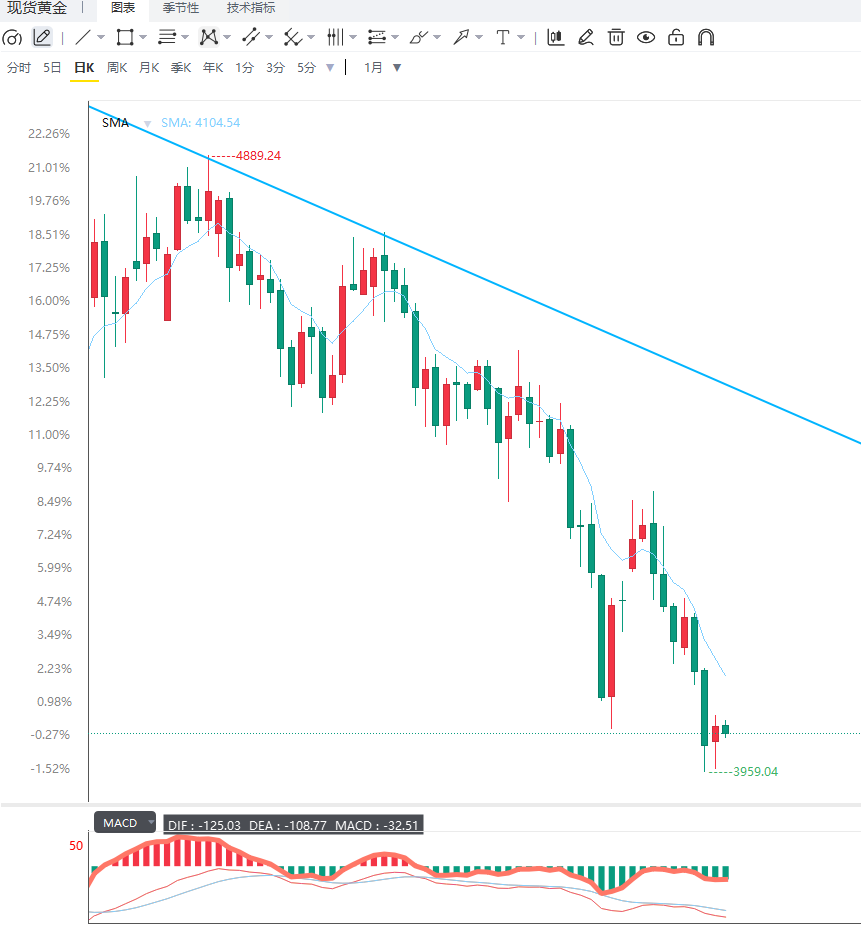
From a daily chart perspective, spot gold has been trading below short-term moving averages after a continuous decline, exhibiting an overall weak and volatile pattern with weakening bullish momentum. The $4,000 level has become a key support area; a break below this level could lead to further declines towards the $3,960- $3,920 area. On the upside, key resistance levels to watch are $4,050 and $4,100 . Only a sustained move above $4,100 could allow gold to resume its upward trend. Currently, the daily momentum is bearish, but the medium- to long-term uptrend structure has not been completely broken.
From a 4-hour chart perspective, gold is maintaining a downward trend within a volatile channel. Short-term moving averages continue to diverge downwards, and the MACD is below the zero line with expanding green momentum bars, indicating that bears still hold the short-term initiative. However, as prices gradually approach the important psychological level of $4,000, a technical rebound in gold cannot be ruled out if safe-haven demand intensifies further. In the short term, watch for resistance around $4,050 . A break above this area could lead to a further challenge of $4,100 ; a break below $4,000 could accelerate the test of the $3,960 support area.
Editor's Summary : Persistently high core inflation in the US has kept market expectations for further monetary tightening by the Federal Reserve strong, continuing to put downward pressure on gold prices due to the dollar and US Treasury yields. However, renewed volatility in the Middle East and increased shipping security risks in the Strait of Hormuz have also led to a resurgence in safe-haven demand, providing some support for gold. In the short term, gold's price movement will likely continue to oscillate between "high interest rate pressure" and "geopolitical safe-haven demand." If subsequent US economic data remains strong, gold may continue its correction; if the situation in the Middle East deteriorates further or the Federal Reserve releases dovish signals, gold prices are expected to regain upward momentum.
Data released by the U.S. Bureau of Economic Analysis showed that the core personal consumption expenditures (Core PCE) price index, which is closely watched by the Federal Reserve, rose 3.4% year-on-year in May, up from 3.3% in April, reaching its highest level since October 2023, indicating that core inflation remains resilient. Meanwhile, the overall U.S. PCE price index rose 4.1% year-on-year in May, up from 3.8% in April. Although the overall data met market expectations, the continued high level further solidified the market's judgment that U.S. inflationary pressures have not yet eased significantly.
Persistent high inflation has prompted the market to reassess the Federal Reserve's future policy path. Currently, investors generally expect the Fed to further tighten monetary policy at its September meeting. With expectations of continued high interest rates strengthening, dollar-denominated assets continue to become more attractive, while gold, which does not generate fixed interest income, sees its investment value decline relatively in a high-interest-rate environment, thus limiting capital inflows.
However, geopolitical factors continue to provide some support for the gold market. Market research indicates that a ship was attacked by an unidentified flying object in the Strait of Hormuz, and prior to this incident, several cargo ships had turned back while attempting to transit this vital global energy transport route. Market concerns are growing that tensions in the region could escalate again, impacting global energy supplies and further pushing up international oil prices and inflation.
Currently, the gold market is influenced by two forces. On the one hand, persistently high US inflation, rising expectations of interest rate hikes, and a strengthening dollar continue to suppress gold prices; on the other hand, safe-haven demand stemming from the ongoing tensions in the Middle East is limiting further downside for gold. Investors will now focus on the University of Michigan Consumer Sentiment Index, consumer inflation expectations, and speeches by New York Fed President John Williams and Minneapolis Fed President Neal Kashkari to better assess the Fed's future policy direction.
From a daily chart perspective, spot gold has been trading below short-term moving averages after a continuous decline, exhibiting an overall weak and volatile pattern with weakening bullish momentum. The $4,000 level has become a key support area; a break below this level could lead to further declines towards the $3,960- $3,920 area. On the upside, key resistance levels to watch are $4,050 and $4,100 . Only a sustained move above $4,100 could allow gold to resume its upward trend. Currently, the daily momentum is bearish, but the medium- to long-term uptrend structure has not been completely broken.
From a 4-hour chart perspective, gold is maintaining a downward trend within a volatile channel. Short-term moving averages continue to diverge downwards, and the MACD is below the zero line with expanding green momentum bars, indicating that bears still hold the short-term initiative. However, as prices gradually approach the important psychological level of $4,000, a technical rebound in gold cannot be ruled out if safe-haven demand intensifies further. In the short term, watch for resistance around $4,050 . A break above this area could lead to a further challenge of $4,100 ; a break below $4,000 could accelerate the test of the $3,960 support area.
Editor's Summary : Persistently high core inflation in the US has kept market expectations for further monetary tightening by the Federal Reserve strong, continuing to put downward pressure on gold prices due to the dollar and US Treasury yields. However, renewed volatility in the Middle East and increased shipping security risks in the Strait of Hormuz have also led to a resurgence in safe-haven demand, providing some support for gold. In the short term, gold's price movement will likely continue to oscillate between "high interest rate pressure" and "geopolitical safe-haven demand." If subsequent US economic data remains strong, gold may continue its correction; if the situation in the Middle East deteriorates further or the Federal Reserve releases dovish signals, gold prices are expected to regain upward momentum.
- Risk Warning and Disclaimer
- The market involves risk, and trading may not be suitable for all investors. This article is for reference only and does not constitute personal investment advice, nor does it take into account certain users’ specific investment objectives, financial situation, or other needs. Any investment decisions made based on this information are at your own risk.