Attacks on cargo ships ignite safe-haven demand, Labour's leadership change triggers political premiums—a double whammy for the pound.
2026-06-26 10:30:03
On Friday (June 26) during the Asian session, the pound traded in a narrow range against the dollar, currently trading below the 1.3200 level.
Although US PCE data reinforced inflation stickiness and market expectations for a Fed rate hike cooled, providing some breathing room for the pound, the attack on cargo ships in the Strait of Hormuz reignited geopolitical safe-haven demand, coupled with domestic political uncertainty in the UK, limiting the pound's upside potential.
The U.S. Personal Consumption Expenditures (PCE) price index report released on Thursday confirmed the persistence of inflationary pressures.
Although the core PCE data was generally in line with expectations, service inflation remained sticky, indicating that price pressures have not subsided quickly.
However, after the US and Iran signed a temporary peace agreement earlier this month, crude oil prices have fallen back to pre-war levels, significantly easing market concerns about an inflationary shock caused by soaring energy prices. This positive development prompted traders to reduce their bets on multiple Federal Reserve rate hikes this year, putting short-term pressure on the dollar index and providing temporary support for the pound against the dollar.
However, the downside potential for the US dollar appears to be relatively limited.
Market expectations for the Federal Reserve's policy path remain generally hawkish. Deutsche Bank predicts two rate hikes in September and December, while Bank of America is more aggressive, forecasting one hike each in September, October, and December. Real yields remain high, and the overall strength of the US dollar has not fundamentally changed.
Investors should pay attention to subsequent statements from Federal Reserve officials. If inflation data continues to be overbought, the dollar may rebound rapidly, limiting the upside potential of the pound.
Geopolitical tensions in the Strait of Hormuz escalated sharply on Thursday. Reports of an attack by Iran's Islamic Revolutionary Guard Corps on a Singapore-flagged cargo ship triggered a rapid market reaction. Crude oil prices saw a modest rebound, and the geopolitical risk premium, which had significantly diminished due to the preliminary US-Iran peace agreement, is being re-incorporated into asset prices.
The International Maritime Organization (IMO) of the United Nations has suspended evacuation operations in the Strait of Hormuz, further highlighting the vulnerability of the security situation in this critical waterway. This incident not only threatens the safety of approximately one-fifth of global oil shipments but has also reignited investor demand for safe-haven assets. The US dollar, as a traditional safe-haven currency, has become significantly more attractive, with the dollar index strengthening again, exerting significant downward pressure on non-US currencies, including the British pound.
Against this backdrop, the pound sterling came under downward pressure against the dollar. Market concerns arose that if the disagreement between Iran and the West over control of the Strait of Hormuz escalated further, the risk of energy supply disruptions would push up global inflation expectations and reinforce the Federal Reserve's need to maintain higher interest rates.
In the short term, geopolitical uncertainty will be a key factor driving currency market volatility. Investors need to closely monitor subsequent developments and the oil market. If tensions persist, the strong dollar may continue, putting additional downward pressure on precious metals and risk assets.
The pound also faces domestic political pressure. British Prime Minister Keir Starmer announced his resignation on June 22, officially launching the Labour Party leadership contest, which has injected a political risk premium into the pound.
Although market expectations of rapid consolidation within the Labour Party had previously provided support for the pound, the formal commencement of the leadership contest means that uncertainty will persist in the coming weeks.
Investors' wait-and-see attitude toward the new government's policy direction further limited the upside potential of the pound.
According to the daily chart, the pound against the dollar has entered a downward trend. After reaching two highs of 1.3867 and 1.3657, the price has continued to decline. Currently, the exchange rate has fallen below the short-term MA20 moving average, and the MA50 and MA100 are also exerting downward pressure, forming layers of resistance. The highs on the chart are gradually moving lower.
In terms of indicators, the MACD is in the bearish zone below the zero line, the DIFF continues to be lower than the DEA, and the green momentum bars continue to expand, indicating that the bearish momentum is still continuing; the RSI has fallen back to 34.56, close to the 30 oversold line, indicating a short-term need for a slight recovery and rebound, but no clear bottom reversal signal has appeared.
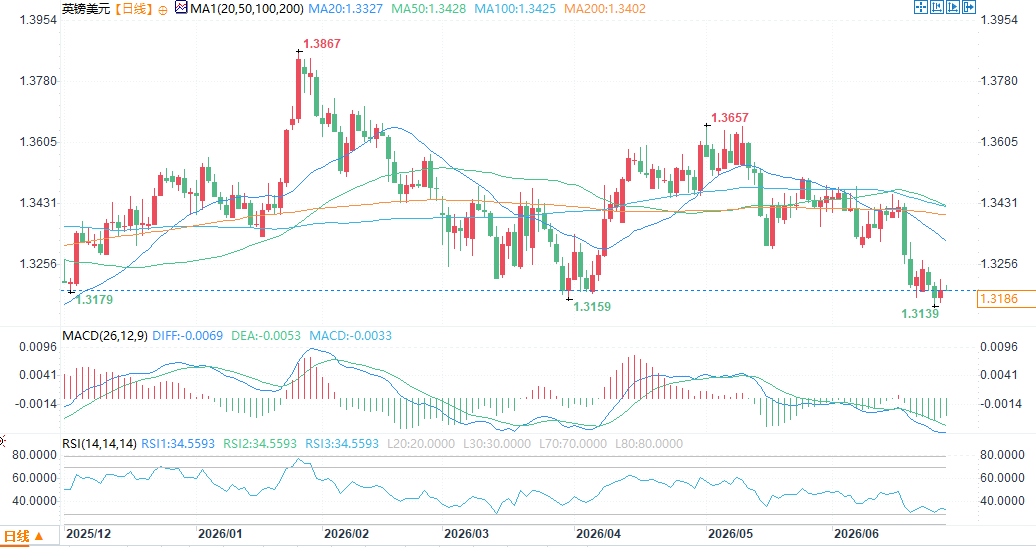
(GBP/USD daily chart, source: FX678)
At 10:29 Beijing time on June 26, the British pound was trading at 1.3183/84 against the US dollar.
Although US PCE data reinforced inflation stickiness and market expectations for a Fed rate hike cooled, providing some breathing room for the pound, the attack on cargo ships in the Strait of Hormuz reignited geopolitical safe-haven demand, coupled with domestic political uncertainty in the UK, limiting the pound's upside potential.
PCE data confirms sticky inflation, but expectations for interest rate hikes have cooled somewhat.
The U.S. Personal Consumption Expenditures (PCE) price index report released on Thursday confirmed the persistence of inflationary pressures.
Although the core PCE data was generally in line with expectations, service inflation remained sticky, indicating that price pressures have not subsided quickly.
However, after the US and Iran signed a temporary peace agreement earlier this month, crude oil prices have fallen back to pre-war levels, significantly easing market concerns about an inflationary shock caused by soaring energy prices. This positive development prompted traders to reduce their bets on multiple Federal Reserve rate hikes this year, putting short-term pressure on the dollar index and providing temporary support for the pound against the dollar.
However, the downside potential for the US dollar appears to be relatively limited.
Market expectations for the Federal Reserve's policy path remain generally hawkish. Deutsche Bank predicts two rate hikes in September and December, while Bank of America is more aggressive, forecasting one hike each in September, October, and December. Real yields remain high, and the overall strength of the US dollar has not fundamentally changed.
Investors should pay attention to subsequent statements from Federal Reserve officials. If inflation data continues to be overbought, the dollar may rebound rapidly, limiting the upside potential of the pound.
Geopolitical risks reignite: Attack on a cargo ship in Hormuz fuels demand for the safe-haven dollar.
Geopolitical tensions in the Strait of Hormuz escalated sharply on Thursday. Reports of an attack by Iran's Islamic Revolutionary Guard Corps on a Singapore-flagged cargo ship triggered a rapid market reaction. Crude oil prices saw a modest rebound, and the geopolitical risk premium, which had significantly diminished due to the preliminary US-Iran peace agreement, is being re-incorporated into asset prices.
The International Maritime Organization (IMO) of the United Nations has suspended evacuation operations in the Strait of Hormuz, further highlighting the vulnerability of the security situation in this critical waterway. This incident not only threatens the safety of approximately one-fifth of global oil shipments but has also reignited investor demand for safe-haven assets. The US dollar, as a traditional safe-haven currency, has become significantly more attractive, with the dollar index strengthening again, exerting significant downward pressure on non-US currencies, including the British pound.
Against this backdrop, the pound sterling came under downward pressure against the dollar. Market concerns arose that if the disagreement between Iran and the West over control of the Strait of Hormuz escalated further, the risk of energy supply disruptions would push up global inflation expectations and reinforce the Federal Reserve's need to maintain higher interest rates.
In the short term, geopolitical uncertainty will be a key factor driving currency market volatility. Investors need to closely monitor subsequent developments and the oil market. If tensions persist, the strong dollar may continue, putting additional downward pressure on precious metals and risk assets.
Uncertainty in British Domestic Politics: Starmer's Resignation and the Labour Party Leadership Struggle
The pound also faces domestic political pressure. British Prime Minister Keir Starmer announced his resignation on June 22, officially launching the Labour Party leadership contest, which has injected a political risk premium into the pound.
Although market expectations of rapid consolidation within the Labour Party had previously provided support for the pound, the formal commencement of the leadership contest means that uncertainty will persist in the coming weeks.
Investors' wait-and-see attitude toward the new government's policy direction further limited the upside potential of the pound.
Technical Analysis
According to the daily chart, the pound against the dollar has entered a downward trend. After reaching two highs of 1.3867 and 1.3657, the price has continued to decline. Currently, the exchange rate has fallen below the short-term MA20 moving average, and the MA50 and MA100 are also exerting downward pressure, forming layers of resistance. The highs on the chart are gradually moving lower.
In terms of indicators, the MACD is in the bearish zone below the zero line, the DIFF continues to be lower than the DEA, and the green momentum bars continue to expand, indicating that the bearish momentum is still continuing; the RSI has fallen back to 34.56, close to the 30 oversold line, indicating a short-term need for a slight recovery and rebound, but no clear bottom reversal signal has appeared.
(GBP/USD daily chart, source: FX678)
At 10:29 Beijing time on June 26, the British pound was trading at 1.3183/84 against the US dollar.
- Risk Warning and Disclaimer
- The market involves risk, and trading may not be suitable for all investors. This article is for reference only and does not constitute personal investment advice, nor does it take into account certain users’ specific investment objectives, financial situation, or other needs. Any investment decisions made based on this information are at your own risk.