The euro/yen pair remains in a triangular consolidation pattern, awaiting a breakout near the 184 level.
2026-06-26 14:42:13
The euro edged lower against the yen (EUR/JPY) in Asian trading on Friday, trading around 183.90 . Although it recorded a modest gain in the previous session, the overall rebound was limited, and the market remained cautious, with the exchange rate continuing to trade within its recent consolidation range.

The core factor currently influencing the euro/yen exchange rate remains the shift in monetary policy expectations within the Eurozone and Japan. On one hand, Japan's recently released Tokyo Consumer Price Index continued to rise, and the market still holds some expectations for the Bank of Japan to further normalize its monetary policy, providing some support for the yen. On the other hand, the European Central Bank recently released relatively dovish policy signals, cooling market expectations for further rapid tightening and causing the euro to weaken overall.
Meanwhile, global markets remain affected by the situation in the Middle East and fluctuations in international energy prices, leading investors to maintain a cautious risk appetite. Repeated risk aversion provided some support for the yen, but the significant interest rate differential between Japan and the US and Europe limited the yen's appreciation potential, resulting in the euro/yen exchange rate generally maintaining a range-bound trading pattern.
From a technical perspective, the exchange rate is currently still within a symmetrical triangle consolidation structure, indicating a relatively balanced market sentiment between buyers and sellers, with volatility continuing to narrow. As the consolidation period lengthens, the market is accumulating new directional momentum, and once the upper and lower boundaries of the triangle are broken, the exchange rate's volatility is expected to increase significantly.
It's worth noting that although the exchange rate is slightly higher than the daily volume-weighted average price (VWAP) of 183.81 , indicating that buying interest still exists, the overall technical advantage has not yet fully shifted to the bulls as the price has not yet effectively broken through the key moving average resistance. The market will likely remain cautious until a trend breakout occurs.
Currently, investors will continue to focus on the policy moves of the European Central Bank and the Bank of Japan, changes in global risk sentiment, and the performance of economic data from Europe and the United States in order to determine whether the euro/yen exchange rate can break out of its current consolidation pattern.
From a daily chart perspective, the EUR/JPY pair remains in a weak, oscillating pattern, with the exchange rate continuing to trade below the 9-day moving average at 184.38 and the 50-day moving average at 184.91 . The short-term bearish structure has not yet changed significantly. Meanwhile, the price continues to move within a symmetrical triangle, indicating that the market is still in a directional decision-making phase. On the downside, the first support level to watch is around 183.40 , near the lower edge of the triangle. A decisive break below this level could lead to further declines towards the 181.87 and 180.81 areas. On the upside, key resistance levels to watch are 184.38 , 184.91 , and 186.00 . A break and hold above 186.00 could open up further upside potential and a retest of the historical high of 187.95 .
From a 4-hour chart perspective, the exchange rate continues its sideways consolidation, with short-term moving averages converging and the MACD hovering near the zero line. The momentum bars are narrowing, indicating that neither the bulls nor the bears have a clear advantage. The 14-period RSI has fallen back to around 38 , reflecting that the bears still have a slight advantage, but it has not yet entered the extreme oversold zone, and there is still a risk of further pullback in the short term. If the exchange rate can regain a foothold above 184.90 , it may challenge 186.00 in the short term; if it breaks below the 183.40 support, it may accelerate its test of the lows near 181.87 .
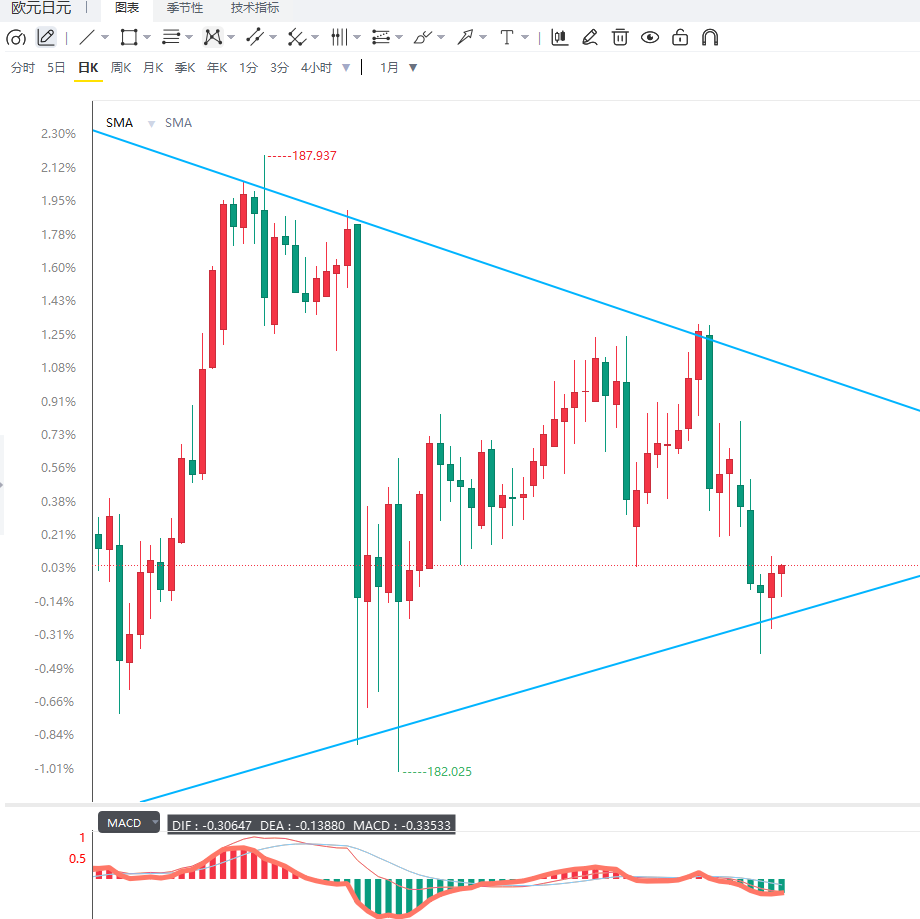
Editor's Summary : The EUR/JPY pair is currently in a typical consolidation phase, lacking new fundamental catalysts, with bulls and bears continuing to battle within a triangular trading range. In the short term, rising Japanese inflation, ECB policy expectations, and global risk sentiment will continue to influence the exchange rate. As volatility narrows, the EUR/JPY is approaching a directional decision point. Investors should pay close attention to the key levels of 183.40 and 186.00; a decisive breakout could trigger a new trend.
The core factor currently influencing the euro/yen exchange rate remains the shift in monetary policy expectations within the Eurozone and Japan. On one hand, Japan's recently released Tokyo Consumer Price Index continued to rise, and the market still holds some expectations for the Bank of Japan to further normalize its monetary policy, providing some support for the yen. On the other hand, the European Central Bank recently released relatively dovish policy signals, cooling market expectations for further rapid tightening and causing the euro to weaken overall.
Meanwhile, global markets remain affected by the situation in the Middle East and fluctuations in international energy prices, leading investors to maintain a cautious risk appetite. Repeated risk aversion provided some support for the yen, but the significant interest rate differential between Japan and the US and Europe limited the yen's appreciation potential, resulting in the euro/yen exchange rate generally maintaining a range-bound trading pattern.
From a technical perspective, the exchange rate is currently still within a symmetrical triangle consolidation structure, indicating a relatively balanced market sentiment between buyers and sellers, with volatility continuing to narrow. As the consolidation period lengthens, the market is accumulating new directional momentum, and once the upper and lower boundaries of the triangle are broken, the exchange rate's volatility is expected to increase significantly.
It's worth noting that although the exchange rate is slightly higher than the daily volume-weighted average price (VWAP) of 183.81 , indicating that buying interest still exists, the overall technical advantage has not yet fully shifted to the bulls as the price has not yet effectively broken through the key moving average resistance. The market will likely remain cautious until a trend breakout occurs.
Currently, investors will continue to focus on the policy moves of the European Central Bank and the Bank of Japan, changes in global risk sentiment, and the performance of economic data from Europe and the United States in order to determine whether the euro/yen exchange rate can break out of its current consolidation pattern.
From a daily chart perspective, the EUR/JPY pair remains in a weak, oscillating pattern, with the exchange rate continuing to trade below the 9-day moving average at 184.38 and the 50-day moving average at 184.91 . The short-term bearish structure has not yet changed significantly. Meanwhile, the price continues to move within a symmetrical triangle, indicating that the market is still in a directional decision-making phase. On the downside, the first support level to watch is around 183.40 , near the lower edge of the triangle. A decisive break below this level could lead to further declines towards the 181.87 and 180.81 areas. On the upside, key resistance levels to watch are 184.38 , 184.91 , and 186.00 . A break and hold above 186.00 could open up further upside potential and a retest of the historical high of 187.95 .
From a 4-hour chart perspective, the exchange rate continues its sideways consolidation, with short-term moving averages converging and the MACD hovering near the zero line. The momentum bars are narrowing, indicating that neither the bulls nor the bears have a clear advantage. The 14-period RSI has fallen back to around 38 , reflecting that the bears still have a slight advantage, but it has not yet entered the extreme oversold zone, and there is still a risk of further pullback in the short term. If the exchange rate can regain a foothold above 184.90 , it may challenge 186.00 in the short term; if it breaks below the 183.40 support, it may accelerate its test of the lows near 181.87 .
Editor's Summary : The EUR/JPY pair is currently in a typical consolidation phase, lacking new fundamental catalysts, with bulls and bears continuing to battle within a triangular trading range. In the short term, rising Japanese inflation, ECB policy expectations, and global risk sentiment will continue to influence the exchange rate. As volatility narrows, the EUR/JPY is approaching a directional decision point. Investors should pay close attention to the key levels of 183.40 and 186.00; a decisive breakout could trigger a new trend.
- Risk Warning and Disclaimer
- The market involves risk, and trading may not be suitable for all investors. This article is for reference only and does not constitute personal investment advice, nor does it take into account certain users’ specific investment objectives, financial situation, or other needs. Any investment decisions made based on this information are at your own risk.