Short covering illusion? Why did the attacks fail to save oil prices?
2026-06-26 14:52:50
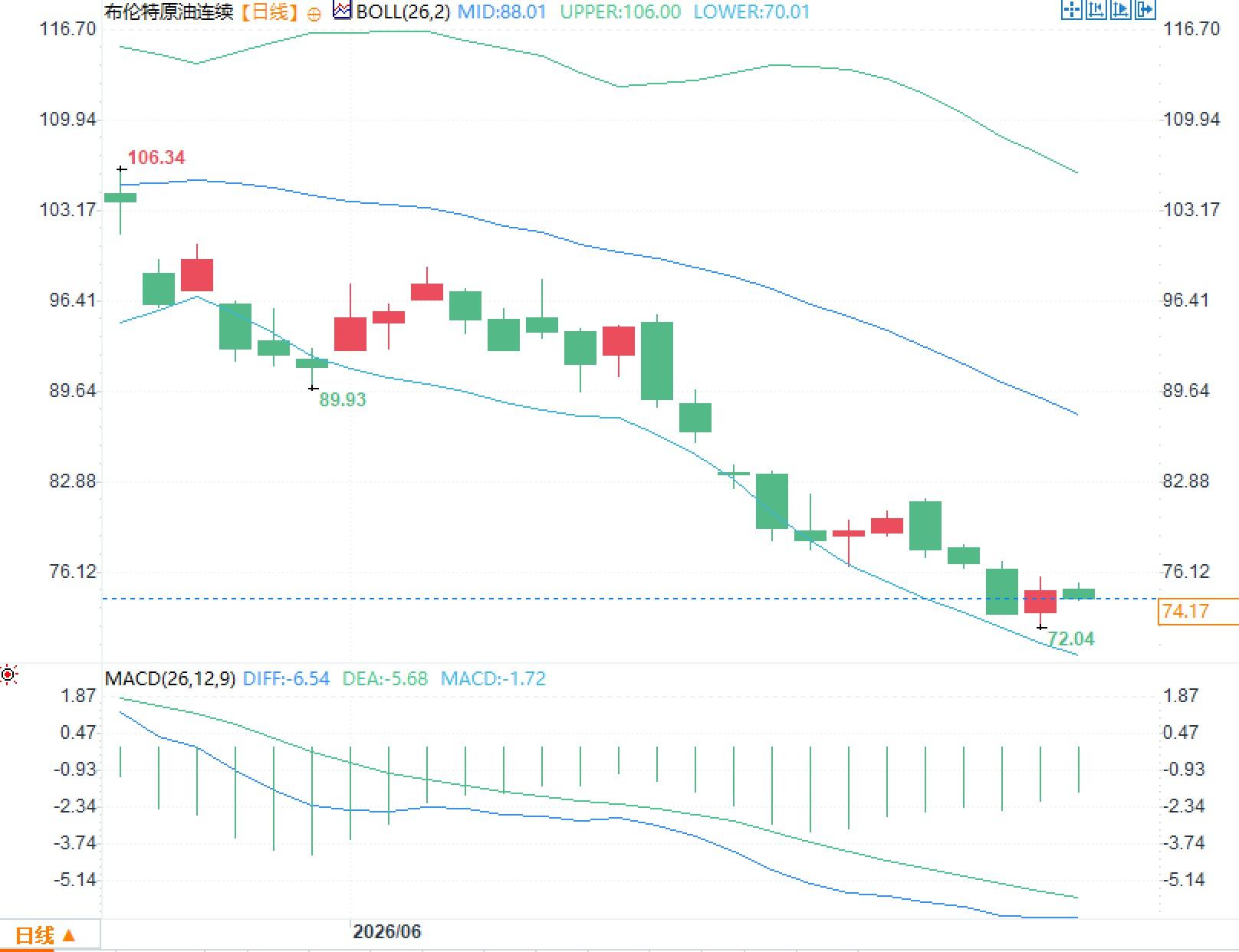
On Friday, June 26, Brent crude oil remained around $74 per barrel, while West Texas Intermediate (WTI) crude oil traded above $70 per barrel, with both benchmark oil prices continuing their downward trend this week. The previous trading day saw a cargo ship struck by an unidentified object southeast of Oman, briefly triggering short covering. However, as passage through the Strait of Hormuz accelerated, the market tended to view the incident as a risk disturbance rather than a renewed expansion of supply disruptions.
This is also the most noteworthy change in oil prices for traders. The fact that oil prices haven't continued to rise in response to security events indicates that marginal pricing power is temporarily on the side of flow recovery, rather than on the side of conflict escalation. In other words, the market is reducing the previously excessive tail risk premium, but hasn't completely eliminated the security risks in the Taiwan Strait. A price drop doesn't mean the risk has disappeared; it simply means the market believes that the speed at which visible supply is re-entering the trade chain has, in the short term, outweighed the impact of a single point of attack.

The Strait of Hormuz influences crude oil prices not only because of its narrow geographical location, but also because it carries a highly concentrated volume of export traffic. In 2024, approximately 20 million barrels of oil were transported through the strait per day, accounting for about one-fifth of global liquid petroleum consumption and a significant proportion of global seaborne oil trade. Blockage of such a passage affects not only individual oil-producing countries, but the entire chain of export shipments, shipping schedules, insurance, refinery arrival times, and regional price differentials.
For some time, restricted passage through the Strait of Hormuz forced a reduction in some Middle Eastern production, prompting traders to reassess the availability of spot supply, vessel scheduling, and the pace of floating storage release. Now, with ships able to freely pass through the Strait, crude oil previously detained near production areas has re-entered the market. This change directly compressed the safe passage premium in the futures market and explains why oil prices only rebounded briefly after the attack on the cargo ship, subsequently failing to escape downward pressure on the weekly chart.
However, pricing has not returned to full normalcy. The current normal central route is considered to pose safety risks, leading some vessels to divert towards the Iranian side or along the Omani coastline. Furthermore, the Iranian Straits Authority has imposed safety restrictions on routes outside its jurisdiction, meaning shipowners and insurers need to reassess route selection, escort costs, and delay risks. For the market, the restoration of passage addresses the issue of volume; route fragmentation and unclear safety responsibilities do not resolve the price issue.
Judging from the market reaction, the attack on the cargo ship triggered a typical short covering rally, rather than a rebuilding of trend-following buying. This is because the incident itself did not cause deaths, environmental damage, or grounding of ships; the vessels could still continue sailing. Such news is sufficient to trigger rapid liquidation, but not enough to indicate that millions of barrels of visible daily supply are leaving the market again.
More importantly, oil prices had already accumulated a high insurance premium in response to conflict risks. As long as the Strait of Hormuz does not re-enter a state of substantial blockade and tankers can still pass through, the market will incorporate security events into volatility rather than long-term supply gaps. The recent nearly 20% drop in Brent crude oil this month indicates that both macro and commodity accounts are reducing the weighting of conflict premiums. The price decline is not a disregard for risk, but rather a reordering of probabilities.
The crude oil market is shifting from being driven by one-sided news to a phase where pricing is now influenced by inventory levels, shipping schedules, production recovery, and the forward curve. Short-term events can still create significant volatility, but their sustainability diminishes if they don't translate into failed shipments, tanker delays, port shutdowns, or export controls. The market is not focused on whether there is an attack, but rather on whether the attack alters the actual flow rate of deliverable crude oil.
The current supply situation is neither simply loose nor simply tight; rather, it presents a situation where there is a growing willingness to resume production alongside a shortage of tankers. Gulf oil-producing countries are increasing supply, with producers such as the UAE, Kuwait, and Qatar all having an incentive to resume and increase exports. The problem is that production leaving the oil fields is only the first step. Whether enough tankers can be found, whether they can safely pass through the straits, and whether they can arrive at refineries on schedule will determine whether this supply actually enters the consumer market.
Iraq's actions are particularly noteworthy. The country hopes to increase its quotas from the oil-producing alliance to compensate for sales losses caused by previous export restrictions. Although its oil sector subsequently clarified that withdrawing from the alliance was not the government's official position, the quota dispute reflects a deeper contradiction: when the Straits of Hormuz reopens, producers with spare capacity or financial pressure will tend to make up for lost sales as quickly as possible. If multiple producers simultaneously seek to replenish their quotas, the medium-term supply expectation in the crude oil market will shift from a shortage correction to a potential surplus.
However, the shortage of shipping capacity will limit the speed of this process. The fact that some Iraqi oil fields have been forced to suspend production due to difficulties in securing tankers shows that not all current output can be smoothly converted into exports. For oil prices, increased production at oil fields lowers long-term expectations, while limited shipping increases short-term uncertainty. The combination of these two forces can easily lead to rapid intraday fluctuations rather than a smooth trend.
This is also the most noteworthy change in oil prices for traders. The fact that oil prices haven't continued to rise in response to security events indicates that marginal pricing power is temporarily on the side of flow recovery, rather than on the side of conflict escalation. In other words, the market is reducing the previously excessive tail risk premium, but hasn't completely eliminated the security risks in the Taiwan Strait. A price drop doesn't mean the risk has disappeared; it simply means the market believes that the speed at which visible supply is re-entering the trade chain has, in the short term, outweighed the impact of a single point of attack.
The Strait of Hormuz influences crude oil prices not only because of its narrow geographical location, but also because it carries a highly concentrated volume of export traffic. In 2024, approximately 20 million barrels of oil were transported through the strait per day, accounting for about one-fifth of global liquid petroleum consumption and a significant proportion of global seaborne oil trade. Blockage of such a passage affects not only individual oil-producing countries, but the entire chain of export shipments, shipping schedules, insurance, refinery arrival times, and regional price differentials.
For some time, restricted passage through the Strait of Hormuz forced a reduction in some Middle Eastern production, prompting traders to reassess the availability of spot supply, vessel scheduling, and the pace of floating storage release. Now, with ships able to freely pass through the Strait, crude oil previously detained near production areas has re-entered the market. This change directly compressed the safe passage premium in the futures market and explains why oil prices only rebounded briefly after the attack on the cargo ship, subsequently failing to escape downward pressure on the weekly chart.
However, pricing has not returned to full normalcy. The current normal central route is considered to pose safety risks, leading some vessels to divert towards the Iranian side or along the Omani coastline. Furthermore, the Iranian Straits Authority has imposed safety restrictions on routes outside its jurisdiction, meaning shipowners and insurers need to reassess route selection, escort costs, and delay risks. For the market, the restoration of passage addresses the issue of volume; route fragmentation and unclear safety responsibilities do not resolve the price issue.
Judging from the market reaction, the attack on the cargo ship triggered a typical short covering rally, rather than a rebuilding of trend-following buying. This is because the incident itself did not cause deaths, environmental damage, or grounding of ships; the vessels could still continue sailing. Such news is sufficient to trigger rapid liquidation, but not enough to indicate that millions of barrels of visible daily supply are leaving the market again.
More importantly, oil prices had already accumulated a high insurance premium in response to conflict risks. As long as the Strait of Hormuz does not re-enter a state of substantial blockade and tankers can still pass through, the market will incorporate security events into volatility rather than long-term supply gaps. The recent nearly 20% drop in Brent crude oil this month indicates that both macro and commodity accounts are reducing the weighting of conflict premiums. The price decline is not a disregard for risk, but rather a reordering of probabilities.
The crude oil market is shifting from being driven by one-sided news to a phase where pricing is now influenced by inventory levels, shipping schedules, production recovery, and the forward curve. Short-term events can still create significant volatility, but their sustainability diminishes if they don't translate into failed shipments, tanker delays, port shutdowns, or export controls. The market is not focused on whether there is an attack, but rather on whether the attack alters the actual flow rate of deliverable crude oil.
The current supply situation is neither simply loose nor simply tight; rather, it presents a situation where there is a growing willingness to resume production alongside a shortage of tankers. Gulf oil-producing countries are increasing supply, with producers such as the UAE, Kuwait, and Qatar all having an incentive to resume and increase exports. The problem is that production leaving the oil fields is only the first step. Whether enough tankers can be found, whether they can safely pass through the straits, and whether they can arrive at refineries on schedule will determine whether this supply actually enters the consumer market.
Iraq's actions are particularly noteworthy. The country hopes to increase its quotas from the oil-producing alliance to compensate for sales losses caused by previous export restrictions. Although its oil sector subsequently clarified that withdrawing from the alliance was not the government's official position, the quota dispute reflects a deeper contradiction: when the Straits of Hormuz reopens, producers with spare capacity or financial pressure will tend to make up for lost sales as quickly as possible. If multiple producers simultaneously seek to replenish their quotas, the medium-term supply expectation in the crude oil market will shift from a shortage correction to a potential surplus.
However, the shortage of shipping capacity will limit the speed of this process. The fact that some Iraqi oil fields have been forced to suspend production due to difficulties in securing tankers shows that not all current output can be smoothly converted into exports. For oil prices, increased production at oil fields lowers long-term expectations, while limited shipping increases short-term uncertainty. The combination of these two forces can easily lead to rapid intraday fluctuations rather than a smooth trend.
- Risk Warning and Disclaimer
- The market involves risk, and trading may not be suitable for all investors. This article is for reference only and does not constitute personal investment advice, nor does it take into account certain users’ specific investment objectives, financial situation, or other needs. Any investment decisions made based on this information are at your own risk.