Qatar restarts bidding, Saudi Arabia resumes loading, Abu Dhabi sells 48 million barrels – a Middle East supply tsunami is coming.
2026-06-26 15:33:07
On Friday (June 26) during Asian trading hours, WTI crude oil prices fell back to around $70.20 per barrel, giving back more than 2% of the gains made the previous day due to the attack on a cargo ship.
Despite escalating geopolitical tensions in the Strait of Hormuz, a surge in supply resulting from the full resumption of exports by Middle Eastern oil-producing countries ultimately outweighed market concerns about geopolitical risks.

The core driver of the decline in crude oil prices is the rapid increase in actual supply. Qatar Energy has released its first tender for crude oil shipments in July and August since the outbreak of the US-Iran conflict, covering Saheen, Qatar Marine, and Qatar Onshore crude varieties.
According to the tender documents, Qatar is granting buyers the flexibility to load or pick up goods via ship-to-ship transshipment between Fujairah and Sohar, injecting a considerable amount of additional supply into the market. Previously, the Iraqi National Oil Marketing Organization and the Kuwait Oil Company had issued tenders for shipments in July.
Meanwhile, Saudi Aramco officially resumed crude oil loading operations at its Rastanura terminal in the Gulf region, which had been shut down for nearly four months. Data tracked by the London Stock Exchange Group shows that two Very Large Crude Carriers (VLCCs), each capable of carrying 2 million barrels of crude oil, are currently loading at the terminal, with a third waiting nearby.
With Abu Dhabi National Oil Company selling at least 48 million barrels of crude oil this month through three separate tenders, the full recovery of export activity in the Middle East has finally convinced traders that physical crude oil supplies remain ample despite ongoing military risks.
Oil prices surged in early Asian trading on Thursday following an attack on a cargo ship. The suspected missile attack near Oman prompted the UN's International Maritime Organization to suspend evacuations from the Strait of Hormuz, reigniting concerns about global energy security.
Geopolitical tensions escalated further after the market closed – U.S. officials accused Iranian armed forces of firing on cargo ships, while Iran issued a stern warning that it would no longer guarantee the safety of ships sailing outside designated routes.
However, this geopolitical risk pulse failed to sustain the upward momentum in oil prices. Market participants quickly turned their attention to the actual supply side—navigation in the Strait of Hormuz remained highly active, and a new wave of crude oil was entering the market. Ultimately, the fundamental realities on the supply side outweighed geopolitical anxieties.
JPMorgan Chase believes that despite recent geopolitical events causing price volatility, the soft supply and demand fundamentals will persist, and the global oil market faces significant oversupply pressure. The US-Iran peace agreement has facilitated the gradual reopening of the Strait of Hormuz, and exports via alternative routes from countries like the UAE have recovered to 85% of pre-war levels, further easing supply tensions.
JPMorgan Chase points out that January data shows clear signs of an oil surplus, and the balance sheet is expected to maintain a large surplus throughout the year. OPEC+ will need to extend voluntary and involuntary production cuts to prevent excessive inventory accumulation. While geopolitical risk premiums may fluctuate in the short term, crude oil faces downward pressure due to medium- to long-term fundamentals.
The bank advises investors to short sell on rallies or manage risk through structured futures products.
Overall, JPMorgan believes that current oil prices already reflect too much optimism, and the crude oil market will return to a weak supply-demand driven pattern in 2026. Investors should be wary of the downward pressure on prices from inventory accumulation.
Goldman Sachs believes that the US-Iran peace agreement has accelerated the resumption of navigation in the Strait of Hormuz, and coupled with increased global supply resilience, the oil market's supply-demand balance will gradually shift towards a more relaxed state. Although short-term geopolitical events may trigger a rebound, the faster-than-expected recovery in supply will limit the upside potential for oil prices.
Goldman Sachs points out that tanker traffic is expected to fully recover by the end of July, easing inventory replenishment pressure, but non-OPEC+ production growth and slowing demand pose dual constraints. They predict that the global oil market will shift from a shortage to a balance or even a slight surplus in 2026. As a cyclical asset, crude oil has limited upside potential against the backdrop of geopolitical easing, and faces structural downside risks in the medium to long term.
From a technical perspective, according to the daily chart, US crude oil futures are generally in a medium- to long-term downtrend, having fallen sharply from the year's high of $119.48. The current price has broken below the resistance of multiple medium- and long-term moving averages. The short-term 20-day moving average (MA20), medium-term 50-day moving average (MA50), and 100-day moving average (MA100) are all declining, continuously forming strong resistance above the price, indicating that the bearish trend dominates the market.
In terms of indicators, the MACD continues to operate in the bearish zone below the zero axis, the DIFF-6.27 is stable below the DEA-5.25, the green energy bars continue to expand, and the downward momentum has not shown any obvious convergence; the RSI value is 30.32, close to the 30 oversold threshold, indicating a short-term demand for a weak recovery rebound after overselling, but no bottom divergence reversal signal has appeared.
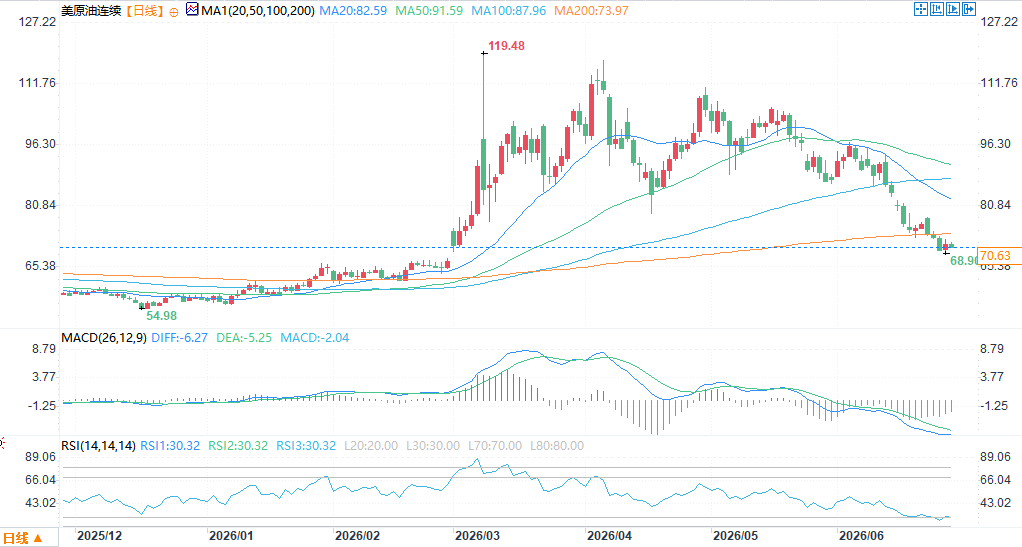
(US crude oil futures daily chart, source: FX678)
At 15:32 Beijing time on June 26, US crude oil futures were trading at $70.20 per barrel.
Despite escalating geopolitical tensions in the Strait of Hormuz, a surge in supply resulting from the full resumption of exports by Middle Eastern oil-producing countries ultimately outweighed market concerns about geopolitical risks.
Middle Eastern supply is fully recovering: Qatar, Iraq, Saudi Arabia, and Abu Dhabi are all ramping up production.
The core driver of the decline in crude oil prices is the rapid increase in actual supply. Qatar Energy has released its first tender for crude oil shipments in July and August since the outbreak of the US-Iran conflict, covering Saheen, Qatar Marine, and Qatar Onshore crude varieties.
According to the tender documents, Qatar is granting buyers the flexibility to load or pick up goods via ship-to-ship transshipment between Fujairah and Sohar, injecting a considerable amount of additional supply into the market. Previously, the Iraqi National Oil Marketing Organization and the Kuwait Oil Company had issued tenders for shipments in July.
Meanwhile, Saudi Aramco officially resumed crude oil loading operations at its Rastanura terminal in the Gulf region, which had been shut down for nearly four months. Data tracked by the London Stock Exchange Group shows that two Very Large Crude Carriers (VLCCs), each capable of carrying 2 million barrels of crude oil, are currently loading at the terminal, with a third waiting nearby.
With Abu Dhabi National Oil Company selling at least 48 million barrels of crude oil this month through three separate tenders, the full recovery of export activity in the Middle East has finally convinced traders that physical crude oil supplies remain ample despite ongoing military risks.
Geopolitical risks provided a short-term pulse, but failed to reverse the supply-driven pattern.
Oil prices surged in early Asian trading on Thursday following an attack on a cargo ship. The suspected missile attack near Oman prompted the UN's International Maritime Organization to suspend evacuations from the Strait of Hormuz, reigniting concerns about global energy security.
Geopolitical tensions escalated further after the market closed – U.S. officials accused Iranian armed forces of firing on cargo ships, while Iran issued a stern warning that it would no longer guarantee the safety of ships sailing outside designated routes.
However, this geopolitical risk pulse failed to sustain the upward momentum in oil prices. Market participants quickly turned their attention to the actual supply side—navigation in the Strait of Hormuz remained highly active, and a new wave of crude oil was entering the market. Ultimately, the fundamental realities on the supply side outweighed geopolitical anxieties.
Institutional Views
JPMorgan Chase believes that despite recent geopolitical events causing price volatility, the soft supply and demand fundamentals will persist, and the global oil market faces significant oversupply pressure. The US-Iran peace agreement has facilitated the gradual reopening of the Strait of Hormuz, and exports via alternative routes from countries like the UAE have recovered to 85% of pre-war levels, further easing supply tensions.
JPMorgan Chase points out that January data shows clear signs of an oil surplus, and the balance sheet is expected to maintain a large surplus throughout the year. OPEC+ will need to extend voluntary and involuntary production cuts to prevent excessive inventory accumulation. While geopolitical risk premiums may fluctuate in the short term, crude oil faces downward pressure due to medium- to long-term fundamentals.
The bank advises investors to short sell on rallies or manage risk through structured futures products.
Overall, JPMorgan believes that current oil prices already reflect too much optimism, and the crude oil market will return to a weak supply-demand driven pattern in 2026. Investors should be wary of the downward pressure on prices from inventory accumulation.
Goldman Sachs believes that the US-Iran peace agreement has accelerated the resumption of navigation in the Strait of Hormuz, and coupled with increased global supply resilience, the oil market's supply-demand balance will gradually shift towards a more relaxed state. Although short-term geopolitical events may trigger a rebound, the faster-than-expected recovery in supply will limit the upside potential for oil prices.
Goldman Sachs points out that tanker traffic is expected to fully recover by the end of July, easing inventory replenishment pressure, but non-OPEC+ production growth and slowing demand pose dual constraints. They predict that the global oil market will shift from a shortage to a balance or even a slight surplus in 2026. As a cyclical asset, crude oil has limited upside potential against the backdrop of geopolitical easing, and faces structural downside risks in the medium to long term.
From a technical perspective, according to the daily chart, US crude oil futures are generally in a medium- to long-term downtrend, having fallen sharply from the year's high of $119.48. The current price has broken below the resistance of multiple medium- and long-term moving averages. The short-term 20-day moving average (MA20), medium-term 50-day moving average (MA50), and 100-day moving average (MA100) are all declining, continuously forming strong resistance above the price, indicating that the bearish trend dominates the market.
In terms of indicators, the MACD continues to operate in the bearish zone below the zero axis, the DIFF-6.27 is stable below the DEA-5.25, the green energy bars continue to expand, and the downward momentum has not shown any obvious convergence; the RSI value is 30.32, close to the 30 oversold threshold, indicating a short-term demand for a weak recovery rebound after overselling, but no bottom divergence reversal signal has appeared.
(US crude oil futures daily chart, source: FX678)
At 15:32 Beijing time on June 26, US crude oil futures were trading at $70.20 per barrel.
- Risk Warning and Disclaimer
- The market involves risk, and trading may not be suitable for all investors. This article is for reference only and does not constitute personal investment advice, nor does it take into account certain users’ specific investment objectives, financial situation, or other needs. Any investment decisions made based on this information are at your own risk.