Australian economy shows initial signs of weakness, and the risk of a Fed rate hike reignites – the Australian dollar enters a difficult quarter against the US dollar.
2026-06-26 15:06:03
On Friday (June 26) during the Asian session, the Australian dollar fluctuated at low levels against the US dollar, currently trading below 0.6900.
As the Australian dollar enters the third quarter, market focus is shifting back from geopolitics to monetary policy and economic growth prospects.
The Middle East conflict has not become a lasting macroeconomic driver as many feared, oil prices have fallen, and traders are once again weighing the relative policy paths of the Reserve Bank of Australia and the Federal Reserve.
Recent data has begun to shift in a direction unfavorable to the Reserve Bank of Australia's (RBA) hawkish stance. While inflation remains above the RBA's comfort zone, consumer confidence and business activity have shown signs of weakness, and employment and household spending have encountered setbacks. May data briefly reinforced bearish expectations for the Australian dollar against the US dollar – contracting household spending, unemployment rising to a four-year high, and weaker-than-expected employment data.
However, June data largely reversed these concerns: spending rebounded, the unemployment rate fell slightly, and employment recovered. While the overall unemployment rate is still on an upward trend, the latest data does not indicate that the economy is on the verge of collapse.
Inflation remains a prominent issue. Core CPI, excluding highly volatile items, rose 3.6% year-on-year, even though overall CPI has fallen to 4.0%. Both figures are well above the Reserve Bank of Australia's (RBA) target range of 2% to 3%. Unless inflation falls more rapidly, the RBA is likely to maintain a hawkish stance—even if it ultimately chooses not to raise interest rates.
The Reserve Bank of Australia (RBA) kept the cash rate unchanged at 4.35% at its June meeting, following three consecutive rate hikes totaling 75 basis points. While policymakers maintained a dovish hawkish tone, this represents a step back from the more hawkish rhetoric accompanying previous rate hikes. RBA cash rate futures imply a peak rate of 4.50% in December, only 15 basis points higher than the current rate.
Three of the four major banks expect the Reserve Bank of Australia to eventually shift to easing after holding rates steady, while Westpac is the only major bank that predicts further rate hikes.
With crude oil prices now down 37.5% from their post-war peak and only about 20% higher than pre-war levels, inflationary pressures, while still high, are far less severe than when the Reserve Bank of Australia signaled an urgent need for interest rate hikes.
Therefore, further interest rate hikes should be considered a low-probability scenario, and the Reserve Bank of Australia is expected to keep interest rates unchanged throughout the third quarter, which would expose the Australian dollar to greater risk should the Federal Reserve tighten policy again.
With Powell replaced by Warsh as the new chairman of the Federal Reserve, the market increasingly believes that the Fed's next move will likely be an interest rate hike.
Federal funds rate futures indicate a 63.4% probability of a rate hike in September, while the probability of a December rate hike has risen to 81.7%. The final Q1 GDP figure was revised upward to an annualized 2.1%, while core PCE inflation remained high at 3.4% year-on-year, well above the target. Retail sales continued to exceed expectations, and business surveys remained expanding, with the high "prices paid" sub-index indicating persistent inflationary pressures.
Persistent inflation, resilient labor market data, and hawkish comments from FOMC members have prompted traders to rebuild expectations for further rate hikes by the Federal Reserve this year.
The main risk to this outlook is a significant deterioration in US economic data, which could eliminate expectations of further tightening, weaken the US dollar, stabilize the AUD/USD interest rate differential, and thus allow the Australian dollar to outperform its overall neutral seasonal tendency against the US dollar.
According to the daily chart, the medium-to-long-term bullish trend of the Australian dollar against the US dollar has ended. Since the high of 0.7277, the exchange rate has continued to decline, currently breaking below short-term and medium-term moving averages, with only the long-term 200-day moving average (MA200) at 0.6857 providing weak support. The overall trend has shifted to a downward channel. The MA20, MA50, and MA100 have all turned downwards, forming layers of resistance. Each small rebound is suppressed by the short-term moving averages, and the price highs are gradually moving lower, establishing a bearish pattern.
In terms of indicators, the MACD is running in the bearish zone below the zero axis, the DIFF is consistently lower than the DEA, and the green bars continue to expand, indicating that the downward momentum has not yet weakened significantly. The RSI value is 28.84, falling into the oversold zone below 30, indicating a short-term technical rebound demand, but there are currently no bottom divergence reversal signals.
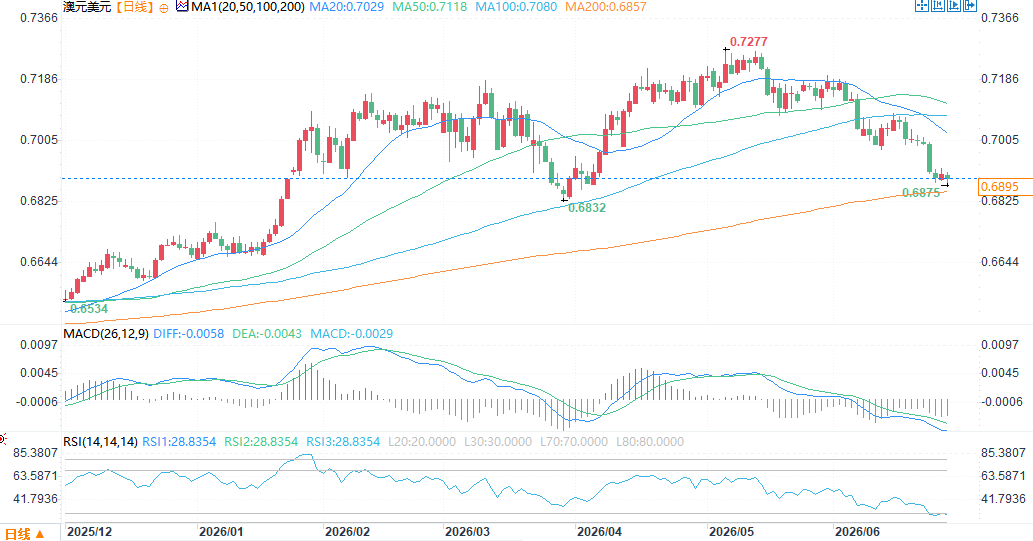
(AUD/USD daily chart, source: FX678)
At 15:05 Beijing time on June 26, the Australian dollar was trading at 0.6895/96 against the US dollar.
As the Australian dollar enters the third quarter, market focus is shifting back from geopolitics to monetary policy and economic growth prospects.
The Middle East conflict has not become a lasting macroeconomic driver as many feared, oil prices have fallen, and traders are once again weighing the relative policy paths of the Reserve Bank of Australia and the Federal Reserve.
Fundamental Outlook: The Australian economy is showing initial signs of slowing down, but inflation remains a pain point.
Recent data has begun to shift in a direction unfavorable to the Reserve Bank of Australia's (RBA) hawkish stance. While inflation remains above the RBA's comfort zone, consumer confidence and business activity have shown signs of weakness, and employment and household spending have encountered setbacks. May data briefly reinforced bearish expectations for the Australian dollar against the US dollar – contracting household spending, unemployment rising to a four-year high, and weaker-than-expected employment data.
However, June data largely reversed these concerns: spending rebounded, the unemployment rate fell slightly, and employment recovered. While the overall unemployment rate is still on an upward trend, the latest data does not indicate that the economy is on the verge of collapse.
Inflation remains a prominent issue. Core CPI, excluding highly volatile items, rose 3.6% year-on-year, even though overall CPI has fallen to 4.0%. Both figures are well above the Reserve Bank of Australia's (RBA) target range of 2% to 3%. Unless inflation falls more rapidly, the RBA is likely to maintain a hawkish stance—even if it ultimately chooses not to raise interest rates.
Reserve Bank of Australia Outlook: Is the Rate Hike Cycle Over?
The Reserve Bank of Australia (RBA) kept the cash rate unchanged at 4.35% at its June meeting, following three consecutive rate hikes totaling 75 basis points. While policymakers maintained a dovish hawkish tone, this represents a step back from the more hawkish rhetoric accompanying previous rate hikes. RBA cash rate futures imply a peak rate of 4.50% in December, only 15 basis points higher than the current rate.
Three of the four major banks expect the Reserve Bank of Australia to eventually shift to easing after holding rates steady, while Westpac is the only major bank that predicts further rate hikes.
With crude oil prices now down 37.5% from their post-war peak and only about 20% higher than pre-war levels, inflationary pressures, while still high, are far less severe than when the Reserve Bank of Australia signaled an urgent need for interest rate hikes.
Therefore, further interest rate hikes should be considered a low-probability scenario, and the Reserve Bank of Australia is expected to keep interest rates unchanged throughout the third quarter, which would expose the Australian dollar to greater risk should the Federal Reserve tighten policy again.
Federal Reserve Outlook: Market pricing in further rate hike risks
With Powell replaced by Warsh as the new chairman of the Federal Reserve, the market increasingly believes that the Fed's next move will likely be an interest rate hike.
Federal funds rate futures indicate a 63.4% probability of a rate hike in September, while the probability of a December rate hike has risen to 81.7%. The final Q1 GDP figure was revised upward to an annualized 2.1%, while core PCE inflation remained high at 3.4% year-on-year, well above the target. Retail sales continued to exceed expectations, and business surveys remained expanding, with the high "prices paid" sub-index indicating persistent inflationary pressures.
Persistent inflation, resilient labor market data, and hawkish comments from FOMC members have prompted traders to rebuild expectations for further rate hikes by the Federal Reserve this year.
The main risk to this outlook is a significant deterioration in US economic data, which could eliminate expectations of further tightening, weaken the US dollar, stabilize the AUD/USD interest rate differential, and thus allow the Australian dollar to outperform its overall neutral seasonal tendency against the US dollar.
Technical Analysis
According to the daily chart, the medium-to-long-term bullish trend of the Australian dollar against the US dollar has ended. Since the high of 0.7277, the exchange rate has continued to decline, currently breaking below short-term and medium-term moving averages, with only the long-term 200-day moving average (MA200) at 0.6857 providing weak support. The overall trend has shifted to a downward channel. The MA20, MA50, and MA100 have all turned downwards, forming layers of resistance. Each small rebound is suppressed by the short-term moving averages, and the price highs are gradually moving lower, establishing a bearish pattern.
In terms of indicators, the MACD is running in the bearish zone below the zero axis, the DIFF is consistently lower than the DEA, and the green bars continue to expand, indicating that the downward momentum has not yet weakened significantly. The RSI value is 28.84, falling into the oversold zone below 30, indicating a short-term technical rebound demand, but there are currently no bottom divergence reversal signals.
(AUD/USD daily chart, source: FX678)
At 15:05 Beijing time on June 26, the Australian dollar was trading at 0.6895/96 against the US dollar.
- Risk Warning and Disclaimer
- The market involves risk, and trading may not be suitable for all investors. This article is for reference only and does not constitute personal investment advice, nor does it take into account certain users’ specific investment objectives, financial situation, or other needs. Any investment decisions made based on this information are at your own risk.