Capital Economics is bearish on the long-term outlook for gold, believing that expectations of a Fed rate hike could push gold prices further down towards $3,500.
2026-06-26 14:58:31
On Friday during Asian trading hours, spot gold continued its weak performance, fluctuating around $4,000 per ounce . While many investors believe that the $4,000 level may attract some bargain hunters after the previous rapid decline, institutional opinions remain cautious, and significant disagreement persists regarding the medium- to long-term outlook for gold.
Capital Economics economist Hamad Hussein stated that current market expectations for a gold rebound may be overly optimistic. Looking at the next year and a half, gold prices still face further downward pressure, primarily due to the anticipated continued tightness of US monetary policy and the potential for further increases in real interest rates.
The agency believes that with US inflation remaining above policy targets, the Federal Reserve slowing its rate cuts, and even the possibility of further rate hikes, real yields will continue to remain relatively high. Since gold itself does not generate fixed income, the opportunity cost of holding gold increases as real yields rise, leading funds to flow more towards higher-yielding dollar assets, which will continue to weaken gold's investment appeal.
Furthermore, Capital Economics points out that if a significant correction occurs in global stock markets, gold may not immediately demonstrate its advantages as a traditional safe-haven asset. During a sudden stock market sell-off, some institutional investors may be forced to sell highly liquid assets, including gold, to meet funding needs due to increased margin requirements. This liquidity pressure could cause gold to fall in tandem with risk assets, further amplifying the gold price correction.
Based on the above assessment, Capital Economics predicts that international gold prices may fall back to around $3,500 per ounce by the end of 2026 , and could further decline to around $3,250 per ounce by the end of 2027. This forecast implies that the institution believes gold will still face a prolonged valuation correction process in the future.
However, market participants generally believe that the future trend of gold will still be influenced by multiple factors, including the Federal Reserve's policy path, the performance of US economic growth, changes in global inflation, and geopolitical developments. If the US economy slows down significantly in the future, real yields decline, or global safe-haven demand continues to rise, gold may still receive some support in the short term. Therefore, investors still need to dynamically assess the market direction in conjunction with changes in fundamentals.
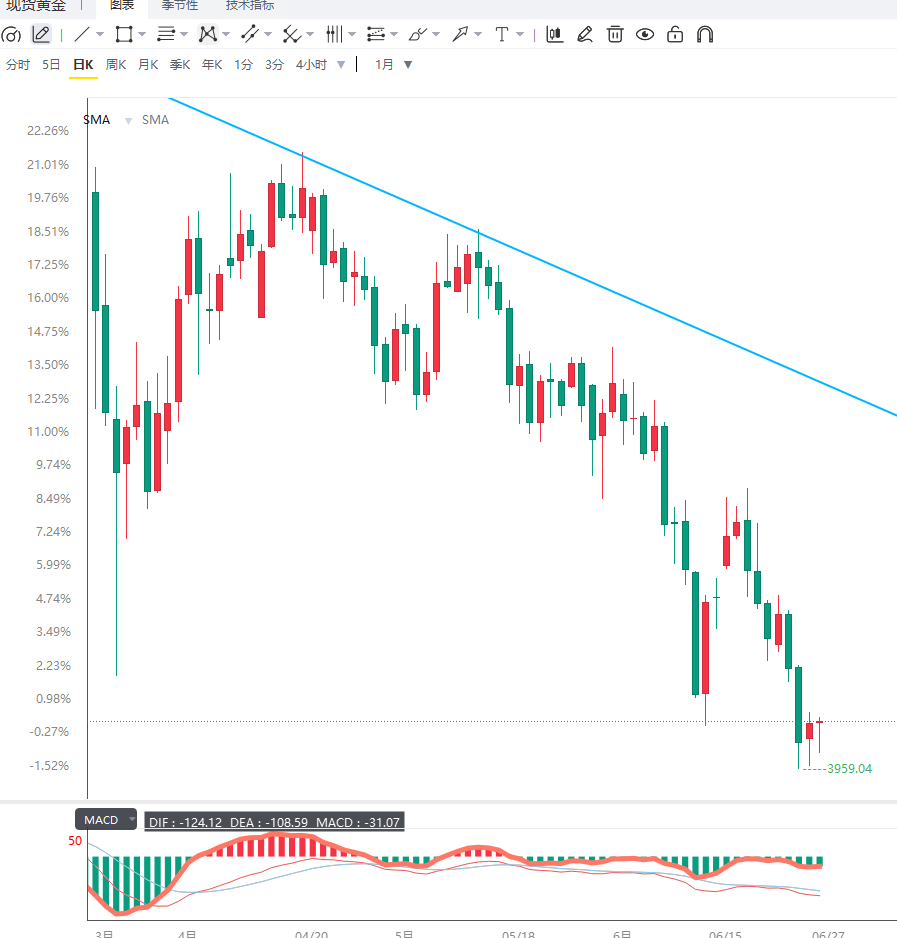
From a daily chart perspective, spot gold remains in a weak and volatile pattern, with prices trading below short-term moving averages, and the downtrend has not yet shown a clear reversal. The $4,000 level is currently a key support; a break below this level could lead to further testing of the $3,960 and $3,920 areas. On the upside, watch for resistance at $ 4,050 , $4,100 , and $4,150 . Until a firm foothold above $4,100 is established, any rebounds should be viewed as technical corrections, and the overall trend remains bearish.
From a 4-hour chart perspective, gold maintains a weak consolidation pattern. Short-term moving averages continue to trend downwards, and the MACD remains below the zero line, although the green histogram has narrowed, indicating a slight weakening of bearish momentum. If the price can hold above $4,000 and break through the $4,050 resistance level, a short-term technical rebound is possible; however, a break below $4,000 could open up further downside potential, testing support levels around $3,960 or even $3,920 .
Editor's Summary : Capital Economics remains relatively cautious about the future trend of gold, believing that the high real yield environment will continue to weaken the investment value of gold, and expects gold prices to have further downside potential over the next 18 months. In the short term, the $4,000 mark remains a key battleground between bulls and bears, while the Federal Reserve's monetary policy, changes in real yields, and global risk sentiment will remain key factors determining the medium- to long-term trend of gold. Until the trend shows significant improvement, gold may continue to trade with a slightly bearish bias.
Capital Economics economist Hamad Hussein stated that current market expectations for a gold rebound may be overly optimistic. Looking at the next year and a half, gold prices still face further downward pressure, primarily due to the anticipated continued tightness of US monetary policy and the potential for further increases in real interest rates.
The agency believes that with US inflation remaining above policy targets, the Federal Reserve slowing its rate cuts, and even the possibility of further rate hikes, real yields will continue to remain relatively high. Since gold itself does not generate fixed income, the opportunity cost of holding gold increases as real yields rise, leading funds to flow more towards higher-yielding dollar assets, which will continue to weaken gold's investment appeal.
Furthermore, Capital Economics points out that if a significant correction occurs in global stock markets, gold may not immediately demonstrate its advantages as a traditional safe-haven asset. During a sudden stock market sell-off, some institutional investors may be forced to sell highly liquid assets, including gold, to meet funding needs due to increased margin requirements. This liquidity pressure could cause gold to fall in tandem with risk assets, further amplifying the gold price correction.
Based on the above assessment, Capital Economics predicts that international gold prices may fall back to around $3,500 per ounce by the end of 2026 , and could further decline to around $3,250 per ounce by the end of 2027. This forecast implies that the institution believes gold will still face a prolonged valuation correction process in the future.
However, market participants generally believe that the future trend of gold will still be influenced by multiple factors, including the Federal Reserve's policy path, the performance of US economic growth, changes in global inflation, and geopolitical developments. If the US economy slows down significantly in the future, real yields decline, or global safe-haven demand continues to rise, gold may still receive some support in the short term. Therefore, investors still need to dynamically assess the market direction in conjunction with changes in fundamentals.
From a daily chart perspective, spot gold remains in a weak and volatile pattern, with prices trading below short-term moving averages, and the downtrend has not yet shown a clear reversal. The $4,000 level is currently a key support; a break below this level could lead to further testing of the $3,960 and $3,920 areas. On the upside, watch for resistance at $ 4,050 , $4,100 , and $4,150 . Until a firm foothold above $4,100 is established, any rebounds should be viewed as technical corrections, and the overall trend remains bearish.
From a 4-hour chart perspective, gold maintains a weak consolidation pattern. Short-term moving averages continue to trend downwards, and the MACD remains below the zero line, although the green histogram has narrowed, indicating a slight weakening of bearish momentum. If the price can hold above $4,000 and break through the $4,050 resistance level, a short-term technical rebound is possible; however, a break below $4,000 could open up further downside potential, testing support levels around $3,960 or even $3,920 .
Editor's Summary : Capital Economics remains relatively cautious about the future trend of gold, believing that the high real yield environment will continue to weaken the investment value of gold, and expects gold prices to have further downside potential over the next 18 months. In the short term, the $4,000 mark remains a key battleground between bulls and bears, while the Federal Reserve's monetary policy, changes in real yields, and global risk sentiment will remain key factors determining the medium- to long-term trend of gold. Until the trend shows significant improvement, gold may continue to trade with a slightly bearish bias.
- Risk Warning and Disclaimer
- The market involves risk, and trading may not be suitable for all investors. This article is for reference only and does not constitute personal investment advice, nor does it take into account certain users’ specific investment objectives, financial situation, or other needs. Any investment decisions made based on this information are at your own risk.