Gold bulls are still not at ease despite regaining the $4,000 mark.
2026-06-26 19:39:40
On Friday, June 26, spot gold rebounded above the $4,000/ounce mark after a sharp decline. Currently, gold is trading around $4,050/ounce, having rebounded slightly on the day, but the decline over the past month is still close to 9%, and the technical damage from the pullback from the year's highs has not yet been repaired. Meanwhile, the US dollar index is still hovering around 101, the 10-year US Treasury yield is around 4.38%, and the US May personal consumption expenditure price index rose to 4.1% year-on-year, with the core index rising to 3.4% year-on-year, causing the market to continue repricing around whether the Federal Reserve needs to maintain a tight monetary policy.
The immediate trigger for this round of gold price rebound was that while US inflation data remained high, it did not significantly exceed market expectations. The personal consumption expenditure price index rose 0.4% month-on-month in May, while personal income, disposable income, and personal consumption expenditure all increased by 0.7% month-on-month, indicating that price pressures have not subsided and demand has not collapsed significantly.
Therefore, the rebound in gold prices near $4,000 is more likely a sign of easing interest rate fears rather than a renewed strengthening of the macroeconomic narrative. As a non-interest-bearing asset, gold's most sensitive variables remain real interest rates and dollar liquidity. When the market corrects from the Fed's "rapid rate hikes" to "still relatively tight but with an uncertain pace," short covering will push up gold prices. However, if the 10-year US Treasury yield continues to remain above 4.3%, gold's valuation anchor will remain suppressed.
The US dollar index was around 101.20 on June 26, down about 0.23% from the previous trading day, but still up about 2.01% over the past month. This means that the foreign exchange pressure on gold has not truly eased, but has only retreated from its highs in the short term. The common logic for dollar-denominated commodities is that a stronger dollar increases the purchasing costs for non-dollar buyers and also increases the relative attractiveness of holding cash-like assets.
The bond market is equally crucial. The 10-year US Treasury yield is around 4.38%, while the 2-year and 10-year yields have slightly declined after the inflation data release, but their absolute levels remain high. If nominal interest rates remain high, and inflation expectations do not rise significantly in tandem, real interest rates will continue to suppress gold. In other words, gold can rebound when inflation data is "not worse," but it will be difficult to quickly resume its previous one-sided upward trend in an environment of persistently high real yields.
From the daily chart, spot gold is currently priced at around $4050 per ounce, still below the Bollinger Band middle line at $4307.92 per ounce, and the upper band has moved down to $4659.79 per ounce, indicating that the medium-term trading channel continues to compress downwards. The lower band is located around $3956.05 per ounce, and the recent low of $3959.04 per ounce is almost right next to the lower band, showing that the $4000 area has become a psychological and technical convergence zone where bulls and bears repeatedly contend.
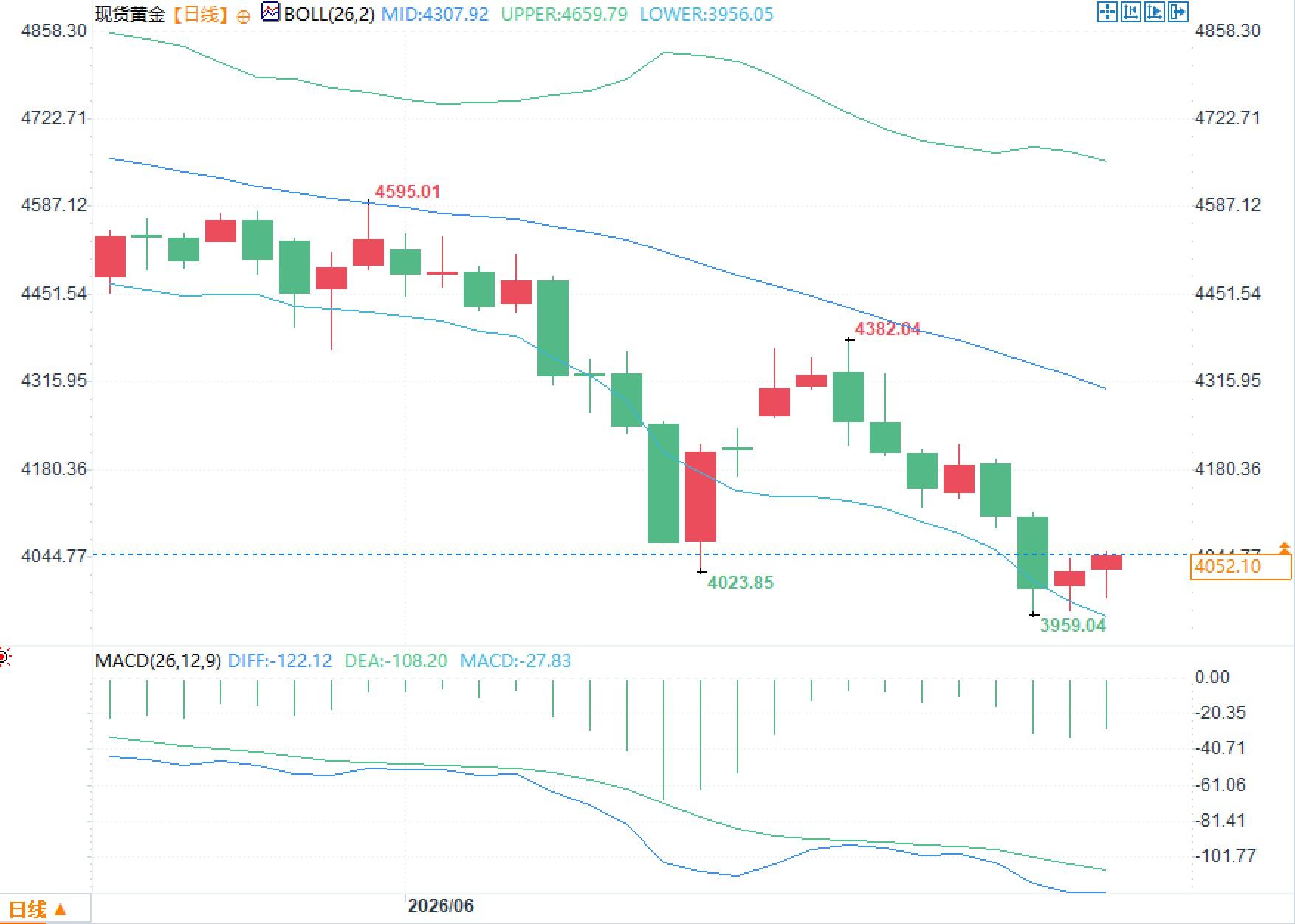
On the MACD front, the DIFF is -122.12 and the DEA is -108.20, with the histogram still in negative territory, indicating that the trend correction is not yet complete. More notably, after gold prices fell from around $4595.01, the rebound highs have been progressively lower, with the $4382.04 level failing to be effectively broken, suggesting that selling pressure from trapped investors and trend-following funds remains. Only when prices approach and stabilize above the Bollinger Middle Band will the market reassess whether this decline has entered a structural correction phase.
Gold's significant price increase over the past year has transformed it from a safe-haven asset into a highly liquid asset with realizable profits in portfolios. Saxo Markets recently pointed out that when crowded growth trades come under pressure, investors tend to sell "assets they can sell," not just "assets they want to sell." This explains why gold might be sold off when tech stock volatility, margin pressures, and portfolio risk reduction all occur simultaneously.
Invesco also emphasized that gold has largely absorbed the risk of further tightening, but has not yet fully digested the environment of "maintaining high real interest rates for a longer period." This assessment hits the core contradiction in the current market: high inflation should support gold, but if the Fed's response function shifts to a more hawkish stance, gold will not face an inflation protection premium, but rather an increased opportunity cost.
Question 1: Does gold's rebound above $4,000 mean the end of the downtrend?
A: That's not a simple interpretation. The current rebound mainly stems from the cooling of bets on extreme interest rate hikes after inflation data did not significantly exceed expectations. However, the US dollar and US Treasury yields remain high, and technically they are still below the Bollinger Band middle line.
Question 2: Why does gold price fall despite high inflation?
A: The key lies in real interest rates. If high inflation prompts the Federal Reserve to maintain a tight policy, rising yields will increase the opportunity cost of holding gold, thereby offsetting the demand for inflation protection.
Question 3: What will the market focus on next?
A: The key questions are whether the US dollar will continue to fall, whether the 10-year US Treasury yield will decline, and whether gold prices can break free from the back-and-forth fluctuations around $4,000.
The rebound in gold prices is not a trend reversal, but rather a correction after an oversold condition.
The immediate trigger for this round of gold price rebound was that while US inflation data remained high, it did not significantly exceed market expectations. The personal consumption expenditure price index rose 0.4% month-on-month in May, while personal income, disposable income, and personal consumption expenditure all increased by 0.7% month-on-month, indicating that price pressures have not subsided and demand has not collapsed significantly.
Therefore, the rebound in gold prices near $4,000 is more likely a sign of easing interest rate fears rather than a renewed strengthening of the macroeconomic narrative. As a non-interest-bearing asset, gold's most sensitive variables remain real interest rates and dollar liquidity. When the market corrects from the Fed's "rapid rate hikes" to "still relatively tight but with an uncertain pace," short covering will push up gold prices. However, if the 10-year US Treasury yield continues to remain above 4.3%, gold's valuation anchor will remain suppressed.
The US dollar and real interest rates remain the core sources of pressure on gold.
The US dollar index was around 101.20 on June 26, down about 0.23% from the previous trading day, but still up about 2.01% over the past month. This means that the foreign exchange pressure on gold has not truly eased, but has only retreated from its highs in the short term. The common logic for dollar-denominated commodities is that a stronger dollar increases the purchasing costs for non-dollar buyers and also increases the relative attractiveness of holding cash-like assets.
The bond market is equally crucial. The 10-year US Treasury yield is around 4.38%, while the 2-year and 10-year yields have slightly declined after the inflation data release, but their absolute levels remain high. If nominal interest rates remain high, and inflation expectations do not rise significantly in tandem, real interest rates will continue to suppress gold. In other words, gold can rebound when inflation data is "not worse," but it will be difficult to quickly resume its previous one-sided upward trend in an environment of persistently high real yields.
Technical analysis indicates that the bearish structure has not yet been broken.
From the daily chart, spot gold is currently priced at around $4050 per ounce, still below the Bollinger Band middle line at $4307.92 per ounce, and the upper band has moved down to $4659.79 per ounce, indicating that the medium-term trading channel continues to compress downwards. The lower band is located around $3956.05 per ounce, and the recent low of $3959.04 per ounce is almost right next to the lower band, showing that the $4000 area has become a psychological and technical convergence zone where bulls and bears repeatedly contend.
On the MACD front, the DIFF is -122.12 and the DEA is -108.20, with the histogram still in negative territory, indicating that the trend correction is not yet complete. More notably, after gold prices fell from around $4595.01, the rebound highs have been progressively lower, with the $4382.04 level failing to be effectively broken, suggesting that selling pressure from trapped investors and trend-following funds remains. Only when prices approach and stabilize above the Bollinger Middle Band will the market reassess whether this decline has entered a structural correction phase.
Funding behavior shifted from safe-haven buying to liquidity realization.
Gold's significant price increase over the past year has transformed it from a safe-haven asset into a highly liquid asset with realizable profits in portfolios. Saxo Markets recently pointed out that when crowded growth trades come under pressure, investors tend to sell "assets they can sell," not just "assets they want to sell." This explains why gold might be sold off when tech stock volatility, margin pressures, and portfolio risk reduction all occur simultaneously.
Invesco also emphasized that gold has largely absorbed the risk of further tightening, but has not yet fully digested the environment of "maintaining high real interest rates for a longer period." This assessment hits the core contradiction in the current market: high inflation should support gold, but if the Fed's response function shifts to a more hawkish stance, gold will not face an inflation protection premium, but rather an increased opportunity cost.
Frequently Asked Questions
Question 1: Does gold's rebound above $4,000 mean the end of the downtrend?
A: That's not a simple interpretation. The current rebound mainly stems from the cooling of bets on extreme interest rate hikes after inflation data did not significantly exceed expectations. However, the US dollar and US Treasury yields remain high, and technically they are still below the Bollinger Band middle line.
Question 2: Why does gold price fall despite high inflation?
A: The key lies in real interest rates. If high inflation prompts the Federal Reserve to maintain a tight policy, rising yields will increase the opportunity cost of holding gold, thereby offsetting the demand for inflation protection.
Question 3: What will the market focus on next?
A: The key questions are whether the US dollar will continue to fall, whether the 10-year US Treasury yield will decline, and whether gold prices can break free from the back-and-forth fluctuations around $4,000.
- Risk Warning and Disclaimer
- The market involves risk, and trading may not be suitable for all investors. This article is for reference only and does not constitute personal investment advice, nor does it take into account certain users’ specific investment objectives, financial situation, or other needs. Any investment decisions made based on this information are at your own risk.