Weekly Forex Market Review: Interest rate hike expectations propel the dollar to a more than one-year high, the yen nears a 40-year low, and the pound struggles in a political vacuum.
2026-06-27 15:03:12
This week, the global foreign exchange market was once again dominated by the strong presence of the Federal Reserve. The US dollar index climbed steadily at the beginning of the week, reaching a 13-month high. Although it experienced a slight pullback later due to economic data, it still recorded its second consecutive weekly gain and is on track for its largest monthly increase since July last year. This trend not only reflects the market's strong expectations of a hawkish stance from the new Fed Chairman Warsh, but also incorporates multiple factors such as stock market volatility and geopolitical uncertainty, providing solid support for the dollar. Meanwhile, the yen continued to face pressure near 40-year lows, while the pound sterling experienced increased volatility due to political upheaval in the UK. Overall, the dollar's strong position is unlikely to change in the short term, while other major currencies face varying degrees of challenges.
The Australian dollar fell 1.68% against the US dollar this week, its biggest weekly drop in nearly three weeks, hitting a low of 0.6875, its lowest since April 3, before closing near 0.6890. The New Zealand dollar fell 1.81% against the US dollar this week, hitting a low of 0.5625, its lowest since November 26, 2025, before closing near 0.5634. The euro fell 0.78% against the US dollar this week, hitting a low of 1.1324%, its lowest since the end of May 2025, before closing near 1.1380.
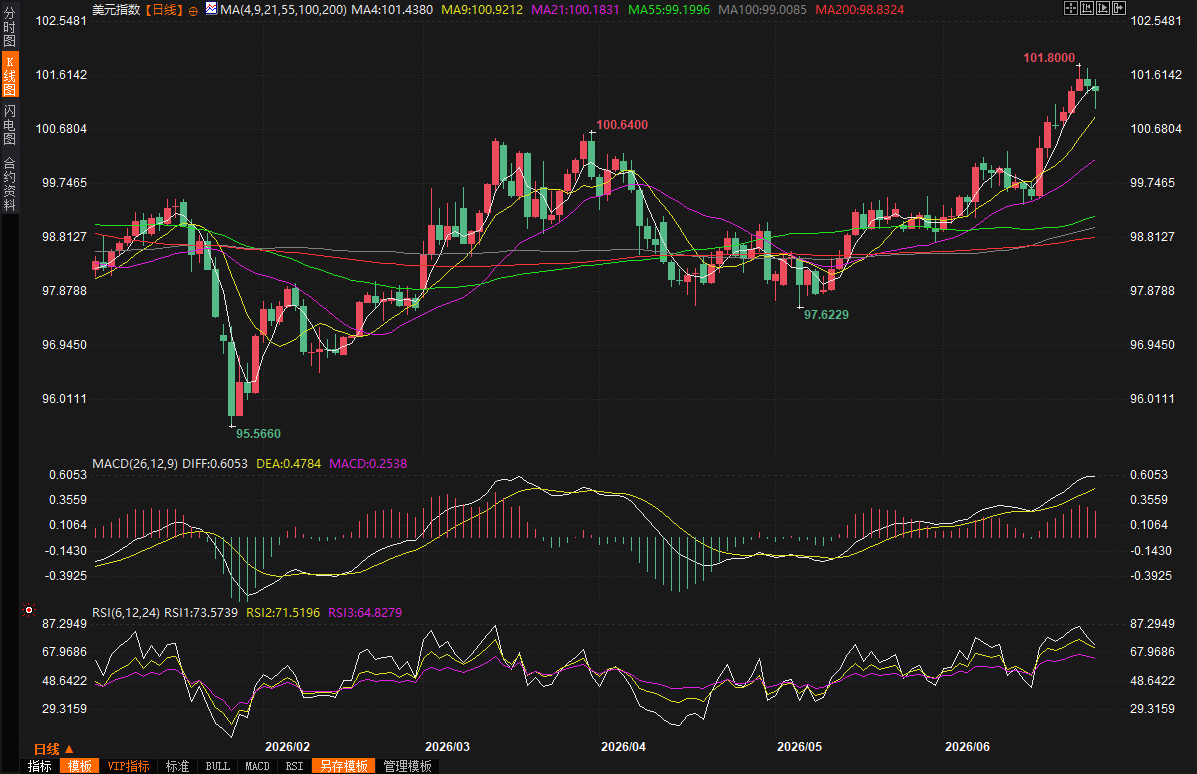
The US dollar's performance this week has been nothing short of spectacular. The dollar index rose for the first three days of the week, reaching a 13-month high of 101.83 on Wednesday (June 24), breaking through the key psychological levels of 100 and 101. Behind this strong upward surge is the convergence of three forces.
First and foremost, there was a sharp shift in Federal Reserve policy expectations. New Chairman Kevin Warsh delivered a distinctly hawkish signal at his first policy meeting on June 17th – the policy statement was significantly shortened, forward guidance was removed, and the dot plot showed nearly half of the members supporting a rate hike this year. The market reacted swiftly. According to the CME Group's FedWatch tool, traders now expect an 86.1% probability of a December rate hike, up from around 61% before the meeting. The probability of a 25 basis point rate hike in September is currently around 72%. Bank of America Global Research made the most aggressive prediction – expecting the Fed to raise rates by 25 basis points each in September, October, and December; Deutsche Bank predicts two rate hikes this year, in September and December.
Secondly, the stock market volatility triggered by the sharp correction in tech stocks increased the attractiveness of the US dollar as a safe-haven asset. The prospect of higher financing costs and persistent valuation concerns put pressure on the stock market, leading to a surge of funds into dollar assets seeking refuge.
Third, geopolitical factors provided additional support. Although the prospect of a preliminary peace agreement between the US and Iran has attracted market attention, Iran has stated that substantive negotiations have not yet officially begun, and the future status of the Strait of Hormuz remains uncertain, meaning that the geopolitical risk premium has not completely disappeared.
It's worth noting that this round of dollar strengthening has overturned the trading logic of several months ago. Previously, the market generally believed that geopolitical conflicts in the Middle East driving up oil prices would raise inflation expectations, thus benefiting the dollar, forming the logic of "high oil prices, strong dollar." However, since mid-May, international oil prices have cumulatively fallen by about 30%, while the dollar index has risen instead, creating a clear divergence of "falling oil prices, rising dollar." The core reason is that the commodity market first traded the decline in geopolitical risk premiums, while the currency market was still trading on the Federal Reserve's hawkish pricing.
Inflation data released on Thursday (June 25) met market expectations, and coupled with further weakening of oil prices (WTI crude oil fell more than 3% to $69.23 per barrel on Friday), slightly dampened market expectations for a Federal Reserve rate hike. The dollar index ended its three-day winning streak and fell for the second consecutive trading day on Friday. As of the close of trading on Friday (June 26), the dollar index closed at 101.36, still recording a weekly gain of 0.59%. U.S. Treasury Secretary Bessant's remarks on Wednesday were significant—he pointed out that a stronger dollar does not necessarily depend on rising interest rates; even during periods of rate cuts, the dollar can strengthen due to accelerated U.S. economic growth, and the widening interest rate differential between the U.S. economy and weaker economies can also support the dollar.
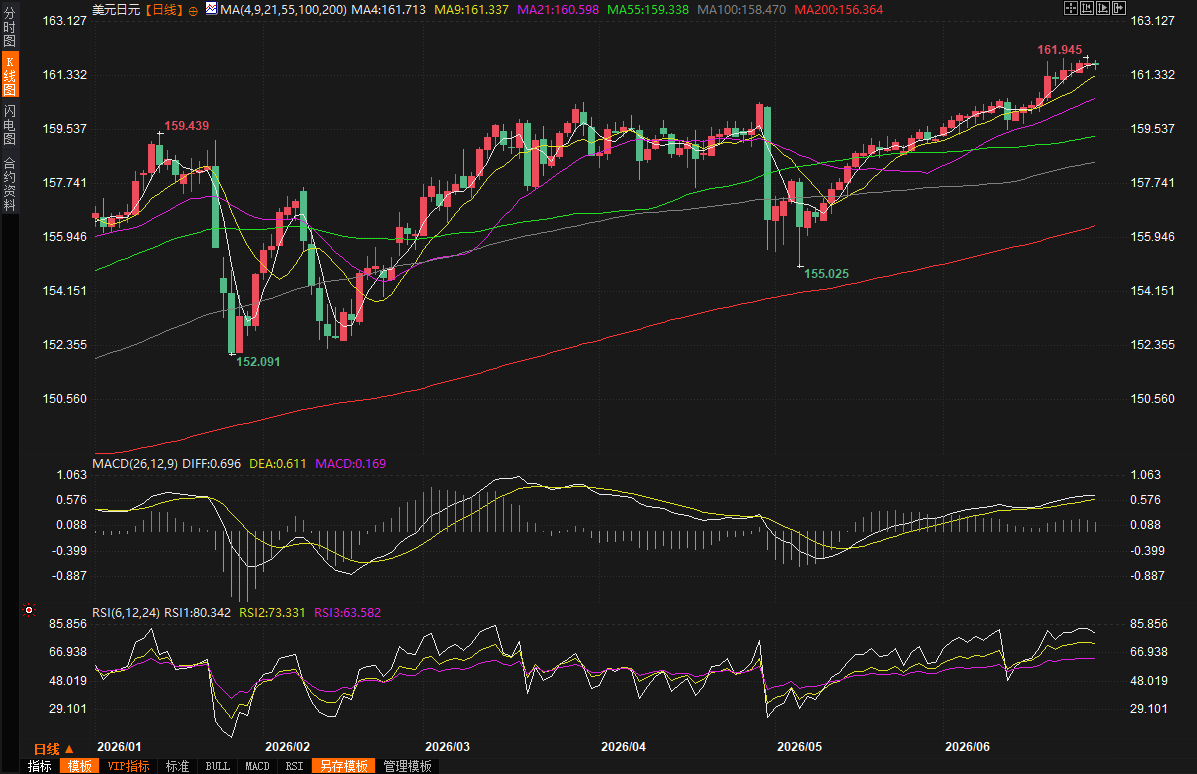
If the US dollar was the protagonist this week, then the Japanese yen was undoubtedly the biggest supporting character—or rather, the victim. The dollar rose to 161.93 against the yen at one point this week, just a step away from its all-time high of 161.96 since 1986. It closed at 161.74 on Friday, up 0.3% for the week, marking gains in six of the past seven weeks. The yen dipped slightly to around 161.66. A break above 161.96 would mark a new high in nearly 40 years.
The yen's vulnerability stems from the massive interest rate differential of over 500 basis points between the US dollar and Japan. The Federal Reserve's benchmark interest rate remains at 3.50%-3.75%, while the Bank of Japan, despite raising its benchmark rate to its highest level since 1995 in June, still maintains a policy rate of only 1%. Strong expectations of Fed tightening and continued balance sheet reduction support US Treasury yields, while the Bank of Japan's relatively weak tightening efforts continue to put pressure on the yen through carry trades. Market analysts point out that the volatility of the USD/JPY exchange rate is fundamentally driven by the interest rate differential, and market attention is largely focused on how the Fed will adjust its policy; upward pressure on the yen will persist.
Japanese authorities were not indifferent. Japanese Finance Minister Satsuki Katayama held an online meeting with US Treasury Secretary Bessenter on Monday evening, focusing on policy responses to the yen's weakness, which might include foreign exchange market intervention. Katayama stated that the authorities were prepared to respond to exchange rate fluctuations at any time. However, the verbal warning had a fleeting effect—the yen briefly rebounded after the announcement but quickly resumed its downward trend. Markets warned that the threat of intervention only slowed, not reversed, the yen's depreciation.
Former Bank of Japan (BOJ) Policy Board member Sayuri Shirai offered a more pessimistic forecast on Tuesday—the dollar could rise to 165 against the dollar if the Federal Reserve raises interest rates this year. She expects the BOJ to raise rates by 25 basis points in October or December, noting that the recent decline in oil prices has not truly supported the yen. Meanwhile, hawkish policy board member Naoki Tamura stated on Thursday that the BOJ should push interest rates towards a neutral level at a pace of raising rates every few months. He estimates Japan's neutral interest rate to be around 2%, significantly higher than the current policy rate of 1%.
Some analysts point out that, given the risk of intervention, shorting USD/JPY is more attractively priced ahead of next week's US jobs report – if the US non-farm payroll data is weak, authorities might intervene. However, they emphasize that this is only a short-term strategy, and they still prefer to go long on USD/JPY after early July. The market seems to be in a stalemate – authorities have drawn a red line around 160-162, but without actual intervention, the fundamental pressure from interest rate differentials will continue to push USD/JPY higher.
The pound's situation this week is equally precarious. This week marks the 10th anniversary of the Brexit referendum, and domestic politics have been thrown into turmoil again – Labour Prime Minister Starmer announced his resignation on Monday. After Chief Secretary to the Treasury Jones stated on Wednesday that he would not run for Labour leadership and would endorse former Manchester Mayor Burnham, Burnham seems to have no obstacles left and is poised to become Britain's seventh prime minister in 10 years.
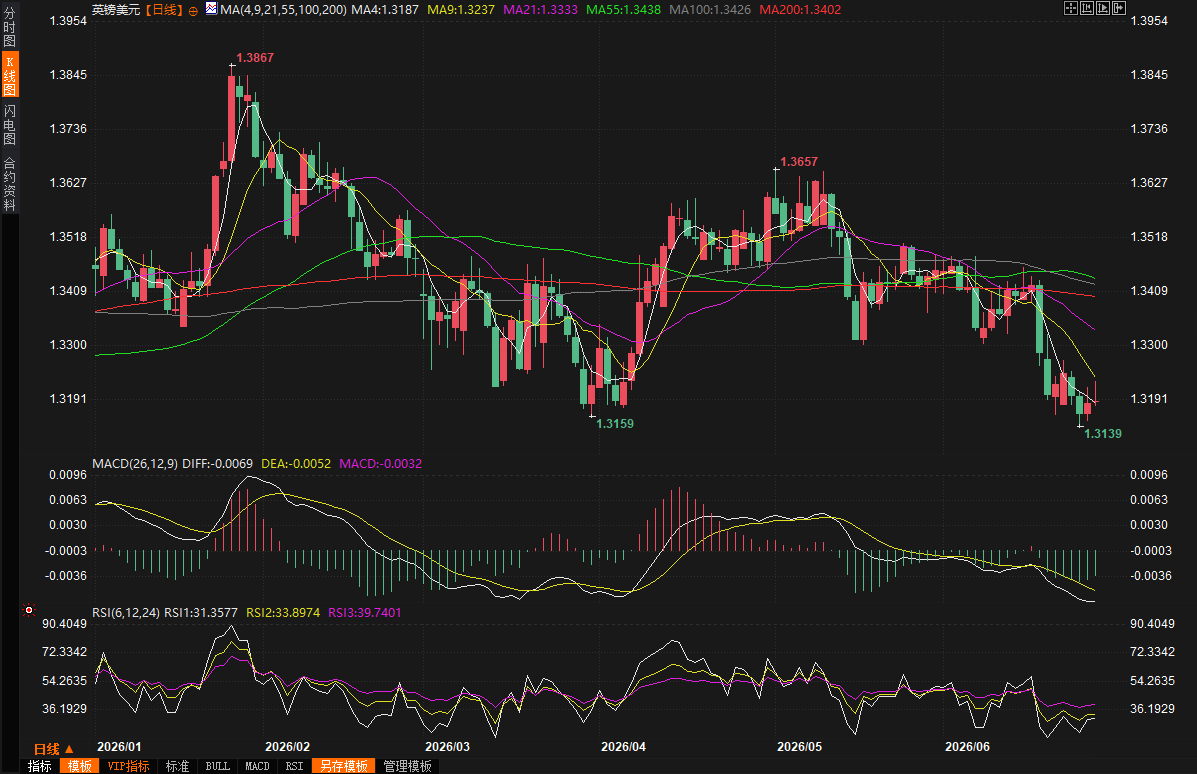
The impact of the political vacuum on the pound is evident. On June 18th, the Bank of England voted 7-2 to keep interest rates at 3.75%, with two members supporting a rate hike, and services inflation remaining close to 3.7%—this should have provided support for the pound. However, the pound fell sharply by about 300 points from the 1.3450 area to a multi-month low near 1.3150. The catalyst was not central bank policy, but rather the uncertainty created by the leadership vacuum: uncertainty regarding fiscal direction, spending plans, and the timing of the election were the factors the market initially priced in.
However, as obstacles to Burnham's coronation gradually disappeared, the pound received some respite near the weekend. Market analysts believe this provided some support for the pound. Burnham's team's statement that they would abide by the fiscal rules set by current Chancellor Reeves also calmed market sentiment. Analysts generally believe that Burnham will succeed Starmer as Prime Minister before July 17, and his policy speech next week will be closely watched by pound traders.
On Friday, the pound closed near 1.3191 against the dollar, down 0.26% for the week, marking its second consecutive weekly decline. The pound has fallen nearly 2% so far in June and is on track for its worst monthly performance since July last year. The euro was roughly unchanged against the pound at 0.8615. Traders now expect the Bank of England to raise interest rates once in 2026, down from 33 basis points a week ago to 21 basis points.
In addition, the suspension of hostilities between the US and Iran caused oil prices to fall by about 20% in two weeks, which to some extent relieved the pressure on the Bank of England to raise interest rates to prevent inflation, but also eliminated potential positive factors for the pound.
The market will see a series of major events next week, which could significantly increase volatility.
Wednesday (July 1st) will be the absolute focus of the coming week. At 7:00 PM that evening, Federal Reserve Chairman Warsh, ECB President Lagarde, Bank of England Governor Bailey, and Bank of Canada Governor Macklem will speak together at the ECB's Sintra Forum. This will be Warsh's first appearance alongside the heads of major global central banks since taking office, and his remarks may further outline the Fed's policy path. The Eurozone's preliminary June HICP reading will also be released on the same day—the Eurozone HICP rose to 3.2% in May, and if the June data continues to rise, it could strengthen expectations that the ECB will continue to raise interest rates.
Thursday (July 2nd) will mark the first "non-farm payrolls night" under Warsh's leadership—the highly anticipated US June non-farm payrolls report will be released. Previously, May saw an increase of 172,000 non-farm jobs, with the unemployment rate remaining at 4.3%. The market expects an average monthly increase of 50,000 to 60,000 non-farm jobs this summer. If the unemployment rate falls below 4.0%, the Federal Reserve may consider the risk of an overheated labor market sufficient to justify a rate hike. Some institutions have explicitly stated that if the non-farm payrolls data is weak, the Japanese authorities may use this opportunity to intervene in the yen.
Other data to watch include: Tuesday's US June consumer confidence index and May JOLTS job openings; Wednesday's ADP private sector employment report and ISM manufacturing PMI; and Tuesday's final UK Q1 GDP figure (previously forecast at 0.6% quarter-on-quarter growth).
Next Friday is Independence Day in the United States, and the US stock market will be closed. The gold and crude oil markets will also close early, which is expected to limit trading activity. Investors need to adjust their positions in advance.
Overall, the current strength of the US dollar is built on the market's firm expectation of a Federal Reserve rate hike this year. Next week's non-farm payroll data will be a key test of this expectation—strong data will further solidify rate hike expectations, and the dollar is likely to reach new highs; weak data could trigger a temporary pullback in the dollar and open the door for yen intervention. In any case, a storm is brewing.
The Australian dollar fell 1.68% against the US dollar this week, its biggest weekly drop in nearly three weeks, hitting a low of 0.6875, its lowest since April 3, before closing near 0.6890. The New Zealand dollar fell 1.81% against the US dollar this week, hitting a low of 0.5625, its lowest since November 26, 2025, before closing near 0.5634. The euro fell 0.78% against the US dollar this week, hitting a low of 1.1324%, its lowest since the end of May 2025, before closing near 1.1380.
I. US Dollar: Three major positive factors converge, and it takes a short break after hitting a 13-month high.
The US dollar's performance this week has been nothing short of spectacular. The dollar index rose for the first three days of the week, reaching a 13-month high of 101.83 on Wednesday (June 24), breaking through the key psychological levels of 100 and 101. Behind this strong upward surge is the convergence of three forces.
First and foremost, there was a sharp shift in Federal Reserve policy expectations. New Chairman Kevin Warsh delivered a distinctly hawkish signal at his first policy meeting on June 17th – the policy statement was significantly shortened, forward guidance was removed, and the dot plot showed nearly half of the members supporting a rate hike this year. The market reacted swiftly. According to the CME Group's FedWatch tool, traders now expect an 86.1% probability of a December rate hike, up from around 61% before the meeting. The probability of a 25 basis point rate hike in September is currently around 72%. Bank of America Global Research made the most aggressive prediction – expecting the Fed to raise rates by 25 basis points each in September, October, and December; Deutsche Bank predicts two rate hikes this year, in September and December.
Secondly, the stock market volatility triggered by the sharp correction in tech stocks increased the attractiveness of the US dollar as a safe-haven asset. The prospect of higher financing costs and persistent valuation concerns put pressure on the stock market, leading to a surge of funds into dollar assets seeking refuge.
Third, geopolitical factors provided additional support. Although the prospect of a preliminary peace agreement between the US and Iran has attracted market attention, Iran has stated that substantive negotiations have not yet officially begun, and the future status of the Strait of Hormuz remains uncertain, meaning that the geopolitical risk premium has not completely disappeared.
It's worth noting that this round of dollar strengthening has overturned the trading logic of several months ago. Previously, the market generally believed that geopolitical conflicts in the Middle East driving up oil prices would raise inflation expectations, thus benefiting the dollar, forming the logic of "high oil prices, strong dollar." However, since mid-May, international oil prices have cumulatively fallen by about 30%, while the dollar index has risen instead, creating a clear divergence of "falling oil prices, rising dollar." The core reason is that the commodity market first traded the decline in geopolitical risk premiums, while the currency market was still trading on the Federal Reserve's hawkish pricing.
Inflation data released on Thursday (June 25) met market expectations, and coupled with further weakening of oil prices (WTI crude oil fell more than 3% to $69.23 per barrel on Friday), slightly dampened market expectations for a Federal Reserve rate hike. The dollar index ended its three-day winning streak and fell for the second consecutive trading day on Friday. As of the close of trading on Friday (June 26), the dollar index closed at 101.36, still recording a weekly gain of 0.59%. U.S. Treasury Secretary Bessant's remarks on Wednesday were significant—he pointed out that a stronger dollar does not necessarily depend on rising interest rates; even during periods of rate cuts, the dollar can strengthen due to accelerated U.S. economic growth, and the widening interest rate differential between the U.S. economy and weaker economies can also support the dollar.
II. Japanese Yen: Under heavy pressure from interest rate differentials, its fate hangs by a thread at a 40-year low.
If the US dollar was the protagonist this week, then the Japanese yen was undoubtedly the biggest supporting character—or rather, the victim. The dollar rose to 161.93 against the yen at one point this week, just a step away from its all-time high of 161.96 since 1986. It closed at 161.74 on Friday, up 0.3% for the week, marking gains in six of the past seven weeks. The yen dipped slightly to around 161.66. A break above 161.96 would mark a new high in nearly 40 years.
The yen's vulnerability stems from the massive interest rate differential of over 500 basis points between the US dollar and Japan. The Federal Reserve's benchmark interest rate remains at 3.50%-3.75%, while the Bank of Japan, despite raising its benchmark rate to its highest level since 1995 in June, still maintains a policy rate of only 1%. Strong expectations of Fed tightening and continued balance sheet reduction support US Treasury yields, while the Bank of Japan's relatively weak tightening efforts continue to put pressure on the yen through carry trades. Market analysts point out that the volatility of the USD/JPY exchange rate is fundamentally driven by the interest rate differential, and market attention is largely focused on how the Fed will adjust its policy; upward pressure on the yen will persist.
Japanese authorities were not indifferent. Japanese Finance Minister Satsuki Katayama held an online meeting with US Treasury Secretary Bessenter on Monday evening, focusing on policy responses to the yen's weakness, which might include foreign exchange market intervention. Katayama stated that the authorities were prepared to respond to exchange rate fluctuations at any time. However, the verbal warning had a fleeting effect—the yen briefly rebounded after the announcement but quickly resumed its downward trend. Markets warned that the threat of intervention only slowed, not reversed, the yen's depreciation.
Former Bank of Japan (BOJ) Policy Board member Sayuri Shirai offered a more pessimistic forecast on Tuesday—the dollar could rise to 165 against the dollar if the Federal Reserve raises interest rates this year. She expects the BOJ to raise rates by 25 basis points in October or December, noting that the recent decline in oil prices has not truly supported the yen. Meanwhile, hawkish policy board member Naoki Tamura stated on Thursday that the BOJ should push interest rates towards a neutral level at a pace of raising rates every few months. He estimates Japan's neutral interest rate to be around 2%, significantly higher than the current policy rate of 1%.
Some analysts point out that, given the risk of intervention, shorting USD/JPY is more attractively priced ahead of next week's US jobs report – if the US non-farm payroll data is weak, authorities might intervene. However, they emphasize that this is only a short-term strategy, and they still prefer to go long on USD/JPY after early July. The market seems to be in a stalemate – authorities have drawn a red line around 160-162, but without actual intervention, the fundamental pressure from interest rate differentials will continue to push USD/JPY higher.
III. The British Pound: Struggling to Survive in a Political Vacuum
The pound's situation this week is equally precarious. This week marks the 10th anniversary of the Brexit referendum, and domestic politics have been thrown into turmoil again – Labour Prime Minister Starmer announced his resignation on Monday. After Chief Secretary to the Treasury Jones stated on Wednesday that he would not run for Labour leadership and would endorse former Manchester Mayor Burnham, Burnham seems to have no obstacles left and is poised to become Britain's seventh prime minister in 10 years.
The impact of the political vacuum on the pound is evident. On June 18th, the Bank of England voted 7-2 to keep interest rates at 3.75%, with two members supporting a rate hike, and services inflation remaining close to 3.7%—this should have provided support for the pound. However, the pound fell sharply by about 300 points from the 1.3450 area to a multi-month low near 1.3150. The catalyst was not central bank policy, but rather the uncertainty created by the leadership vacuum: uncertainty regarding fiscal direction, spending plans, and the timing of the election were the factors the market initially priced in.
However, as obstacles to Burnham's coronation gradually disappeared, the pound received some respite near the weekend. Market analysts believe this provided some support for the pound. Burnham's team's statement that they would abide by the fiscal rules set by current Chancellor Reeves also calmed market sentiment. Analysts generally believe that Burnham will succeed Starmer as Prime Minister before July 17, and his policy speech next week will be closely watched by pound traders.
On Friday, the pound closed near 1.3191 against the dollar, down 0.26% for the week, marking its second consecutive weekly decline. The pound has fallen nearly 2% so far in June and is on track for its worst monthly performance since July last year. The euro was roughly unchanged against the pound at 0.8615. Traders now expect the Bank of England to raise interest rates once in 2026, down from 33 basis points a week ago to 21 basis points.
In addition, the suspension of hostilities between the US and Iran caused oil prices to fall by about 20% in two weeks, which to some extent relieved the pressure on the Bank of England to raise interest rates to prevent inflation, but also eliminated potential positive factors for the pound.
IV. Next Week's Outlook: The Double Storm of Non-Farm Payrolls Night and Central Bank Forum
The market will see a series of major events next week, which could significantly increase volatility.
Wednesday (July 1st) will be the absolute focus of the coming week. At 7:00 PM that evening, Federal Reserve Chairman Warsh, ECB President Lagarde, Bank of England Governor Bailey, and Bank of Canada Governor Macklem will speak together at the ECB's Sintra Forum. This will be Warsh's first appearance alongside the heads of major global central banks since taking office, and his remarks may further outline the Fed's policy path. The Eurozone's preliminary June HICP reading will also be released on the same day—the Eurozone HICP rose to 3.2% in May, and if the June data continues to rise, it could strengthen expectations that the ECB will continue to raise interest rates.
Thursday (July 2nd) will mark the first "non-farm payrolls night" under Warsh's leadership—the highly anticipated US June non-farm payrolls report will be released. Previously, May saw an increase of 172,000 non-farm jobs, with the unemployment rate remaining at 4.3%. The market expects an average monthly increase of 50,000 to 60,000 non-farm jobs this summer. If the unemployment rate falls below 4.0%, the Federal Reserve may consider the risk of an overheated labor market sufficient to justify a rate hike. Some institutions have explicitly stated that if the non-farm payrolls data is weak, the Japanese authorities may use this opportunity to intervene in the yen.
Other data to watch include: Tuesday's US June consumer confidence index and May JOLTS job openings; Wednesday's ADP private sector employment report and ISM manufacturing PMI; and Tuesday's final UK Q1 GDP figure (previously forecast at 0.6% quarter-on-quarter growth).
Next Friday is Independence Day in the United States, and the US stock market will be closed. The gold and crude oil markets will also close early, which is expected to limit trading activity. Investors need to adjust their positions in advance.
Overall, the current strength of the US dollar is built on the market's firm expectation of a Federal Reserve rate hike this year. Next week's non-farm payroll data will be a key test of this expectation—strong data will further solidify rate hike expectations, and the dollar is likely to reach new highs; weak data could trigger a temporary pullback in the dollar and open the door for yen intervention. In any case, a storm is brewing.
- Risk Warning and Disclaimer
- The market involves risk, and trading may not be suitable for all investors. This article is for reference only and does not constitute personal investment advice, nor does it take into account certain users’ specific investment objectives, financial situation, or other needs. Any investment decisions made based on this information are at your own risk.