The British pound remained range-bound against the US dollar, and the oversold rebound did not change the downward trend.
2026-06-29 13:26:30
The pound fell slightly against the dollar in Asian trading on Monday, giving back gains from an earlier gap up and trading around 1.3200 . Overall, the pair consolidated quickly after a short-term surge, with market sentiment turning cautious again.
From an external perspective, the safe-haven appeal of the US dollar has once again become a dominant force. The US and Iran recently agreed to suspend military confrontation in the Gulf region and plan to hold a new round of negotiations in Qatar. While this development has alleviated market concerns about energy supply disruptions to some extent, the previous conflict surrounding the Strait of Hormuz has not completely subsided, keeping the market highly sensitive to the stability of the geopolitical situation.
Amidst fluctuating risk sentiment, funds flowed back into dollar assets in the short term, pushing the dollar index higher and putting pressure on the pound. The decline in GBP/USD is more of a passive adjustment driven by changes in risk appetite than a significant deterioration in the pound's fundamentals. Meanwhile, the UK's domestic political situation has also become a crucial variable affecting the pound. As the previous political turmoil continues to unfold, the power structure within the Labour Party has undergone significant changes. Market surveys indicate that newly elected MP Andy Burnham's support within the party is rising, and the market anticipates he may face a higher probability of becoming a government leader around mid-July.
Rising political uncertainty typically influences currency movements through a "policy expectation reassessment" channel. Especially when the direction of fiscal policy and economic reforms remains unclear, markets tend to increase risk premiums, thus suppressing the pound's performance. Structurally, the pound's current movement exhibits a typical "dual-pressure model": on one hand, the transmission of dollar volatility due to changes in global risk sentiment; on the other hand, the pressure on the UK currency from rising domestic political uncertainty. This makes the exchange rate more likely to fluctuate within a range in the absence of a clear trend driver.
In the short term, market focus remains on the progress of negotiations between the US and Iran. If geopolitical tensions ease further, demand for the US dollar as a safe haven may decrease, thus providing some support for the pound. Conversely, if tensions escalate again, it could push the dollar higher and limit the pound's upside potential.
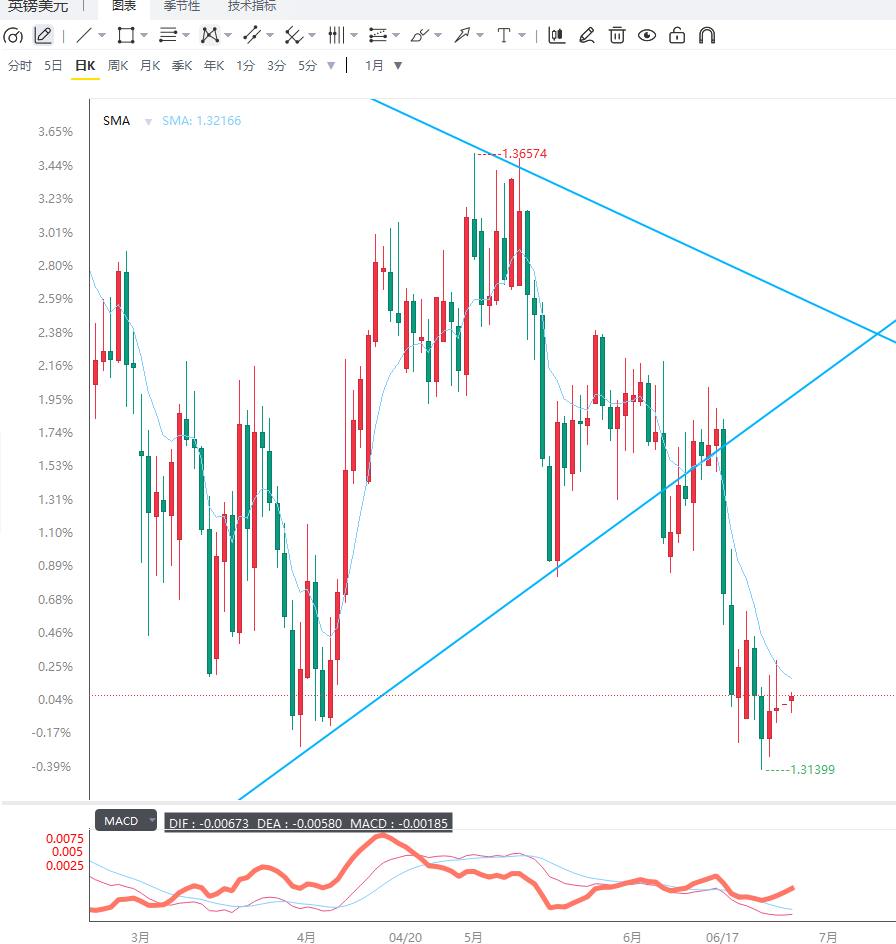
From a daily chart perspective, GBP/USD has entered a sideways consolidation range after its previous rebound, fluctuating roughly between 1.3150 and 1.3300 . The trend structure has not yet formed a clear breakout direction, exhibiting more of a consolidation and correction pattern. The current price is in a neutral-to-strong zone, but has repeatedly encountered resistance near 1.3300, indicating significant upward pressure. On the downside, the first support level to watch is around 1.3150 , a key support area that has been tested multiple times recently. A break below this level could shift the short-term structure to a weak consolidation, potentially testing the 1.3050 area. Resistance lies in the 1.3300-1.3350 area ; a successful break and hold above this level could open up further upside potential.
From a 4-hour chart perspective, the exchange rate gapped up and then quickly fell back, indicating that the short-term bullish momentum failed to continue and the market has entered a correction phase. The moving average system is flattening, and short-term momentum indicators have fallen from high levels to neutral territory, suggesting that market sentiment has shifted from optimism to a wait-and-see approach. If the exchange rate can stabilize above 1.3180, it may still maintain its oscillating rebound structure; however, if it breaks below this area, it may retest the 1.3150 support level in the short term.
Editor's Summary <br/>Overall, the current GBP/USD exchange rate is influenced by both external geopolitical uncertainties and domestic political changes in the UK, lacking a single, clear trend driver in the short term. The US dollar's temporary rebound due to safe-haven demand is putting pressure on the pound, while the uncertainty surrounding the UK political situation further amplifies market caution. From a medium-term perspective, the pound remains in a range-bound trading pattern, with no clear directional choice. Future movements will depend on three key variables: the progress of US-Iran negotiations, changes in global risk sentiment, and further clarification of the UK political situation. Until then, the exchange rate is likely to remain in a consolidation pattern between 1.3150 and 1.3350.
From an external perspective, the safe-haven appeal of the US dollar has once again become a dominant force. The US and Iran recently agreed to suspend military confrontation in the Gulf region and plan to hold a new round of negotiations in Qatar. While this development has alleviated market concerns about energy supply disruptions to some extent, the previous conflict surrounding the Strait of Hormuz has not completely subsided, keeping the market highly sensitive to the stability of the geopolitical situation.
Amidst fluctuating risk sentiment, funds flowed back into dollar assets in the short term, pushing the dollar index higher and putting pressure on the pound. The decline in GBP/USD is more of a passive adjustment driven by changes in risk appetite than a significant deterioration in the pound's fundamentals. Meanwhile, the UK's domestic political situation has also become a crucial variable affecting the pound. As the previous political turmoil continues to unfold, the power structure within the Labour Party has undergone significant changes. Market surveys indicate that newly elected MP Andy Burnham's support within the party is rising, and the market anticipates he may face a higher probability of becoming a government leader around mid-July.
Rising political uncertainty typically influences currency movements through a "policy expectation reassessment" channel. Especially when the direction of fiscal policy and economic reforms remains unclear, markets tend to increase risk premiums, thus suppressing the pound's performance. Structurally, the pound's current movement exhibits a typical "dual-pressure model": on one hand, the transmission of dollar volatility due to changes in global risk sentiment; on the other hand, the pressure on the UK currency from rising domestic political uncertainty. This makes the exchange rate more likely to fluctuate within a range in the absence of a clear trend driver.
In the short term, market focus remains on the progress of negotiations between the US and Iran. If geopolitical tensions ease further, demand for the US dollar as a safe haven may decrease, thus providing some support for the pound. Conversely, if tensions escalate again, it could push the dollar higher and limit the pound's upside potential.
From a daily chart perspective, GBP/USD has entered a sideways consolidation range after its previous rebound, fluctuating roughly between 1.3150 and 1.3300 . The trend structure has not yet formed a clear breakout direction, exhibiting more of a consolidation and correction pattern. The current price is in a neutral-to-strong zone, but has repeatedly encountered resistance near 1.3300, indicating significant upward pressure. On the downside, the first support level to watch is around 1.3150 , a key support area that has been tested multiple times recently. A break below this level could shift the short-term structure to a weak consolidation, potentially testing the 1.3050 area. Resistance lies in the 1.3300-1.3350 area ; a successful break and hold above this level could open up further upside potential.
From a 4-hour chart perspective, the exchange rate gapped up and then quickly fell back, indicating that the short-term bullish momentum failed to continue and the market has entered a correction phase. The moving average system is flattening, and short-term momentum indicators have fallen from high levels to neutral territory, suggesting that market sentiment has shifted from optimism to a wait-and-see approach. If the exchange rate can stabilize above 1.3180, it may still maintain its oscillating rebound structure; however, if it breaks below this area, it may retest the 1.3150 support level in the short term.
Editor's Summary <br/>Overall, the current GBP/USD exchange rate is influenced by both external geopolitical uncertainties and domestic political changes in the UK, lacking a single, clear trend driver in the short term. The US dollar's temporary rebound due to safe-haven demand is putting pressure on the pound, while the uncertainty surrounding the UK political situation further amplifies market caution. From a medium-term perspective, the pound remains in a range-bound trading pattern, with no clear directional choice. Future movements will depend on three key variables: the progress of US-Iran negotiations, changes in global risk sentiment, and further clarification of the UK political situation. Until then, the exchange rate is likely to remain in a consolidation pattern between 1.3150 and 1.3350.
- Risk Warning and Disclaimer
- The market involves risk, and trading may not be suitable for all investors. This article is for reference only and does not constitute personal investment advice, nor does it take into account certain users’ specific investment objectives, financial situation, or other needs. Any investment decisions made based on this information are at your own risk.