Crude oil analysis: Behind the 90,338 net long contracts, are funds betting on a supply reversal?
2026-06-29 15:58:07
On Monday, June 29th, Brent crude oil did not exhibit a strong risk premium despite the renewed tensions between the US and Iran over the weekend. Currently, Brent crude is priced at around $73, still close to the lower Bollinger Band. This means the market is prioritizing "supply recovery" over "Strait crossing risks" in its pricing strategy. This focus on pricing is precisely what warrants the most attention in the current oil market.

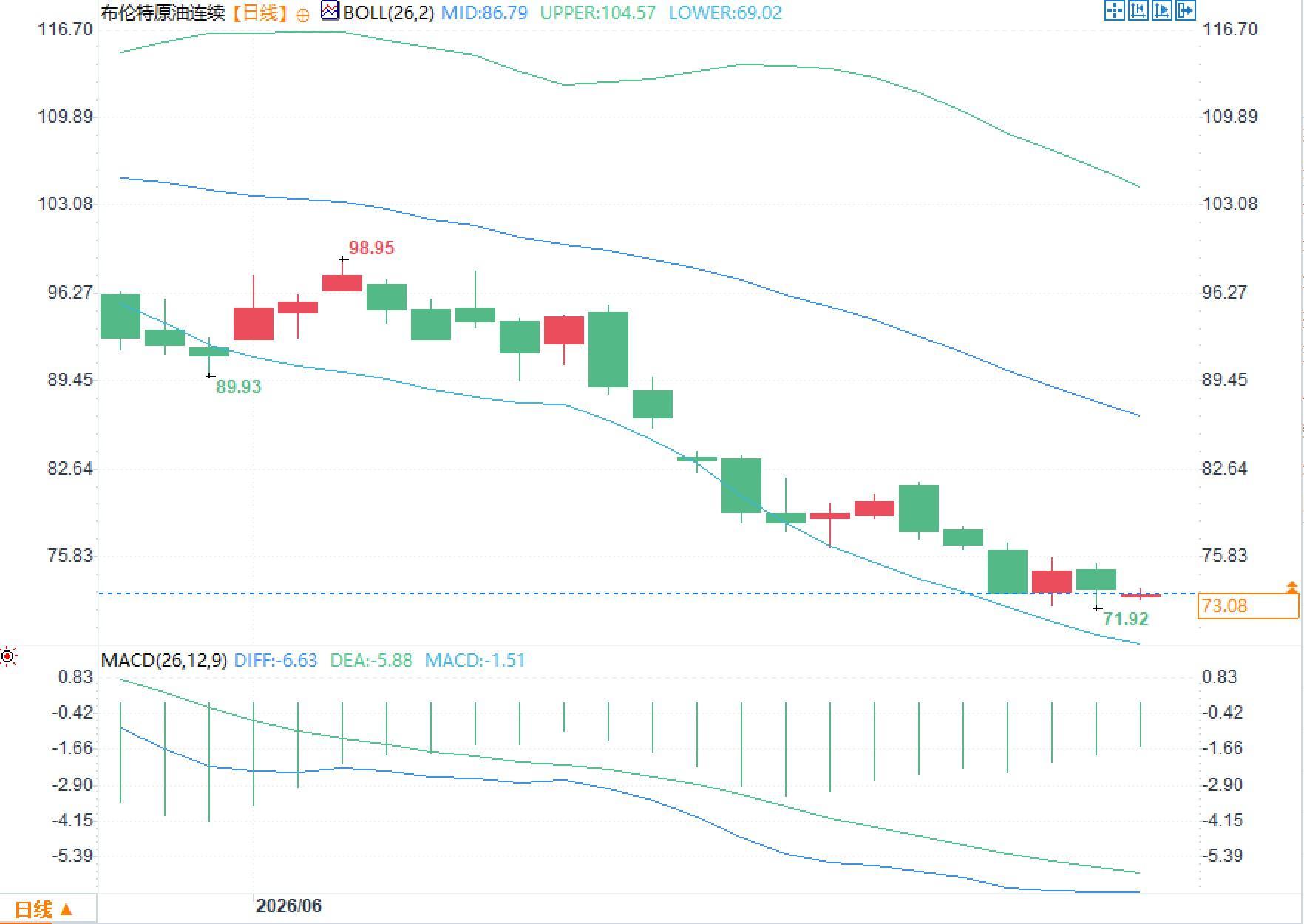
From a technical perspective, Brent crude oil's current price is still significantly below the Bollinger Middle Band at 86.79, and even further below the Upper Band at 104.57. This indicates that the current decline is not a simple pullback driven by news, but rather a clear downward shift in the trend center. The MACD indicator shows a DIF of -6.63, a DEA of -5.88, and a histogram value of -1.51, suggesting that momentum has not yet fully recovered. With the price approaching the Lower Bollinger Band at 69.02, technically it represents a low-level consolidation after a period of weakness, rather than a confirmation of a trend reversal.
More importantly, the escalating tensions between the US and Iran over the weekend, coupled with increased shipping risks in the Strait of Hormuz, should have strengthened risk premiums, but oil prices only rose moderately. Price quotes show no strong indication of tight spot pricing between the previous month's contract and the more distant month's contract; the near-term curve seems to reflect expectations of inventory and logistical recovery. This suggests the market is downplaying geopolitical risks and placing more weight on the return of Gulf supply, the recovery of refinery operations, and temporarily weak demand.
The prevailing market pricing assumption is that Gulf supply will continue to recover, and the return of oil flows will alleviate the previous shortfall. However, this assumption is too linear. Following the weekend events between the US and Iran, relevant maritime agencies have raised their navigation threat assessment of the Strait of Hormuz to a higher level, and tanker industry organizations have also advised avoiding sending tankers through the waterway whenever possible. Meanwhile, discussions surrounding passage fees, route arrangements, and security measures remain unresolved, indicating that the strait has not returned to its pre-event low-friction state.
The core issue in the Hormuz isn't simply whether passage is possible, but rather the efficiency of passage, insurance costs, shipowner willingness, loading and unloading schedules, and the stability of refinery restocking. If any of these links is disrupted, the nominal supply recovery may not smoothly translate into deliverable supply. The International Energy Agency's June report also indicated that global supply is projected to fall to 102.4 million barrels per day in 2026, a decrease of 3.9 million barrels per day year-on-year, while demand is expected to decline by 1.1 million barrels per day year-on-year. Supply chain normalization remains affected by waterway clearing, transportation arrangements, and political constraints.
Position data shows that speculative funds reduced their net long positions in ICE Brent crude by 23,790 contracts, bringing the total to 90,338 contracts, the lowest level since mid-December 2025. Since each ICE Brent contract represents 1,000 barrels, this net long position roughly corresponds to a nominal exposure of 90.338 million barrels, a significant contraction compared to previous levels. More importantly, the reduction mainly came from long position liquidation, with a weekly decrease of 52,097 contracts, indicating that funds were not simply increasing defensive positions, but actively reducing their exposure to upward pressure on oil prices.
These changes in positioning have two implications for prices. First, the trend remains weak, and funds are not in a hurry to cover geopolitical risks. Second, with net long positions falling to low levels, if supply recovery falls short of expectations or cross-strait risks escalate again, low positions will amplify price volatility. Further declines in oil prices require continued improvement in supply inflows and a narrowing of crack spreads; a renewed upward correction in oil prices would require new pressures on transportation, insurance, or physical delivery.
Compared to crude oil itself, the tightness of middle distillate fuels is more noteworthy. Reports indicate that Russia is discussing diesel export restrictions, with officials emphasizing that if implemented, they are likely to be short-term. Even if brief, this will impact the already tight diesel and heating oil markets. Russia exports approximately 900,000 barrels per day of diesel, playing a significant role in the refined oil balance in Europe and the surrounding region.
This means that the crude oil market is seeing "supply repatriation expectations," while the refined product market is seeing "crack support." If crude oil prices are pressured by the recovery of Gulf oil flows, but diesel crack spreads remain high, refinery profit structures may diverge. The real core variables are whether the recovery of crude oil flows can be simultaneously translated into processable supply for refineries, and whether the shortage of middle distillates will continue to push up refined product premiums. Currently, the market is underestimating not the conflict itself, but the complexity of restarting the supply chain after the conflict.
Limited price rebound indicates that risk premium has been compressed.
From a technical perspective, Brent crude oil's current price is still significantly below the Bollinger Middle Band at 86.79, and even further below the Upper Band at 104.57. This indicates that the current decline is not a simple pullback driven by news, but rather a clear downward shift in the trend center. The MACD indicator shows a DIF of -6.63, a DEA of -5.88, and a histogram value of -1.51, suggesting that momentum has not yet fully recovered. With the price approaching the Lower Bollinger Band at 69.02, technically it represents a low-level consolidation after a period of weakness, rather than a confirmation of a trend reversal.
More importantly, the escalating tensions between the US and Iran over the weekend, coupled with increased shipping risks in the Strait of Hormuz, should have strengthened risk premiums, but oil prices only rose moderately. Price quotes show no strong indication of tight spot pricing between the previous month's contract and the more distant month's contract; the near-term curve seems to reflect expectations of inventory and logistical recovery. This suggests the market is downplaying geopolitical risks and placing more weight on the return of Gulf supply, the recovery of refinery operations, and temporarily weak demand.
The Hormuz variable has not disappeared, and the supply recovery path has been over-linearized.
The prevailing market pricing assumption is that Gulf supply will continue to recover, and the return of oil flows will alleviate the previous shortfall. However, this assumption is too linear. Following the weekend events between the US and Iran, relevant maritime agencies have raised their navigation threat assessment of the Strait of Hormuz to a higher level, and tanker industry organizations have also advised avoiding sending tankers through the waterway whenever possible. Meanwhile, discussions surrounding passage fees, route arrangements, and security measures remain unresolved, indicating that the strait has not returned to its pre-event low-friction state.
The core issue in the Hormuz isn't simply whether passage is possible, but rather the efficiency of passage, insurance costs, shipowner willingness, loading and unloading schedules, and the stability of refinery restocking. If any of these links is disrupted, the nominal supply recovery may not smoothly translate into deliverable supply. The International Energy Agency's June report also indicated that global supply is projected to fall to 102.4 million barrels per day in 2026, a decrease of 3.9 million barrels per day year-on-year, while demand is expected to decline by 1.1 million barrels per day year-on-year. Supply chain normalization remains affected by waterway clearing, transportation arrangements, and political constraints.
Speculative funds are withdrawing, and oil prices are entering a zone of "crowded short positions, but not necessarily safe."
Position data shows that speculative funds reduced their net long positions in ICE Brent crude by 23,790 contracts, bringing the total to 90,338 contracts, the lowest level since mid-December 2025. Since each ICE Brent contract represents 1,000 barrels, this net long position roughly corresponds to a nominal exposure of 90.338 million barrels, a significant contraction compared to previous levels. More importantly, the reduction mainly came from long position liquidation, with a weekly decrease of 52,097 contracts, indicating that funds were not simply increasing defensive positions, but actively reducing their exposure to upward pressure on oil prices.
These changes in positioning have two implications for prices. First, the trend remains weak, and funds are not in a hurry to cover geopolitical risks. Second, with net long positions falling to low levels, if supply recovery falls short of expectations or cross-strait risks escalate again, low positions will amplify price volatility. Further declines in oil prices require continued improvement in supply inflows and a narrowing of crack spreads; a renewed upward correction in oil prices would require new pressures on transportation, insurance, or physical delivery.
Diesel crack spread is an underestimated second main theme.
Compared to crude oil itself, the tightness of middle distillate fuels is more noteworthy. Reports indicate that Russia is discussing diesel export restrictions, with officials emphasizing that if implemented, they are likely to be short-term. Even if brief, this will impact the already tight diesel and heating oil markets. Russia exports approximately 900,000 barrels per day of diesel, playing a significant role in the refined oil balance in Europe and the surrounding region.
This means that the crude oil market is seeing "supply repatriation expectations," while the refined product market is seeing "crack support." If crude oil prices are pressured by the recovery of Gulf oil flows, but diesel crack spreads remain high, refinery profit structures may diverge. The real core variables are whether the recovery of crude oil flows can be simultaneously translated into processable supply for refineries, and whether the shortage of middle distillates will continue to push up refined product premiums. Currently, the market is underestimating not the conflict itself, but the complexity of restarting the supply chain after the conflict.
- Risk Warning and Disclaimer
- The market involves risk, and trading may not be suitable for all investors. This article is for reference only and does not constitute personal investment advice, nor does it take into account certain users’ specific investment objectives, financial situation, or other needs. Any investment decisions made based on this information are at your own risk.