Oil prices continued to fluctuate at low levels, while the USD/CAD exchange rate fluctuated and adjusted, awaiting stabilization.
2026-06-29 13:26:35
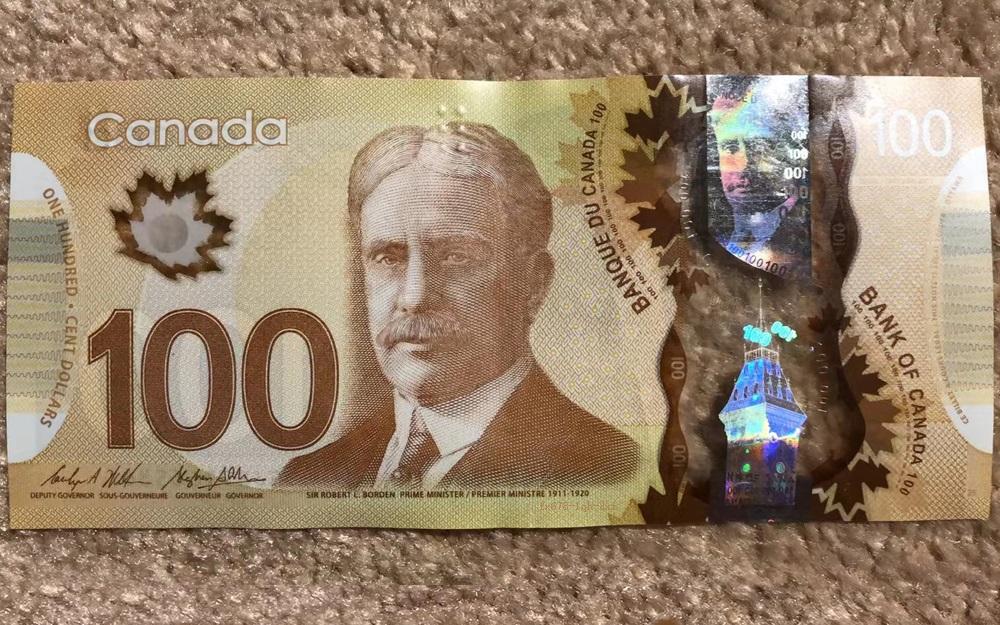
The USD/CAD pair continued to be under pressure during Monday's Asian trading session, declining for the third consecutive trading day to around 1.4190 . The current movement primarily reflects a temporary pullback in the US dollar index and a market reaction to the recovery in risk sentiment brought about by easing tensions in the Middle East.
The United States and Iran have agreed to suspend recent military clashes in the Gulf region and plan to resume negotiations in Qatar. This development has eased market concerns about the risk of supply disruptions in the Strait of Hormuz, thereby weakening short-term safe-haven demand for the US dollar. The escalation of conflict in the region in previous days had initially boosted the dollar, but as the situation entered the negotiation phase, the dollar's upward momentum has clearly weakened.
However, the downside potential for the dollar remains somewhat supported. The market is still pricing in a hawkish policy path from the Federal Reserve, and market surveys show that traders' pricing in the probability of future rate hikes remains high. With the US non-farm payroll data due this week, the market will reassess the resilience of the labor market and the interest rate path, which may limit further dollar weakness.
On the other hand, the Canadian dollar's performance is also constrained by multiple factors. As a commodity currency, the Canadian dollar is highly correlated with crude oil prices, but recent declines in oil prices have weakened its fundamental support. WTI crude oil is currently trading around $70 , and due to a temporary easing of geopolitical tensions, the market has quickly given up the premium for supply disruptions, putting pressure on oil prices and indirectly dragging down the Canadian dollar's performance.
Structurally, the USD/CAD pair is currently exhibiting a typical "two-way resistance structure": the US dollar has weakened due to improved risk sentiment, but falling oil prices have simultaneously weakened the Canadian dollar, significantly slowing the pace of the decline. The market is currently in a phase of alternating event-driven and data-driven movements. Short-term focus is on US non-farm payroll data and progress in Middle East negotiations. If the employment data is stronger than expected, the US dollar may find support, thus limiting further downside for USD/CAD; conversely, weak data could push the pair further down to test lower support levels.
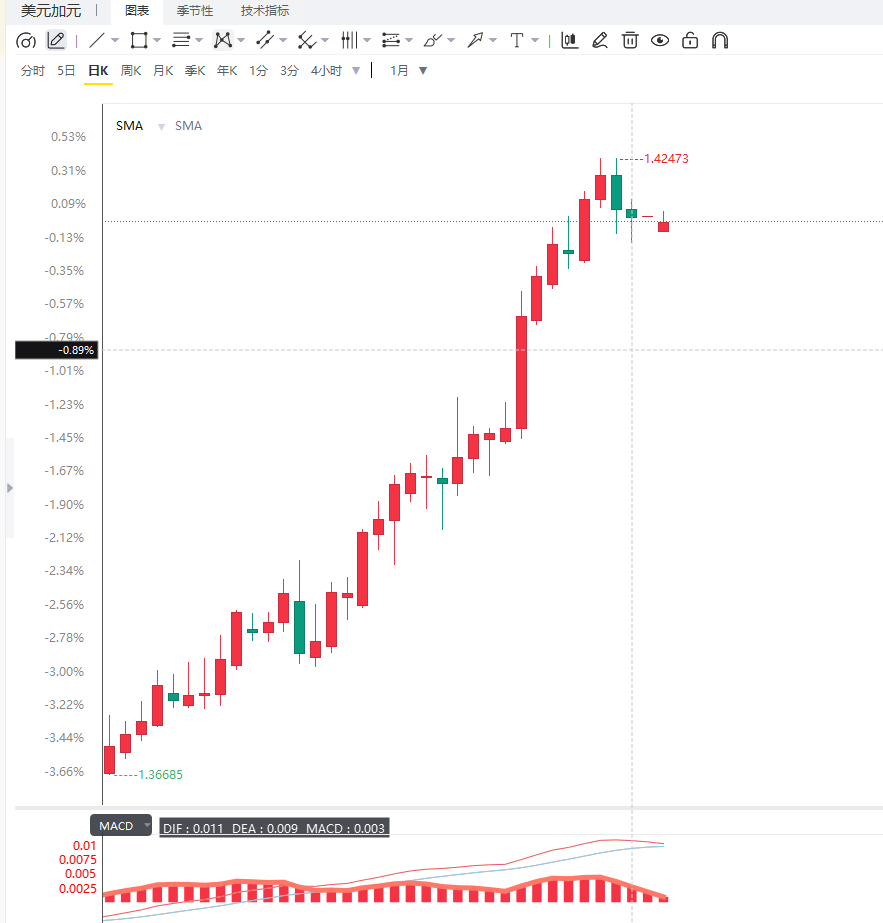
From a daily chart perspective, USD/CAD has entered a correction phase after its previous surge, currently trading in the 1.4180-1.4200 range . The overall trend remains within a high-level consolidation structure. Resistance is concentrated in the 1.4250-1.4300 area , a previous period of high trading volume and a temporary high. A retest of this level could potentially resume the upward trend. On the downside, initial support is around 1.4120 , a key support level for the short-term pullback. A break below this level could lead to a further test of the 1.4050-1.4000 area , the lower edge of the previous consolidation range, which holds significant technical importance.
From a 4-hour chart perspective, the exchange rate has entered a sideways consolidation phase after a continuous decline. The moving average system has gradually flattened out from its upward trend, indicating weakening short-term momentum. Momentum indicators are in neutral to weak territory, suggesting a lack of clear directional drivers in the market. If the price fails to break below 1.4180, it may enter a period of low-level consolidation; if it breaks below, the short-term correction may continue.
Editor's Summary <br/>Overall, the current USD/CAD exchange rate is influenced by both changes in safe-haven demand for the US dollar and a decline in oil prices, creating a clear hedging structure between bulls and bears, resulting in a lack of clear short-term trend. The US dollar weakened due to easing geopolitical risks, but the simultaneous decline in oil prices weakened support for the Canadian dollar, limiting the downside potential of the exchange rate. In the medium term, USD/CAD will continue to fluctuate around expectations of US dollar policy and oil price volatility. Until the US non-farm payroll data and the situation in the Middle East become clearer, the exchange rate is likely to remain within the 1.4050 to 1.4300 range, and a trend breakout still requires confirmation from new macroeconomic drivers.
The United States and Iran have agreed to suspend recent military clashes in the Gulf region and plan to resume negotiations in Qatar. This development has eased market concerns about the risk of supply disruptions in the Strait of Hormuz, thereby weakening short-term safe-haven demand for the US dollar. The escalation of conflict in the region in previous days had initially boosted the dollar, but as the situation entered the negotiation phase, the dollar's upward momentum has clearly weakened.
However, the downside potential for the dollar remains somewhat supported. The market is still pricing in a hawkish policy path from the Federal Reserve, and market surveys show that traders' pricing in the probability of future rate hikes remains high. With the US non-farm payroll data due this week, the market will reassess the resilience of the labor market and the interest rate path, which may limit further dollar weakness.
On the other hand, the Canadian dollar's performance is also constrained by multiple factors. As a commodity currency, the Canadian dollar is highly correlated with crude oil prices, but recent declines in oil prices have weakened its fundamental support. WTI crude oil is currently trading around $70 , and due to a temporary easing of geopolitical tensions, the market has quickly given up the premium for supply disruptions, putting pressure on oil prices and indirectly dragging down the Canadian dollar's performance.
Structurally, the USD/CAD pair is currently exhibiting a typical "two-way resistance structure": the US dollar has weakened due to improved risk sentiment, but falling oil prices have simultaneously weakened the Canadian dollar, significantly slowing the pace of the decline. The market is currently in a phase of alternating event-driven and data-driven movements. Short-term focus is on US non-farm payroll data and progress in Middle East negotiations. If the employment data is stronger than expected, the US dollar may find support, thus limiting further downside for USD/CAD; conversely, weak data could push the pair further down to test lower support levels.
From a daily chart perspective, USD/CAD has entered a correction phase after its previous surge, currently trading in the 1.4180-1.4200 range . The overall trend remains within a high-level consolidation structure. Resistance is concentrated in the 1.4250-1.4300 area , a previous period of high trading volume and a temporary high. A retest of this level could potentially resume the upward trend. On the downside, initial support is around 1.4120 , a key support level for the short-term pullback. A break below this level could lead to a further test of the 1.4050-1.4000 area , the lower edge of the previous consolidation range, which holds significant technical importance.
From a 4-hour chart perspective, the exchange rate has entered a sideways consolidation phase after a continuous decline. The moving average system has gradually flattened out from its upward trend, indicating weakening short-term momentum. Momentum indicators are in neutral to weak territory, suggesting a lack of clear directional drivers in the market. If the price fails to break below 1.4180, it may enter a period of low-level consolidation; if it breaks below, the short-term correction may continue.
Editor's Summary <br/>Overall, the current USD/CAD exchange rate is influenced by both changes in safe-haven demand for the US dollar and a decline in oil prices, creating a clear hedging structure between bulls and bears, resulting in a lack of clear short-term trend. The US dollar weakened due to easing geopolitical risks, but the simultaneous decline in oil prices weakened support for the Canadian dollar, limiting the downside potential of the exchange rate. In the medium term, USD/CAD will continue to fluctuate around expectations of US dollar policy and oil price volatility. Until the US non-farm payroll data and the situation in the Middle East become clearer, the exchange rate is likely to remain within the 1.4050 to 1.4300 range, and a trend breakout still requires confirmation from new macroeconomic drivers.
- Risk Warning and Disclaimer
- The market involves risk, and trading may not be suitable for all investors. This article is for reference only and does not constitute personal investment advice, nor does it take into account certain users’ specific investment objectives, financial situation, or other needs. Any investment decisions made based on this information are at your own risk.