Economic recovery coupled with a sharp drop in employment – conflicting signals from the Eurozone, and the ECB's interest rate hike window quietly closing.
2026-06-30 08:07:48
The euro traded in a narrow range against the dollar in early Asian trading on Tuesday (June 30), currently hovering around 1.1420. This followed three consecutive days of gains.
A business and consumer survey released by the European Commission on the 29th showed that the Eurozone's economic sentiment index rebounded moderately in June, but remained far below pre-Middle East war levels, while employment expectations weakened significantly.
With inflationary pressures gradually easing, the question of whether the European Central Bank should continue raising interest rates has become increasingly urgent.
Fortunately, Europe's concerns have shifted from fuel shortages to extreme heat – which, while equally detrimental to the economy, is undoubtedly much better than a new energy shock.
In June, the Eurozone Economic Sentiment Index (ESI) rose from 93.7 to 95.0, marking the second consecutive month of modest improvement. It is noteworthy that most of this survey was completed before the US-Iran agreement was reached; if the agreement is maintained, the ESI is expected to rise further.
However, the June output survey results showed disappointing performance in both the industrial and service sectors. The Eurozone is clearly ending a weak quarter, and the risk of economic stagnation is real. On a slightly reassuring note, business expectations for the coming months are improving.
Worryingly, employment expectations are weakening significantly. A June survey showed that respondents had drastically reduced their plans to hire new employees in the coming months, a further decline from previous months and reaching a recent low. This not only reflects businesses' cautious attitude towards the economic outlook but may also continue to drag down the recovery of the service sector.
As the main driver of employment in the Eurozone, a weakening hiring intention in the service sector will directly impact the overall vitality of the labor market. If this trend continues, the unemployment rate may rebound in the coming quarters, especially in countries with already fragile labor markets such as France, Italy, and Spain. Analysts point out that although inflationary pressures are gradually easing, companies still face multiple pressures, including high financing costs, demand uncertainty, and geopolitical risks, leading to more conservative hiring decisions.
Furthermore, the impact of the extreme heat on outdoor work and the service sector cannot be ignored, potentially further suppressing short-term hiring demand. Although Europe has recovered somewhat from the energy crisis, the continued deterioration in employment expectations remains a significant concern for economic recovery. The European Central Bank, in assessing monetary policy, may need to pay closer attention to labor market signals to avoid exacerbating employment pressures through excessive tightening.
At a critical juncture when inflation concerns have resurfaced, June saw a rapid decline in sales price expectations for both industrial and service sectors. This suggests that core inflationary pressures had already begun to ease before the US-Iran agreement was reached and the subsequent sharp drop in oil prices.
From the perspective of corporate pricing behavior, although companies are still passing on high costs to consumers, the pace of planned price increases seems to be slowing down—a structural change that deserves close attention.
For the European Central Bank, the core issue lies in its confidence in the fragile US-Iran agreement. Superficially, the window for raising interest rates seems to have closed: oil prices have fallen rapidly, economic growth is slow, and businesses' motivation to raise prices has weakened.
However, the risks are equally significant – if the agreement breaks down and the problems resurface, inflationary pressures could rebound rapidly. Therefore, it is not a bad thing to spend more time observing the situation before the next interest rate decision.
For the European Central Bank, July may be a good time to pause and observe – much like the "summer break" that other sectors of Europe are experiencing.
According to the daily chart, the euro/dollar exchange rate is in a clear downtrend. The price has weakened continuously since the April high of 1.1848, recently testing a low of 1.1324 before rebounding slightly. The moving average system is fully bearish, with the 20-day (1.1493), 50-day, 100-day, and 200-day moving averages acting as downward pressure. Short-term rebounds are capped by the 20-day moving average, and the medium-term moving averages are also turning downwards, indicating that the medium- to long-term downtrend remains unchanged.
In terms of indicators, the MACD indicator shows a DIFF value of -0.0063 and a DEA value of -0.0057, with both lines remaining below the zero axis. The MACD red bars are extremely short, showing only a weak repair signal. Although the bearish momentum has slightly weakened, it has not formed an effective bullish reversal. The RSI1 value is 37.62, which is in the neutral to weak range of 30-50. It has not entered the oversold range, and the downward momentum has not been fully released, so the rebound strength is limited.
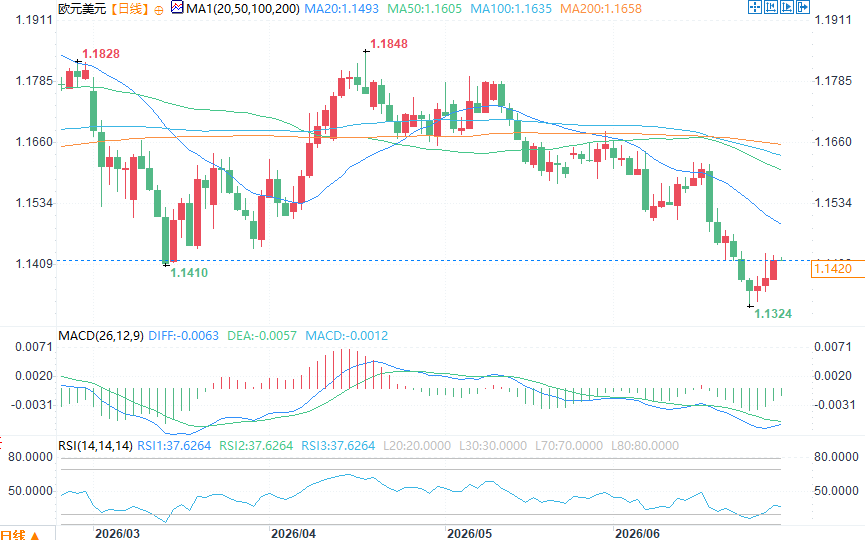
(Euro/USD daily chart, source: FX678)
At 8:00 AM Beijing time on June 30, the euro was trading at 1.1418/19 against the US dollar.
A business and consumer survey released by the European Commission on the 29th showed that the Eurozone's economic sentiment index rebounded moderately in June, but remained far below pre-Middle East war levels, while employment expectations weakened significantly.
With inflationary pressures gradually easing, the question of whether the European Central Bank should continue raising interest rates has become increasingly urgent.
Fortunately, Europe's concerns have shifted from fuel shortages to extreme heat – which, while equally detrimental to the economy, is undoubtedly much better than a new energy shock.
Business Climate Index: Cautious Rebound, Fundamentals Remain Weak
In June, the Eurozone Economic Sentiment Index (ESI) rose from 93.7 to 95.0, marking the second consecutive month of modest improvement. It is noteworthy that most of this survey was completed before the US-Iran agreement was reached; if the agreement is maintained, the ESI is expected to rise further.
However, the June output survey results showed disappointing performance in both the industrial and service sectors. The Eurozone is clearly ending a weak quarter, and the risk of economic stagnation is real. On a slightly reassuring note, business expectations for the coming months are improving.
Deteriorating employment expectations: Hidden worries emerge
Worryingly, employment expectations are weakening significantly. A June survey showed that respondents had drastically reduced their plans to hire new employees in the coming months, a further decline from previous months and reaching a recent low. This not only reflects businesses' cautious attitude towards the economic outlook but may also continue to drag down the recovery of the service sector.
As the main driver of employment in the Eurozone, a weakening hiring intention in the service sector will directly impact the overall vitality of the labor market. If this trend continues, the unemployment rate may rebound in the coming quarters, especially in countries with already fragile labor markets such as France, Italy, and Spain. Analysts point out that although inflationary pressures are gradually easing, companies still face multiple pressures, including high financing costs, demand uncertainty, and geopolitical risks, leading to more conservative hiring decisions.
Furthermore, the impact of the extreme heat on outdoor work and the service sector cannot be ignored, potentially further suppressing short-term hiring demand. Although Europe has recovered somewhat from the energy crisis, the continued deterioration in employment expectations remains a significant concern for economic recovery. The European Central Bank, in assessing monetary policy, may need to pay closer attention to labor market signals to avoid exacerbating employment pressures through excessive tightening.
Inflation Signals: Price Expectations Falling at an Accelerated Pace
At a critical juncture when inflation concerns have resurfaced, June saw a rapid decline in sales price expectations for both industrial and service sectors. This suggests that core inflationary pressures had already begun to ease before the US-Iran agreement was reached and the subsequent sharp drop in oil prices.
From the perspective of corporate pricing behavior, although companies are still passing on high costs to consumers, the pace of planned price increases seems to be slowing down—a structural change that deserves close attention.
Implications for the European Central Bank's policies
For the European Central Bank, the core issue lies in its confidence in the fragile US-Iran agreement. Superficially, the window for raising interest rates seems to have closed: oil prices have fallen rapidly, economic growth is slow, and businesses' motivation to raise prices has weakened.
However, the risks are equally significant – if the agreement breaks down and the problems resurface, inflationary pressures could rebound rapidly. Therefore, it is not a bad thing to spend more time observing the situation before the next interest rate decision.
For the European Central Bank, July may be a good time to pause and observe – much like the "summer break" that other sectors of Europe are experiencing.
Technical Analysis
According to the daily chart, the euro/dollar exchange rate is in a clear downtrend. The price has weakened continuously since the April high of 1.1848, recently testing a low of 1.1324 before rebounding slightly. The moving average system is fully bearish, with the 20-day (1.1493), 50-day, 100-day, and 200-day moving averages acting as downward pressure. Short-term rebounds are capped by the 20-day moving average, and the medium-term moving averages are also turning downwards, indicating that the medium- to long-term downtrend remains unchanged.
In terms of indicators, the MACD indicator shows a DIFF value of -0.0063 and a DEA value of -0.0057, with both lines remaining below the zero axis. The MACD red bars are extremely short, showing only a weak repair signal. Although the bearish momentum has slightly weakened, it has not formed an effective bullish reversal. The RSI1 value is 37.62, which is in the neutral to weak range of 30-50. It has not entered the oversold range, and the downward momentum has not been fully released, so the rebound strength is limited.
(Euro/USD daily chart, source: FX678)
At 8:00 AM Beijing time on June 30, the euro was trading at 1.1418/19 against the US dollar.
- Risk Warning and Disclaimer
- The market involves risk, and trading may not be suitable for all investors. This article is for reference only and does not constitute personal investment advice, nor does it take into account certain users’ specific investment objectives, financial situation, or other needs. Any investment decisions made based on this information are at your own risk.