The yen fell to a 40-year low after a former central bank official suggested that potential inflation has reached 3%, and an interest rate hike may come as early as December.
2026-06-30 11:07:41
On Tuesday (June 30) during Asian trading hours, the US dollar touched 162.40 against the Japanese yen, the highest intraday level since 1986, and is currently trading around 162.15.
Market concerns that the Japanese government might resist further interest rate hikes by the central bank limited the yen's upside potential.
A former senior Bank of Japan official recently stated that the central bank's next interest rate hike is likely to occur before December, earlier than most economists expect. This is based on the fact that the Bank of Japan's own calculations of potential inflation have averaged close to 3% over the past four years, far exceeding its 2% target level.
Meanwhile, the official core CPI (excluding fresh food) for May only recorded 1.4%. This significant discrepancy between the two figures presents a challenge for policy communication and could potentially catalyze an earlier interest rate hike. Any signal from Governor Ueda regarding "potential inflation indicators gaining greater policy weight" would be a substantial hawkish trigger.

Former Bank of Japan executive director Kenzo Yamamoto told the media that the central bank's next interest rate hike may come before December, in stark contrast to economists' general expectation of "keeping rates unchanged until the end of the year."
Yamamoto pointed out that the basis for taking early action is a potential inflation indicator that excludes the effects of fresh food and government subsidies—an indicator that has averaged about 3% over the past four years, consistently higher than the central bank’s target level of 2%.
Yamamoto believes that this reading reflects "real inflationary pressures," rather than the temporary or policy distortions presented by the surface data.
Japan's core CPI, excluding fresh food, was only 1.4% in May, a modest figure that allowed the central bank to maintain its assessment that "price trends remain slightly below 2%."
However, Yamamoto points out that the apparent weakness in the data is mainly due to the cost-of-living measures implemented by Prime Minister Sanae Takaichi—policies that actively suppressed consumer-facing price levels. If the subsidy effect is removed, the underlying inflation picture is far from mild.
This data divergence is significant for policy direction:
If we take core CPI as the anchor: the reason for holding rates steady is valid, and a rate hike in December seems to be a reasonable choice;
If we focus more on potential inflation indicators, the reasons for taking early action become hard to ignore.
Yamamoto stated that he would be concerned if the central bank viewed its own estimates of potential inflation as unreliable signals, and warned that such interpretation could make inflation more entrenched.
Yamamoto explicitly advocated that the Bank of Japan should shift from its current accommodative stance to proactively curbing inflation. He specifically warned that if policy is not tightened in time before the effects of subsidies fade, inflation expectations may face the risk of becoming decoupled, at which point the cost of correction would far outweigh the cost of acting prematurely.
From a market perspective, if interest rates are raised before December, the yen will face accelerated appreciation pressure, and the US-Japan interest rate differential will further narrow against the backdrop of uncertainty surrounding the policy paths of the Federal Reserve and the European Central Bank. The Japanese government bond yield curve will be under pressure across the board, and the global fixed-income market will also be difficult to escape unscathed—given Japan's position as a major holder of foreign bonds, any rise in yields could be transmitted to the European and American bond markets through portfolio rebalancing.
Overall, raising interest rates ahead of schedule is not only a technical choice for domestic inflation management, but also a potential key variable reshaping the logic of global asset pricing. The market needs to closely monitor any signals released by Governor Ueda regarding future policy paths.
According to the daily chart, the USD/JPY pair maintains a long-term strong bullish trend, with the price rising steadily from the May low of 155.03. The moving average system is in a complete bullish alignment, with the MA20, MA50, MA100, and MA200 providing layered support from bottom to top. The price has consistently held above all moving averages, indicating a solid medium- to long-term uptrend. In the short term, strong support is formed by the 20-day moving average at 160.89.
In terms of indicators, the MACD is running in the bullish zone above the zero axis, the DIFF (0.720) continues to stand above the DEA (0.648), and the red bars are steadily increasing in volume, indicating that the bullish momentum remains strong. The RSI value is 74.62, approaching the overbought zone of 80, reflecting that the short-term bullish momentum is overextended and there is a need for a high-level consolidation and pullback.
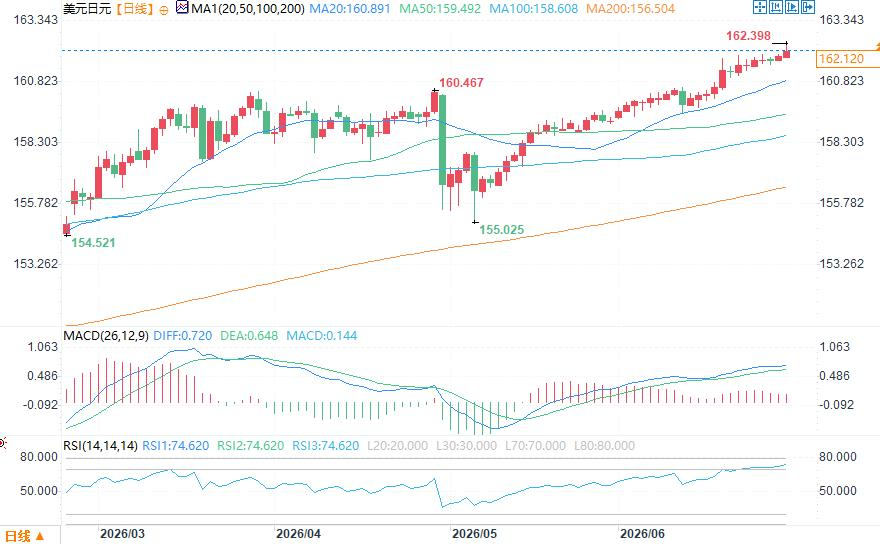
(USD/JPY daily chart, source: FX678)
At 11:07 Beijing time on June 30, the USD/JPY exchange rate was 162.14/15.
Market concerns that the Japanese government might resist further interest rate hikes by the central bank limited the yen's upside potential.
A former senior Bank of Japan official recently stated that the central bank's next interest rate hike is likely to occur before December, earlier than most economists expect. This is based on the fact that the Bank of Japan's own calculations of potential inflation have averaged close to 3% over the past four years, far exceeding its 2% target level.
Meanwhile, the official core CPI (excluding fresh food) for May only recorded 1.4%. This significant discrepancy between the two figures presents a challenge for policy communication and could potentially catalyze an earlier interest rate hike. Any signal from Governor Ueda regarding "potential inflation indicators gaining greater policy weight" would be a substantial hawkish trigger.
Key takeaway: Former senior central bank official clearly points to an earlier interest rate hike.
Former Bank of Japan executive director Kenzo Yamamoto told the media that the central bank's next interest rate hike may come before December, in stark contrast to economists' general expectation of "keeping rates unchanged until the end of the year."
Yamamoto pointed out that the basis for taking early action is a potential inflation indicator that excludes the effects of fresh food and government subsidies—an indicator that has averaged about 3% over the past four years, consistently higher than the central bank’s target level of 2%.
Yamamoto believes that this reading reflects "real inflationary pressures," rather than the temporary or policy distortions presented by the surface data.
Data Discrepancy: The Policy Mystery Between 1.4% and 3%
Japan's core CPI, excluding fresh food, was only 1.4% in May, a modest figure that allowed the central bank to maintain its assessment that "price trends remain slightly below 2%."
However, Yamamoto points out that the apparent weakness in the data is mainly due to the cost-of-living measures implemented by Prime Minister Sanae Takaichi—policies that actively suppressed consumer-facing price levels. If the subsidy effect is removed, the underlying inflation picture is far from mild.
This data divergence is significant for policy direction:
If we take core CPI as the anchor: the reason for holding rates steady is valid, and a rate hike in December seems to be a reasonable choice;
If we focus more on potential inflation indicators, the reasons for taking early action become hard to ignore.
Yamamoto stated that he would be concerned if the central bank viewed its own estimates of potential inflation as unreliable signals, and warned that such interpretation could make inflation more entrenched.
Policy Implications: Shifting from loose monetary policy to proactive inflation control
Yamamoto explicitly advocated that the Bank of Japan should shift from its current accommodative stance to proactively curbing inflation. He specifically warned that if policy is not tightened in time before the effects of subsidies fade, inflation expectations may face the risk of becoming decoupled, at which point the cost of correction would far outweigh the cost of acting prematurely.
From a market perspective, if interest rates are raised before December, the yen will face accelerated appreciation pressure, and the US-Japan interest rate differential will further narrow against the backdrop of uncertainty surrounding the policy paths of the Federal Reserve and the European Central Bank. The Japanese government bond yield curve will be under pressure across the board, and the global fixed-income market will also be difficult to escape unscathed—given Japan's position as a major holder of foreign bonds, any rise in yields could be transmitted to the European and American bond markets through portfolio rebalancing.
Overall, raising interest rates ahead of schedule is not only a technical choice for domestic inflation management, but also a potential key variable reshaping the logic of global asset pricing. The market needs to closely monitor any signals released by Governor Ueda regarding future policy paths.
Technical Analysis
According to the daily chart, the USD/JPY pair maintains a long-term strong bullish trend, with the price rising steadily from the May low of 155.03. The moving average system is in a complete bullish alignment, with the MA20, MA50, MA100, and MA200 providing layered support from bottom to top. The price has consistently held above all moving averages, indicating a solid medium- to long-term uptrend. In the short term, strong support is formed by the 20-day moving average at 160.89.
In terms of indicators, the MACD is running in the bullish zone above the zero axis, the DIFF (0.720) continues to stand above the DEA (0.648), and the red bars are steadily increasing in volume, indicating that the bullish momentum remains strong. The RSI value is 74.62, approaching the overbought zone of 80, reflecting that the short-term bullish momentum is overextended and there is a need for a high-level consolidation and pullback.
(USD/JPY daily chart, source: FX678)
At 11:07 Beijing time on June 30, the USD/JPY exchange rate was 162.14/15.
- Risk Warning and Disclaimer
- The market involves risk, and trading may not be suitable for all investors. This article is for reference only and does not constitute personal investment advice, nor does it take into account certain users’ specific investment objectives, financial situation, or other needs. Any investment decisions made based on this information are at your own risk.