Crude oil trading alert: Crude oil prices have smoothed out geopolitical premiums and are maintaining low-level fluctuations, awaiting the formation of a new consolidation range.
2026-06-30 09:26:33
WTI crude oil prices retreated during Asian trading hours, falling to around $70.10 per barrel , ending a previous short-term rebound. This pullback was primarily driven by fluctuating geopolitical signals, with market pricing of Middle East risks diverging again. Previously, the US president indicated that a new round of talks between the US and Iran might be held in Doha, Qatar, leading the market to bet on a de-escalation of geopolitical tensions. However, Iran subsequently denied any formal meeting arrangements, emphasizing that the current focus remained on implementing existing understandings rather than advancing final agreement negotiations, causing market expectations to cool rapidly.

Amid inconsistent diplomatic signals, the energy market is reassessing supply risk premiums. The stability of the Strait of Hormuz, a vital global energy transport route, remains a key market concern. Iran has stated it will maintain its management arrangements for passage through the waterway, even if some regional partners do not participate in the relevant mechanisms, and while a temporary agreement allows for toll-free passage for a certain period, the future toll collection mechanism remains uncertain. This issue has drawn explicit opposition from the United States and some European and Gulf states, complicating the future of shipping regulations.
From an actual shipping perspective, although some vessels were damaged in localized clashes over the weekend, causing a brief slowdown in maritime activity, overall traffic flow continued, and there were no signs of a systemic withdrawal by shipping operators. However, rising insurance costs and stricter risk assessments of shipping routes have provided potential support for forward crude oil transportation costs.
At the market level, oil prices have entered a technical consolidation phase after a recent rapid rebound. The interplay between risk premiums and macroeconomic demand expectations has become the dominant factor. On the one hand, geopolitical uncertainties limit the downside potential of oil prices; on the other hand, there are no clear signs of improvement in global demand, limiting upward momentum. Overall, market sentiment is cautious and wait-and-see, with short-term volatility remaining high.
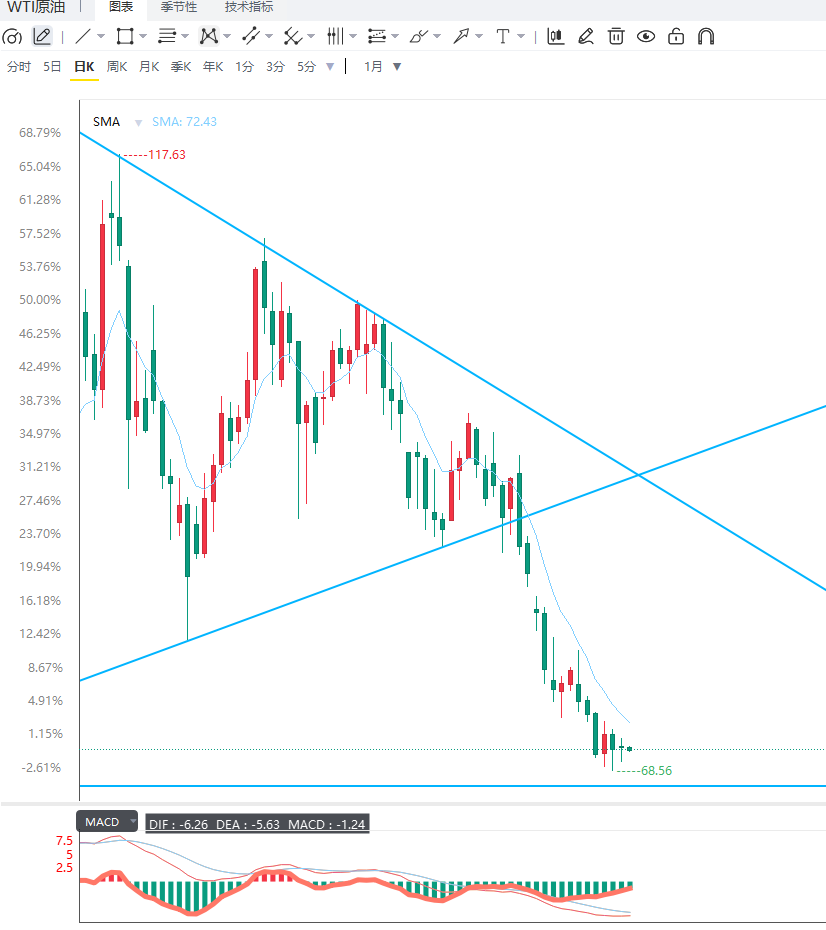
From a daily chart perspective, WTI crude oil remains in a wide-range consolidation pattern, with lower highs but no significant break below support levels. Prices are consolidating within a range of $68 to $72. Currently, oil prices are near the lower edge of the medium-term equilibrium range. If prices cannot regain a foothold above $72, upward potential will be limited; conversely, a break below the $68 support area could trigger a new round of technical correction, opening up room for a move towards $65.
From a 4-hour chart perspective, the short-term trend shows a slightly weak and volatile structure. The moving average system has gradually shifted from a bullish alignment to convergence and shows slight signs of downward turning, indicating weakening short-term momentum. Multiple attempts to break above $71 have failed to establish a significant breakthrough, suggesting continued selling pressure. If the price fails to break through the $71.5 area again, it may continue to test the $69 support area or even lower in the short term. Conversely, a break above $72 with significant volume could reactivate the rebound momentum and test the previous high resistance area.
Editor's Summary:
In summary, WTI crude oil's current price movement remains highly dependent on geopolitical signals. Repeated diplomatic statements from the US and Iran have caused continued volatility in market risk pricing, while uncertainty surrounding the Strait of Hormuz mechanism has further amplified expectations of supply-side fluctuations. Although oil prices have found a temporary equilibrium around $70 in the short term, the trend direction remains unclear, and the market remains in a highly volatile phase driven primarily by news. If diplomatic signals ease in the future, oil prices may return to a demand-driven logic and face downward pressure; conversely, if shipping risks escalate further, there is still room for risk premiums to rise. Overall, a range-bound trading strategy is more reasonable in the short term, with key attention focused on the breakout direction of the $68 support and $72 resistance levels.
Amid inconsistent diplomatic signals, the energy market is reassessing supply risk premiums. The stability of the Strait of Hormuz, a vital global energy transport route, remains a key market concern. Iran has stated it will maintain its management arrangements for passage through the waterway, even if some regional partners do not participate in the relevant mechanisms, and while a temporary agreement allows for toll-free passage for a certain period, the future toll collection mechanism remains uncertain. This issue has drawn explicit opposition from the United States and some European and Gulf states, complicating the future of shipping regulations.
From an actual shipping perspective, although some vessels were damaged in localized clashes over the weekend, causing a brief slowdown in maritime activity, overall traffic flow continued, and there were no signs of a systemic withdrawal by shipping operators. However, rising insurance costs and stricter risk assessments of shipping routes have provided potential support for forward crude oil transportation costs.
At the market level, oil prices have entered a technical consolidation phase after a recent rapid rebound. The interplay between risk premiums and macroeconomic demand expectations has become the dominant factor. On the one hand, geopolitical uncertainties limit the downside potential of oil prices; on the other hand, there are no clear signs of improvement in global demand, limiting upward momentum. Overall, market sentiment is cautious and wait-and-see, with short-term volatility remaining high.
From a daily chart perspective, WTI crude oil remains in a wide-range consolidation pattern, with lower highs but no significant break below support levels. Prices are consolidating within a range of $68 to $72. Currently, oil prices are near the lower edge of the medium-term equilibrium range. If prices cannot regain a foothold above $72, upward potential will be limited; conversely, a break below the $68 support area could trigger a new round of technical correction, opening up room for a move towards $65.
From a 4-hour chart perspective, the short-term trend shows a slightly weak and volatile structure. The moving average system has gradually shifted from a bullish alignment to convergence and shows slight signs of downward turning, indicating weakening short-term momentum. Multiple attempts to break above $71 have failed to establish a significant breakthrough, suggesting continued selling pressure. If the price fails to break through the $71.5 area again, it may continue to test the $69 support area or even lower in the short term. Conversely, a break above $72 with significant volume could reactivate the rebound momentum and test the previous high resistance area.
Editor's Summary:
In summary, WTI crude oil's current price movement remains highly dependent on geopolitical signals. Repeated diplomatic statements from the US and Iran have caused continued volatility in market risk pricing, while uncertainty surrounding the Strait of Hormuz mechanism has further amplified expectations of supply-side fluctuations. Although oil prices have found a temporary equilibrium around $70 in the short term, the trend direction remains unclear, and the market remains in a highly volatile phase driven primarily by news. If diplomatic signals ease in the future, oil prices may return to a demand-driven logic and face downward pressure; conversely, if shipping risks escalate further, there is still room for risk premiums to rise. Overall, a range-bound trading strategy is more reasonable in the short term, with key attention focused on the breakout direction of the $68 support and $72 resistance levels.
- Risk Warning and Disclaimer
- The market involves risk, and trading may not be suitable for all investors. This article is for reference only and does not constitute personal investment advice, nor does it take into account certain users’ specific investment objectives, financial situation, or other needs. Any investment decisions made based on this information are at your own risk.