Gold has fallen below the $4,000 mark and may accelerate its decline in the short term.
2026-06-30 10:12:43
Spot gold continued its weakness during Asian trading hours, falling back to around $3,960 per ounce , extending the correction trend of the previous trading day. This decline was mainly driven by a combination of factors, including macroeconomic interest rate expectations and fluctuating geopolitical sentiment. While assessing the situation in the Middle East, the market is also repricing the Federal Reserve's policy path, leaving gold in a short-term consolidation pattern under pressure due to multiple intertwined drivers.

Geopolitically, reports from the US indicated that a new round of talks between the US and Iran was expected to take place in Doha, Qatar, initially raising market hopes for a de-escalation. However, Iran has not confirmed these reports, and the high level of diplomatic uncertainty has prevented safe-haven demand from gaining sustained momentum. While the market remains highly sensitive to the situation in the Middle East, the lack of substantial escalation or the spread of systemic conflict has kept safe-haven buying of gold relatively restrained.
Meanwhile, the Federal Reserve's policy path remains the core factor suppressing gold prices. Although the Federal Open Market Committee kept interest rates unchanged at its June meeting, the policy stance signaled a " longer-term maintenance of high interest rates, and even the possibility of rate hikes this year ," prompting the market to reassess the real interest rate environment. Since gold itself does not generate returns, its relative attractiveness has significantly decreased in a high-interest-rate environment, which is one of the key reasons for the recent continued pressure on gold prices.
Market analysts point out that the gold market is currently caught in a tug-of-war between "safe-haven support and interest rate suppression." On the one hand, the situation in the Middle East may still trigger short-term safe-haven impulses with unexpected news; on the other hand, the US dollar and US Treasury yields remain resilient under the support of high interest rate expectations, putting continuous pressure on gold prices and making it difficult for them to form a trend of upward movement.
In the short term, market focus is on the upcoming US ADP employment data and non-farm payroll report. Strong employment data will further reinforce market expectations that the Federal Reserve will maintain high interest rates for longer, pushing the dollar higher and putting additional pressure on gold. Conversely, if the job market shows signs of cooling, it may weaken the dollar's momentum, providing some support for gold.
From the perspective of capital flows, the current market risk appetite is generally cautious, with precious metal assets being more of a temporary safe-haven asset than a trending upward asset. At the institutional trading level, short-term long and short positions are frequently switching, and volatility remains at a relatively high level.
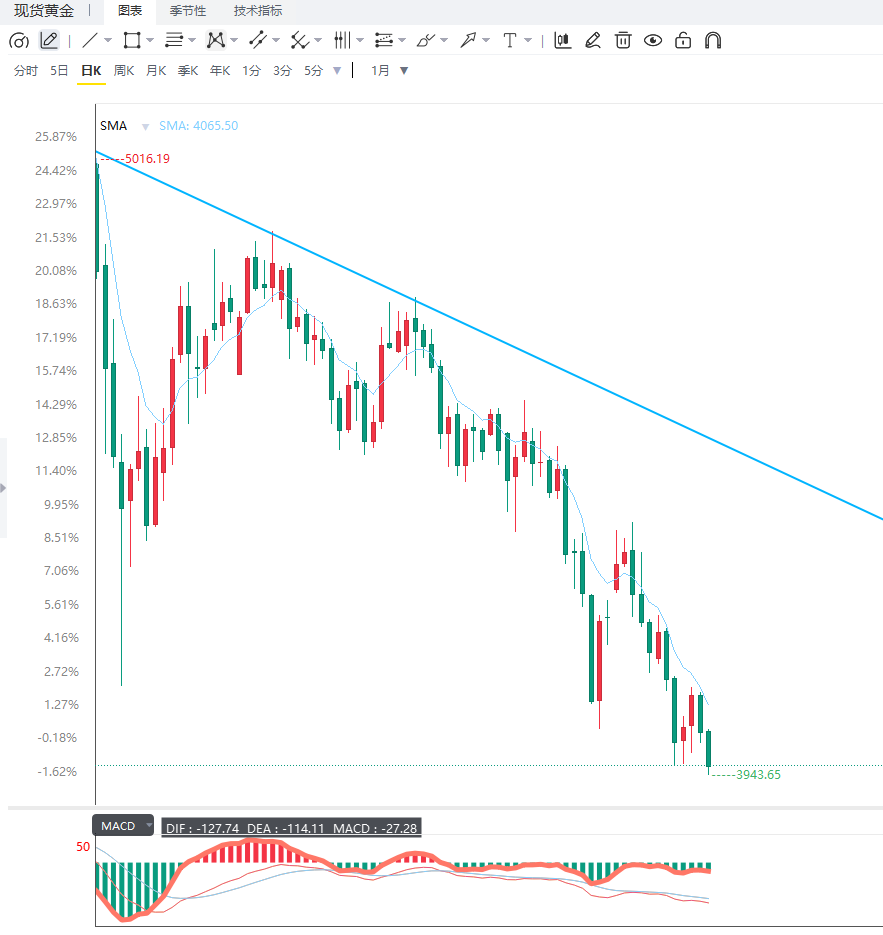
From a daily chart perspective, gold is still in a pullback correction phase after a period of high-level consolidation. Since falling from its previous high, the price has gradually entered a downward channel, with weakening trend momentum but not yet completely breaking the medium-to-long-term upward structure. The key support area is currently located in the $3920-$3950 range, which coincides with a previous period of dense trading and a psychological level. Resistance is concentrated in the $4050-$4080 range; if this area cannot be effectively broken, gold prices will likely maintain a weak and volatile pattern in the short term.
From a 4-hour chart perspective, gold's short-term structure is bearish, with the moving average system showing signs of turning downwards from a high level, indicating further weakening of short-term momentum. Multiple attempts to rebound have failed to regain a foothold above $4040, suggesting significant selling pressure above. If the price continues to trade below the $4020-$4040 range, it may further test the $3900 support level; conversely, if a positive data release or geopolitical development drives a break above $4050, the price could potentially return to the upper limit of the current trading range in the short term.
Editor's Summary:
In summary, gold is currently in a dynamic balance between macroeconomic interest rate pressure and geopolitical safe-haven support, but the overall trend remains one of oscillating pressure. The expectation of the Federal Reserve maintaining high interest rates for an extended period constitutes the core medium-term pressure, while the Middle East situation, although providing temporary safe-haven support, lacks sustained escalation momentum. In the short term, the market will focus on the impact of US employment data on the repricing of the dollar and interest rate expectations. Without a clear fundamental breakout signal, gold is expected to remain range-bound with a slight downward bias, and the direction of the $3950 support and $4050 resistance levels needs to be closely observed.
Geopolitically, reports from the US indicated that a new round of talks between the US and Iran was expected to take place in Doha, Qatar, initially raising market hopes for a de-escalation. However, Iran has not confirmed these reports, and the high level of diplomatic uncertainty has prevented safe-haven demand from gaining sustained momentum. While the market remains highly sensitive to the situation in the Middle East, the lack of substantial escalation or the spread of systemic conflict has kept safe-haven buying of gold relatively restrained.
Meanwhile, the Federal Reserve's policy path remains the core factor suppressing gold prices. Although the Federal Open Market Committee kept interest rates unchanged at its June meeting, the policy stance signaled a " longer-term maintenance of high interest rates, and even the possibility of rate hikes this year ," prompting the market to reassess the real interest rate environment. Since gold itself does not generate returns, its relative attractiveness has significantly decreased in a high-interest-rate environment, which is one of the key reasons for the recent continued pressure on gold prices.
Market analysts point out that the gold market is currently caught in a tug-of-war between "safe-haven support and interest rate suppression." On the one hand, the situation in the Middle East may still trigger short-term safe-haven impulses with unexpected news; on the other hand, the US dollar and US Treasury yields remain resilient under the support of high interest rate expectations, putting continuous pressure on gold prices and making it difficult for them to form a trend of upward movement.
In the short term, market focus is on the upcoming US ADP employment data and non-farm payroll report. Strong employment data will further reinforce market expectations that the Federal Reserve will maintain high interest rates for longer, pushing the dollar higher and putting additional pressure on gold. Conversely, if the job market shows signs of cooling, it may weaken the dollar's momentum, providing some support for gold.
From the perspective of capital flows, the current market risk appetite is generally cautious, with precious metal assets being more of a temporary safe-haven asset than a trending upward asset. At the institutional trading level, short-term long and short positions are frequently switching, and volatility remains at a relatively high level.
From a daily chart perspective, gold is still in a pullback correction phase after a period of high-level consolidation. Since falling from its previous high, the price has gradually entered a downward channel, with weakening trend momentum but not yet completely breaking the medium-to-long-term upward structure. The key support area is currently located in the $3920-$3950 range, which coincides with a previous period of dense trading and a psychological level. Resistance is concentrated in the $4050-$4080 range; if this area cannot be effectively broken, gold prices will likely maintain a weak and volatile pattern in the short term.
From a 4-hour chart perspective, gold's short-term structure is bearish, with the moving average system showing signs of turning downwards from a high level, indicating further weakening of short-term momentum. Multiple attempts to rebound have failed to regain a foothold above $4040, suggesting significant selling pressure above. If the price continues to trade below the $4020-$4040 range, it may further test the $3900 support level; conversely, if a positive data release or geopolitical development drives a break above $4050, the price could potentially return to the upper limit of the current trading range in the short term.
Editor's Summary:
In summary, gold is currently in a dynamic balance between macroeconomic interest rate pressure and geopolitical safe-haven support, but the overall trend remains one of oscillating pressure. The expectation of the Federal Reserve maintaining high interest rates for an extended period constitutes the core medium-term pressure, while the Middle East situation, although providing temporary safe-haven support, lacks sustained escalation momentum. In the short term, the market will focus on the impact of US employment data on the repricing of the dollar and interest rate expectations. Without a clear fundamental breakout signal, gold is expected to remain range-bound with a slight downward bias, and the direction of the $3950 support and $4050 resistance levels needs to be closely observed.
- Risk Warning and Disclaimer
- The market involves risk, and trading may not be suitable for all investors. This article is for reference only and does not constitute personal investment advice, nor does it take into account certain users’ specific investment objectives, financial situation, or other needs. Any investment decisions made based on this information are at your own risk.