With confidence rising and inflation falling, is there still any doubt that the Reserve Bank of New Zealand will raise interest rates next week?
2026-06-30 14:47:31
On Tuesday (June 30) during the Asian session, the New Zealand dollar fluctuated at low levels against the US dollar, currently trading around 0.5650.
New data released on Tuesday showed that New Zealand business confidence strengthened significantly in June, while inflation indicators fell moderately, providing an encouraging sign of economic recovery – economic activity is picking up, but price pressures have not risen in tandem.
The ANZ Business Confidence Index jumped from 10.0 to 36.6, and business activity expectations rose from 25.6 to 36.9, indicating increasing optimism among businesses regarding the near-term outlook. More importantly, inflation expectations, cost expectations, and pricing intentions all declined, and this improvement was already evident before the oil price crash, suggesting that the recovery has some endogenous momentum.
The Reserve Bank of New Zealand will hold a policy meeting next week, and this survey provides policymakers with a positive backdrop of "recovering growth and cooling inflation."

The ANZ Business Confidence Index came in at 36.6 in June, a significant jump of 26.6 points from the previous reading of 10.0; the Business Activity Expectations Index also saw a substantial increase, rising from 25.6 to 36.9. Both key indicators point to a rapid improvement in businesses' expectations for the future operating environment.
In its report, ANZ noted that the recovery in business activity was already evident at the beginning of the month—even before the oil price crash following the temporary agreement between the US and Iran.
This means the recovery reflects a substantial improvement in underlying operating conditions, rather than a temporary boost solely from falling energy prices. This distinction is crucial for policymakers because it suggests that growth momentum may be more sustainable.
New Zealand's June ANZ Business Survey showed that inflation-related indicators softened across the board as business confidence rebounded sharply. Inflation expectations fell from 3.63% to 3.36%, business cost expectations fell from 90 to 85, and pricing intentions fell from 56.7 to 50.7, the lowest level since November 2025.
ANZ emphasizes that the decline in inflation indicators began long before the accelerated drop in oil prices, indicating that the easing of price pressures is somewhat endogenous, rather than simply a temporary effect of external energy price changes.
This trend is a positive sign for the Reserve Bank of New Zealand's assessment of domestic inflation stickiness. If price pressures continue to subside endogenously, it will provide the central bank with greater flexibility in subsequent policy decisions.
The Reserve Bank of New Zealand (ANZ) will announce its latest interest rate decision next week. ANZ continues to expect the central bank to raise interest rates by 25 basis points to 5.75%, but believes policymakers may take a more cautious approach afterward.
The reasons are twofold: first, it is necessary to assess the economy's ability to sustain recovery after the interest rate hike cycle—whether the improvement in business confidence can translate into actual spending and investment growth; and second, it is necessary to confirm the sustainability of the decline in inflation—especially whether the lagged effects of the previous oil price shock on inflation have been fully absorbed.
The survey's findings of "recovering confidence + cooling inflation" provide the Reserve Bank of New Zealand with a relatively comfortable policy maneuvering space: it can continue to raise interest rates to solidify its inflation target without being overly concerned that raising rates will stifle the fragile economic recovery.
According to the daily chart, the New Zealand dollar is in a medium-term downtrend against the US dollar. The price has weakened continuously since the May high of 0.5993, and recently rebounded slightly after testing a low of 0.5625. The moving average system is in a complete bearish alignment, with the 20-day moving average (MA20) (0.5755), 50-day, 100-day, and 200-day moving averages providing resistance from top to bottom. The price continues to trade below all moving averages, and any short-term rebound will face resistance at the 20-day moving average. The medium-term bearish pattern remains unchanged.
In terms of indicators, the MACD lines are running in the bearish zone below the zero axis, the DIFF line at -0.0061 remains below the DEA line at -0.0048, and the green bars continue to expand. Although the bearish momentum has weakened slightly, no bullish reversal signal has been formed. The RSI value is 30.32, close to the oversold threshold of 30, indicating a short-term need for oversold correction, but there is no obvious bottom divergence, and the rebound strength is limited.
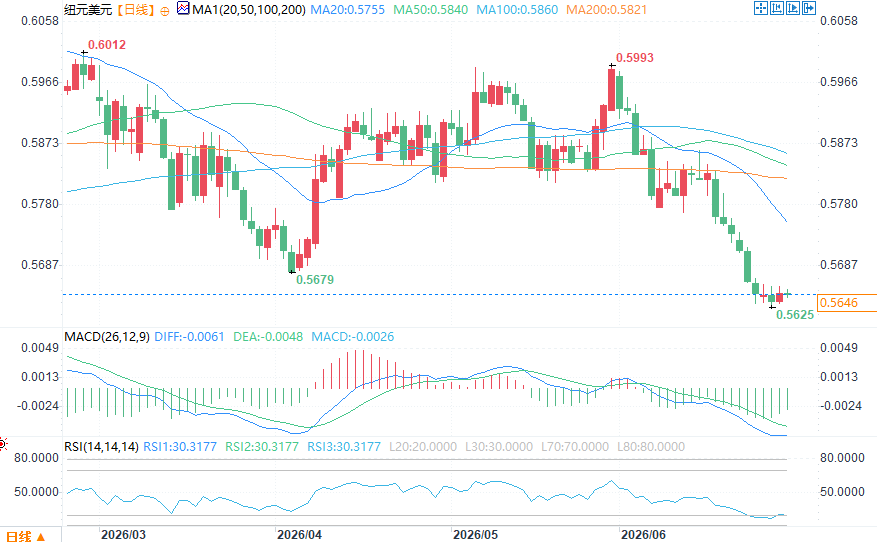
(NZD/USD daily chart, source: FX678)
At 14:25 Beijing time on June 30, the New Zealand dollar was trading at 0.5653/54 against the US dollar.
New data released on Tuesday showed that New Zealand business confidence strengthened significantly in June, while inflation indicators fell moderately, providing an encouraging sign of economic recovery – economic activity is picking up, but price pressures have not risen in tandem.
The ANZ Business Confidence Index jumped from 10.0 to 36.6, and business activity expectations rose from 25.6 to 36.9, indicating increasing optimism among businesses regarding the near-term outlook. More importantly, inflation expectations, cost expectations, and pricing intentions all declined, and this improvement was already evident before the oil price crash, suggesting that the recovery has some endogenous momentum.
The Reserve Bank of New Zealand will hold a policy meeting next week, and this survey provides policymakers with a positive backdrop of "recovering growth and cooling inflation."
Confidence Soars: Business Optimism Improves Across the Board
The ANZ Business Confidence Index came in at 36.6 in June, a significant jump of 26.6 points from the previous reading of 10.0; the Business Activity Expectations Index also saw a substantial increase, rising from 25.6 to 36.9. Both key indicators point to a rapid improvement in businesses' expectations for the future operating environment.
In its report, ANZ noted that the recovery in business activity was already evident at the beginning of the month—even before the oil price crash following the temporary agreement between the US and Iran.
This means the recovery reflects a substantial improvement in underlying operating conditions, rather than a temporary boost solely from falling energy prices. This distinction is crucial for policymakers because it suggests that growth momentum may be more sustainable.
Inflation Cools: Three Major Indicators Decline Simultaneously
New Zealand's June ANZ Business Survey showed that inflation-related indicators softened across the board as business confidence rebounded sharply. Inflation expectations fell from 3.63% to 3.36%, business cost expectations fell from 90 to 85, and pricing intentions fell from 56.7 to 50.7, the lowest level since November 2025.
ANZ emphasizes that the decline in inflation indicators began long before the accelerated drop in oil prices, indicating that the easing of price pressures is somewhat endogenous, rather than simply a temporary effect of external energy price changes.
This trend is a positive sign for the Reserve Bank of New Zealand's assessment of domestic inflation stickiness. If price pressures continue to subside endogenously, it will provide the central bank with greater flexibility in subsequent policy decisions.
Policy implications: A 25 basis point rate hike next week is still expected, but the subsequent path is likely to be cautious.
The Reserve Bank of New Zealand (ANZ) will announce its latest interest rate decision next week. ANZ continues to expect the central bank to raise interest rates by 25 basis points to 5.75%, but believes policymakers may take a more cautious approach afterward.
The reasons are twofold: first, it is necessary to assess the economy's ability to sustain recovery after the interest rate hike cycle—whether the improvement in business confidence can translate into actual spending and investment growth; and second, it is necessary to confirm the sustainability of the decline in inflation—especially whether the lagged effects of the previous oil price shock on inflation have been fully absorbed.
The survey's findings of "recovering confidence + cooling inflation" provide the Reserve Bank of New Zealand with a relatively comfortable policy maneuvering space: it can continue to raise interest rates to solidify its inflation target without being overly concerned that raising rates will stifle the fragile economic recovery.
Technical Analysis
According to the daily chart, the New Zealand dollar is in a medium-term downtrend against the US dollar. The price has weakened continuously since the May high of 0.5993, and recently rebounded slightly after testing a low of 0.5625. The moving average system is in a complete bearish alignment, with the 20-day moving average (MA20) (0.5755), 50-day, 100-day, and 200-day moving averages providing resistance from top to bottom. The price continues to trade below all moving averages, and any short-term rebound will face resistance at the 20-day moving average. The medium-term bearish pattern remains unchanged.
In terms of indicators, the MACD lines are running in the bearish zone below the zero axis, the DIFF line at -0.0061 remains below the DEA line at -0.0048, and the green bars continue to expand. Although the bearish momentum has weakened slightly, no bullish reversal signal has been formed. The RSI value is 30.32, close to the oversold threshold of 30, indicating a short-term need for oversold correction, but there is no obvious bottom divergence, and the rebound strength is limited.
(NZD/USD daily chart, source: FX678)
At 14:25 Beijing time on June 30, the New Zealand dollar was trading at 0.5653/54 against the US dollar.
- Risk Warning and Disclaimer
- The market involves risk, and trading may not be suitable for all investors. This article is for reference only and does not constitute personal investment advice, nor does it take into account certain users’ specific investment objectives, financial situation, or other needs. Any investment decisions made based on this information are at your own risk.